
Beyond the Dotted Line: Charting the Real Path to Purchase

The 5 stages of customer journey map are a framework that helps businesses understand how customers move from initial awareness of a problem through to becoming brand advocates:
- Awareness – The customer recognizes a problem or need
- Consideration – The customer researches and evaluates potential solutions
- Decision – The customer chooses a solution and makes a purchase
- Retention – The customer uses the product and decides whether to stay
- Advocacy – Satisfied customers recommend the brand to others
If you’ve been treating your customer’s path to purchase as a straight line, you’ve been drawing the wrong map.
Most companies operate under a comforting fiction: that customers move predictably from awareness to consideration to decision in a tidy, linear sequence. But only 17% of a customer journey is spent directly conversing with the vendor. The remaining 83% takes place through independent research and internal deliberation, according to Gartner. That means the majority of your customer’s experience with you happens when you’re not in the room.
This is where revenue stalls. Not because your product isn’t good enough. Not because your marketing isn’t clever enough. But because you’re optimizing for a journey you think is happening, rather than the one that actually is.
Customer journey mapping isn’t about drawing flowcharts. It’s about diagnosing where certainty breaks down in your buyer’s mind. It’s about understanding the psychological barriers, emotional friction, and unanswered questions that cause someone to pause, ghost, or churn—even when everything “should” be working.
When companies ignore this reality, they invest in tactics that solve the wrong problems. They add more touchpoints without understanding which ones build trust. They personalize messages without knowing what the customer is actually uncertain about. They measure activity instead of clarity.
But when you map the journey correctly—grounded in psychology, not process—you stop guessing. You see where trust erodes, where momentum dies, and where small changes create outsize impact. You build a system that doesn’t just attract customers, but moves them with confidence through every stage, from the first spark of awareness to the moment they tell someone else your name.
I’m Jeremy Wayne Howell, founder of The Way How, and I’ve spent over 20 years helping companies diagnose why growth stalls by mapping the real, messy, non-linear customer journey and rebuilding strategies around how people actually think and decide. Understanding and applying the 5 stages of customer journey map has been central to turning flat pipelines into predictable revenue for the founders and revenue leaders I work with.
Why Your Sales Funnel is a Myth (And What to Use Instead)
For too long, businesses have relied on the metaphor of the “sales funnel.” It’s a neat, linear model that suggests customers enter at the top (awareness), are filtered down through various stages, and eventually emerge at the bottom as a purchase. While it offers a simple view of conversion, it fundamentally misunderstands human behavior and the complex reality of modern buying.
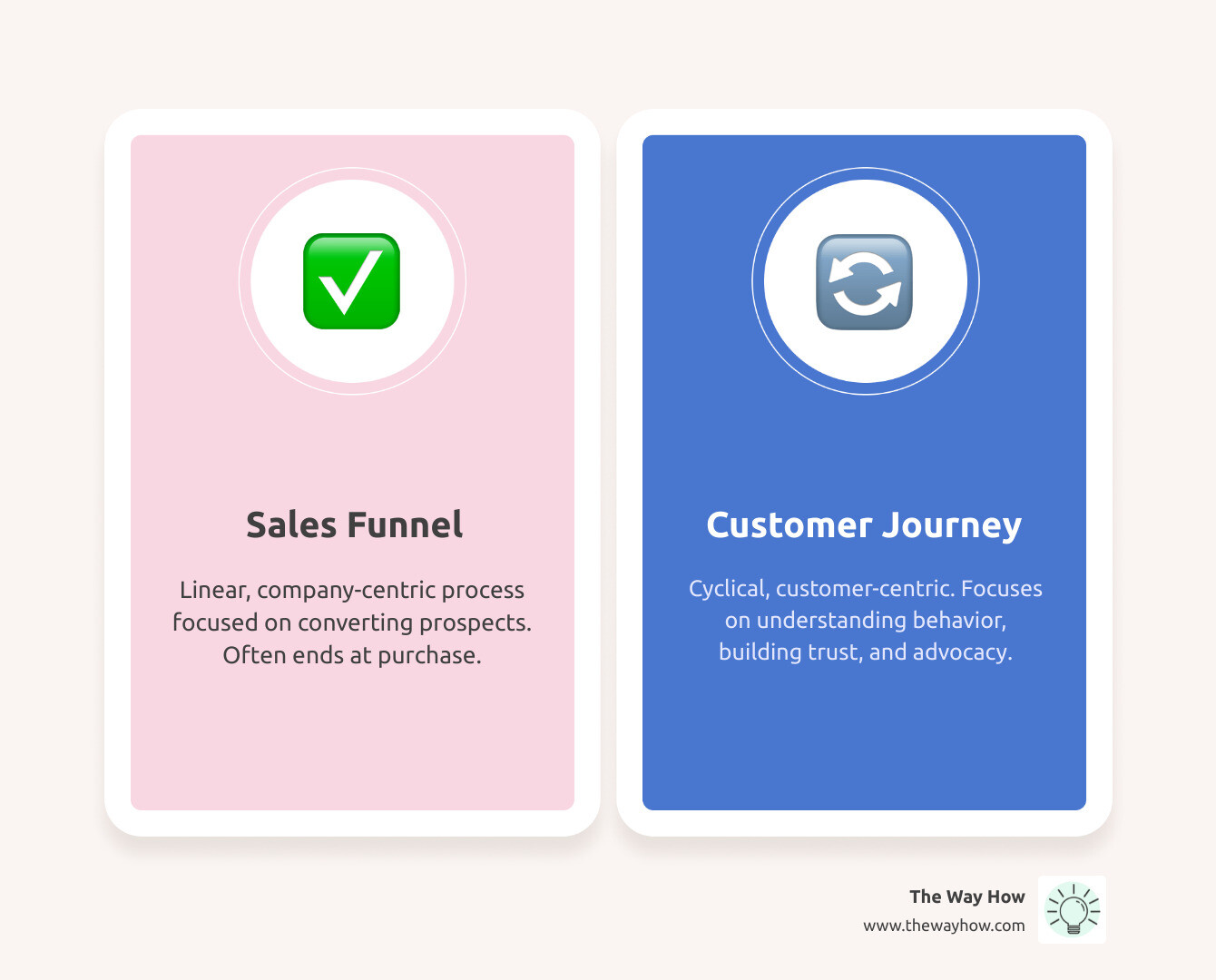
The truth is, the world doesn’t operate in a straight line, and neither do your customers. A sales funnel is a business process, focused on converting prospects into buyers. It’s company-centric, driven by internal sales goals, and often ends at the point of sale.
Understanding the Customer Journey vs. a Sales Funnel
A customer journey, by contrast, is a visual representation of the entire customer lifecycle, covering all 5 stages of customer journey map and the different interactions or touchpoints across channels, including social media, in-store, website, or email. It’s a holistic, customer-centric view that begins long before a potential customer even knows your brand exists and extends far beyond the initial purchase.
The primary difference lies in perspective and scope. While a sales funnel aims to push prospects through a process, a customer journey map seeks to understand and optimize the customer’s experience at every single interaction. It’s about building a relationship, not just closing a deal. As The CX Review highlights, the marketing/sales funnel is now perceived as a customer journey loop by CX experts, recognizing the importance of retention and advocacy for predictable growth. This shift helps us identify and address customer pain points, turning potential stumbling blocks into opportunities for trust and momentum.
| Feature | Sales Funnel | Buyer’s Journey | Customer Journey Map |
|---|---|---|---|
| Scope | Pre-purchase, conversion-focused | Pre-purchase, customer-focused | End-to-end, holistic customer experience |
| Focus | Company’s sales process | Customer’s research & decision-making | Customer’s actions, thoughts, feelings across time |
| Goal | Acquire new customers | Facilitate purchase decision | Build loyalty, retention, and advocacy |
| Perspective | Company-centric | Customer-centric | Customer-centric |
| Stages | Lead, Prospect, Qualified, Opportunity, Sale | Awareness, Consideration, Decision | Awareness, Consideration, Decision, Retention, Advocacy |
| Nature | Linear, often one-way | Linear, focused on a single purchase | Cyclical, iterative, non-linear |
The Buyer’s Journey: A Piece of a Much Bigger Puzzle
The buyer’s journey is a valuable concept, often described as a three-step process: Awareness, Consideration, and Decision. It focuses squarely on the pre-purchase phase, detailing how a customer identifies a problem, explores solutions, and ultimately makes a buying choice. This aligns with our understanding at The Way How that customers spend a significant amount of time (83%, per Gartner) on independent research.
However, the buyer’s journey is just one segment of the larger narrative. It often stops once the purchase is made, leaving a significant post-purchase gap. What happens after the sale? How do customers feel when they use your product? Do they become repeat buyers or advocates? The buyer’s journey doesn’t answer these crucial questions. HubSpot supports this perspective, noting that the customer journey can involve looping back to previous stages, reflecting its iterative nature. We believe that ignoring the post-purchase experience is akin to building a beautiful house and then forgetting to furnish it. The real value, and the true engine of predictable revenue, lies in understanding the entire, cyclical customer journey.
The Psychological Blueprint: Deconstructing the 5 Stages of the Customer Journey Map
At The Way How, we don’t just map customer actions; we map the psychological landscape of their journey. Understanding the customer’s mindset, emotional state, and the cognitive biases at play in each of the 5 stages of customer journey map is crucial for building trust and momentum. This psychology-first approach allows us to identify where certainty gaps exist and design systems that genuinely resonate with human behavior. According to Freshworks, “Businesses stand to gain a lot from understanding their customers’ emotional and psychological states as they interact and purchase from them.” This is precisely our focus.
Stage 1: Awareness – The Spark of a Problem
This is where it all begins: the customer recognizes they have a problem or a need. They might not even know a solution exists, let alone your brand. Their primary goals are problem recognition and initial information gathering. They’re trying to articulate what’s wrong or what they need. This could be triggered by an external event, an internal realization, or even a passive exposure to content. Think of it as the moment of “latent need” becoming a conscious thought.
How to engage: Our focus here is on education, not selling. Businesses should provide valuable, informative content that helps customers understand their problem better. This includes blog posts, guides, infographics, and educational videos that address common pain points without overtly pushing a product. SEO and social media play a critical role in ensuring this content reaches customers as they begin their independent research. For instance, automated AI Phone Calls can be a tool to engage customers with introductory, educational content, sparking curiosity and providing initial value.
Stage 2: Consideration – The Search for Clarity
Once a customer understands their problem, they move into the Consideration stage, actively seeking solutions. This is an intense period of independent research and evaluation. They’re comparing options, looking for detailed information, and trying to clarify which solution best fits their needs. Their emotional state might range from hopeful to overwhelmed by choices. They’re asking, “What are my options? Which one is best for me?”
How to engage: We help businesses provide comprehensive resources that address potential solutions, highlight unique value propositions, and build credibility. This includes case studies, product comparisons, webinars, expert guides, and detailed FAQs. Customer testimonials and reviews become incredibly influential here. As Gartner points out, the vast majority (83%) of a customer’s journey is spent on independent research and internal deliberation. This means our content must be readily available, persuasive, and designed to influence their decision even when we’re not directly interacting with them.
Stage 3: Decision – The Leap of Trust in the 5 stages of a customer journey map
The Decision stage is the culmination of the prior two. The customer has evaluated their options and is now ready to choose a solution and make a purchase. What factors influence this decision? Price, features, reputation, ease of purchase, and trust are paramount. They are actively seeking reassurance that they are making the right choice and looking to overcome any final objections or “certainty gaps.”
How to engage: Our strategies focus on facilitating a smooth purchase process and removing any friction. This means clear pricing, compelling demos, free trials, competitive comparisons, and strong social proof (e.g., testimonials, case studies, guarantees). We ensure that the final steps are as simple and reassuring as possible. As highlighted in How to Create a Customer Journey Map: A Step-by-Step Guide, the goal here is to ensure “customers are ready to make a decision.” We help businesses provide that final push of confidence, changing intent into action.
Stage 4: Retention – The Proof of Value
The purchase is not the finish line; it’s the start of a new, crucial phase. The Retention stage is where customers use your product or service and decide whether to continue their relationship with your brand. This is where you deliver on your promises and prove your value. Their emotional state will be heavily influenced by their post-purchase experience, onboarding, and ongoing support.
How to engage: We focus on strategies that foster loyalty and reduce churn. This includes seamless onboarding processes, proactive customer support, personalized communications, and loyalty programs. It’s well-documented that it’s up to five times more expensive to attract a new customer than it is to keep an existing one. Furthermore, satisfied customers become loyal customers, and customer loyalty directly contributes to increasing profits and reduces churn. A positive experience motivates future purchases (94% of customers agree), and brands with good customer experience can increase revenue by 2-7%. We design systems that consistently deliver value, build trust, and address any post-purchase pain points to reduce churn along the customer journey.
Stage 5: Advocacy – The Echo of a Great Experience
The ultimate goal for any business is to turn satisfied customers into enthusiastic brand advocates. In this stage, customers are so pleased with their experience that they actively recommend your brand to others. They become your most powerful marketing channel, driven by genuine belief and positive experience. Their emotional state is one of satisfaction and pride in their choice.
How to engage: We help businesses encourage and facilitate advocacy through referral programs, opportunities for user-generated content, and community building initiatives. This taps into the powerful psychological phenomenon that 81% of US and UK consumers trust product advice from friends and family over brand messaging. Moreover, 59% of American consumers say that once they’re loyal to a brand, they’re loyal to it for life. Encouraging advocacy isn’t just about getting new leads; it’s about solidifying the loyalty of your existing customer base and creating a virtuous cycle of growth.
From Insight to Impact: How to Build and Use Your Journey Map
Creating a customer journey map is not merely an academic exercise; it’s a strategic imperative. It’s how we move from assumptions about our customers to actionable insights that drive predictable revenue. As Harvard Business School Online emphasizes, a customer journey map is a visual representation of every step a customer takes when interacting with your brand, helping organizations understand each interaction, design better experiences, and improve outcomes.

This process helps us identify pain points and opportunities for improvement. By visualizing the customer’s path, we can pinpoint precisely where customers struggle, feel uncertain, or encounter friction. This diagnostic clarity allows us to leverage customer feedback and data to optimize each stage of the journey, rather than guessing. Personalization, rooted in understanding individual customer needs and behaviors, plays a crucial role in enhancing the customer journey across all stages. Furthermore, technology, from CRM systems to marketing automation and analytics platforms, is essential for supporting the management and optimization of the customer journey, enabling us to collect data, automate tasks, and deliver personalized experiences at scale. Adopting an omnichannel approach ensures a seamless and consistent experience across all touchpoints, which is vital in today’s fragmented digital landscape.
Key Components of a Diagnostic Journey Map
To truly understand and influence the customer journey, a map must go beyond simple touchpoints. It needs to be a diagnostic tool, reflecting the internal world of the customer. Here are the essential components we include:
- Customer Personas: Fictional, data-driven representations of your key audience segments, including their demographics, goals, motivations, and behaviors. This helps us empathize with who we’re mapping for.
- Journey Stages: The distinct phases a customer moves through, like the 5 stages of customer journey map we’ve discussed, but often customized to your specific business context.
- Touchpoints & Channels: Every interaction point (website, email, social media, phone call, in-store, etc.) and the channel through which it occurs.
- Emotions & Mindsets: Crucially, how the customer feels at each touchpoint—their highs, lows, frustrations, and moments of delight. We also consider their mindset: what are they thinking, what questions do they have?
- Pain Points & Opportunities: Explicit and latent frustrations or challenges the customer encounters, and the corresponding opportunities for us to alleviate those pains or create new value.
The 7-Step Process for Mapping Your Customer’s Reality
Creating an effective customer journey map requires a structured, data-driven approach. Here’s how we guide businesses through the process:
- Define Your Goals: Before we draw anything, we clarify why we’re mapping. Are we aiming to improve onboarding, reduce sales friction, or improve customer loyalty? Clear objectives ensure our map is actionable.
- Research the Audience: We gather qualitative and quantitative data through customer interviews, surveys, analytics, and support logs. This ensures our map is based on reality, not assumptions. As Nikki Anderson-Stanier, founder of User Research Academy, emphasizes, without user research, you’re “batting with your eyes closed.”
- Identify Stages in the Journey: We determine the major phases customers typically move through. While the 5 stages of customer journey map (Awareness, Consideration, Decision, Retention, Advocacy) provide a strong framework, we tailor them to your unique business model and customer behavior.
- List Customer Touchpoints: For each stage, we carefully document every interaction point a customer has with your business, both online and offline.
- Capture Emotions, Pain Points, and Motivations: This is where the psychology-first approach truly shines. We map what customers are feeling, thinking, and struggling with at each touchpoint. This helps us uncover “certainty gaps” and unmet needs.
- Identify Opportunities and Solutions: Based on the pain points and emotional lows, we brainstorm and prioritize opportunities to improve the customer experience, whether through process changes, new content, or improved support.
- Visualize the Journey: We translate all this information into a clear, digestible visual map. Tools like Miro offer templates and Lucidchart can be invaluable for this, helping us standardize the format and simplify sharing across teams.
Frequently Asked Questions about the 5 Stages of Customer Journey Map
How does a customer journey map help identify business opportunities?
A journey map visually highlights customer pain points, emotional lows, and “certainty gaps” at each stage. By diagnosing where customers feel friction, confusion, or a lack of trust, businesses can pinpoint precise opportunities for improvement, innovation, and new value creation that directly address those psychological barriers, leading to higher satisfaction and conversion.
What is the biggest mistake to avoid when creating a journey map?
The most common mistake is creating the map from an internal, company-first perspective rather than one based on actual customer research. A map based on assumptions is a work of fiction; it fails to uncover true pain points and leads to misguided strategies. Always ground your map in qualitative and quantitative data directly from your customers.
How often should a customer journey map be updated?
A customer journey map is a living document, not a one-time project. It should be revisited and updated at least annually, or whenever there is a significant change to your product, service, market, or customer behavior. Regularly validating the map ensures your strategies remain aligned with your customers’ evolving reality.
From Map to Momentum: Building a System for Predictable Growth
Understanding the 5 stages of customer journey map isn’t just about empathy; it’s about establishing a system for predictable revenue. By diagnosing the true customer experience, we can design marketing and sales strategies rooted in human behavior, empathy, and decision-making psychology. We move beyond chasing fleeting tactics to build robust systems that create trust, momentum, and sustainable growth.
This involves continuous improvement, where insights from our journey maps feed directly into personalized, omnichannel strategies. We ensure that every touchpoint, every piece of content, and every interaction is intentionally designed to address customer uncertainty and propel them confidently through their journey.
At The Way How, we specialize in helping founders and leadership teams remove uncertainty in their sales and marketing systems. We provide Fractional CMO leadership, HubSpot architecture, and demand generation strategies that transform your understanding of the customer journey into a dependable growth engine.
Ready to stop guessing and start growing with certainty?