
Your CRM Should Build Momentum, Not Frustration

CRM consulting services help businesses select, implement, and optimize customer relationship management systems to improve sales, marketing, and customer service outcomes. Here’s what these services typically include:
- Strategy and Selection - Diagnosing business needs, defining requirements, and choosing the right CRM platform
- Implementation Support - Supervising technical setup, data migration, system integration, and customization
- Optimization and Training - Auditing existing systems, improving workflows, and driving user adoption
- Ongoing Advisory - Providing independent oversight during rollouts and addressing post-launch issues
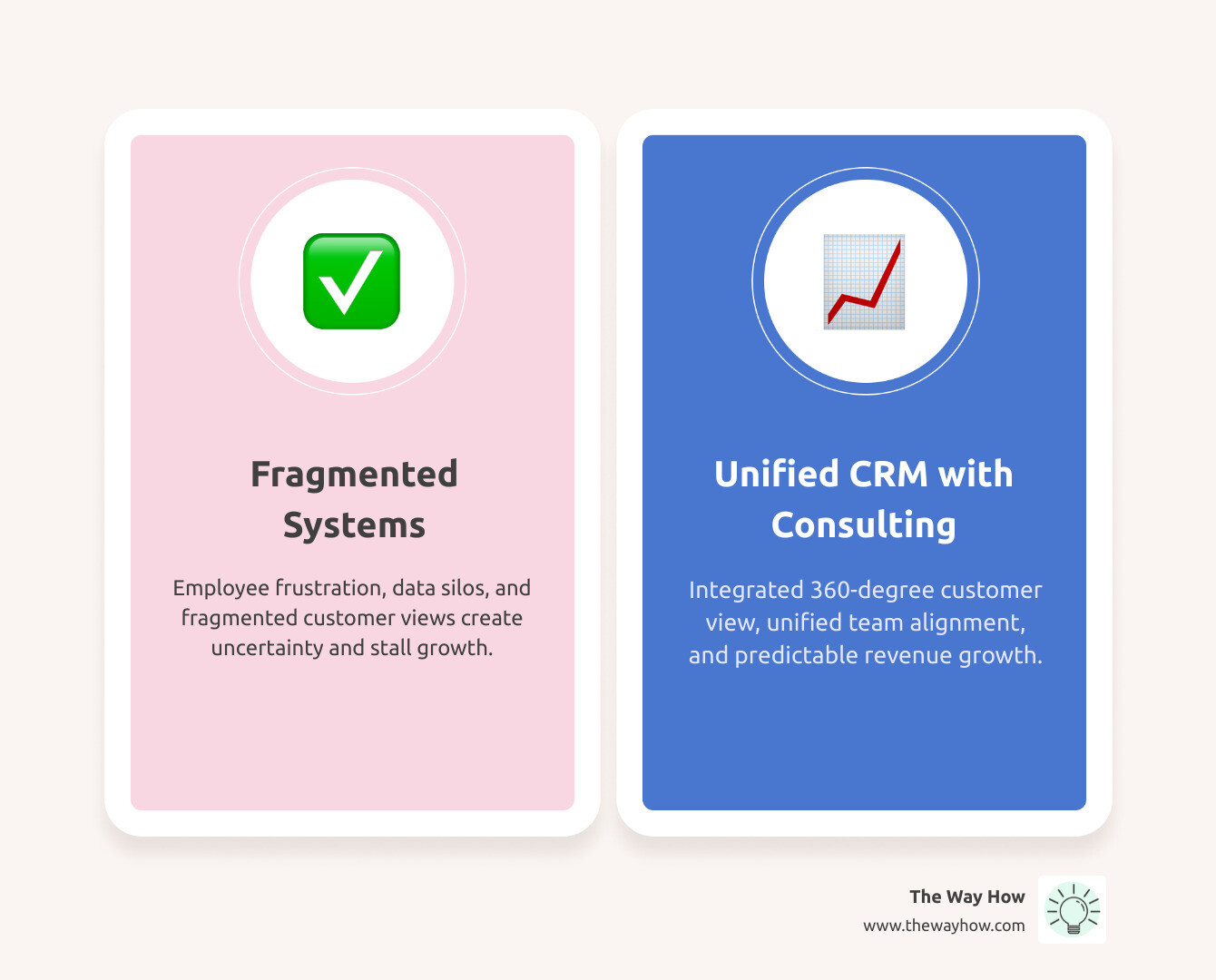
Your team is drowning in fragmented tools. Sales can’t see what marketing is doing. Customer data lives in three different places. And the CRM you bought to solve all of this? It’s just another system no one wants to use.
This frustration isn’t about the software. It’s about uncertainty.
When employees don’t trust the data, when prospects feel like just another entry in a pipeline, and when leadership can’t predict what’s actually driving revenue — that’s when growth stalls. A CRM should create clarity and momentum. Instead, most create friction.
The global CRM market is growing fast — projected to hit $49.6 billion by 2025. But market size doesn’t equal business success. The companies seeing real results aren’t just buying better software. They’re working with consultants who understand the psychology behind why systems fail and how people actually make decisions.
CRM consulting isn’t about installing technology. It’s about diagnosing why your growth engine isn’t working, then building a system that removes uncertainty at every stage of the customer journey. It’s about aligning your team around a single source of truth so everyone — from sales reps to the CEO — knows what’s happening and what to do next.
I’m Jeremy Wayne Howell, founder of The Way How, and I’ve spent over 20 years helping companies rebuild stalled revenue engines by aligning strategy, systems, and buyer psychology. I’ve guided businesses through CRM consulting services that don’t just implement platforms — they create predictable growth by addressing the human side of the equation first.
What is CRM Consulting? (And Why It’s Really About Human Behavior)
At its core, CRM consulting involves leveraging the expertise of seasoned professionals to maximize the potential of a modern CRM platform. But for us, it’s more than just technical setup; it’s a psychology-first approach. We believe a truly effective CRM system is one that aligns with human behavior, empathy, and decision-making psychology. It’s about understanding the journey of your business and the story of your customers, then building a custom solution that shifts your legacy systems and processes to a digital infrastructure that encompasses the entire organization.
Our role goes beyond merely recommending software. We diagnose the “why” behind stalled growth, helping you identify the certainty gaps in your customer journey that are causing friction and inefficiency. Are your employees frustrated because of inefficient, non-integrated, and confusing applications that only offer fragmented views of sales opportunities and customer interactions? These are symptoms of deeper issues that a CRM consultant can help uncover.
A good consultant acts as an objective third party, providing an unbiased perspective on your current state and future needs. We help you chart out robust plans, implement processes for custom CRM solutions, and ensure that your sales, marketing, and service teams are aligned, working from a unified view of every prospect and customer. This strategic clarity, rooted in behavioral insight, is what transforms a CRM from a mere database into a powerful system for building trust, momentum, and predictable revenue.
The Tangible and Intangible ROI of Expert CRM Guidance

Investing in expert CRM consulting services is not merely an expense; it’s a strategic investment that yields significant returns, changing unpredictable results into a dependable growth engine. The benefits are both quantifiable and qualitative, impacting everything from your bottom line to employee morale.
Tangible Benefits:
- Increased Sales Revenue: Research indicates that CRM consultants help companies achieve a remarkable 30-45% increase in sales revenue. This comes from optimized sales pipelines, better lead management, and more effective sales strategies. For instance, Centric Consulting helped a Fortune 500 tech company increase sales productivity by 25% through a Salesforce CRM implementation. Signity Solutions implemented a Salesforce solution for a retail chain that optimized customer loyalty programs and increased repeat customer sales by 15%.
- Higher Marketing ROI: With a consultant’s guidance, businesses can see a 23-30% increase in marketing ROI. This is achieved by leveraging CRM data for targeted campaigns, improved lead generation, and a deeper understanding of customer behavior.
- Increased Sales Productivity: Beyond overall revenue, consultants can streamline sales processes, automate tasks, and provide sales teams with the tools they need to be more efficient. Centric Consulting, for example, increased sales productivity by 25% for a Fortune 500 tech company.
Intangible Benefits:
- Improved Customer Satisfaction (CSAT): By creating a 360-degree view of the customer and enabling personalized interactions, CRM consultants help companies achieve 90-98% CSAT scores. Eide Bailly implemented a CRM system for a healthcare organization that improved patient experience and reduced wait times by 25%.
- Reduced Employee Friction: When systems are integrated and intuitive, employees spend less time battling technology and more time doing their jobs effectively. This leads to higher job satisfaction and productivity.
- A Single Source of Truth: Eliminating fragmented data sources means everyone in your organization operates from the same, accurate information, fostering collaboration and informed decision-making. BroadPoint Technologies implemented a customized Microsoft Dynamics CRM system for a nonprofit organization that resulted in a 30% increase in donor engagement, showcasing the power of a unified system.
These benefits underscore why CRM consulting services are not just about technology, but about driving fundamental improvements across your entire business ecosystem.
A Blueprint for Success: The Core CRM Consulting Services
The consultant’s role in a CRM project is akin to an architect and a general contractor rolled into one. We guide you through every stage, from the initial diagnosis of your needs to the ongoing optimization of your system. Our approach involves end-to-end project supervision, often utilizing agile methodologies like Scrum and Kanban for faster delivery and adaptive planning.
Diagnosis and Strategy: The Foundation of Your CRM System
Before we even think about software, we focus on understanding your business. This involves a thorough audit of your existing systems and processes. We look for those elusive “certainty gaps” — areas where a lack of clear information or predictable outcomes is hindering growth. Our business needs analysis helps clarify your goals, map out current workflows, and gather user requirements.
This diagnostic phase is critical for developing a robust CRM roadmap that aligns technology squarely with your business objectives. It’s about ensuring the chosen solution supports how you want to work, rather than forcing you into a rigid system. We also assess your team’s readiness for change, because even the best technology will fail without buy-in. Assessing your organizational preparedness and identifying gaps with a CRM readiness assessment is a key step before selection and implementation.
Navigating the Maze: How Consultants Help Choose the Right CRM Platform
The CRM market is vast and can feel overwhelming. Salesforce, Microsoft Dynamics, HubSpot, NetSuite - each platform boasts unique strengths and caters to different business needs. Our role is to cut through the noise, helping you choose the right fit based on key factors like:
- Scalability: Will the platform grow with your business?
- Cost: What’s the total cost of ownership, not just the license fee?
- User Experience: Will your team actually enjoy using it? This is crucial for adoption.
- Integration Capabilities: How well does it play with your existing tech stack (ERP, marketing automation, etc.)?
We provide a vendor-neutral perspective, ensuring our recommendations are driven by your strategy and requirements, not by incentives from software providers. We help you identify and prioritize requirements, create a customized CRM scorecard, and evaluate vendors through custom demonstrations. This vendor-neutral approach is critical to finding the best-fit software.
Here’s a simplified comparison of some major platforms:
| Feature/Platform | Salesforce (Sales Cloud) | Microsoft Dynamics 365 | HubSpot CRM | NetSuite CRM |
|---|---|---|---|---|
| Key Focus | Sales Automation, Service, Marketing, Analytics | Sales, Service, Marketing, Finance, ERP | Marketing, Sales, Service, CMS | ERP Integration, Financials, Sales, Service |
| Target Audience | Enterprise to SMB, highly customizable | Mid-market to Enterprise, Microsoft ecosystem users | SMB to Mid-market, inbound methodology | Mid-market to Enterprise, needing unified business management |
| Customization | Very high, extensive app marketplace | High, integrates with Microsoft ecosystem | Moderate to high, extensive app marketplace | High, integrates with NetSuite ERP |
| Pricing Philosophy | Tiered, per user per month, add-ons | Tiered, per user per month, modular apps | Freemium model, tiered, per user per month | Per user per month, often enterprise contracts |
| Integration | Extensive, AppExchange | Strong with Microsoft products, API | Strong with marketing tools, API | Native with NetSuite ERP, API |
Implementation and Adoption: Building a System People Actually Use
Once the right platform is selected, the real work begins. Implementation isn’t just a technical task; it’s a profound organizational change. We focus heavily on the human side of implementation, ensuring robust change management and comprehensive user training. A CRM is only as good as its adoption rate, and we work to make sure your team understands why the new system is better and how to use it effectively.
Technically, our CRM consulting services cover:
- Custom Development: Tailoring the platform to your unique workflows.
- Data Migration: Safely and accurately moving your critical customer data from old systems. This is a complex process where following best practices for CRM data migration is invaluable.
- System Integration: Connecting your CRM with other essential business applications (ERP, marketing automation, customer service tools) to create a seamless ecosystem and that coveted 360-degree view of your customer. Eide Bailly, for instance, assisted a manufacturing company with integrating their CRM with ERP systems, leading to a 20% increase in operational efficiency.
Our goal is not just to launch a new system, but to drive sustained user adoption, ensuring the CRM becomes an indispensable tool that empowers your team and fuels your growth.
Optimizing Your Existing CRM: One of the most valuable CRM consulting services

Perhaps you already have a CRM, but it’s not delivering on its promise. This is a common scenario, and it’s where our optimization services shine. We approach existing systems with a diagnostic lens, auditing for inefficiencies, identifying unused features that could add value, and pinpointing areas where workflows can be improved.
Our optimization process often includes:
- Workflow Improvements: Streamlining processes to reduce manual effort and improve efficiency.
- Data Cleansing: Ensuring the accuracy and integrity of your customer data, which is foundational for reliable insights.
- Enhancing Reporting and Analytics: Configuring dashboards and reports that provide actionable insights into sales performance, marketing effectiveness, and customer satisfaction.
- Open uping Unused Capabilities: Many CRMs are underused. We help you find and implement features you already own but aren’t leveraging.
Sometimes, a full overhaul isn’t necessary. We offer targeted quick fixes and workshops to address specific pain points, provide expert advice on demand, and offer on-call troubleshooting for immediate impact. These focused interventions can make a significant difference in how your team perceives and uses the system.
How to Choose the Right CRM Consultant for Your Business
Choosing a CRM consulting partner is one of the most critical decisions you’ll make for your revenue strategy. It’s about finding a true strategic partner, not just another vendor. We believe in collaboration and transparency, recognizing that the best outcomes stem from a deep understanding of your unique business, culture, and aspirations.
When evaluating potential consultants, we recommend focusing on these key criteria:
Industry-Specific Expertise: Does the consultant understand the nuances of your industry? For example, a firm with experience in the nonprofit sector will understand the unique challenges of donor engagement and fundraising. BroadPoint Technologies, for example, has successfully implemented over 400 CRM projects, demonstrating a strong ability to understand and adapt to various industry needs.
Technical Proficiency: Beyond general CRM knowledge, do they have certified experts in the specific platforms you’re considering (e.g., Salesforce, Microsoft Dynamics, HubSpot)?
A Diagnostic Approach: Do they lead with a “why” before a “what”? A good consultant will first diagnose your business challenges and certainty gaps, rather than immediately prescribing a technical solution.
Transparent Pricing: Understand their billing structure upfront. CRM consulting services costs can vary significantly. Engagements typically start around $15,000 and can range up to $25,000 or more, depending on scope, complexity, and the depth of analysis required. Common pricing models include:
- Hourly Rates: For specific tasks or ongoing support.
- Fixed Project Fees: For clearly defined projects with a set scope.
- Retainers: For ongoing advisory and support.
Verified Client Testimonials: Look for case studies and references from businesses similar to yours. This provides insight into their track record and approach.
Before hiring, ask these questions:
- How do you diagnose underlying business challenges before recommending solutions?
- Can you provide examples of how you’ve helped businesses in our industry achieve specific outcomes?
- What is your approach to change management and user adoption?
- How do you ensure vendor neutrality in your recommendations?
- What are your typical project timelines and deliverables?
The right CRM consulting partner will listen to your needs, understand your business inside and out, and act as a trusted advisor, ensuring your investment in CRM technology drives growth and provides a significant competitive edge.
Frequently Asked Questions about CRM Consulting
How do CRM consultants address industry-specific needs?
CRM consultants understand that a one-size-fits-all approach rarely works. We leverage our experience across various verticals like healthcare, finance, and nonprofits to configure CRMs that meet specific compliance requirements (e.g., HIPAA for healthcare, GDPR for data privacy), unique workflows, and data security needs. For example, Eide Bailly deployed a CRM solution for a financial services firm that increased client retention rates by 18%, while also supporting compliance with financial regulations. Similarly, for nonprofits, consultants help implement systems that effectively manage donor engagement and fundraising, a market projected to reach $927.3 million by 2028. Our role is to ensure the CRM isn’t just a tool, but a strategic asset custom to your industry’s specific demands.
What is the difference between a CRM consultant and an implementation partner?
While the terms are sometimes used interchangeably, there’s a crucial distinction. A CRM consultant (especially one with a psychology-first approach like ours) primarily focuses on strategy and diagnosis—the “why” and “what.” We help you clarify business goals, identify certainty gaps, define requirements, and select the right platform. An implementation partner, on the other hand, often focuses more on the technical execution—the “how.” They handle the hands-on configuration, coding, data migration, and integration.
A great consulting firm often guides you through the entire process, from initial strategy and selection to overseeing the implementation. We act as your advocate, ensuring that the technical implementation aligns perfectly with your strategic objectives and user needs, even if we don’t perform the hands-on coding ourselves.
How long does a typical CRM consulting project take?
The duration of a CRM consulting project can vary widely depending on its scope and complexity. A focused strategy and selection project, where we help you diagnose your needs and choose the right platform, typically runs for 8 to 12 weeks. This phase involves deep findy, requirement gathering, and vendor evaluation.
A full CRM implementation, which includes technical setup, customization, data migration, and user training, can range from a few months to over a year. Factors like the size of your organization, the number of users, the complexity of integrations with other systems, and the volume of data to be migrated all play a significant role. Our aim is always to set clear milestones and adapt the pace to fit your organization’s capacity and needs, ensuring a smooth transition without disrupting daily operations.
From Uncertainty to Clarity: Your Next Step Toward Predictable Growth
We’ve explored how CRM consulting services are not just about technology, but about strategic clarity, behavioral insight, and the profound impact of human psychology on business outcomes. The success of your CRM isn’t measured by the software you choose, but by its ability to remove uncertainty from your sales and marketing systems, creating trust, momentum, and predictable revenue.
At The Way How, we blend strategic clarity with behavioral insight and operational execution. We diagnose why growth is stalled, identify certainty gaps in your customer journey, and design systems that work for your team and your customers. Our approach transforms marketing into a dependable growth engine.
If your team is frustrated, your data is fragmented, and your growth feels unpredictable, it’s time to consider a different approach. Let us help you open up the full potential of your customer relationships. Take the next step to build a dependable growth engine for your business. Explore our services.