A Complete Guide to CRM Systems and Database Management
 Jeremy Wayne Howell : Jul 22, 2026 9:48:31 PM
Automated lead nurturing is the process of using software to deliver the right message to the right person at the right time—based on their behavior, stage in the buying journey, and level of engagement—without requiring manual effort from your sales or marketing team.
Key Components of Automated Lead Nurturing:
You’ve probably been there.
A lead downloads your guide. You make a note to follow up. Three days pass. You send an email. No response. A week later, you try again. Still nothing. Meanwhile, 47 other leads did the same thing—and you’re drowning in spreadsheets, trying to remember who got what and when.
This is what one source called “running on a treadmill”—lots of effort, zero forward motion.
Manual follow-up doesn’t scale. It’s inconsistent, exhausting, and nearly impossible to personalize at volume. Worse, it creates certainty gaps for your buyers. They’re left wondering if you’re paying attention, if you understand their needs, or if they should just move on to a competitor who does.
Automated lead nurturing solves this.
It replaces reactive scrambling with proactive systems. It turns your follow-up from a memory test into a behavioral response engine. And when done right, it doesn’t feel robotic—it feels like you’re reading their mind.
The research is clear: companies using lead nurturing automation see 451% more qualified leads than those doing everything manually. Prospects who experience coordinated messaging across multiple channels convert 47% faster. And businesses that automate see a 53% higher conversion rate from initial response to qualified lead.
But here’s what most guides won’t tell you: automation without psychology is just spam at scale.
The difference between a nurture sequence that builds trust and one that gets ignored isn’t the tool you use—it’s whether you understand what your buyer is thinking, feeling, and doubting at each stage of their journey.
That’s where most companies get stuck. They know what automation is. They’ve even tried it. But they’re automating the wrong things, at the wrong times, for the wrong reasons—and wondering why their pipeline still feels like a leaky bucket.
I’m Jeremy Wayne Howell, and over the past 20 years I’ve helped companies rebuild their go-to-market systems by diagnosing the human problem underneath the performance problem—often starting with fixing broken or misaligned automated lead nurturing strategies. In this guide, we’ll walk through how to build a system that actually works—one that respects buyer psychology, removes friction, and creates predictable momentum toward revenue.
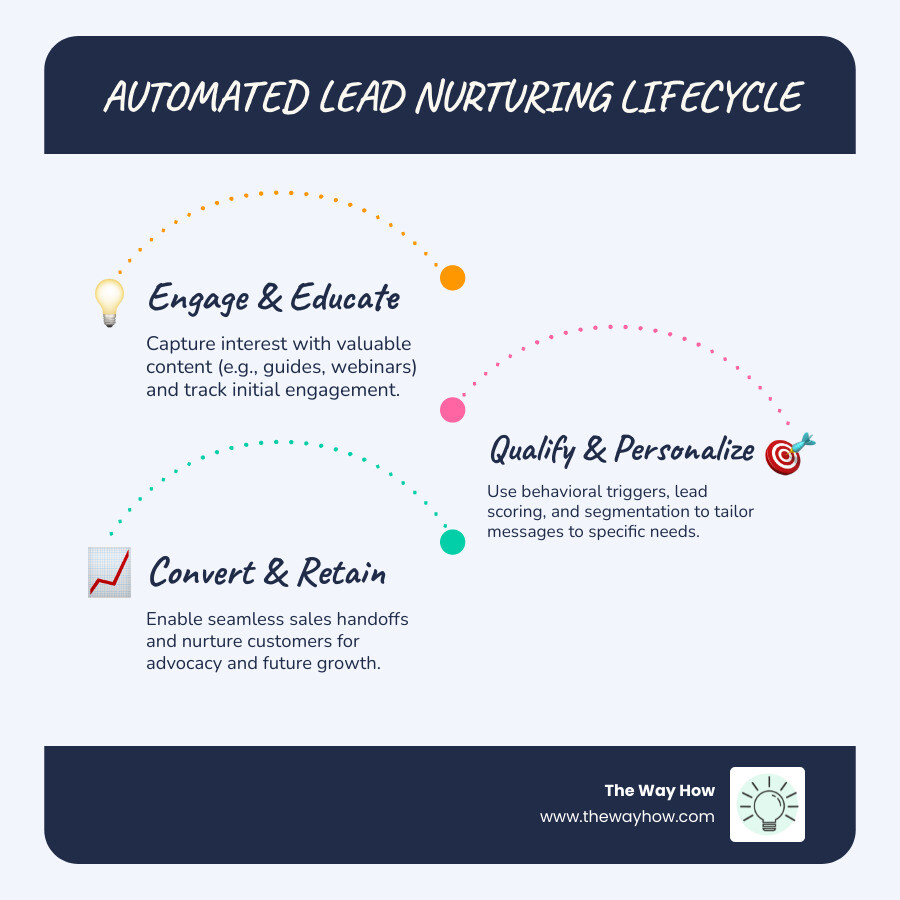
To move beyond the “treadmill,” we must understand that automated lead nurturing is not just about sending emails; it is about relationship architecture. Research shows that 71% of consumers prefer personalized engagement from brands. If your automation feels generic, you are actually creating friction instead of removing it.
At The Way How, we look at the psychology of the buyer. A prospect isn’t just a row in a CRM; they are a person seeking certainty. Effective systems address this by focusing on Hubspot lead generation strategies that prioritize the human experience over the technical trigger.
Successful automation rests on five strategic pillars:
Trust is the ultimate currency in sales. Almost 90% of customers trust a business whose service they have evaluated as “very good.” In the digital world, “service” begins with the first automated touchpoint.
We must use contextual relevance to prove we understand the buyer’s situation. If a lead views your pricing page three times but doesn’t book a call, an empathetic automation would send a comparison guide or a “frequently asked questions” document, not a high-pressure sales pitch. This value-first approach signals that you are a partner in their decision-making process, not just a vendor chasing a quota.
Building a workflow without a map is like building a house without blueprints. You might end up with a roof, but the doors won’t open. To avoid this, we use Hubspot marketing automation to visualize the buyer’s journey before a single email is written.
The process of building your first workflow should follow a logical progression:
To truly scale, you need to differentiate between a student doing research and a VP ready to buy. This is where lead scoring becomes essential.
By combining implicit data (behavioral signals like website visits and email clicks) with explicit data (information they’ve told you, like company size), you can assign a numerical value to every lead. For example:
When a lead crosses a certain threshold, your system should trigger an automated alert to the sales team, ensuring no high-intent lead falls through the cracks.
Today’s buyers are everywhere. They might find you on LinkedIn, read your blog, and receive your emails. To capture their attention, you need a unified multichannel strategy. Prospects who see coordinated messages across multiple channels convert 47% faster than those who only receive emails.
Artificial Intelligence (AI) and Machine Learning (ML) are transforming how we nurture leads from a reactive process to a predictive one. Predictive analytics can now pinpoint the optimal time to send an email or suggest the specific piece of content most likely to trigger a conversion.
However, as we lean into these tools, we must be careful. If you are using AI to generate your outreach, you must ensure you humanize AI writing to maintain a sense of authenticity. AI should be the engine, but the “soul” of the message must remain human.
Despite the rise of automation, human interaction remains vital. We recommend using this writing authenticity guide to ensure your communications don’t sound like a robot wrote them.
To create original and humanized content, use a conversational tone. Use contractions, ask open-ended questions, and speak directly to the lead’s pain points. Automation is a tool for efficiency, but empathy is the tool for connection.
How do you know if your automated lead nurturing is actually working? Many marketers fall into the trap of watching “vanity metrics” like open rates while ignoring the metrics that actually drive revenue.
| Metric Type | Vanity Metrics (The “Trap”) | Revenue Metrics (The “Truth”) |
|---|---|---|
| Focus | Email Open Rates | Sales Velocity |
| Focus | Number of Clicks | Conversion Lift |
| Focus | Total Leads Generated | Cost Per Acquisition (CPA) |
| Focus | Email Deliverability | Pipeline Contribution |
A new Journal of Marketing study finds that automated lead nurturing is highly effective, but only under specific conditions—primarily when the product or service has a relatively simple sales cycle. For complex B2B deals, the automation must be more sophisticated, focusing on education rather than just “nudging” toward a sale. Leveraging Hubspot features like advanced reporting allows us to see exactly where leads are dropping off in the funnel.
While open rates are a good health indicator, we focus on:
One of the biggest obstacles to growth is the “silo” between sales and marketing. Marketing generates leads; Sales ignores them. Sales wants better leads; Marketing says they aren’t following up fast enough.
The average sales rep spends only 36% of their time actually selling. The rest is eaten up by administrative tasks and manual follow-ups. By implementing a proper Hubspot Sales Hub implementation, you give that time back to your team.
The “handoff” is the moment a Marketing Qualified Lead (MQL) becomes a Sales Qualified Lead (SQL). This transition should be invisible to the buyer but crystal clear to your team.
Research shows that responding to a lead within 5 minutes makes you 9x more likely to convert them. Automation makes this possible by triggering instant internal notifications the moment a lead takes a high-intent action. This ensures your sales team is striking while the iron is hot, backed by a Service Level Agreement (SLA) that defines exactly how and when follow-up should occur.
No. It acts as a force multiplier. It handles the repetitive, educational tasks that often clutter a salesperson’s day. This allows your team to focus their energy on high-value human consultation and closing deals, rather than chasing people who aren’t ready to talk yet.
It depends entirely on your sales cycle. For simple e-commerce products, a sequence might last 7–14 days. For complex B2B enterprise software, a nurture track could span 6 months or more, providing consistent value until the buyer reaches their decision window.
Actually, the opposite is true. When rooted in psychology and behavioral triggers, automation feels more personal because it delivers the right information exactly when the buyer is thinking about it. A manual follow-up that comes three days late is far more impersonal than an automated one that arrives exactly when the prospect is on your pricing page.
At The Way How, we believe that growth doesn’t come from chasing the latest “hack”—it comes from removing the uncertainty that keeps buyers from moving forward. Automated lead nurturing is the engine that maintains that momentum.
By blending strategic clarity with behavioral insight, we help you turn your marketing into a dependable growth engine. Whether you are just starting or looking to optimize your marketing automation HubSpot architecture, the goal is the same: to create a system that builds trust, reduces friction, and delivers predictable revenue.
Stop running on the treadmill. It’s time to build a system that moves you forward.
 Jeremy Wayne Howell : Jul 22, 2026 9:48:31 PM
 Jeremy Wayne Howell : Jul 21, 2026 9:47:10 PM
 Jeremy Wayne Howell : Jul 20, 2026 9:46:47 PM