A Complete Guide to CRM Systems and Database Management
 Jeremy Wayne Howell : Jul 22, 2026 9:48:31 PM

B2B sales strategy is the structured, data-informed plan that defines how your company targets, engages, and converts business customers. It goes beyond tactics — it’s the blueprint for creating predictable revenue by understanding buyer psychology, mapping decision-making processes, and aligning your entire revenue engine around how modern buyers actually buy.
A modern B2B sales strategy includes:
If you’re reading this, your sales motion probably feels broken.
Not because your team isn’t working hard. Not because your product isn’t good. But because the playbook you’re running was built for a buyer who no longer exists.
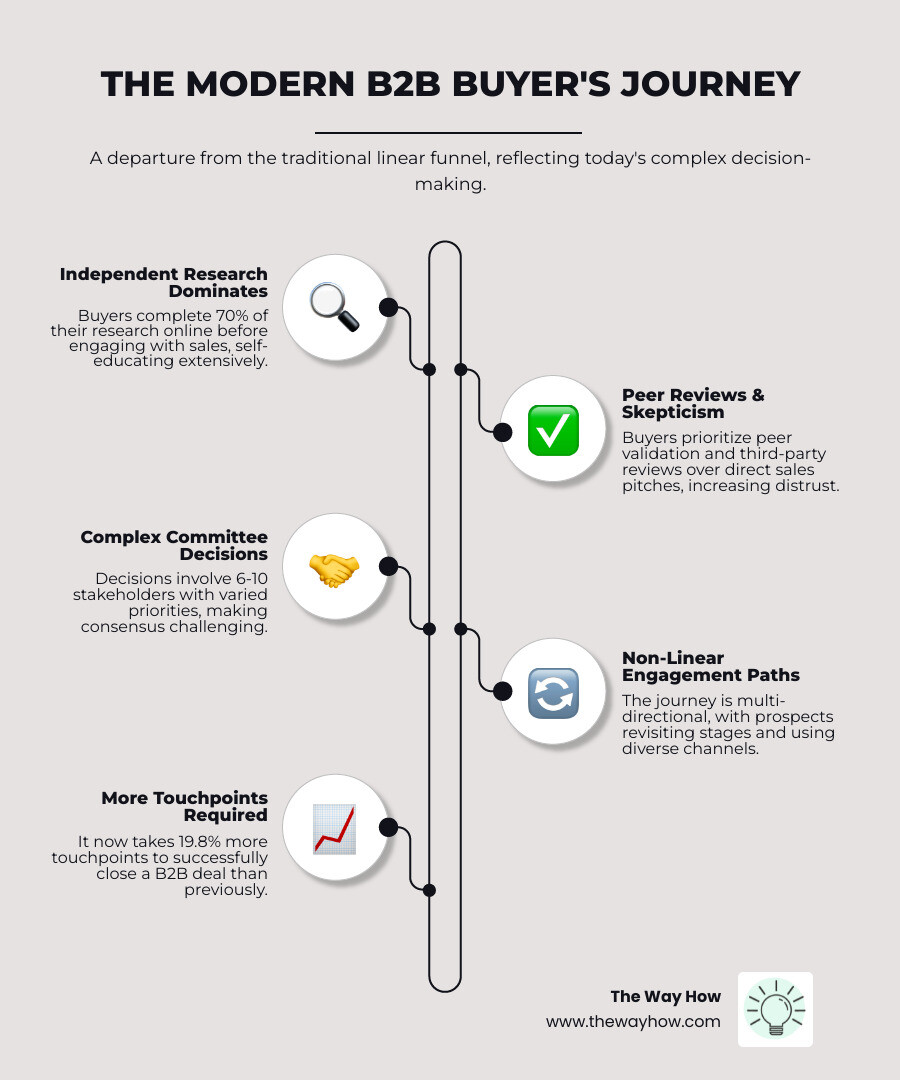
The traditional purchase funnel — awareness, consideration, decision — is officially dead. Modern B2B buyers complete 70% of their research before they ever talk to a salesperson. They’re skeptical of your pitch. They prefer peer reviews over your marketing. And they’re making decisions in committees of 6 to 10 people, each with different priorities and different definitions of success.
Meanwhile, most sales strategies are still optimized for a world where reps controlled information and buyers needed hand-holding. The result? It now takes 19.8% more touchpoints to close a deal than it did just a few years ago. 34% of salespeople admit closing is getting harder. And companies with misaligned sales and marketing teams are losing 10% or more of their revenue every single year.
The problem isn’t effort. It’s diagnosis.
You’re treating symptoms — low reply rates, long sales cycles, ghosting prospects — without understanding the root cause: your strategy is built on outdated assumptions about how people buy.
This guide is different. It doesn’t start with tactics. It starts with the buyer. Because if you don’t understand why someone buys, how they evaluate risk, and who they need to convince internally, no amount of automation or personalization will save you.
We’re going to show you how to build a psychology-first B2B sales strategy — one that creates certainty for your buyers, aligns your revenue engine, and turns stalled growth into predictable momentum.
At The Way How, we believe that to fix a broken sales system, you must first understand the human beings at its center. This means diagnosing what your buyers believe is wrong, what is actually wrong, and where uncertainty exists in their decision-making.
The world of B2B (business-to-business) sales is fundamentally different from B2C (business-to-consumer) sales. In B2B, one business sells goods or services to another. These transactions typically involve higher order values, longer sales cycles, and more complexity than B2C sales. While B2C sales often target short-term transactions driven by immediate need or desire, B2B sales focus on building long-term relationships, understanding the potential return on investment (ROI), and navigating intricate decision-making processes.
Modern B2B buyers are savvy. They’re tech-native and accustomed to finding information on demand. Our research shows that a staggering 96% of consumers research independently before speaking to a company representative. This means that before they even consider reaching out to you, they’ve already completed about 70% of their research online. They’re looking for answers, solutions, and validation, often preferring to do this research online rather than interacting with a sales rep who might push a sales agenda.

The days when a salesperson was the sole gatekeeper of information are long gone. Today, the role of the salesperson has profoundly evolved. Buyers are highly skeptical of traditional sales and marketing messages they encounter. Only 29% of buyers want to talk to a salesperson to learn more about a product, and 57% of buyer decisions are made before they even pick up the phone. This shift implies that the salesperson’s primary function is no longer to “sell” but to “guide.”
Modern buyers prefer interacting with salespeople who listen to their needs and provide relevant information, rather than applying pressure. As a recent Forrester report highlights, 59% of buyers prefer online research to avoid sales pressure. This means successful B2B sales professionals must adopt a value-based, consultative approach, focusing on understanding the buyer’s business, pain points, and desired outcomes. We need to focus on selling change, not just features.
Perhaps the most significant difference in B2B sales is the sheer number of people involved in a purchase decision. B2B buying today is nonlinear, complex, and multi-threaded. Decisions are rarely made by a single person. In a typical firm (100-500 employees), an average of 7 people are involved in most buying decisions. Other sources suggest that most decisions are made by committees of 6 to 10 decision-makers, each with unique concerns and priorities.
This presents a complex web of needs, motivations, and potential objections. Our role, as strategic advisors, is to understand these conflicting priorities, identify the internal champion, and map the influence dynamics within the buying committee. This requires deep empathy mapping – truly understanding the fears, aspirations, and individual metrics of success for each stakeholder. When you focus on creating certainty for each member of that committee, you build momentum for the entire deal.
Building a robust B2B sales strategy isn’t about throwing tactics at a wall to see what sticks. It’s about architecting a system that consistently delivers predictable revenue. This involves several essential components, starting with a precise understanding of who your ideal customer is and how they prefer to buy.
A typical 7-step B2B selling process provides a foundational roadmap: Preparation and Research, Prospecting, Needs Assessment (Findy Call), Value Proposition (Pitch/Demo), Handling Objections, Closing the Deal, and Follow-up and Relationship Management. However, the how you execute each step is where modern strategy truly differentiates.
Before you can sell to anyone, you need to know who you’re selling to. A superficial understanding of your Ideal Customer Profile (ICP) means wasted effort and missed opportunities. We need to go beyond basic firmographics (industry, company size) and dig into a deeper, more nuanced understanding.
This includes:
Leveraging data to target the right prospects, personalize messages, and prioritize leads is no longer optional; it’s a fundamental requirement for success.
The core of your B2B sales strategy hinges on how your product or service naturally drives growth. There isn’t a one-size-fits-all model, but rather a strategic choice between Sales-Led Growth (SLG), Product-Influenced strategies (like Product-Led Growth, PLG), or a Hybrid approach.
| Growth Model | Description | Best For The Way How is a psychology-first marketing and revenue strategy firm that helps founders and leadership teams remove uncertainty in their sales and marketing systems. We specialize in Fractional CMO leadership, HubSpot architecture, and demand generation strategies rooted in human behavior, empathy, and decision-making psychology.
Once you understand who you’re targeting and how your product drives growth, the next critical step is to map out the modern buyer’s journey and align your sales funnel accordingly. The linear “funnel” is indeed dead, replaced by a more complex, non-linear journey where buyers loop back, research independently, and engage on their own terms.
We typically think of the buyer’s journey in three broad stages:
Modern buyers expect a multi-channel approach. One touchpoint isn’t enough; it now takes 19.8% more touchpoints to close B2B deals than it did just a few years ago. This aligns with the classic “Rule of 7,” suggesting a prospect needs to see or hear your message at least seven times before taking action. This means mixing LinkedIn, email, and phone into a coherent sequence, ensuring that each touchpoint aligns with where the buyer is in their journey.
By deeply understanding each stage of the buyer’s journey and strategically mapping your multi-channel touchpoints, you can guide prospects more effectively. This systematic approach forms the bedrock of building a robust client acquisition funnel that reduces uncertainty and drives predictable conversions.
Having a carefully crafted B2B sales strategy is only half the battle. The real magic happens in the execution, where your blueprint transforms into tangible results. This requires seamless integration across your revenue teams, leveraging technology intelligently, and empowering your sales force to engage buyers with authentic value.
Silos kill growth. This isn’t just a catchy phrase; it’s a hard truth costing companies 10% or more of revenue per year due to sales and marketing misalignment. Conversely, 56% of companies with both teams aligned met their revenue goals, and 19% even exceeded them.
True alignment means:
For many organizations, achieving this level of synergy requires strategic leadership. This is often where a Fractional Chief Marketing Officer can step in, providing the strategic clarity and operational guidance to bridge the gap between these critical functions.
With a strong foundation and aligned teams, your sales force is ready to engage. But remember, modern buyers are skeptical of pressure. Your B2B sales strategy for engagement must be built on value, trust, and personalization.
Social Selling: Before you message, engage. Platforms like LinkedIn are crucial for building context and credibility. Over 60% of buyers check out new service providers on social media. Sales professionals should like posts, comment meaningfully, and publish value-driven content. This builds familiarity and authority, turning cold outreach into warm conversations. LinkedIn sees reply rates of 10.3%, significantly higher than many other channels.
Hyper-Personalization at Scale: One-size-fits-all messaging is ineffective. Use context from a prospect’s LinkedIn activity (posts, company changes, common connections) to personalize your message. Personalization delivers significant benefits: engagement can increase by nearly 70%, requests for product demonstrations can grow by 4X, and conversion rates can double.
Leveraging Video in Sales: Add a human face to your message. Short, personalized videos in sales emails can significantly boost reply rates and build rapport more quickly.
Consultative and Value-Based Selling: Focus on outcomes, not features. Your sales team should be equipped to articulate the business impact and ROI of your solution, demonstrating how it solves specific problems and improves the client’s bottom line.
Building Long-Term Relationships: B2B sales are inherently about long-term relationships. Customer relationship management (CRM) isn’t just a tool; it’s a philosophy for building loyalty and retention. This long-term view directly impacts Customer Lifetime Value (CLV), a critical metric for sustainable growth.
Empowering Reps with Sales Enablement Content: Arm your team with ready-to-send resources. This includes:
Companies that develop sales enablement strategies typically win 13.7% higher contract value.
In today’s B2B landscape, technology isn’t just an accessory; it’s the engine that powers your B2B sales strategy. It allows you to scale personalized interactions, gain insights, and streamline processes, freeing up your team to focus on high-value conversations.
The ultimate goal of any B2B sales strategy is to create certainty: certainty for your buyers in their decision, and certainty for your business in its revenue. This requires a relentless focus on measuring what matters, continuously adapting, and overcoming predictable challenges.
To truly understand the health and effectiveness of your B2B sales strategy, you need to track metrics that directly correlate with growth and profitability. Ditching vanity metrics for these core indicators will give you a clear picture:
By focusing on these metrics, you gain an unbiased look at performance and can make data-driven adjustments to your strategy.
Even the most well-designed B2B sales strategy will face challenges. Recognizing and proactively addressing them is key:
B2B sales involve complex, long-term, high-value transactions between businesses, focusing on ROI and relationship-building with multiple stakeholders. B2C sales are typically simpler, shorter, lower-cost transactions with individual consumers driven by immediate need or desire.
A successful strategy is built on a deep understanding of the buyer. Key components include a precise Ideal Customer Profile (ICP), a chosen growth model, a mapped buyer journey, tight sales and marketing alignment, a defined tech stack, and clear metrics for success.
Alignment starts with shared goals and KPIs. It requires creating a unified content strategy, establishing clear lead handoff processes, implementing regular feedback loops, and using a shared CRM to create a single source of truth for all customer interactions.
The landscape of B2B sales has irrevocably shifted. The old playbooks, built on outdated assumptions about buyer behavior, are no longer effective. If your sales motion feels stalled, it’s not a reflection of effort, but likely a symptom of a strategy misaligned with the modern buyer.
At The Way How, we specialize in diagnosing these certainty gaps in the customer journey. We don’t chase tactics; we design systems rooted in human behavior, empathy, and decision-making psychology. By blending strategic clarity, behavioral insight, and operational execution, we help founders and leadership teams remove uncertainty, build trust, and create momentum that translates into predictable revenue.
It’s time to move beyond guesswork and into a system that works. To open up strategic clarity for your revenue systems, we invite you to reach out to us today.
 Jeremy Wayne Howell : Jul 22, 2026 9:48:31 PM
 Jeremy Wayne Howell : Jul 21, 2026 9:47:10 PM
 Jeremy Wayne Howell : Jul 20, 2026 9:46:47 PM