Why Most CRMs Fail Before They Even Launch
CRM software developers build the systems that should be the backbone of your customer relationships—yet most CRM projects fail not because of bad code, but because of a fundamental misunderstanding of what the business actually needs.
If you’re searching for CRM software developers, here’s what you need to know:
| Your Need | What to Look For |
|---|
| Custom Development | Developers who understand your unique workflows and build systems that adapt to your processes, not the other way around |
| Strategic Integration | Teams that connect your CRM with existing tools (ERP, marketing automation, support systems) for a unified data ecosystem |
| AI & Automation | Experts who implement predictive analytics, intelligent automation, and data-driven decision-making capabilities |
| User Adoption | Partners focused on intuitive design and change management, ensuring your team actually uses the system |
| Ongoing Support | Companies that provide continuous optimization, security updates, and performance improvements after launch |
The CRM market is projected to reach $145.61 billion by 2029, yet many businesses are still struggling with systems that don’t fit their needs. The gap between what off-the-shelf software promises and what your business actually requires is where custom development becomes essential.
Here’s the uncomfortable truth: you don’t have a software problem. You have a clarity problem.
Most companies hire developers before they understand what behavior they’re trying to change, what workflows are actually broken, or how their team makes decisions. They start with features instead of strategy. They optimize for the demo, not the day-to-day reality of their sales floor.
The result? Expensive custom software that sits unused. Integrations that create more confusion than clarity. Dashboards that look impressive but don’t drive action.
Great CRM software developers don’t just write code—they ask difficult questions. They challenge assumptions. They map the gap between how you think your team works and how they actually work. They understand that the best CRM isn’t the one with the most features, but the one that removes friction from the most important decisions your team makes every day.
This guide will help you understand when you actually need custom CRM development, how to choose partners who think strategically (not just technically), and what questions to ask before a single line of code is written.
The Strategic Role of CRM: Beyond a Digital Rolodex
A powerful CRM is the backbone of a customer-centric business, but its true value is only opened up when it aligns with your strategic goals. Instead of just storing data, a well-designed CRM provides a clear view of the entire customer journey, helping you understand behavior, anticipate needs, and build lasting trust. With the CRM market projected to reach $145.61 billion by 2029, businesses that treat CRM as a strategic asset will gain a significant competitive advantage.

At its core, a Customer Relationship Management (CRM) system is designed to help businesses manage and analyze customer interactions and data throughout the customer lifecycle. It’s not just about tracking sales; it’s about creating seamless interactions, improving engagement, and optimizing workflows across your entire organization. As big data becomes one of the most valued assets in the digital age, how you manage information about your customers can make or break your business. Investing in the right CRM software yields immense benefits, quickly bringing a return on investment.
The Three Pillars of CRM Functionality
To truly open up the strategic potential of CRM, understand its different functional types. Many modern CRM platforms incorporate elements of all three, but knowing their distinct purposes helps us diagnose what we truly need.
Operational CRM: This type streamlines and automates the front-facing processes in sales, marketing, and customer service. It focuses on making daily interactions more efficient, from lead management to support ticketing. Operational CRMs are the workhorses that handle the day-to-day. They automate routine back-office processes and customer interactions, allowing staff to focus on higher-value tasks. For instance, Salesforce tracks lead contacts and a prospect’s stages of completion from inquiry through sale, while Odoo CRM can automatically schedule follow-up activities based on sales scripts, ensuring no opportunity is missed.
Analytical CRM: This focuses on the “why” behind customer behavior. It helps you analyze data from various touchpoints to identify patterns, segment audiences, and make data-driven decisions. This is the core of Business Data Analysis. Analytical CRMs mine data for new opportunities and performance trends, easing customer acquisition and retention by tracking engagement data. They provide insights into demographics, individual patterns, and customer behavior, crucial when marketing misses targets or sales trends stagnate. For example, AI can be integrated to analyze large amounts of customer data collected from social media, email interactions, website behavior, and purchase history, identifying patterns and trends for predictive analytics to forecast customer behavior, preferences, and churn.
Collaborative CRM: This breaks down silos between departments by sharing customer information across your organization. It ensures that whether a customer is talking to sales, marketing, or support, they receive a consistent and informed experience. Collaborative CRMs are designed to lift customer communication by tracking and sharing customer data across many facets of operations, automating interactions, and improving consistency for the customer and workflow for team members. They help streamline transitions between the marketing, customer acquisition, customer relationship, and loss/churn phases, ensuring a unified customer view.
Key Benefits of a Strategically Built CRM System
A CRM system, when strategically built and implemented, transforms how a business operates, leading to significant improvements across the board.
- Centralized Customer Data: A custom CRM centralizes all customer data, making it easier to track interactions, personalize communication, and strengthen relationships. This single source of truth ensures everyone in the organization has access to the most current and relevant customer information.
- Improved Sales Pipeline: CRM tools help automate sales workflows, leading to more predictable processes and turning all reps into top performers. For instance, SugarCRM uses domain-specific AI to identify hidden opportunities and recommend next steps, while automated scheduling ensures timely follow-ups. In fact, CRM has been shown to increase sales quotas by as much as 65%.
- Improved Customer Service: By providing a comprehensive customer history, CRM enables proactive customer service interactions and allows for quicker, more informed responses. This can lead to a significant improvement in customer satisfaction, with some reports showing a 74% increase.
- Actionable Analytics: Real-time reporting and analytics help businesses track performance, forecast trends, and refine customer engagement strategies. Analytical CRM features, often powered by AI, provide invaluable insights into customer behavior and market opportunities.
- Increased Productivity: Automating tasks like data entry, lead nurturing, and follow-ups reduces manual effort, freeing up teams to focus on high-value activities. CRM has been shown to increase team productivity by over 50% and reduce labor costs by 40%.
- Marketing Automation: CRM integrates seamlessly with marketing automation platforms to streamline lead generation, campaign execution, and customer nurturing. This ensures consistent messaging and helps optimize conversion rates.
A strategically built CRM contributes directly to Business Growth by enhancing customer acquisition, retention, and satisfaction.
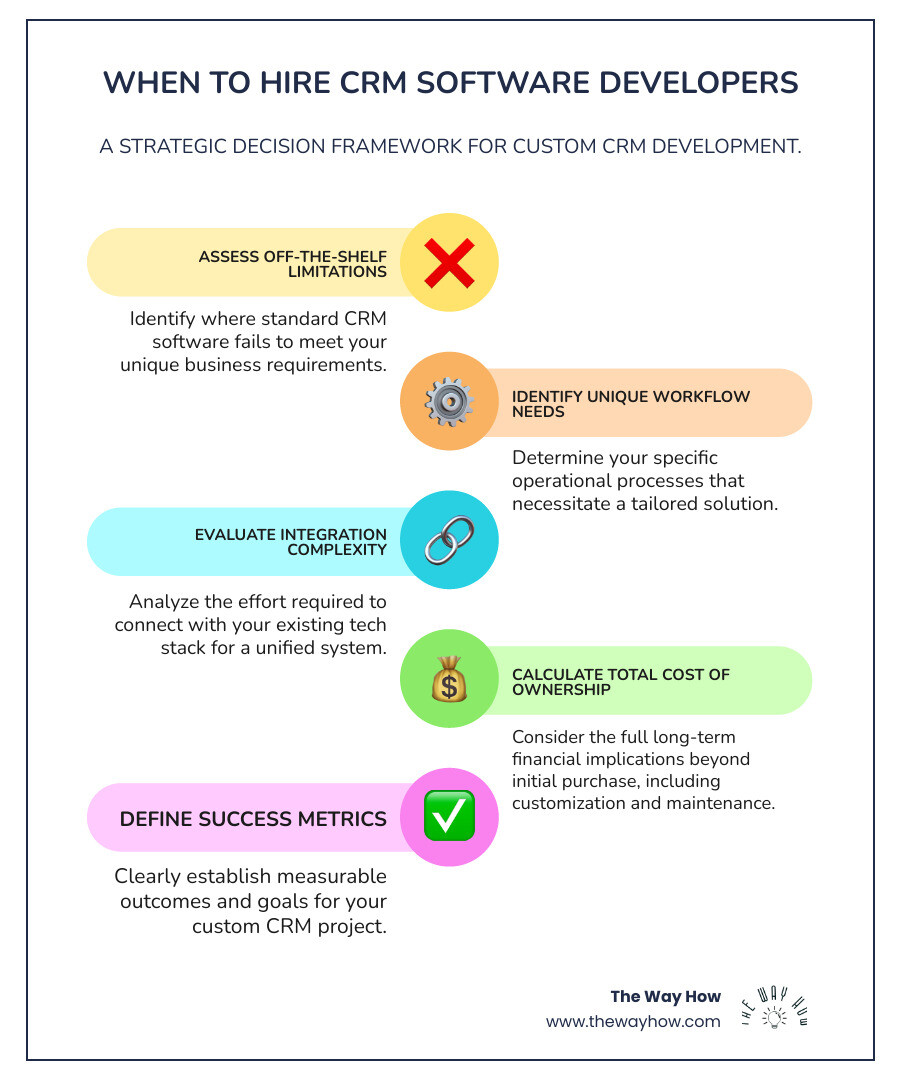
Why and When to Hire CRM Software Developers
Off-the-shelf software often hits a wall when your business has unique workflows, complex integration needs, or specific compliance requirements. This is the point where the conversation shifts from “buying” a CRM to “building” one. Hiring CRM software developers allows us to create a solution custom precisely to your business processes, rather than forcing your processes to fit the software.

We understand that every business believes its workflows are unique. And often, they are! While pre-built CRMs offer a quick start, they can become a straitjacket if they don’t align with your deeply ingrained operational rhythms and customer journey. When you find yourself constantly trying to adapt your business to the software, it’s a clear signal that custom development is needed.
Custom development is particularly crucial when:
- Unique Workflows: Your sales, marketing, or service processes are highly specialized and can’t be adequately supported by generic CRM features.
- Complex System Integration: You need your CRM to talk seamlessly with a multitude of existing systems (ERP, accounting, proprietary tools) that off-the-shelf solutions struggle to connect with.
- Specific Compliance Requirements: Your industry has stringent regulatory or data privacy demands that require tailor-made solutions.
- Scalability for Growth: You foresee rapid expansion and need a system that can evolve and scale with your business without constant workarounds or limitations.
Services Offered by CRM Development Companies
When engaging with CRM software developers, you’re not just getting code; you’re gaining a partner who can provide a comprehensive suite of services to ensure your CRM is a true asset.
- Custom Software Development: This is the bread and butter. Developers build a CRM from the ground up, or heavily customize an existing open-source platform like EspoCRM, to perfectly match your unique business logic, workflows, and user interfaces. Companies like Vention and Euvic specialize in building AI-driven CRM platforms from scratch or tailoring existing solutions.
- CRM Implementation and Integration: Beyond just building, developers manage the entire implementation process, including data migration from legacy systems and seamless integration with your existing tech stack. This includes connecting with ERP, marketing automation, customer service platforms, and data analytics tools. Salesforce’s MuleSoft, for example, is a unified platform for connecting systems, data, and AI models.
- Cloud-Based Solutions: Many modern CRMs are cloud-native, offering flexibility, remote access, and lower infrastructure costs. Developers can build or migrate your CRM to robust cloud environments like AWS, Azure, or Google Cloud, ensuring scalability and accessibility.
- AI & Automation Integration: This is where the magic happens. Developers integrate AI and machine learning capabilities for predictive analytics, automated lead scoring, sentiment tracking, and intelligent task automation. This transforms your CRM from a data repository into a proactive intelligence hub.
- Legacy System Modernization: If you’re working with an outdated CRM, developers can help transition your business to AI-improved platforms, improving performance, security, and usability. This often involves re-engineering components or migrating data to a more modern architecture.
- Ongoing Support & Optimization: A great development partner doesn’t just deliver and disappear. They provide continuous monitoring, security updates, performance improvements, and iterative development to ensure your CRM remains efficient, secure, and aligned with your evolving business needs. This long-term partnership is crucial for maximizing ROI. For deeper insight into connecting your various platforms, consider our expertise in CRM Integrations.
What Sets Great CRM Software Developers Apart
The market is flooded with development firms, but distinguishing the truly great CRM software developers requires looking beyond technical prowess. We seek partners who share our psychology-first approach.
- Strategic Mindset: A great developer doesn’t just take orders. They seek to understand your business goals, your customer’s journey, and the human behavior driving decisions before writing a single line of code. They act as a Fractional Marketing Director Guide, challenging assumptions and ensuring the technology serves a clear strategic purpose. They diagnose the “why” behind your current challenges.
- Industry Expertise: Understanding the nuances of your specific sector is critical. Developers with experience in your industry comprehend its unique challenges, regulatory landscape, and compliance needs, allowing them to build a solution that’s not just functional, but also compliant and effective. Companies like ScienceSoft and CleverDev Software boast decades of experience across diverse industries.
- User-Centric Design: The most powerful CRM is useless if your team refuses to adopt it. Great CRM software developers prioritize intuitive interfaces that simplify navigation, streamline workflows, and reduce onboarding time. They design systems that people want to use, because they remove friction and improve daily tasks, rather than adding complexity.
- Seamless Integration Capabilities: Your CRM won’t live in a vacuum. Top-tier developers are experts at connecting your CRM with other critical systems like ERPs, marketing automation tools (e.g., HubSpot, Marketo, Pardot), and financial software. They understand API-first development and leverage robust integration platforms to create a unified, harmonious tech ecosystem.
Overcoming Common CRM Implementation Challenges
Implementing a new CRM, especially a custom one, isn’t without its problems. But with the right CRM software developers, these challenges can be transformed into opportunities for greater efficiency and clarity.
- Low User Adoption: This is perhaps the most common failure point. A developer focused on user experience and behavioral psychology can create an intuitive system that reduces training time and encourages use. They design for the human on the other side of the screen, anticipating friction points and building in ease of use. This aligns with our focus on identifying certainty gaps in the customer journey and designing systems that create trust.
- Complex Data Migration: Moving data from old systems is a minefield. Experienced CRM software developers ensure a smooth transition of data without loss or corruption, maintaining data integrity and historical context. They plan carefully, understanding the structure of your existing data (e.g., Workspace, Company, Deal records) and how it needs to map to the new system.
- Poor Integration: A fragmented tech stack leads to data silos and manual workarounds. The right partner builds a robust API strategy and uses platforms like Salesforce’s MuleSoft or EspoCRM’s REST API and Webhooks to create a truly unified tech stack. This ensures all your systems “talk” to each other, providing a single source of truth and automating data flow.
- Scope Creep: Projects can quickly balloon if not managed effectively. A strategic partner helps you define and stick to a clear project scope, avoiding unnecessary costs and delays. They work with you to prioritize features based on strategic impact, ensuring that every development effort contributes to a defined business outcome. For a deeper dive into ensuring your CRM strategy translates into effective action, review our guide on HubSpot CRM Implementation.
The Modern CRM: AI, Data, and Seamless Integrations
Today’s CRMs are intelligent ecosystems, not static databases. The most significant trends—Artificial Intelligence (AI), cloud computing, and API-first architecture—are empowering businesses to move from reactive data entry to proactive, predictive engagement. CRM software developers are at the forefront of implementing these technologies to create smarter, more connected systems.
The evolution of CRM is less about simply tracking customer interactions and more about understanding and anticipating them. This shift is powered by cutting-edge technologies that transform raw data into actionable intelligence.
The Role of AI in Modern CRM Software
AI is not just a buzzword in CRM; it’s a transformative force. It allows us to move beyond basic automation to intelligent, predictive, and personalized customer engagement.
- Predictive Insights: AI algorithms analyze vast amounts of customer data (from social media, email, website behavior, purchase history) to forecast future trends, identify at-risk customers, and score leads. This means we can predict customer behavior and preferences, allowing for proactive interventions and personalized outreach. SugarCRM, for instance, leverages domain-specific AI to identify hidden opportunities and flag at-risk deals.
- Intelligent Automation: AI automates repetitive tasks like data entry, lead routing, and follow-up scheduling, freeing up your team for high-value work that requires human empathy and strategic thinking. This minimizes time spent on mundane tasks, allowing your team to focus on building relationships.
- Personalization at Scale: AI enables hyper-personalized marketing and sales communication based on individual customer data and preferences. Imagine a system that knows exactly what a customer needs before they even ask, delivering custom content and offers.
- Conversational AI: Chatbots and virtual assistants provide instant support, answer common queries, and even qualify leads 24/7. This improves response times and ensures potential customers are engaged even outside business hours. Zoho CRM, for example, allows configuring an MCP server to enable AI agents for autonomous end-to-end task execution.
Facilitating Integrations with Other Business Systems
A custom CRM’s power is magnified when it connects to your entire tech stack. CRM software developers use REST APIs and integration platforms to create a single source of truth, eliminating data silos and streamlining operations.
- ERP Integration: Integrating your CRM with Enterprise Resource Planning (ERP) systems syncs financial, inventory, and operational data with customer profiles. This provides a holistic view of the customer, from their initial inquiry to order fulfillment and billing.
- Marketing Automation Integration: Connecting your CRM with platforms like HubSpot, Marketo, or Pardot ensures seamless lead nurturing, campaign management, and customer segmentation. This allows marketing and sales teams to work in harmony, optimizing the customer journey.
- E-commerce Integration: Unifying customer order history and shopping behavior from e-commerce platforms directly into the CRM provides valuable insights for personalized marketing, upselling, and cross-selling.
- App Ecosystems: A robust integration marketplace, like Salesforce’s AppExchange, or open APIs offered by platforms like EspoCRM and Zoho CRM, extends CRM functionality and value. These allow developers to build custom integrations or leverage pre-built connectors to third-party applications, telephony providers, and more. For an in-depth look at how we leverage analytics to drive business decisions, explore our insights on CRM Analytics.
How to Choose the Right CRM Development Partner
Selecting a development partner is the most critical decision in your custom CRM journey. The right partner is more than a vendor; they are a strategic guide who can translate your business needs into a functional, scalable, and valuable asset. We believe this choice is about finding someone who understands your deepest uncertainties and can help you build certainty.
A Step-by-Step Guide to Choosing Your Partner
- Define Your “Why”: Before you look for developers, clarify your business objectives. What broken process are you trying to fix? What specific outcomes do you need? This isn’t about listing features; it’s about identifying the behavioral shifts and clarity gaps you want to address. If you’re struggling with this, engaging a Hiring a Fractional CMO Guide can help clarify your strategic direction.
- Research and Shortlist: Look for companies with proven experience in your industry and a portfolio of successful custom CRM projects. Examine their case studies to see if they’ve tackled similar challenges to yours and delivered measurable results. Look for evidence of a psychology-first approach, where they prioritize understanding human behavior.
- Evaluate Their Process: During consultations, ask about their findy and development process. Do they prioritize understanding your business strategy and customer journey? Do they ask probing questions about your team’s decision-making and pain points? A great partner will invest heavily in understanding your problem before proposing a solution.
- Understand Pricing Models: Discuss whether a fixed-price, time-and-materials, or retainer model is best for your project. Be wary of quotes that seem too good to be true; quality custom development is an investment, not a bargain. Ensure transparency in their cost structures.
- Check for Ongoing Support: A great partner doesn’t disappear after launch. Ensure they offer ongoing support, maintenance, and optimization services. Your business will evolve, and your CRM needs to evolve with it. This long-term partnership ensures your investment continues to pay dividends.
Key Questions to Ask Potential Developers
When you’re interviewing potential CRM software developers, don’t just focus on their technical stack. Ask questions that reveal their strategic depth and alignment with your business philosophy.
- How do you ensure the final product will align with our business goals? This question probes their strategic thinking. Look for answers that detail a findy process, stakeholder interviews, and a clear understanding of your desired outcomes, not just feature lists.
- Can you show us a case study of a similar project you’ve completed? Specific examples demonstrate their experience and ability to deliver. Pay attention to how they describe solving client problems and the results achieved, particularly in terms of user adoption and process improvement.
- How do you handle project management and communication? Clear communication is paramount. Understand their methodologies (e.g., Agile, Scrum), how often you’ll receive updates, and who your primary point of contact will be. This ensures transparency and reduces uncertainty.
- What is your process for ensuring user adoption after launch? This is a critical question for us. It reveals their understanding of human behavior and change management. Do they offer training, intuitive UI design, or post-launch support to help your team accept the new system?
- How do you approach security and data protection? Given the sensitive nature of customer data, their security protocols are non-negotiable. Ask about compliance (e.g., GDPR, HIPAA), encryption, access controls, and their track record in safeguarding information.
The Future of CRM and Its Impact on Business
The evolution of CRM is moving toward a future of hyper-personalization and autonomous systems. The CRM will become the central nervous system of the enterprise, where AI agents not only provide insights but also execute complex tasks across sales, marketing, and service. Businesses that invest in a flexible, custom-built CRM foundation today will be best positioned to adapt and thrive in this new landscape.
We envision a future where CRM systems are not just reactive tools, but proactive partners in growth.
- Hyper-personalization: The future CRM will deliver truly individualized experiences at every touchpoint, anticipating needs and preferences with uncanny accuracy. This moves beyond segmentation to a one-to-one relationship at scale.
- Agentic AI: This is perhaps the most exciting frontier. AI agents won’t just analyze data; they’ll autonomously perform end-to-end tasks, automating repetitive manual steps across hundreds of services. Imagine an AI agent qualifying leads, scheduling meetings, or even drafting personalized follow-up emails, all based on real-time data and learned patterns.
- Omnichannel Experience: Customers expect seamless transitions between channels. Future CRMs will orchestrate a truly unified customer experience across web, mobile, social, and in-person interactions, ensuring context is always maintained.
- Proactive Engagement: Rather than waiting for customer inquiries, the CRM will identify potential issues or opportunities and initiate engagement proactively. This shift from reactive to proactive service and sales will redefine customer relationships.
This future isn’t far off. Platforms like Salesforce are already incorporating conversational AI and agentic capabilities, while Zoho CRM offers tools to transform its platform into an agent-executable system. The businesses that accept these advancements with a flexible, custom-built CRM will be better equipped to foster deeper customer relationships and drive sustainable Business Growth. For a comprehensive understanding of how to prepare your business for these strategic shifts, we invite you to learn more about our approach to CRM strategy and implementation.
Conclusion
Building a custom CRM is a strategic investment in the future of your customer relationships. It’s an opportunity to break free from rigid software and design a system that truly supports your team and delights your customers. Success begins not with code, but with clarity—a deep understanding of your business processes and the human behavior that drives them.
By partnering with a guide who prioritizes strategy before execution, you can build more than just software; you can build a predictable engine for growth. The Way How helps businesses design revenue systems rooted in behavioral insight and operational clarity. If you’re ready to build a CRM that creates momentum and certainty, explore how our strategic services can help you craft the perfect solution.
 Jeremy Wayne Howell : Jul 22, 2026 9:48:31 PM