A Complete Guide to CRM Systems and Database Management
 Jeremy Wayne Howell : Jul 22, 2026 9:48:31 PM
8 min read

CRM for real estate developers is specialized software designed to manage the entire lifecycle of property development projects—from land acquisition and construction to sales and after-sales support. Unlike CRMs for individual agents, these systems are built for complex inventories (developments, buildings, units), long sales cycles, and intricate payment milestones.
| CRM Platform | Best For | Key Strength |
|---|---|---|
| Zoho-based CRMs | Customization and scalability | Highly adaptable with industry-specific modules |
| Propertybase (Salesforce) | Enterprise-grade operations | Robust reporting and integration capabilities |
| Unlatch | New-build and off-plan sales | Purpose-built simplicity with AI lead tools |
| HubSpot | Marketing-driven developers | Powerful inbound marketing and automation |
If you’re managing development projects, you know the chaos. Your sales data is in one system, property inventory in another, and contracts in a third. This disconnection creates hidden costs: time wasted on manual updates, revenue lost from leads who slip through the cracks, and team morale eroded by friction-filled processes.
The real estate development business is fundamentally different from traditional sales. You’re orchestrating complex, multi-year projects with evolving inventory and staged payments. This complexity demands more than a generic CRM; it requires a system that understands your specific workflow and removes uncertainty for your team and your buyers.
Most developers realize this after trying to force-fit an agent-focused CRM into their operations. The cost isn’t just on a balance sheet; it’s in missed opportunities and a nagging sense that your business is more chaotic than it should be. The right CRM doesn’t just organize data. It creates clarity, changing your business from a collection of moving parts into a predictable system.
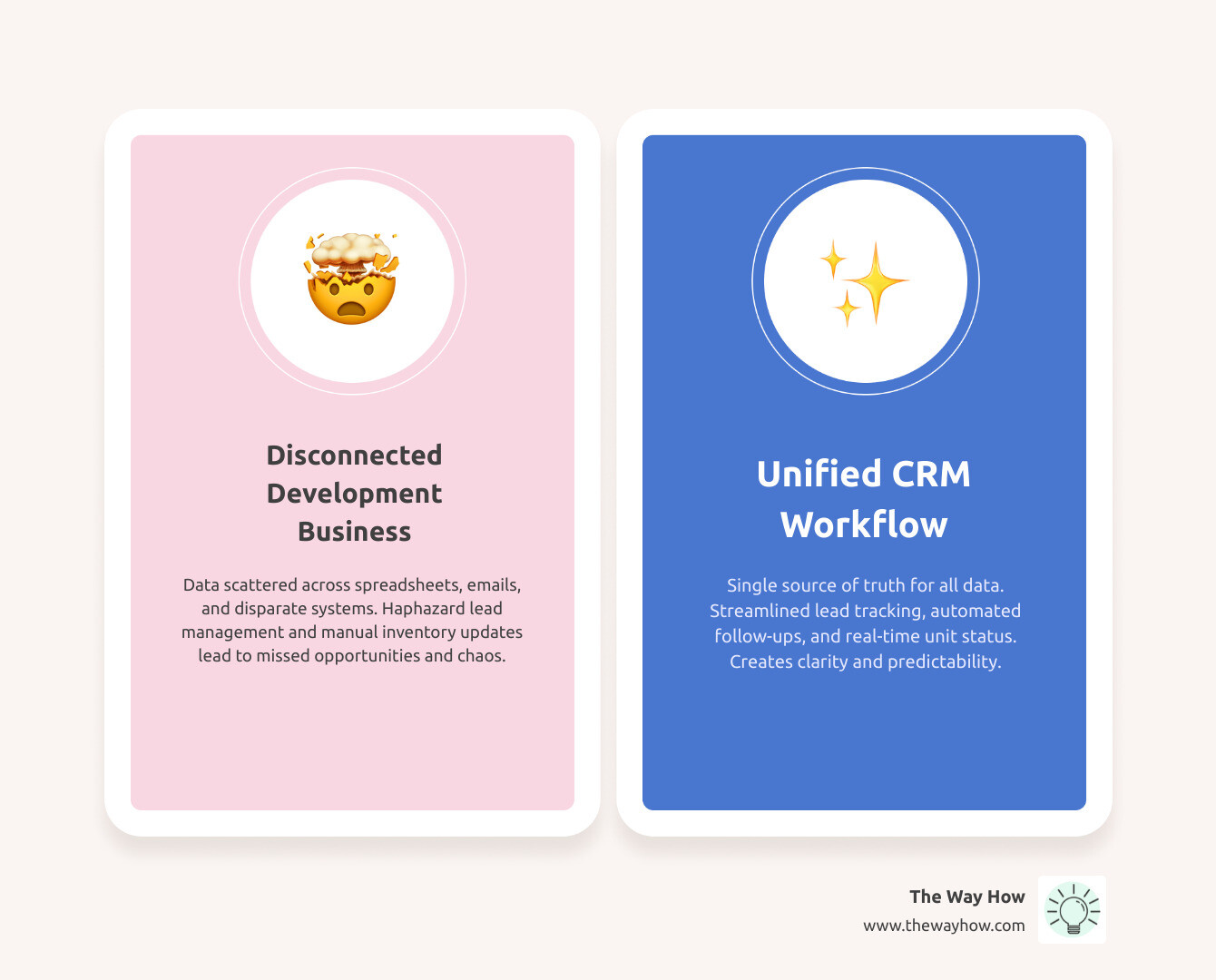
A specialized CRM for real estate developers addresses the core challenges that stem from this complexity:
A CRM built for developers moves your business from chaos to clarity. It’s a hub for managing relationships, properties, and deals, turning your sales and marketing into a predictable growth engine.
This section explains how a specialized CRM moves beyond simple contact management to become the central nervous system for a development project, creating clarity from the ground up.
For developers, managing properties means overseeing an ecosystem of developments, buildings, and units. A robust CRM for real estate developers is built to handle this hierarchy. It provides dedicated modules to structure your inventory, tracking individual units from a granular level. This allows your team to see real-time unit availability—available, reserved, or sold—at a glance, eliminating manual spreadsheet updates and embarrassing double-bookings. Advanced CRMs even offer visual stacking plans for an intuitive overview. By centralizing all property data like floor plans, pricing, and photos, the CRM becomes the single source of truth, empowering your team with accurate information.

The development sales cycle is a marathon of nurturing leads, managing offers, and navigating complex contracts. A specialized CRM for real estate developers brings predictability to this journey.
Here’s how it creates certainty:
By centralizing these critical components, a CRM builds trust and momentum, guiding buyers confidently from blueprint to ownership.
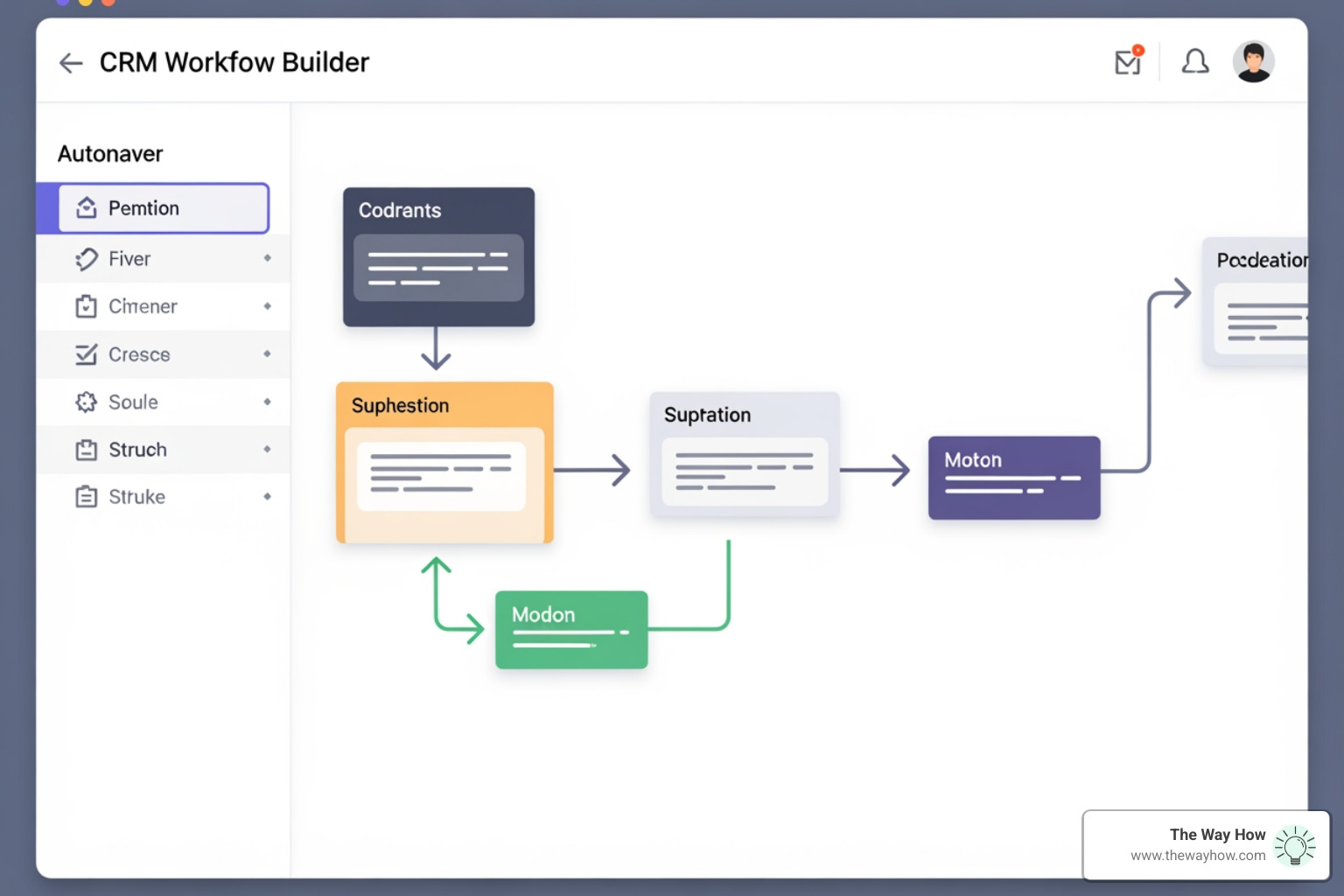
Your team’s time should be spent building relationships and closing deals, not on repetitive administrative tasks. Workflow automation within a crm for real estate developers is the key to reclaiming those valuable hours.
Automation allows you to reduce mundane jobs like data entry and status updates. Instead of drafting emails from scratch, your team can use pre-composed, personalized templates for every stage of the sales cycle. The system can also be configured to send trigger-based alerts, such as assigning a follow-up task to an agent when a lead shows interest in a specific unit. By embedding industry-standard workflows directly into the CRM, you ensure consistency and compliance across all projects. Our experience with HubSpot Marketing Automation confirms how crucial these automated sequences are for nurturing leads effectively. This strategic reallocation of time empowers your team to focus on high-value activities, boosting productivity and profitability.
Different CRMs are built on different philosophies. Understanding how top contenders align with the specific needs of a real estate developer is key to choosing a system that truly fits your business.
Many specialized crm for real estate developers are built on Zoho’s robust and flexible platform. This approach combines the stability of a global CRM with deep customization for the development industry. Because Zoho is highly adaptable, it allows you to mold the CRM to your unique business processes rather than forcing your operations into a rigid system. These solutions often come with pre-configured modules for developments, buildings, and units, and can scale with your business. For those seeking a truly unified ecosystem, Zoho One offers an entire suite of integrated business apps. For more details, you can find More info about Zoho integrations.
Built on the Salesforce platform, Propertybase is a crm for real estate developers designed for the scale and complexity of large firms. Leveraging Salesforce provides an incredibly stable, secure, and scalable foundation trusted by global businesses. It’s ideal for developers managing multiple concurrent projects or diverse asset classes. The platform’s powerful reporting engine delivers deep insights for data-driven decision-making, and its extensive integration capabilities ensure seamless data flow across your tech stack. If your business demands sophisticated client management and comprehensive reporting, you can Choose Propertybase.
Unlatch offers a focused approach as a purpose-built crm for real estate developers specializing in new-build and off-plan sales. Its philosophy centers on simplicity and user adoption, aiming to be a tool your team will actually use. Designed from the ground up for developers, it features a clean interface, a multi-publish function to post ads across partner sites, and AI tools for lead recommendations. A visual sales pipeline and granular user permissions provide clarity and control over the sales process. For developers focused on an efficient new-build sales workflow, you can Request a demo of Unlatch.
While not exclusively for developers, HubSpot’s powerful platform is highly advantageous for companies with a strong focus on inbound marketing. HubSpot excels at HubSpot Lead Generation, helping you attract and capture leads through landing pages, forms, and other digital channels. Its marketing automation is perfect for nurturing leads over long sales cycles. With custom objects, the CRM can be configured to manage developments, buildings, and units. For developers who use Content Marketing HubSpot to educate buyers, the platform provides an all-in-one solution that integrates sales, marketing, and service, offering a holistic view of every client interaction.
Selecting a CRM isn’t about finding the one with the most features; it’s about diagnosing your unique operational gaps and choosing the system that brings the most certainty to your team and your buyers. We approach this as a strategic investment in predictable growth.
Before looking at software, we must understand your business. This diagnostic phase ensures the CRM you choose solves your actual problems.
The goal is to find a system that works for your business process and terminology, not the other way around.
Once we understand your needs, we can identify the non-negotiable features that address the unique complexities of real estate development.
A CRM is useless if it’s a silo or if your team won’t use it. These practical considerations are critical for success.
The core difference lies in complexity and scale. A CRM for agents is built for individual transactions and client management. A crm for real estate developers, however, is a project-centric system designed to manage an entire development lifecycle.
It must handle a complex inventory hierarchy (developments, buildings, units), track long sales cycles with staged payments, and manage relationships with a wider range of stakeholders, including investors and contractors. As research notes, it’s a hub for managing “relationships, properties, and deals,” which is far more complex than a standard agent’s pipeline.
A developer’s relationship with a buyer extends long after the sale. A CRM is crucial for managing this long-term connection to drive referrals and repeat business. It centralizes all client communication and documentation, creating a single source of truth for after-sales support.
For post-handover issues, the CRM can integrate with a HubSpot Ticketing system to manage service requests efficiently. You can also automate check-in messages, anniversary greetings, and feedback requests to nurture the relationship without constant manual effort. This transforms one-time buyers into long-term advocates for your brand.
AI and analytics transform a CRM from a passive data repository into a proactive, strategic tool. Their role is to extract intelligence from your data to help you make smarter, faster decisions.
By leveraging AI, your CRM becomes a partner that helps you anticipate buyer needs, optimize strategies, and reduce uncertainty in your business.
A CRM is a critical piece of the puzzle, but it’s not the whole picture. It provides the structure, but a true growth engine is built on a deep understanding of your buyer’s psychology and a strategy that creates certainty at every step. By diagnosing your system’s core challenges before prescribing a tool, you can turn your development projects into a predictable and scalable business. We, at The Way How, specialize in building these psychology-first revenue systems, ensuring that your CRM isn’t just a tool, but a cornerstone of your sustained success.
 Jeremy Wayne Howell : Jul 22, 2026 9:48:31 PM
 Jeremy Wayne Howell : Jul 21, 2026 9:47:10 PM
 Jeremy Wayne Howell : Jul 20, 2026 9:46:47 PM