A Complete Guide to CRM Systems and Database Management
 Jeremy Wayne Howell : Jul 22, 2026 9:48:31 PM
12 min read

Inbound marketing web design is not about making your website look modern. It’s about building a system that attracts the right visitors, answers their questions before they ask, and guides them toward a buying decision—all without a single sales call.
What is inbound marketing web design?
Here’s what most B2B companies get wrong: they treat their website like a billboard. It exists to display information about who they are, what they do, and why they’re great.
But your buyers don’t care about your story—not yet. They care about their own problems. And they’re solving those problems online, right now, with or without you.
According to research, 70% of the buyer’s journey is completed before someone ever talks to a salesperson. That means by the time a prospect reaches out, they’ve already decided if you’re credible, relevant, and worth their time.
Your website is where that decision happens.
If it doesn’t answer their questions, reduce their anxiety, or guide them forward, they’ll move on. And they won’t come back.
The difference between a website that generates leads and one that collects dust isn’t design trends or clever copy. It’s psychology. It’s understanding what your buyer needs to feel, know, and believe at each stage of their journey—and building a system that delivers it.
That’s what inbound marketing web design is really about. Not aesthetics. Not tactics. Certainty.
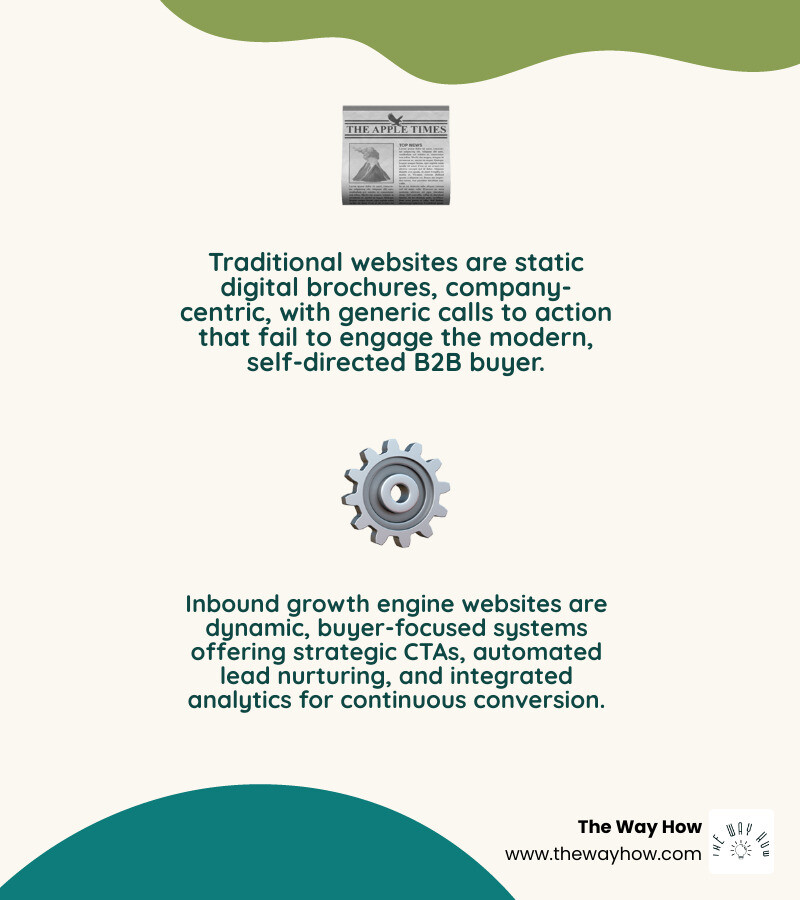
Many B2B businesses, despite having what appears to be a “modern” website, find their growth stalled. Why? Because the very foundation of how B2B buyers operate has shifted dramatically. Our research shows that 63% of shopping journeys start online, whether buyers are searching for a specific product or just gathering information. The internet has become the first port of call for almost any purchase, and B2B buyers are no exception.
This means your website isn’t just a digital storefront; it’s often the first, and most crucial, salesperson your prospects encounter. If it’s still operating as a digital brochure—a static repository of company information—it’s failing to meet the demands of today’s discerning B2B buyer. We’ve found that traditional B2B sales and marketing techniques are becoming obsolete because they don’t cater to the self-directed, research-heavy nature of modern buying.
The old, linear sales funnel—where a prospect moves neatly from awareness to consideration to decision—is largely a myth in the B2B world. B2B purchase journeys are generally long and complex, often described as a “maze-like” process. Buyers return to a potential vendor’s site six or seven times before they arrive at a purchase decision. This isn’t a straight line; it’s a looping, iterative process.
Moreover, B2B purchasing decisions rarely fall on a single individual. Studies indicate that 6 to 10 other people are normally involved in a purchase decision. This means your website isn’t just speaking to one persona; it’s speaking to an entire committee, each with their own questions, concerns, and needs for validation. They are constantly seeking information to justify their preferences to their peers.
The challenge for us, then, is to design a website that anticipates these loops, provides constant validation, and addresses the varied needs of multiple stakeholders. It’s about designing for buyer empowerment, where they expect to find answers and build confidence on their own terms.
If your sales team isn’t actively using your website to answer common prospect questions, then your website isn’t truly integrated into your sales process. Many websites are company-centric, broadcasting “we do this” or “we are great.” But buyers are looking for solutions to their problems. They are asking, “What’s in it for me?”
When your website doesn’t answer the most common questions potential buyers have and instill enough trust to get them to purchase, what is it actually doing? It’s creating certainty gaps. We believe that your website is a sales tool, not just a marketing tool. It should be designed to shorten your sales cycle and increase your close rate right away. This means addressing questions like “How much does it cost?” “What problems does it solve?” “How does it compare to alternatives?” and “What do others say about it?”—the “Big 5” topics that every buyer has on their mind.
A misaligned digital experience—one that doesn’t anticipate these questions or guide the buyer—can stall growth. It leaves buyers searching for answers elsewhere, creating friction and uncertainty where there should be clarity and momentum.

At The Way How, we recognize that effective inbound marketing web design is fundamentally about applied psychology. It’s about understanding human behavior, empathy, and decision-making to build trust and drive predictable revenue. We aim to create empathy at scale, reducing the cognitive load on our visitors and removing perceived risks. This builds authority and fosters a sense of reciprocity, where by providing value, we earn trust.
As Jennifer Shore from SmartBug Media articulated, an inbound-optimized website is centered around providing value to narrowly defined personas. This means every element, from navigation to content, is crafted to resonate deeply with the psychological needs of our ideal buyer.
Uncertainty is a growth killer. Our goal is to eliminate it from the buyer’s journey on your website. This starts with intuitive navigation and an exceptional user experience (UX). Users expect to find answers quickly; more than half of them expect a website to load in three seconds or less. If they can’t, they’ll leave.
We prioritize clear pathways that guide visitors effortlessly. This includes:
B2B buyers are inherently cautious. Their purchasing decisions often involve significant investments and affect their entire company. In this context, trust is the only currency that matters. This is where social proof becomes indispensable.
Social proof acts as a powerful form of risk reversal, alleviating buyer anxiety. We integrate:
When a brand talks about itself, it’s often taken with a grain of salt. Social proof provides external validation, reassuring potential customers that your claims are backed by real-world success. It helps answer the critical question: “Can I trust these people to solve my problem?”
Our approach is to guide, not to sell aggressively. We aim to make our website the ultimate resource for our buyers, helping them solve their problems, even if it means giving away “the crown jewels” of our expertise. The value of attracting leads and establishing thought leadership far outweighs the risk of competitors benefiting from our information.
This philosophy aligns perfectly with the StoryBrand framework, where the customer is positioned as the hero of their own story, and your brand acts as the trusted guide. This means:
By guiding our buyers through their journey, we build trust and momentum, creating an environment where they feel empowered to make informed decisions.
At the heart of effective inbound marketing web design is a systematic approach that aligns with the inbound methodology: Attract, Engage, and Delight. This isn’t just a marketing funnel; it’s a continuous loop designed to build trust, foster relationships, and generate predictable revenue. Your website becomes the central hub for this entire process, orchestrating content, lead generation, and nurturing efforts seamlessly.
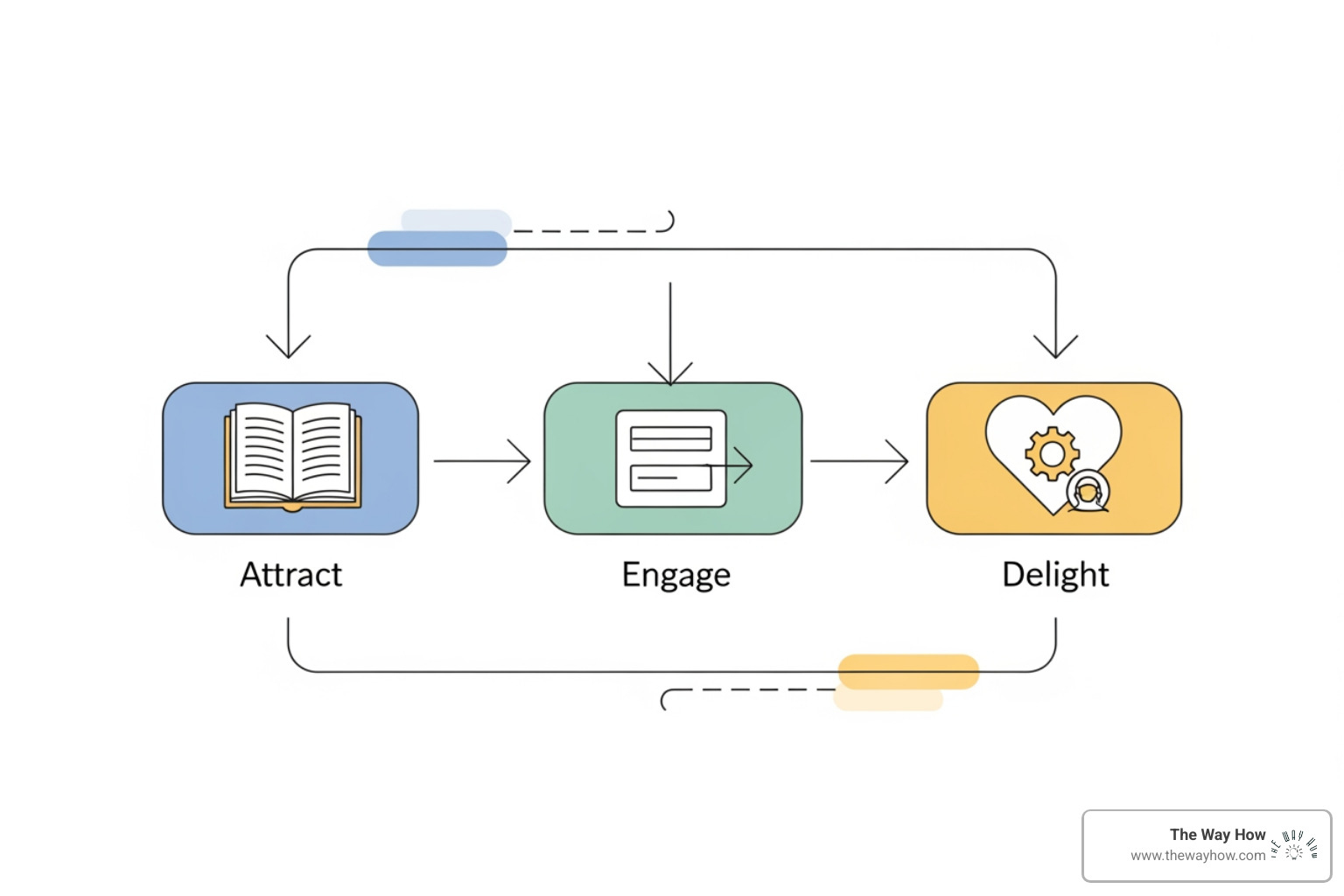
The Attract stage is all about drawing the right audience to your website. We achieve this by anticipating and answering their unspoken questions, which is where SEO becomes an act of empathy. It’s about showing up where they’re already looking for solutions.
Our content strategy revolves around:
Once visitors are on your site, the Engage stage is about nurturing their interest and guiding them toward becoming qualified leads. This involves providing valuable resources and clear opportunities for interaction.
Key elements for engagement include:
The Delight stage focuses on ensuring customer satisfaction and turning happy clients into brand advocates. Your website continues to play a vital role here, reinforcing their decision and providing ongoing value.
Strategies for delight include:
The most brilliant strategy and compelling content can be undermined by a frustrating user experience. In the digital field, friction is the enemy of trust and momentum. Our psychology-first approach means we obsess over removing these unseen barriers, treating technical excellence as a fundamental form of trust-building. We know that modern buyers and website visitors are impatient, and their time and attention are precious.
Users are incredibly impatient. A study shows more than half of users expect a website to load in three seconds or less. If your website doesn’t load quickly, it doesn’t matter how great your content is; they will leave. In fact, a one-second delay in page load time can result in a 7% reduction in conversions. This isn’t just an SEO factor; it’s a direct reflection of respect for your visitor’s time.
We prioritize site speed optimization through:
We regularly use tools like Google’s PageSpeed Insights and webpagetest.org to monitor and improve site performance, aiming for load times as close to or below five seconds.
The world lives on mobile. As of February 2019, mobile devices accounted for 47.96% of internet traffic. We are well past the point where mobile is an afterthought; it’s the primary way many users interact with the internet. Google has adopted a mobile-first mentality, and so should we.
Our inbound marketing web design is inherently mobile-first, ensuring a seamless experience regardless of the device. This means:
A website that performs flawlessly across all devices not only improves user experience but also boosts search engine rankings, as Google favors responsive sites.
Our work doesn’t stop at launch; it evolves. We believe in data-driven iteration, constantly refining our inbound marketing web design based on how real users interact with the site. This removes guesswork and ensures continuous improvement in trust-building and lead generation.
We leverage a suite of analytics tools:
By constantly listening to user behavior through these metrics, we can identify certainty gaps, make targeted improvements, and ensure our websites are always evolving to meet the psychological needs of our buyers, driving momentum and predictable revenue.
A traditional site acts as a digital brochure, broadcasting information about the company. It’s often static, company-centric, and features generic calls-to-action. An inbound site, on the other hand, is a dynamic system designed to attract specific visitors, answer their questions, build trust, and guide them through their decision-making process. It effectively acts as your best 24/7 salesperson, offering value at every stage of the buyer’s journey and converting visitors into leads through strategic design and content.
Design directly impacts lead generation by building trust, reducing friction, and providing clear pathways to conversion. Elements like intuitive navigation, fast load times, mobile responsiveness, and compelling calls-to-action make it easier for a visitor to find what they’re looking for and take the next step. A design rooted in buyer psychology addresses a prospect’s anxieties, making them feel safe and understood, increasing their likelihood of engaging with content offers and becoming a lead. When the user experience is seamless and purposeful, conversion rates naturally improve.
Yes, absolutely. While a full redesign can be a powerful tool for change, you can absolutely begin applying inbound principles to your existing website today. We recommend starting by auditing your existing content to see if it answers key buyer questions. Then, optimize your highest-traffic pages with clearer, more relevant calls-to-action. Create a single, high-value landing page for a compelling content offer (like an eBook or checklist). Ensure your site is mobile-friendly, as this is crucial for user experience and SEO. Iterative improvements, guided by analytics, can yield significant results and lay the groundwork for a more comprehensive inbound strategy.
We’ve explored how inbound marketing web design is far more than just aesthetics—it’s a psychology-first approach to building trust, removing uncertainty, and generating predictable revenue. Your website, when designed with inbound principles, transforms from a static cost center into a dynamic growth engine.
This requires a fundamental mindset shift: from talking about ourselves to empathizing with our buyers, from pushing products to guiding solutions, and from chasing tactics to designing systems for certainty. By focusing on human behavior, clarity, and continuous improvement, we can create websites that not only attract but also engage and delight, building momentum in every stage of the customer journey.
At The Way How, we specialize in helping founders and leadership teams achieve this change. We diagnose why growth is stalled, identify certainty gaps in your customer journey, and design systems that create trust, momentum, and predictable revenue.
Learn how our services can transform your website into a growth system
 Jeremy Wayne Howell : Jul 22, 2026 9:48:31 PM
 Jeremy Wayne Howell : Jul 21, 2026 9:47:10 PM
 Jeremy Wayne Howell : Jul 20, 2026 9:46:47 PM