A Complete Guide to CRM Systems and Database Management
 Jeremy Wayne Howell : Jul 22, 2026 9:48:31 PM
9 min read

Endowment effect marketing leverages a simple psychological truth: people value things more once they feel ownership. This cognitive bias explains why customers hesitate to cancel free trials, why sellers demand higher prices than buyers will pay, and why a personalized product feels more valuable than an identical generic one.
Quick Answer: How to Leverage the Endowment Effect in Marketing
Imagine you just upgraded your laptop. When selling your old one, you list it for $900 because you paid $1,000 new. But buyers see a used device worth maybe $500. This gap isn’t about greed on either side—it’s the endowment effect at work.
The moment something becomes “ours,” our brains rewire its value. Sellers in experiments demand prices twice as high as what buyers will pay for identical items. In one study, people who owned a water bottle wanted £4.00 to sell it, while non-owners would only pay £1.00.
This isn’t irrational. It’s deeply human. And it’s exactly why your free trial works better than you think, why customization drives conversions, and why that “cancel anytime” promise actually increases commitment.
For founders and revenue leaders tired of tactics that don’t stick, understanding this psychological principle changes everything. You’re not looking for another growth hack. You’re looking for a system built on how people actually make decisions—one that creates genuine attachment rather than fleeting interest.
The endowment effect isn’t about manipulation. It’s about meeting customers where their psychology already lives. When someone feels ownership before they buy, the sale stops being a transaction and becomes a confirmation of something they’ve already decided.
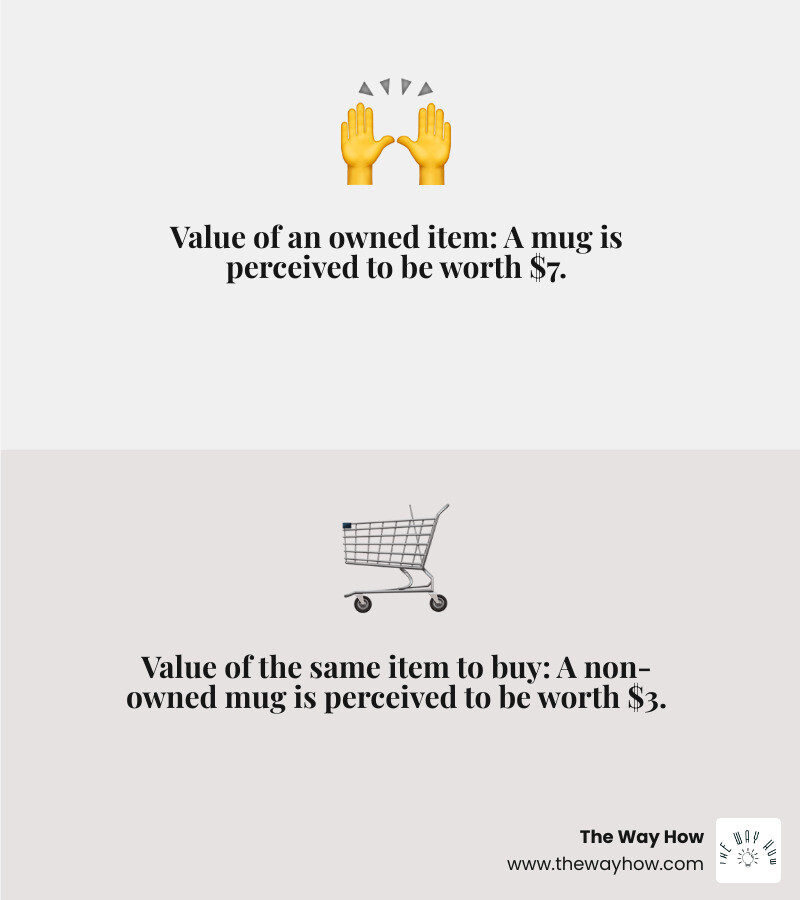
The endowment effect, often called divestiture aversion, is a hypothesis in psychology and behavioral economics stating that people ascribe more value to things merely because they own them [1] Wikipedia. This cognitive bias leads us to overvalue our possessions compared to identical items we don’t own. It’s a fundamental aspect of human decision-making that profoundly impacts consumer behavior.
Consider a simple experiment: give a group of people identical coffee mugs. Then ask some to name a price to sell their mug (Willingness to Accept, or WTA) and others to name a price to buy an identical mug (Willingness to Pay, or WTP). Consistently, the WTA is significantly higher than the WTP. In some studies, the ratio of WTA to WTP frequently exceeds two. For example, owners of a water bottle might demand £4.00 to sell it, while non-owners are only willing to pay £1.00 to acquire it. This disparity isn’t about the item’s objective market value; it’s about the subjective value we assign to it once it’s “ours.”
This effect isn’t limited to physical goods. It extends to services, subscriptions, and even ideas. When we feel we possess something, we are less willing to part with it, and we demand a higher compensation if we do. This seemingly irrational behavior is deeply rooted in our psychological makeup, driven by two powerful forces: loss aversion and psychological ownership.
At the heart of the endowment effect lies loss aversion. First described by Daniel Kahneman and Amos Tversky in their seminal work on Prospect Theory, this principle states that “we hate experiencing losses approximately twice as much as we like gains” [Kahneman and Tversky’s original study]. In simpler terms, the emotional pain of losing $50 is far more potent than the pleasure of finding $50.
When we own an item, selling it is framed as a loss. To overcome this inherent aversion to loss, we demand a premium. This is vividly illustrated in studies like the one by Carmon and Ariely, where people who won tickets for a basketball game were willing to sell them for significantly higher prices (e.g., $2,400) than what others were willing to pay (e.g., $175). The emotional attachment and the perceived loss of the experience amplified the sellers’ valuation.
For marketers, understanding this means recognizing that once a customer feels they possess something—whether it’s a product, a service, or even a discount—taking it away or asking them to give it up is met with strong resistance. Our marketing strategies must acknowledge this fundamental human tendency.

Beyond the fear of loss, the very act of possessing something, even temporarily or psychologically, inflates its perceived value. This is known as the mere ownership effect. It suggests that the moment an item becomes “mine,” its perceived worth increases in our minds.
This ownership doesn’t have to be legal or permanent. Even the idea of possession can trigger the endowment effect. For instance, a study in 2013 found that users who interact with products via touch screens develop a perception of ownership, setting them up for the endowment effect. The tactile experience, the ability to manipulate an image or customize a product, creates a psychological bond.
This psychological ownership is a powerful lever for marketers. If we can foster this feeling of “mine” early in the customer journey, we can significantly increase the perceived value of our products or services, making them harder to part with and more desirable to acquire.
The most effective endowment effect marketing doesn’t just sell a product; it transfers a sense of ownership to the customer before they’ve even paid. This is where you move from understanding theory to building a system that creates momentum and trust. We want to empower customers to internalize the value of what we offer, making them active participants in their own decision to buy.

Physical interaction is a primal way to establish ownership. That’s why car dealerships offer test drives, and Apple stores encourage customers to play with their devices. But in today’s digital-first world, we can replicate this sensation virtually.
With 90 percent of shoppers using smartphones in stores by 2016, interactive digital experiences are paramount. Allowing customers to zoom, rotate, and interact with product images, use augmented reality (AR) for virtual try-ons, or explore detailed 3D models can create a strong sense of psychological ownership. For digital products, where the endowment effect is typically weaker, intensive interaction during a free trial phase is crucial to build that emotional connection. Our goal is to help customers visualize themselves using and benefiting from the product, making it feel less like a potential purchase and more like an existing part of their lives.
The power of loss aversion means that people are more motivated to avoid losing something they perceive as theirs than to gain something new. We can leverage this by carefully framing our offers and communications.
Instead of a generic “Save up to 30%!”, consider a more possessive approach: “You can save up to 30%!” This subtle shift in language implies the discount is already theirs, and not taking advantage of it means losing out. McKinsey documented a compelling example with an Italian telco company. Initially, when customers wanted to cancel, the company offered “If you stay, we’ll give you 100 free calls.” This didn’t work well. When they changed the framing to “Your account has already been credited with 100 free calls. If you cancel, you will lose them,” retention rates significantly improved.
Similarly, when Airbnb pitched to homeowners, they didn’t just state potential earnings. They showed specific amounts, like “You could earn almost $2,600,” and then asked, “How would you use an extra $2,564?” This encourages the homeowner to imagine the money as already theirs, making the opportunity to earn it more tangible and the thought of not earning it feel like a loss. By framing benefits as already existing and belonging to the customer, we tap into their innate desire to avoid loss.
Now that we understand the psychological underpinnings, let’s explore practical strategies to implement endowment effect marketing and drive predictable growth.
Freemium models are arguably one of the most effective applications of the endowment effect. By offering a basic version of a product or service for free, companies allow users to experience ownership without upfront commitment. Over time, users invest their time, customize settings, integrate the tool into their workflow, and generate data. The product becomes “their” tool.
Consider Hotjar, which offers a free basic version. While it limits page views, it provides access to most premium features. Users can set up heatmaps, recordings, and surveys. Once they’ve invested time in setting up their accounts and collecting some data, the thought of losing access to that setup or upgrading to open up more data becomes less about a new purchase and more about retaining what they’ve already built and integrated into their operations. Google’s offer of 100GB of free storage for two years with certain computer purchases, then charging after, works on the same principle. The longer a user interacts with and personalizes the offering, the harder it becomes to give it up.
When customers actively participate in shaping a product or service, their sense of ownership skyrockets. This phenomenon, sometimes referred to as the “IKEA effect,” means that we value things more when we’ve put our own effort, choices, and personality into them.
Offering customization options—from monograms on clothing to configuring a complex software solution—allows customers to embed their identity into the product. Starbucks, for example, fosters psychological ownership not just through its inviting store designs but also by personalizing orders with customer names. This small act creates a unique connection to the product.
Beyond direct customization, involving users in brand-related processes, such as asking for feedback, allowing them to rate content, or even contributing user-generated content, can foster a deeper sense of belonging and ownership. This makes the product feel like a collaborative creation, increasing its perceived value exponentially.
A generous free trial or a flexible return policy isn’t just about reducing risk for the customer; it’s a powerful mechanism for creating temporary, yet impactful, ownership.
When a customer takes home a product for a 30-day free trial, or uses a software for an extended period, it integrates into their daily life. It becomes a part of their routine, their tools, their environment. The thought of packing it up, removing it from their workflow, or returning it suddenly feels like a tangible loss. This is why free trials significantly increase the likelihood of purchase by creating a sense of ownership. Tesla’s extended test drives operate on this principle, allowing potential buyers to experience the car as if it were already theirs.
Similarly, generous return policies encourage purchase decisions by allowing customers to “own” the product for a period, knowing they can return it if unsatisfied. The hope, from a marketing perspective, is that during this period of ownership, the endowment effect will kick in, making the customer reluctant to part with their new possession.
While endowment effect marketing offers immense potential, we must approach it with strategic foresight and an ethical compass. Understanding the subtle differences in how buyers and sellers perceive value, and ensuring our methods are persuasive rather than manipulative, is paramount for building lasting trust and predictable revenue.
The endowment effect inherently creates a valuation gap between buyers and sellers, often leading to market friction and “bad deals” that never materialize. Sellers, due to their ownership, demand a price (WTA) that is significantly higher than what buyers are willing to pay (WTP). This discrepancy is not arbitrary; it’s a direct consequence of the psychological biases at play.
In numerous studies, median selling prices are consistently higher than median buying prices across various consumer goods. For instance, in one experiment, sellers demanded £4.80 for a water bottle, while buyers were only willing to pay £2.50. Why such a difference? Because sellers are anchored to their perceived value, often closer to the market price they believe the item should cost, given its quality. Buyers, on the other hand, are primarily concerned with acquiring a “good deal” — a low price relative to the perceived quality and market value. They are often willing to pay only if they can acquire the item at a considerable discount. This means buyers are more likely to walk away from a transaction if they don’t perceive it as a favorable deal.
This disparity highlights a critical insight: buyers and sellers, while agreeing on the objective market price of an item, have vastly different ideas of what constitutes a “good deal.” Sellers focus on the value of what they possess, while buyers focus on the value they could gain relative to their investment. This gap is a primary reason why many transactions, from selling a used car to negotiating a business deal, often fall through.
At The Way How, we believe in marketing rooted in human behavior, empathy, and decision-making psychology. Leveraging cognitive biases like the endowment effect comes with a responsibility to our customers. The distinction between ethical persuasion and manipulation is crucial.
Ethical endowment effect marketing helps a customer find and appreciate the true value of a product that genuinely solves their problem. It creates a sense of ownership that reinforces a positive, value-driven decision. For example, a free trial that allows a customer to deeply integrate a beneficial software into their workflow, leading them to happily convert to a paid plan, is ethical persuasion. They’ve experienced the value, and the endowment effect simply makes it harder to give up that proven benefit.
Manipulation, however, occurs when the endowment effect is used to trick a customer into a purchase they later regret, leading to buyer’s remorse and eroding trust. This might involve obscuring costs, creating artificial scarcity, or using language that guilt-trips rather than genuinely informs. Our aim is always to build long-term relationships and predictable revenue, and that is only possible through transparency and a commitment to delivering genuine value. We diagnose why growth is stalled, identify certainty gaps in the customer journey, and design systems that create trust, momentum, and predictable revenue. This approach ensures that we’re teaching before we persuade, and diagnosing before we prescribe, fostering a relationship where customers feel empowered, not exploited.
The endowment effect is more than a marketing tactic; it’s a fundamental principle of human behavior. By understanding the psychology of ownership and loss aversion, we can move beyond guesswork and build an empathetic marketing system that creates genuine customer attachment and predictable revenue. It’s about designing a customer journey where people feel a sense of ownership at every step, changing your product from a commodity into an indispensable part of their lives.
For founders and leadership teams, this means shifting focus from merely selling features to cultivating a deep sense of psychological ownership. It means providing opportunities for interaction, personalization, and temporary possession that allow customers to experience the value firsthand. By framing choices in terms of avoiding loss and emphasizing what customers stand to gain by retaining “their” product, we build a resilient connection that transcends fleeting trends.
The Way How helps founders and leadership teams build these psychology-first systems. We diagnose the certainty gaps in your customer journey and design strategies rooted in human behavior to create trust, momentum, and a dependable growth engine.
 Jeremy Wayne Howell : Jul 22, 2026 9:48:31 PM
 Jeremy Wayne Howell : Jul 21, 2026 9:47:10 PM
 Jeremy Wayne Howell : Jul 20, 2026 9:46:47 PM