A Complete Guide to CRM Systems and Database Management
 Jeremy Wayne Howell : Jul 22, 2026 9:48:31 PM

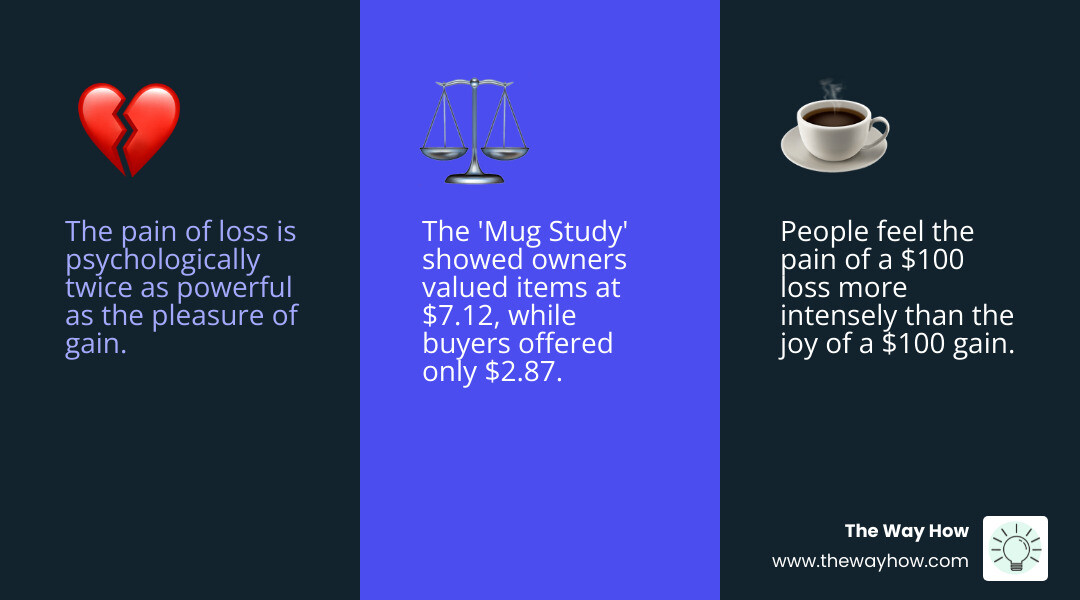
Loss aversion marketing is the practice of framing offers to emphasize what customers stand to lose by not acting, rather than what they’ll gain. It works because the pain of losing is psychologically twice as powerful as the pleasure of gaining something of equal value.
Key principles of loss aversion marketing:
Here’s the problem most founders face: you’ve built something valuable, but prospects hesitate and don’t convert. This isn’t about your product. It’s about how the human brain processes decisions.
When someone considers buying, they’re not just weighing benefits; they’re calculating risk. They imagine losing money, time, or the comfort of the status quo. That fear of loss is often stronger than any promise of gain. Research shows losses are felt about twice as as equivalent gains. For example, people selling a mug they own value it far more than people looking to buy the same mug.
This isn’t about manipulation. It’s about understanding your customer’s mindset.
Most marketing advice tells you to highlight benefits. That’s incomplete. If you’re not addressing the loss your customer fears—the cost of inaction or the risk of staying put—you’re missing half the conversation.
I’m Jeremy Wayne Howell, and I’ve spent over 20 years helping companies fix stalled growth by focusing on buyer psychology. Loss aversion marketing, when applied ethically, helps customers see the real cost of not solving their problem.
Basic Loss aversion marketing vocab:
At The Way How, we diagnose why growth is stalled by identifying certainty gaps in the customer journey. A fundamental gap stems from the cognitive bias of loss aversion. First articulated by Nobel laureates Daniel Kahneman and Amos Tversky, this principle explains that people evaluate outcomes as gains or losses relative to a reference point.
Their research revealed a critical insight: the psychological impact of a loss is significantly more potent than that of an equivalent gain. The pain of losing $100 feels far worse than the pleasure of finding $100. Studies consistently show a loss can be psychologically twice as powerful as a gain, an asymmetry that is the bedrock of loss aversion.
Neuroscience supports this, showing heightened activity in the amygdala—the brain’s fear and risk center—when people anticipate potential losses. This suggests our aversion to loss is wired into our survival instincts. To learn more about how the brain influences purchasing decisions, explore our guide on neuromarketing techniques. This tendency is so deeply ingrained that even capuchin monkeys exhibit the same bias in economic decisions.
While related, loss aversion and risk aversion are distinct.
| Feature | Loss Aversion | Risk Aversion |
|---|---|---|
| Primary Focus | The unequal psychological impact of losses versus gains; losses are felt more intensely. | The preference for a sure outcome over a gamble with an equal or higher expected value. |
| Emotional Driver | Fear of regret, pain of giving something up, emphasizing what might be lost. | Discomfort with uncertainty, preferring predictable outcomes. |
| Context | Applies to situations where a reference point defines an outcome as a gain or a loss (e.g., losing money). | Applies to situations involving uncertainty, regardless of whether the outcome is framed as a gain or loss. |
| Example | You’d rather save $50 than gain $50, or you’re reluctant to sell a stock at a loss. | You’d choose a guaranteed $100 over a 50% chance of $200 (even if the expected value is the same). |
Loss aversion deals with the value we assign to outcomes, while risk aversion is about our comfort with uncertainty.
Loss aversion often interacts with other cognitive biases:
The Endowment Effect describes our tendency to overvalue things we own. Once we possess something, giving it up feels like a loss. We explore this in our guide on endowment effect marketing.
The Status Quo Bias is our preference for things to stay the same. The effort and risk of switching from the familiar can be a powerful deterrent, making us stick with what we have, even when better alternatives exist.
Finally, reference points act as a baseline for evaluating gains and losses. The original price of an item, for instance, anchors our perception of a “good deal.” Understanding how to manage these reference points is key, a concept we cover in anchoring bias marketing.
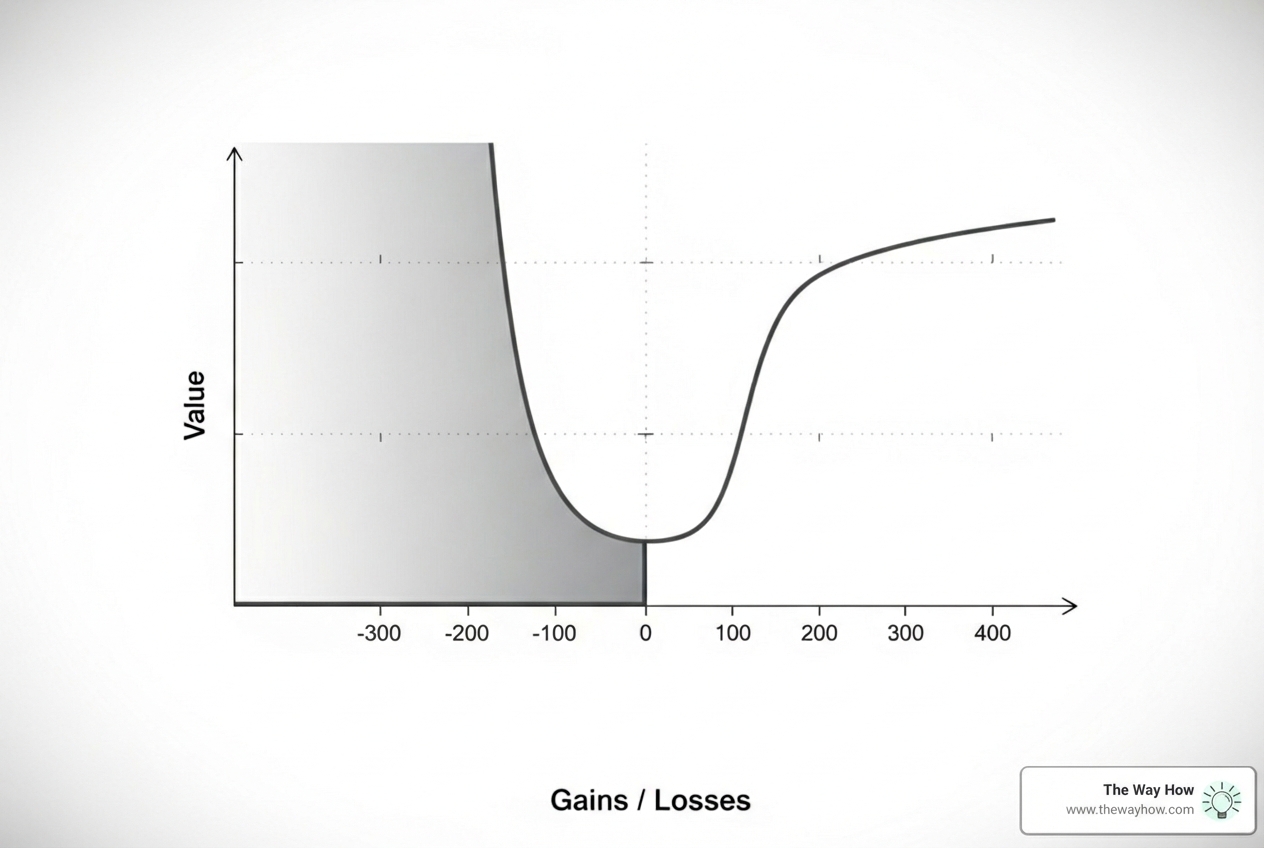
The influence of loss aversion permeates nearly every decision we make, shaping consumer behavior, financial choices, and social interactions. To understand why customers act (or don’t), we must grasp this bias.
For example, consumers are more responsive to price increases than to equivalent discounts because a price hike feels like a loss. This inertia, driven by the fear of losing what we have, makes change difficult and reinforces the status quo.
In finance, loss aversion is a notorious pitfall. Investors often suffer from “myopic loss aversion,” making them overly sensitive to short-term dips. This can lead to irrational decisions, like selling a stock too early to avoid further losses or holding a losing stock too long hoping to break even. You can explore this in research on myopic loss aversion.
When a customer considers a purchase, they struggle with the “pain of spending money”—the perceived loss of that money and its alternative uses. This psychological friction causes hesitation.
The famous mug study by Kahneman, Knetsch, and Thaler illustrates this perfectly. Participants given a mug (sellers) valued it at an average of $7.12, while those asked to buy one (buyers) would only pay $2.87. The sellers faced a loss, which felt more significant than the buyers’ potential gain. This gap shows how we value what we could lose almost twice as much as what we could gain. This principle helps businesses understand and overcome buyer’s reluctance.
Loss aversion is also prominent in B2B sales and product adoption.
In B2B, the “fear of switching costs” is a classic example. A client may see the benefits of your solution but hesitate due to the perceived losses of migrating data, retraining staff, and disrupting workflows. They stick with an underperforming vendor because the known is safer than the unknown. Social proof can mitigate this by showing that similar businesses have switched successfully, reducing the perceived risk.
Similarly, in product adoption, users resist changing software because they’ve invested time in learning existing tools. Giving that up feels like a loss of personal investment, even if a new product promises greater long-term productivity.
At The Way How, we believe understanding loss aversion is about empathy, not manipulation. When applied ethically, it becomes a tool for clarity, helping customers see the true cost of inaction and guiding them to a beneficial solution. The key is framing offers and language to make the implicit costs of a problem explicit, as noted in The Robert Collier Letter Book.
Creating genuine scarcity and urgency taps into the fear of missing out (FOMO) on an opportunity. When something is limited, its perceived value increases.
Effective tactics include:
In e-commerce tests, loss aversion tactics have been shown to significantly increase conversions by making customers feel they might lose an opportunity.
This strategy uses the Endowment Effect by giving customers a sense of ownership without commitment. We explore this in our guide on endowment effect marketing.
The language you use is paramount. It’s not just what you say, but how you say it.
The way messages are phrased can dramatically alter their reception. For more on this, see our marketing framing effect guide.
While loss aversion marketing is powerful, it must be used with care. At The Way How, our philosophy is rooted in empathy, not exploitation. There’s a fine line between ethical persuasion that helps customers and manipulation that erodes trust for short-term gain. Misusing loss aversion can lead to brand decay, as customers feel pushed or anxious rather than empowered.
Over-reliance on loss aversion can lead to negative outcomes:
To use loss aversion ethically, shift the focus from artificial scarcity to genuine problem-solving.
The most common examples are limited-time offers and scarcity messaging. Phrases like “Sale ends tonight!” or “Only 3 left!” tap into the fear of losing a deal. This creates a stronger impetus to act than simply highlighting the gain. Free trials are also common, as they establish psychological ownership, making the loss of the service after the trial feel significant.
While loss aversion is a universal bias, its effectiveness varies. It’s highly effective in industries with tangible risks, like finance, security, and health, as well as e-commerce. For luxury brands focused on aspiration, an aggressive approach may feel off-brand. The key is to frame your solution as preventing a genuine customer loss, not inventing artificial scarcity.
Measuring the impact requires A/B testing and analysis:
As a consumer, understanding loss aversion helps you make more rational decisions.
Recognizing this bias is the first step toward making more informed choices.
Loss aversion is a powerful insight, not a silver bullet. It’s one essential tool in a robust marketing and revenue system built on a deep understanding of human behavior. At The Way How, we don’t advocate for chasing fleeting tactics. Instead, we diagnose why growth is stalled, identify certainty gaps in the customer journey, and design systems that create trust, momentum, and predictable revenue.
Our approach blends strategic clarity, behavioral insight, and operational execution. We help founders and leadership teams move beyond surface-level marketing to build a psychology-first foundation. By understanding biases like loss aversion – and knowing when and how to apply them ethically – we transform marketing into a dependable growth engine. The goal isn’t just to make a sale; it’s to reduce uncertainty for your customers and build lasting trust.
If you’re ready to remove uncertainty from your sales and marketing systems and build a strategy rooted in human behavior and empathy, we’re here to guide you. Learn more about our strategic marketing services and find how we can help you turn insights into predictable growth.
 Jeremy Wayne Howell : Jul 22, 2026 9:48:31 PM
 Jeremy Wayne Howell : Jul 21, 2026 9:47:10 PM
 Jeremy Wayne Howell : Jul 20, 2026 9:46:47 PM