A Complete Guide to CRM Systems and Database Management
 Jeremy Wayne Howell : Jul 22, 2026 9:48:31 PM
NetSuite SuiteTalk SOAP session management changes have fundamentally altered how integrations authenticate, maintain sessions, and stay alive — and if your team hasn’t caught up, your integrations may already be running on borrowed time.
Here is a quick summary of the most critical changes:
| Change | Detail |
|---|---|
| Login/logout operations | No longer functional as of the 2020.1 endpoint |
| Required authentication | Token-Based Authentication (TBA) replaces login operations |
| Request-level credentials | Removed as of the 2020.2 endpoint |
| Inactivity timeout | Sessions expire after 20 minutes of inactivity |
| Absolute session timeout | Sessions expire after 60 minutes regardless of activity |
| Operation timeout | Any single operation exceeding 15 minutes is automatically terminated |
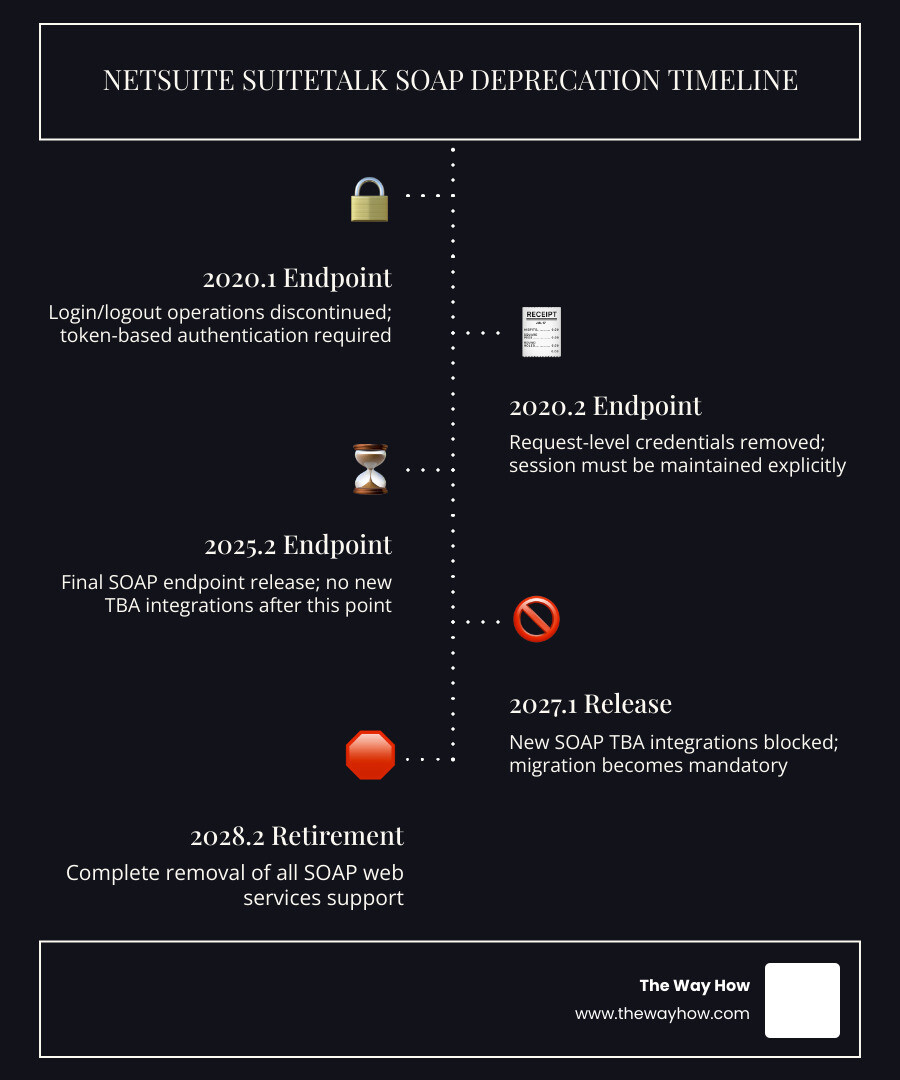
| New TBA integrations | Blocked entirely starting with the 2027.1 release |
| Final SOAP endpoint | 2025.2 is the last planned SOAP endpoint |
| Full SOAP retirement | SOAP will be completely removed with the 2028.2 release |
These aren’t minor config updates. They are structural changes that affect how your systems authenticate, how long they can stay connected, and whether they will work at all after 2028.
Most teams discover these changes the hard way — a session drops in production, an authentication call returns an error, or a nightly sync silently fails. The underlying cause is almost always the same: an integration built on assumptions that NetSuite has since invalidated.
The pressure this creates isn’t just technical. For founders and operations leaders, a broken integration means broken data, broken reporting, and broken trust in the systems your revenue decisions depend on.
I’m Jeremy Wayne Howell, founder of The Way How, and over the past two decades I’ve worked directly with revenue and operations teams to diagnose exactly these kinds of systemic vulnerabilities — including the compounding risk that comes from NetSuite SuiteTalk SOAP session management changes that quietly erode integration reliability. In this guide, I’ll walk you through what changed, why it matters, and how to build toward a more stable, future-proof integration architecture.
Integrations are the nervous system of modern business operations. When they function smoothly, they are invisible. But when they fail, they introduce a distinct brand of operational anxiety that ripples through leadership teams.
Many organizations suffer from a hidden form of technical debt: integrations built years ago on legacy protocols that continue to run silently in the background. Because these integrations “work,” they are ignored. This creates a false sense of security.
Underneath the surface, quiet deprecations slowly erode the foundation of these systems. Security standards evolve, old endpoints are retired, and session management policies tighten. When an integration suddenly breaks due to an unaddressed session management update, the immediate cost is technical, but the deeper cost is psychological.

Operational certainty disappears. Leadership teams lose faith in their dashboard metrics, customer data syncs stall, and manual workarounds are hastily assembled to plug the gaps. The cognitive load on your engineering and IT teams spikes as they scramble to patch a system they may not fully understand.
To restore momentum and eliminate this systemic vulnerability, we must look past the immediate symptoms and understand the technical realities driving these changes.
NetSuite has systematically dismantled legacy, stateful session management in favor of modern, stateless, and highly secure authentication patterns. Historically, integrations behaved much like human users: they logged in, received a session identifier, performed operations over an extended period, and logged out.
This stateful model relied heavily on session cookies (specifically the JSESSIONID cookie) to maintain a persistent connection to the NetSuite application servers. While convenient, this approach is fundamentally misaligned with modern security best practices and cloud-scale architecture.
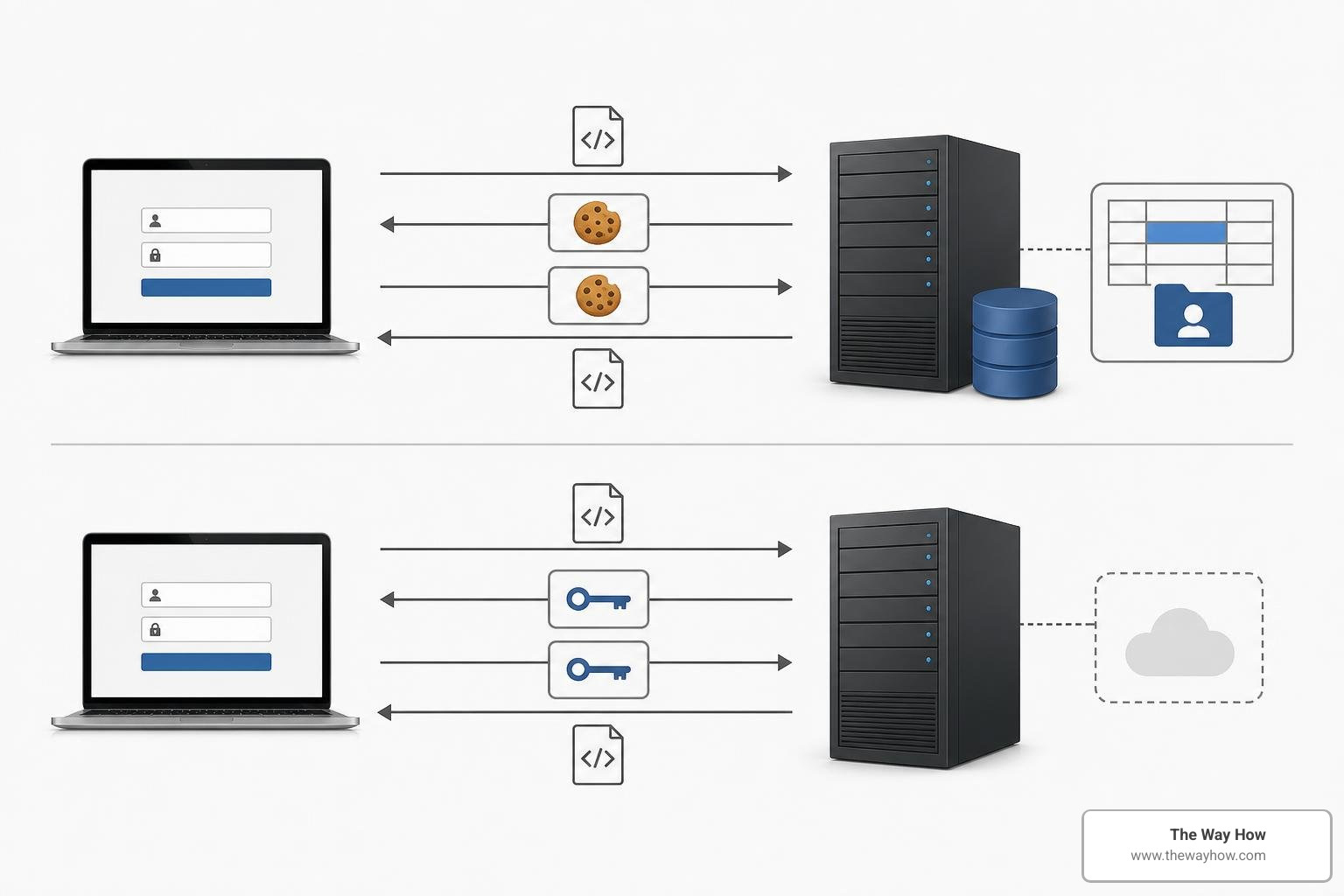
To address these vulnerabilities, NetSuite introduced sweeping updates to how SOAP web services handle identity and session lifecycles. The most significant shift is the transition away from persistent cookie-based sessions to stateless, token-based authentication (TBA) and OAuth 2.0.
For developers managing legacy systems, understanding the rules outlined in the official Session Management for SOAP Web Services documentation is no longer optional — it is a prerequisite for keeping integrations functional.
The decline of traditional session establishment began in earnest with the 2020.1 endpoint, which officially disabled the standard login and logout operations for SOAP web services. Integrations could no longer pass a user’s password to establish a multi-request session. Instead, they were forced to adopt Token-Based Authentication (TBA), which utilizes a tokenPassport complex type in the SOAP header of every single request.
This shift was closely followed by the 2020.2 release, which removed support for request-level credentials via the traditional Passport complex type. This meant developers could no longer pass raw user credentials in individual request headers to bypass session management.
For secure token-based communication, NetSuite requires cryptographic signatures. Integrations must use HMAC-SHA256 for generating signatures within the tokenPassport header. Legacy algorithms like HMAC-SHA1 are completely unsupported and will result in malformed syntax or authentication errors.
Furthermore, to maintain compatibility and security compliance, requests should target modern WSDL versions, such as the 2021.2 WSDL or newer, which fully support these cryptographic standards.
This transition represents a major step forward in security compliance, aligning NetSuite’s API infrastructure with OWASP (Open Web Application Security Project) guidelines. By enforcing stateless, token-signed requests, NetSuite minimizes the risk of credential exposure and session hijacking. For a detailed breakdown of how to construct these payloads, developers should refer to the documentation on Structuring SOAP Requests to Include Authentication Details.
Even when using token-based authentication, integrations must still operate within strict session, inactivity, and execution limits. NetSuite enforces three distinct timeout thresholds to protect platform stability and system resources:
InvalidSessionFault or SESSION_TIMED_OUT error and re-authenticate.In addition to timeouts, integrations must navigate strict concurrency limits. Concurrency is governed at both the user and account levels.
By default, standard NetSuite accounts have limited concurrent request slots. To scale execution capacity, organizations use SuiteCloud Plus licenses. One SuiteCloud Plus license allows the designation of one concurrent SOAP web services user who can send up to 10 concurrent requests.
As of the 2017.2 release, web services concurrency is governed globally per account, meaning the total pool of available slots is shared across SOAP, REST, and RESTlet endpoints.
To understand how these limitations differ between legacy SOAP and modern REST architectures, consider the following structural comparison:
| Governance Metric | SOAP Web Services | REST Web Services |
|---|---|---|
| Primary Auth Method | Token-Based Authentication (OAuth 1.0) | OAuth 2.0 (Client Credentials / Auth Code) |
| Session State | Semi-stateful (requires cookie/session tracking if using login) | Entirely stateless (bearer tokens) |
| Absolute Timeout | 60 minutes (for established sessions) | N/A (Tokens are short-lived; refreshed programmatically) |
| Inactivity Timeout | 20 minutes | N/A |
| Max Operation Limit | 15 minutes per request | 15 minutes per request |
| Max Record Limit | 1,000 records per search page | 1,000 records per search page |
| Concurrency Scaling | Scaled via SuiteCloud Plus (10 slots per license) | Shared global account concurrency pool |
For a deeper dive into these platform limitations, developers can consult the NetSuite SuiteTalk SOAP API Capabilities | knowledgelib.io resource.
For organizations maintaining legacy integrations that rely on session-based endpoints, managing HTTP cookies is a critical technical requirement. When an integration successfully authenticates via legacy operations, the NetSuite server returns several cookies in the Set-Cookie HTTP response header, including JSESSIONID, NS_ROUTING_VERSION, and NS_VER.
To maintain a valid session across subsequent SOAP requests, the client application must capture these cookies and include them in the headers of every subsequent HTTP request. Failing to persist and return these cookies will result in NetSuite treating each request as a brand-new session, quickly exhausting concurrent user limits and triggering immediate SESSION_TIMED_OUT or InvalidSessionFault errors.
Implementing cookie persistence varies significantly by development platform, and both .NET and Java environments have unique quirks that developers must address:
SoapHttpClientProtocol class does not maintain cookies. Developers must explicitly instantiate and assign a CookieContainer to the web service client instance. Additionally, the default timeout for .NET SOAP requests is 100 seconds. Because NetSuite operations can run for up to 15 minutes, developers must manually increase the client-side timeout property to match or exceed NetSuite’s limits to prevent premature connection drops.axis.jar and explicitly call setMaintainSession(true) on the service locator stub.For complete code examples and platform-specific workarounds, developers should review the official guide on Session Management for Web Services.
While patching legacy SOAP integrations might keep your systems online today, it is ultimately a temporary solution. Oracle NetSuite has set a hard deadline for the complete retirement of all SOAP web services.
The transition timeline is aggressive, and organizations must plan their migration strategies accordingly:
The path forward is clear: organizations must migrate their integration architectures to SuiteTalk REST Web Services or custom RESTlets, authenticated exclusively via OAuth 2.0.
Unlike the legacy TBA model, which utilizes OAuth 1.0 signatures, OAuth 2.0 provides a simpler, more secure, and industry-standard authentication flow. For machine-to-machine integrations, the OAuth 2.0 Client Credentials Grant using JWT (JSON Web Tokens) and private certificates is the highly recommended approach.
For organizations embarking on this transition, the SuiteTalk (Web Services) Integration documentation and the NetSuite Applications Suite - SOAP Removal Plans FAQ serve as essential migration blueprints.
NetSuite deprecated legacy login and logout operations to eliminate the security risks associated with stateful, cookie-based sessions. Traditional login methods required integrations to transmit user credentials (usernames and passwords) or store them within integration configurations, exposing them to potential compromise.
By enforcing Token-Based Authentication (TBA) and moving toward OAuth 2.0, NetSuite ensures that all API requests are cryptographically signed and stateless, aligning the platform with modern OWASP security standards and preventing session hijacking.
SuiteCloud Plus licenses expand an account’s concurrent processing capacity. By default, a NetSuite account has a base concurrency limit. Adding a SuiteCloud Plus license allows an organization to designate a specific web services concurrent user who can submit up to 10 concurrent requests.
These licenses scale account-level limits, allowing high-volume integrations to process requests in parallel without triggering concurrency governance faults.
The transition is structured across several key milestones:
Organizations must migrate all legacy SOAP integrations to REST web services or RESTlets before the 2028.2 release to avoid operational disruptions.
When integrations run on outdated protocols, the technical risk quickly translates into business risk. A single broken session can halt a billing run, delay customer onboarding, or distort the pipeline data your executive team relies on to make strategic decisions. At The Way How, we look at these technical challenges through a psychological lens: we understand that system reliability is the foundation of organizational trust.
We specialize in helping leadership teams eliminate operational friction and remove uncertainty from their growth engines. Rather than chasing quick tactical patches, we diagnose the underlying gaps in your technology architecture, alignment, and data flows.
Whether you need a comprehensive system audit, a structured migration roadmap from SOAP to REST, or hands-on fractional leadership to align your systems with your revenue strategy, we help you build a secure, dependable foundation.
Let’s replace system anxiety with operational momentum. To learn more about how we can help you audit your integrations and secure your systems, explore our services:
 Jeremy Wayne Howell : Jul 22, 2026 9:48:31 PM
 Jeremy Wayne Howell : Jul 21, 2026 9:47:10 PM
 Jeremy Wayne Howell : Jul 20, 2026 9:46:47 PM