

Why “More” Isn’t the Answer to Growth

Business growth acceleration is the work of building a predictable, sustainable path to revenue expansion by addressing the psychological, strategic, and operational friction that stalls momentum.
Before most leaders arrive here, they have already tried to solve growth problems the same way they solved their startup problems: by doing more.
- More campaigns.
- More features.
- More sales activity.
- More headcount.
On the surface, it feels rational. Growth has always followed effort, so if progress slows, the obvious answer is to push harder. But that is usually a misdiagnosis of what is really happening inside the business and inside the minds of customers and teams.
The Reader: What You Believe Is Wrong
If you are reading this, you are likely a founder, revenue leader, or operator inside a growing B2B company. Emotionally, you are caught between pride and frustration. You know you have built something real. You have proof in the form of customers, revenue, and a team that believes in the work.
At the same time, you feel a persistent drag:
- Sales cycles feel slower and less predictable.
- Marketing output has increased, but signal from the market has not.
- Your team is busy, but you are unsure if you are getting closer to your targets or simply moving faster in place.
Cognitively, you may have framed the problem as a “top-of-funnel” issue, a “brand awareness” gap, or a “we need better salespeople” problem. You might suspect that competitors are simply outspending or out-innovating you. The nagging belief is that you have fallen behind on tactics or tools.
What Is Actually Wrong: The Clarity Gap
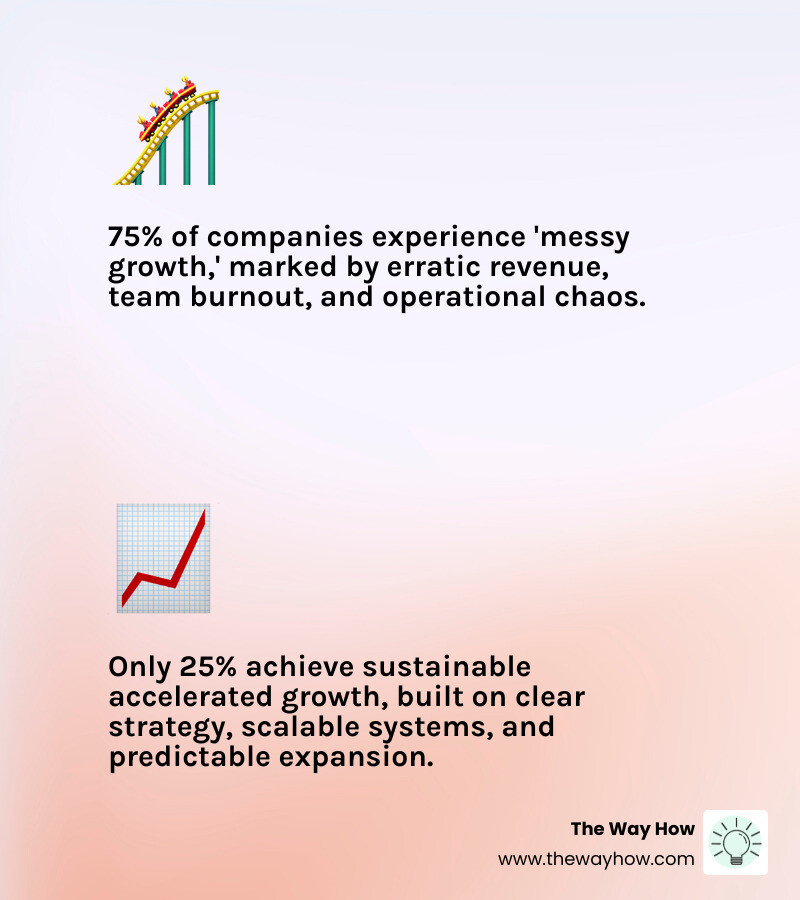
The data on growth tells a different story. Only a small minority of companies grow sustainably over time. The rest experience what we call messy growth: spikes in revenue followed by operational chaos, team burnout, and eventually, stagnation. Activity increases, but progress does not.
This is rarely a failure of ambition or effort. It is a failure of clarity.
Growth stalls when companies chase tactics before they understand the human behavior driving their customers’ decisions and their team’s execution. It stalls when:
- Founders cannot let go of the work they used to do and remain the central problem-solver for everything.
- Pricing and packaging send a confused signal about value, risk, and fit.
- The original story of “why we exist” has faded, leaving teams going through the motions rather than moving toward a shared purpose.
- Systems and processes lag behind demand, forcing people to compensate with heroic effort.
The real issue is that the mental model of how growth happens has not evolved, even though the company has. The business is still being run as if effort is the primary growth lever, when in reality, the psychological and structural friction has become the limiting factor.
Where Uncertainty Lives in Your Decisions
When we speak with founders and revenue leaders at The Way How, the same uncertainties surface again and again:
- “Are we targeting the right customers, or have we simply normalized selling to whoever shows up?”
- “Is our offer truly differentiated in the minds of buyers, or are we just incrementally better on paper?”
- “Are we underpricing because we are scared to test the market, or because we genuinely believe we are not worth more?”
- “If growth did double, would our systems and people be able to keep up without breaking?”
These are not tactical questions. They are behavioral questions—about how your buyers make sense of risk and reward, and how your team makes sense of priorities, accountability, and safety.
Business growth acceleration is not primarily a marketing problem. It is a clarity problem expressed through marketing, sales, and operations.
At The Way How, a psychology-first marketing and revenue strategy firm, our role is not to throw more channels, tools, or campaigns at you. Our role is to help you understand why growth has stalled in the first place and where human behavior—not just numbers—is signaling friction.
Those who make bold, strategic moves during uncertain times usually do so because they have resolved this uncertainty. They are not braver by nature; they are clearer by design.
Sustainable growth acceleration is less about adding more and more about carefully removing what no longer fits: outdated roles, cluttered offers, noisy messaging, and brittle systems. When you remove this friction, you do not just speed up revenue; you restore confidence—for your buyers, your team, and yourself.
I am Jeremy Wayne Howell, founder of The Way How. For over 20 years, I have helped businesses surface and resolve the psychological and systemic barriers to business growth acceleration. My background in sales and marketing showed me how often teams are asked to execute without clarity. The work we do now is about changing that pattern: teaching before prescribing, diagnosing before recommending tactics, and building growth strategies that are grounded in how people actually think, decide, and act.
Diagnosing the Drag: The Hidden Barriers to Acceleration
Growth stalls not from a lack of effort, but from hidden friction in your strategy, story, and systems. Before you can accelerate, you must diagnose what’s holding you back. We believe that true growth begins with clarity, and clarity often comes from understanding the subtle blockages in your operational flow and psychological alignment.
The Founder’s Bottleneck: Transitioning from ‘Doer’ to Leader
At The Way How, we’ve seen this dynamic play out countless times: a brilliant founder, adept at the initial “doing” of everything to get the business off the ground, suddenly finds themselves overwhelmed as the company begins to scale. This is the “founder’s trap,” where the very hands-on style that propelled early success becomes the biggest bottleneck to further Business growth acceleration.
Often, the biggest bottleneck to growth is the founder, who may be stuck in a ‘doer’ role rather than evolving into a leader of doers. This isn’t a personal failing; it’s a natural progression that requires a significant psychological shift. It means letting go of low-leverage tasks, delegating with confidence, and empowering a team to execute. Scalable leadership isn’t just about managing people; it’s about stepping into a visionary role, setting the direction, and trusting others to steer the path. Without this transition, the founder becomes the single point of failure, limiting the entire organization’s potential to expand beyond their personal capacity.
Transition coaching for entrepreneurs focuses on precisely this shift: moving founders from being the doer to being the leader of doers. It helps them step into visionary leadership roles, release the grip on tasks that can and should be delegated, and create empowered, self-sufficient teams. Our goal is to help you move beyond firefighting and focus on strategic growth, knowing your operations are in capable hands.
The Fading Narrative: When Your ‘Why’ Gets Lost in Translation
Every successful business starts with a compelling “why”—a clear purpose that resonates with founders, employees, and early customers. But as businesses grow, this initial spark can dim, leading to a critical barrier to Business growth acceleration: the lack of a clear growth narrative.
When the “why” gets lost, the consequences ripple through the entire organization. Internally, it leads to a loss of purpose, deeper silos, and difficulty retaining talent. High performers, in particular, want to be part of something meaningful; if your company is perceived as just chasing revenue, they will likely seek opportunities elsewhere. Externally, sales pitches become less compelling, marketing messaging gets fuzzy, and customers disengage, viewing your company as merely a vendor rather than a trusted partner.
A strong, consistent growth narrative is essential for aligning internal teams and resonating with external stakeholders. It clarifies who you are, what problems you solve, and why anyone should care. Without it, your efforts, no matter how tactical, will lack cohesion and impact. We help leaders articulate this narrative, ensuring that every message, from internal communications to customer-facing campaigns, reinforces a unified and powerful vision.
The Value-Price Disconnect: Are You Speaking Your Customer’s Language?
One of the most common,, barriers to Business growth acceleration is a fundamental disconnect between your pricing strategy and the perceived value you offer. When pricing isn’t aligned to value, it’s like trying to speak a different language than your customer.
Pricing that is too low, too flat, or outdated can lead to several growth-stifling problems:
- Undervaluing your offers: You leave money on the table, signaling to customers that your solutions aren’t worth more.
- Attracting the wrong customers: Price-sensitive buyers often churn quickly and demand more resources, diverting focus from ideal clients.
- Killing profitability: Heavy discounting, often used as a crutch for weak value propositions, erodes margins and creates a dangerous internal norm where sales believe only price cuts win.
- Capping revenue growth: If your pricing doesn’t scale with the value you deliver, you hit a ceiling.
- Making strategic shifts harder: Changing an established, misaligned pricing model can be a painful uphill battle.
Many businesses get stuck in “feature wars,” believing that adding more features will inherently drive more sales. However, as we often remind our clients, customers don’t buy more; they buy better. Better usually means simpler, clearer, and more focused. Bloated products, packed with features customers don’t need, cost more to build but don’t translate into paid value.
Instead, we advocate for reframing value propositions to be emotionally relevant and outcome-based. It’s about understanding what problem you really solve for your customer, not just what your product does. This psychological insight allows for value-based pricing, where your monetization scales in lockstep with the value you create, aligning your revenue model with your customer’s success.
| Feature-Based Pricing | Value-Based Pricing |
|---|---|
| Focuses on product attributes and functionalities | Focuses on customer outcomes, benefits, and emotional relevance |
| Often leads to “feature bloat” and competitive matching | Emphasizes differentiation and unique problem-solving |
| Can result in undervaluing or overpricing without market context | Aligns price with the perceived and actual value delivered to the customer |
| Prone to discounting wars and commoditization | Supports premium pricing and stronger customer relationships |
| May attract customers looking for the cheapest option | Attracts ideal customers who prioritize solutions and are willing to pay for results |
The Blueprint for Business Growth Acceleration
True business growth acceleration is not a bag of tricks. It is a deliberate, holistic process grounded in how humans actually make decisions—inside your customer’s organization and inside your own. It requires a resilient foundation built from strategic clarity, scalable systems, and a culture that understands why it is growing, not just how.
Most leaders look for the blueprint in other companies’ playbooks: a specific outbound cadence, a channel mix, a new pricing scheme. The real blueprint is simpler and less visible: it is the set of decisions you stop making on autopilot.
Strategic Focus: The Discipline of Saying “No”
When growth slows, leaders often assume they have not said “yes” to enough opportunities. In reality, the more common problem is that they have said “yes” to too many.
In the context of business growth acceleration, focus is not a slogan—it is a series of uncomfortable trade-offs. It means:
- Letting go of markets that are merely “possible” to win and concentrating on those where you are meaningfully different in the buyer’s mind.
- Refusing projects that pull your team into custom work that erodes your ability to deliver consistently.
- Choosing a clear ideal customer profile, even if it feels like you are walking away from potential revenue in the short term.
Our research and experience show that most of the meaningful, compounding growth inside a business comes from maximizing the value of its core: the customers you serve best, the problems you solve most deeply, and the offers that are easiest for buyers to understand and say yes to.
Where leaders often feel uncertain is not in the idea of focus itself, but in what to focus on. They ask:
- “If we narrow our ICP, will our pipeline dry up?”
- “If we stop saying yes to custom requests, will key customers leave?”
- “If we choose a differentiated position, what if we choose wrong?”
At The Way How, we do not answer those questions with opinions. We answer them by examining behavior: how your best customers found you, what they actually value in you, and where they feel certainty or doubt during their decision-making process. Strategic focus becomes less theoretical and more observable.
Once that behavioral clarity exists, the “no” becomes less risky. You are no longer rejecting random opportunities; you are intentionally protecting the context where you deliver the most value and where growth compounds.
Scaling strategies still require orchestration across talent, markets, and partnerships, but without this psychological and strategic focus, orchestration turns into noise. The work we do with clients often starts by mapping where their focus has quietly fragmented, and which “certainty gaps” in their understanding of customers are forcing them into reactive decisions.
Building the Engine: Systematizing How You Create Certainty
Once strategic clarity is in place, the next step in business growth acceleration is to build an operational engine that can reliably turn that clarity into outcomes. This is less about technology for its own sake and more about designing systems that reduce cognitive load and emotional friction for both your team and your buyers.
Messy growth appears when sales outpace your ability to deliver a consistent experience. Internally, this looks like:
- Key processes living in people’s heads instead of being captured and shared.
- Deals getting delayed or lost because handoffs between teams are unclear.
- Leaders spending more time chasing updates than making strategic decisions.
From a buyer psychology perspective, every one of these internal breakdowns shows up externally as uncertainty: inconsistent communication, slow responses, and a general sense that working with you will be effortful.
Systematizing operations—through process design, automation, and a thoughtful technology stack—is not about chasing efficiency metrics. It is about lowering the perceived and actual risk of choosing you. When routine tasks are automated, when data is reliable, and when teams know exactly what happens after each decision, two things happen:
- Your buyers feel more confident moving forward.
- Your team has more mental bandwidth to focus on high-value, human work.
We often work with clients to design HubSpot architecture and related systems, not as IT projects, but as behavior projects. We ask:
- What information does a buyer need to feel safe at each stage of the journey?
- What information does your team need to make a confident decision or handoff?
- Where do people currently invent their own version of the process because the system is unclear?
Only then do we design workflows, automations, and reporting. The goal is an engine that does not just move data faster, but reduces ambiguity for everyone involved.

The Human Element: Culture as the Real Operating System
No amount of planning or technology will lead to sustainable business growth acceleration if the human operating system—your leadership and culture—runs on fear, ambiguity, or learned helplessness.
High-performance cultures are often described in abstract terms: ownership, accountability, psychological safety. These are not motivational posters; they are conditions that directly influence how people behave when faced with uncertainty.
In growth contexts, your team is constantly making micro-decisions:
- Do I raise this risk now, or wait and hope it goes away?
- Do I tell the client the honest answer, even if it may slow the deal?
- Do I experiment with a better way, or stick to the script to avoid criticism?
The aggregate of these decisions either accelerates or quietly stalls growth.
Our work with leaders at The Way How focuses on making culture observable and actionable. We look at how information flows, how decisions are made, and how people talk about failure and success. The question is not “Do we have a good culture?” but “What behaviors does our current culture reward, and are those behaviors aligned with the growth we say we want?”
Firms that successfully implement growth-accelerating strategies tend to share one trait: they have built the courage to execute into their culture, not just their leadership persona. That courage is supported by clarity of purpose, clear roles, and systems that make it safe to act on what people see.
Mentorship, structured development, and transparent communication are not “soft” initiatives; they are mechanisms for changing behavior at scale. When employees are engaged, understand the story they are part of, and feel supported in making decisions, they stop waiting for permission and start moving the strategy forward in daily, tangible ways.
In that sense, accelerated growth is the byproduct of a company where human psychology is not an afterthought—but the primary design constraint of its strategy, systems, and leadership.
Activating Acceleration: Data, Finance, and Customer-Centricity
With a solid blueprint in place, you can activate Business growth acceleration by leveraging insights from data, guiding decisions with robust financial management, and maintaining an unwavering focus on your ideal customer’s journey. This is where strategic clarity meets operational execution.
Leveraging Data and Technology for True Business Growth Acceleration
In today’s landscape, data and technology are not just tools; they are the fuel for Business growth acceleration. We move beyond vanity metrics to focus on actionable insights derived from customer analytics and predictive models. Companies with the greatest AI maturity have been growing 3 percentage points more (or 4.7x) year over year than companies with the least maturity. This statistic isn’t just interesting; it’s a clear indicator that intelligent application of technology, particularly AI, is a critical differentiator for growth.
The economic potential of generative AI goes beyond merely optimizing existing processes; it drives entirely new growth models and exponential expansion. By effectively adopting and applying AI, businesses can find and capture new growth opportunities across three horizons. This involves using data to refine target markets, optimize customer acquisition by tracking funnel performance, and evolving products based on usage and satisfaction data. For us, this means designing robust HubSpot architecture and implementing demand generation strategies that are not just data-driven, but also rooted in human behavior and decision-making psychology, ensuring that technology amplifies, rather than replaces, genuine customer connection.
Financial Forecasting as a Strategic Compass
Business growth acceleration is fundamentally linked to sound financial management. Strategic forecasting transforms your financial data from a historical record into a powerful strategic compass. It’s about predicting future cash flow, allocating resources effectively, and ensuring you have the necessary capital to fund growth initiatives. This moves businesses from reactive accounting to proactive financial strategy.
The importance of financial management and strategic forecasting in growth acceleration cannot be overstated. It allows leaders to make informed decisions, mitigate risks, and seize opportunities. A Guide to growth: Financial strategies for scaling businesses emphasizes that scaling from $25 million to $100 million or more in revenue requires a sophisticated growth strategy that evolves with your business, demanding tools and processes that match operational complexity. By understanding your financial trajectory, you can maintain the courage to execute bold growth plans, even amidst economic uncertainty. We help our clients build these forecasting capabilities, linking financial strategy directly to their marketing and revenue systems to create predictable, profitable expansion.
Nailing Your Ideal Customer: The Foundation for Business Growth Acceleration
At The Way How, we believe that truly understanding and “nailing” your ideal customer is the single most powerful lever for Business growth acceleration. This goes far beyond basic demographics; it dives deep into customer journey mapping, buyer psychology, and identifying the “certainty gaps” that exist in their decision-making process.
By focusing on psychographics and applying empathy in marketing, we aim to solve for the customer’s core problem, not just their surface-level needs. This means understanding their emotional drivers, their fears, their aspirations, and how they make choices. When you truly speak your ideal customer’s language, your messaging becomes more resonant, your sales process becomes more efficient, and your customer lifetime value increases. This precision ensures that your growth efforts are directed towards the most valuable segments, leading to higher customer retention and referral rates, and ultimately, sustainable, accelerated revenue.
Frequently Asked Questions About Business Growth Acceleration
What is the difference between ‘messy growth’ and sustainable, accelerated growth?
Messy growth is characterized by increased revenue at the cost of chaos, team burnout, and operational breakdowns. It’s often reactive, driven by short-term tactics, and ultimately unsustainable. It’s when sales increase, but systems lag, leading to plateaus or backslides. Sustainable, accelerated growth, on the other hand, is intentional. It’s built on scalable systems, a clear strategy, and a healthy culture, leading to predictable, profitable expansion without burning out your team or yourself. It involves sustained performance, increased market share, and improved operational capacity, all while maintaining clarity and control.
What is the single biggest mistake leaders make when trying to accelerate growth?
The biggest mistake leaders make when trying to accelerate growth is focusing on tactics before strategy. They jump to “more leads,” “new software,” or “additional features” without first diagnosing the root cause of their stalled growth. This often stems from a lack of clarity in their value proposition, a shallow understanding of their ideal customer’s psychology, or internal systems that create friction rather than flow. Without diagnosing these fundamental “certainty gaps” in the customer journey and internal operations, new tactics simply exacerbate existing problems, leading to more activity but little actual progress.
How does company culture impact growth acceleration?
Company culture acts as the operating system for Business growth acceleration. A strong, positive culture—one built on accountability, psychological safety, and shared purpose—empowers teams to take ownership, innovate, and execute with rigor. When employees feel valued and understand their contribution to the larger mission, they are more engaged, adaptable, and productive. Conversely, a toxic or misaligned culture creates friction, resistance, and burnout, sabotaging even the best strategies. It can lead to internal silos, difficulty retaining talent, and a general lack of the “courage to execute” that is common among successful growth-accelerating firms. Culture determines how effectively your strategy is implemented and how sustainably your business can grow.
From Friction to Flow: Choosing Your Next Step
Sustainable business growth acceleration is not about hustling harder; it is about seeing more clearly. When you understand the real reasons growth has stalled—how your buyers think, where your team hesitates, and which systems quietly drain energy—momentum stops feeling mysterious.
If you feel like you are working too hard for the results you are seeing, the question is not “What else should we be doing?” but “What do we need to understand differently?”
- Where are we assuming the problem is volume, when it is actually clarity?
- Where are we compensating for weak systems with heroic effort?
- Where are our buyers hesitating, not because of price or features, but because their decision still feels risky or unclear?
At The Way How, we begin by teaching, not prescribing. We help founders and revenue leaders map the psychological and systemic friction inside their growth engine, then design strategies, narratives, and systems that restore predictability without burning people out.
If you sense that “more” is no longer the answer, your next move is not another tactic. It is a clearer lens. When you are ready to examine your growth through that lens—and build an engine that reflects how your customers and your team actually behave—we are ready to guide that work with you.
Learn how our services can bring clarity to your growth strategy