A Complete Guide to CRM Systems and Database Management
 Jeremy Wayne Howell : Jul 22, 2026 9:48:31 PM
Customer journey stages are the distinct psychological phases a person moves through from first becoming aware of a problem to becoming a loyal advocate for your brand. Understanding these stages is critical because it reveals where your prospects are losing confidence and abandoning their path to purchase.
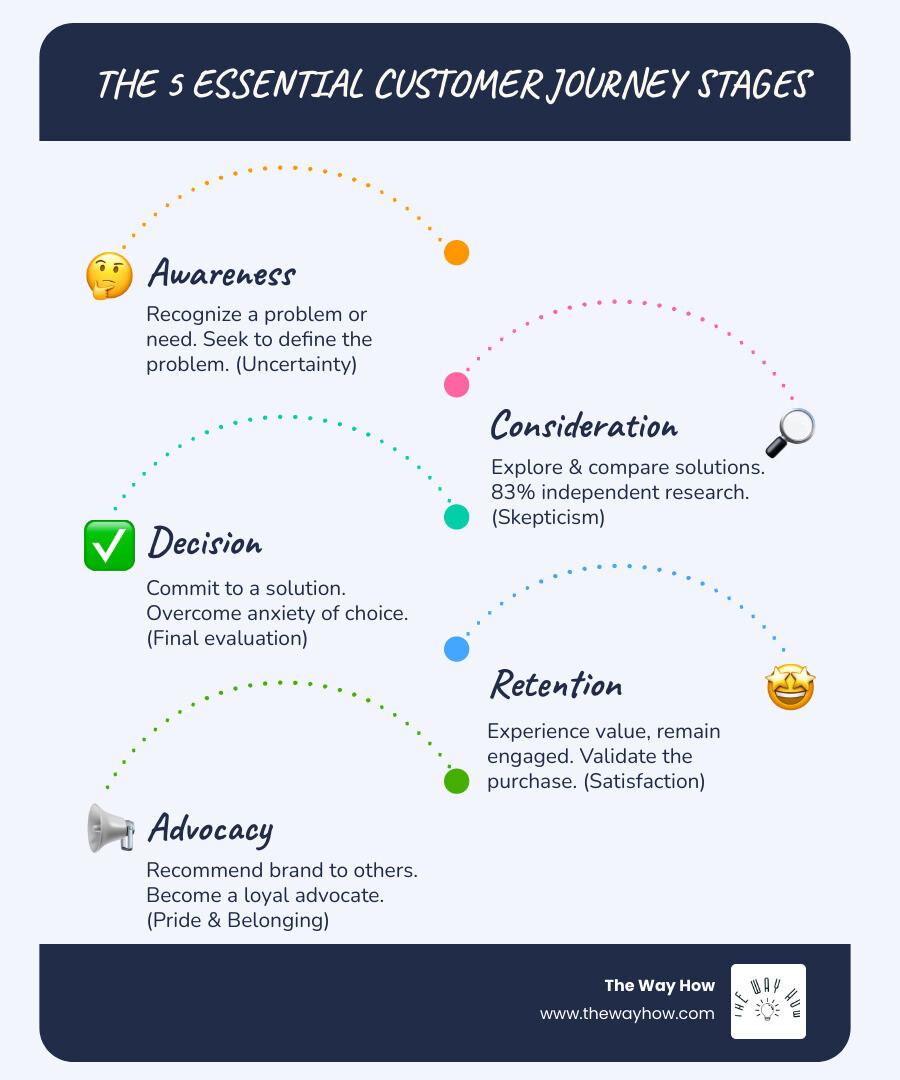
The 5 essential customer journey stages are:
Here’s the uncomfortable truth: your marketing isn’t failing because you chose the wrong tactics. It’s failing because it’s disconnected from how humans actually make decisions.
Most businesses operate with a comforting fiction. They imagine customers moving smoothly down a funnel: awareness at the top, purchase at the bottom, nice and linear. This model is tidy, measurable, and utterly divorced from reality.
Real buying decisions are messy. They loop back. They stall. They restart. According to Gartner research, only 17% of the customer journey involves direct interaction with vendors. The remaining 83% happens in the dark—through independent research, internal debate, and conversations you’ll never see.
Nearly 50% of consumers will switch brands if a business fails to anticipate their needs. That statistic isn’t about product quality or pricing. It’s about understanding the psychological landscape your customers are navigating and being present with the right support at the right moment.
The traditional funnel assumes customers are objects to be moved. The customer journey recognizes they are humans to be understood. This shift isn’t semantic—it’s strategic. Companies that maximize satisfaction across customer journey stages see a 20% increase in customer satisfaction, a 15% lift in revenue, and a 20% reduction in service costs.
This guide will help you diagnose where your customers are losing certainty, what questions they’re asking at each stage, and how to build a system that creates trust and momentum instead of friction and doubt.

Your marketing isn’t failing because of the wrong tactics; it’s failing because it’s disconnected from the human experience. We often see founders and leadership teams chasing the latest marketing trends, only to find their growth stalled and their revenue unpredictable. Why? Because they’re focusing on the “what” instead of the “why.”
Understanding the customer journey stages isn’t merely a marketing exercise—it’s a core business strategy for survival and growth. It’s about stepping into our customer’s shoes, feeling their frustrations, and anticipating their needs before they even articulate them. This customer-centricity allows us to build trust and create the kind of satisfaction that turns customers into loyal advocates, directly impacting our bottom line.
When we truly grasp the psychological shifts occurring at each stage, we can pinpoint the “certainty gaps” that cause prospects to hesitate or churn. We can then design systems that remove uncertainty from their decision-making process, replacing doubt with confidence. This isn’t just about making a sale; it’s about fostering long-term relationships that lead to predictable revenue. As we’ve seen, nearly 50% of consumers will switch brands if a business fails to anticipate their needs. This statistic highlights that our ability to foresee and address these needs is paramount.
By understanding the customer journey, we can move beyond surface-level tactics and build a robust foundation for Business Growth. We can optimize our HubSpot architecture and demand generation strategies, not based on fleeting trends, but on the enduring principles of human behavior and empathy. This approach allows us to deliver value precisely when and where it’s needed most, changing our marketing into a dependable growth engine.
The customer journey is a series of psychological states. Our job, as strategists and marketers, is to provide the right support at each stage to help the customer move forward with confidence. We need to be the trusted guide, not the pushy salesperson. Let’s break down the mindset, goals, and potential pitfalls of each phase, understanding how each stage of the customer journey differs from the others and why this distinction is crucial for our success.
This isn’t about our brand; it’s about our customer’s problem. They’ve just realized a tension, a frustration, or an aspiration they can’t quite name. They are uncertain and looking for language to define their problem, not a sales pitch. Think of it as a low-grade hum of discomfort or a vague sense that “things could be better.” At this stage, customers are primarily gathering information and trying to understand their situation. They might be browsing blogs, reading articles, or engaging with introductory content. Our goal is to educate and build trust by being the most helpful resource, offering insights into their pain points without immediately pushing a solution. This is where Content Marketing HubSpot can be incredibly powerful, providing valuable, educational content that resonates with their nascent problem.
Now armed with a defined problem, the customer actively seeks and evaluates potential solutions. They’ve moved past “what’s wrong?” to “how do I fix it?” They are skeptical and weighing options, comparing different approaches, and trying to understand the pros and cons of each. According to Gartner, they spend a staggering 83% of this time researching independently, often without direct vendor interaction. They’re looking for proof, credibility, and clarity. Our goal is to build credibility and help them compare effectively, providing transparent, valuable information through case studies, detailed guides, webinars, and comparison tools. Thoughtful email nurturing campaigns can be instrumental here, providing targeted resources that address their specific questions and concerns.
The customer is close to a choice but is now facing the anxiety of commitment. They are asking, “Is this the right choice for me? What if I’m wrong? What if I regret this?” This is a crucial psychological hurdle, where fear of making the wrong choice can lead to analysis paralysis or abandonment. They’re looking for reassurance and a clear path forward. Our goal is to de-risk the decision. We need to remove any last-minute friction, offer compelling social proof (testimonials, reviews, case studies), and provide clear, reassuring final details through personalized demos, free trials, and transparent pricing. This stage is less about convincing them of the value and more about making them comfortable with the commitment. For businesses leveraging digital commerce, optimizing this stage is paramount to Maximize Sales with HubSpot eCommerce.
The purchase is not the end; it’s the beginning of the real experience. The customer is now looking for validation that they made the right choice. They’ve invested their time, money, and trust, and they expect their problem to be solved or their aspiration to be met. A poor post-purchase experience is a primary driver of churn, undermining all the effort we put into acquisition. Our goal is to deliver on our promise and ensure they achieve the value they were sold. This is where we prove our worth, through exceptional onboarding, proactive support, and continuous value delivery. It’s up to five times more expensive to attract a new customer than to retain one, so investing in this stage makes profound business sense. Effective HubSpot Service Hub Onboarding can significantly improve this experience, ensuring customers quickly realize the full potential of their purchase.
When a customer’s experience not only meets but exceeds their expectations, they transition from a consumer to an advocate. They feel a sense of pride, belonging, and genuine satisfaction. They’ve found a solution that works, and they want others to benefit from it. They are now your most powerful marketing channel, as 81% of US and UK consumers trust product advice from friends and family over brand messaging. Furthermore, 59% of American consumers say that once they’re loyal to a brand, they’re loyal to it for life. Our goal is to empower these advocates and amplify their voice, making it easy for them to share their positive experiences. This stage is about nurturing a community, celebrating their success, and recognizing their loyalty. They become our champions, guiding new prospects through their own journeys.
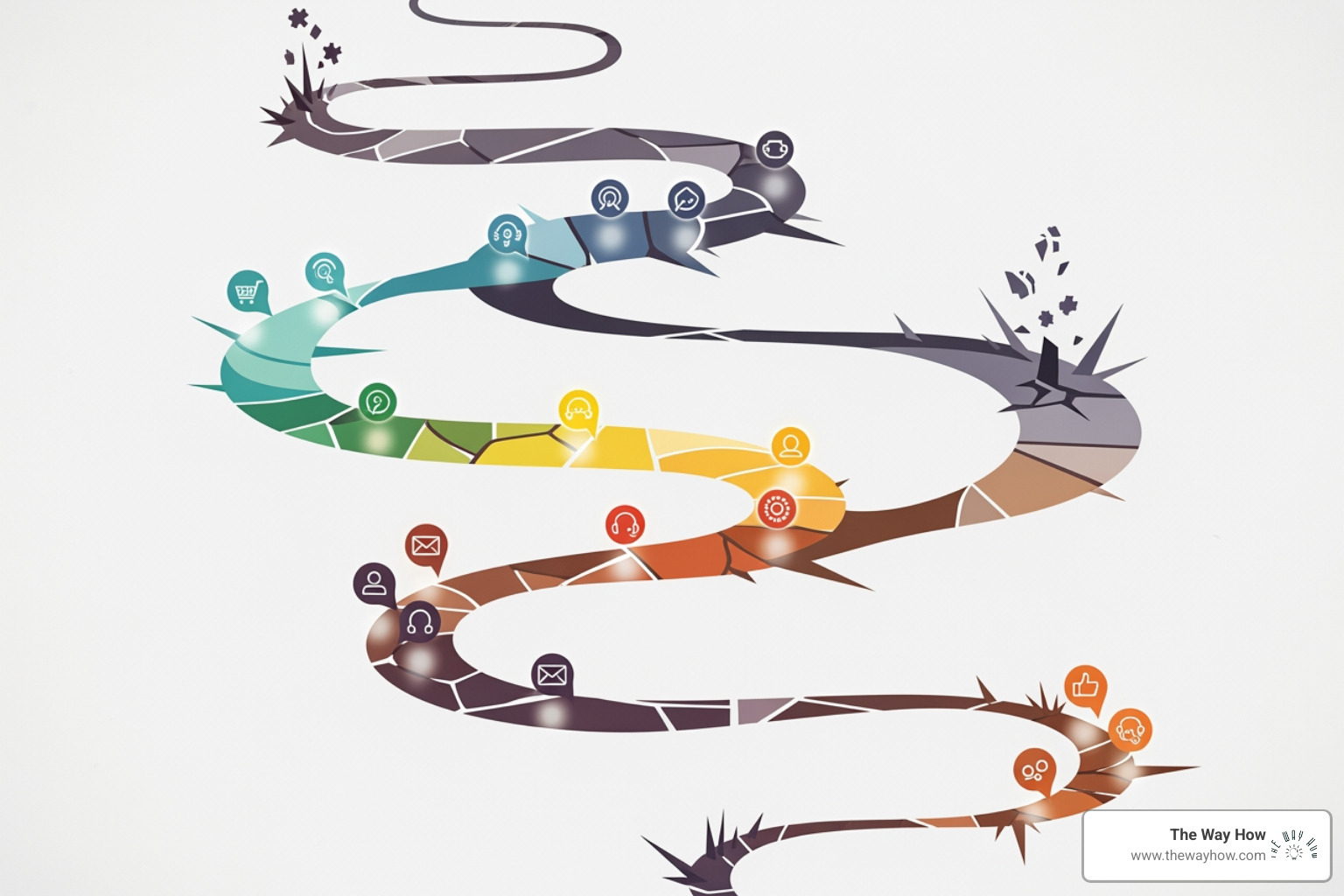
Understanding the abstract concept of customer journey stages is one thing; translating it into a tangible, actionable plan is another. This is where customer journey mapping comes in. A customer journey map is not just a flowchart; it’s a diagnostic tool for empathy. It’s how we visualize the emotional highs and lows, identify the certainty gaps, and pinpoint the moments where trust is won or lost. This process forces us to see our business from the outside in, revealing how customers truly experience our brand, rather than how we think they do.
So, how can businesses effectively map out their customer journeys? We approach this by focusing on the customer’s perspective, combining data with qualitative insights:
This journey mapping process helps us move from assumption to insight. It unifies fragmented efforts across internal departments, ensuring everyone understands their role in the broader customer experience. It’s a living document, evolving as our business and customers do, constantly informing our strategies for improvement.
To further clarify, let’s look at the key differences between the customer journey and the buyer’s journey:
| Feature | Buyer’s Journey | Customer Journey |
|---|---|---|
| Scope | Focused solely on the path to a single purchase | Encompasses the entire relationship with the brand |
| Goal | To make a sale | To build loyalty, foster advocacy, and maximize lifetime value |
| Stages | Typically 3: Awareness, Consideration, Decision | Typically 5+: Awareness, Consideration, Decision, Retention, Advocacy |
| Duration | Relatively shorter, ends at purchase | Ongoing, extends indefinitely post-purchase |
| Perspective | Often sales-centric (moving a prospect through a funnel) | Customer-centric (understanding the human experience) |
Understanding the journey is the diagnosis. Building a system to respond to it is the cure. Once we have our customer journey map, the next step is to operationalize those insights to deliver truly remarkable experiences at scale. This is where personalization and an omnichannel approach, powered by data and feedback, become indispensable.
How does personalization play a role in optimizing the customer journey? Personalization isn’t about being creepy; it’s about being radically helpful. It means tailoring messages, offers, and experiences based on a customer’s unique profile, past interactions, and current stage in their journey. For example, a customer in the Consideration stage might receive an email with relevant case studies, while a customer in the Retention stage might get proactive tips for maximizing product usage. We know that 63% of millennial consumers are willing to share data in exchange for more personalized experiences and offers. This willingness is a clear signal: customers expect us to use data to make their journey smoother and more relevant. Tools like Marketing Automation HubSpot allow us to automate these personalized interactions, ensuring the right message reaches the right person at the right time.
Equally important is the emphasis on an omnichannel experience. What is the importance of an omnichannel experience in the customer journey? An omnichannel approach ensures a seamless, consistent, and integrated experience across all communication channels—whether it’s email, social media, your website, or customer support. It’s not just about being on multiple channels (multichannel); it’s about ensuring those channels talk to each other. If a customer begins a conversation on chat, they should be able to pick it up later via email or phone without repeating themselves. This continuity builds trust and reduces friction, making the customer feel seen and valued, regardless of how they choose to interact with us.
Finally, how can customer feedback and data be leveraged to improve the customer journey? Data is the lifeblood of optimization. We use platforms like HubSpot Analytics to track customer behavior, identify patterns, and measure the effectiveness of our interventions. This includes everything from website engagement and email open rates to customer service interactions and product usage data. But data alone isn’t enough; we need feedback. Actively soliciting customer feedback through surveys, reviews, and direct conversations provides qualitative insights that quantitative data might miss. By combining robust analytics with genuine customer feedback, we create a powerful feedback loop. This allows us to continuously refine our customer journey maps, identify new certainty gaps, and implement improvements that truly resonate with our audience. It’s about overcoming data silos and creating a unified view of the customer, so every interaction is informed and empathetic.
The buyer’s journey is a subset of the customer journey. It focuses only on the pre-purchase stages of Awareness, Consideration, and Decision, with the goal of making a sale. The customer journey, however, is a holistic view of the entire relationship a customer has with your brand. It includes the critical post-purchase stages of Retention and Advocacy, with the ultimate goal of creating a loyal, long-term advocate for your brand. While the buyer’s journey ends at the point of sale, the customer journey continues to nurture the relationship, ensuring satisfaction and encouraging advocacy.
Accept the chaos. Modern journeys are rarely linear; customers loop back, skip stages, and move at their own pace. The key is to use analytics and CRM data to track these behaviors and build automated, adaptive systems. For example, if a customer in the Decision stage revisits early Awareness content, your system should respond with nurturing information relevant to their original problem, not a hard sell about features they’ve already considered. We leverage HubSpot’s flexible architecture to design workflows that anticipate these non-linear movements. As HubSpot supports this perspective, noting that the customer journey can involve looping back to previous stages, reflecting the dynamic nature of real-world interactions. Instead of forcing a linear path, we design for flexibility, ensuring our messaging remains relevant regardless of where a customer is in their unique “grand tour.”
The most common challenges are often internal, not external. They include:
These challenges often stem from a fundamental uncertainty in how to connect internal operations with external customer behavior.
Your customer’s journey is the most critical system in your business. By shifting your perspective from a linear sales funnel—a convenient but ultimately flawed map—to a dynamic, psychology-driven journey, you can move from guesswork to a predictable system for growth. This change requires more than just new tactics; it demands a deep understanding of human behavior, empathy for your customer’s emotional landscape, and a commitment to diagnosing the certainty gaps in your current process.
At The Way How, we specialize in this psychology-first approach. We help founders and leadership teams remove uncertainty in their sales and marketing systems by first diagnosing why growth is stalled, then identifying those crucial certainty gaps in the customer journey stages, and finally, designing robust systems that create trust, momentum, and predictable revenue. Our work blends strategic clarity, behavioral insight, and operational execution to turn marketing into a dependable growth engine.
Ready to stop chasing tactics and start building a predictable growth system rooted in empathy and clarity? Discover how our strategic services can build a predictable growth system for your business.
 Jeremy Wayne Howell : Jul 22, 2026 9:48:31 PM
 Jeremy Wayne Howell : Jul 21, 2026 9:47:10 PM
 Jeremy Wayne Howell : Jul 20, 2026 9:46:47 PM