A Complete Guide to CRM Systems and Database Management
 Jeremy Wayne Howell : Jul 22, 2026 9:48:31 PM
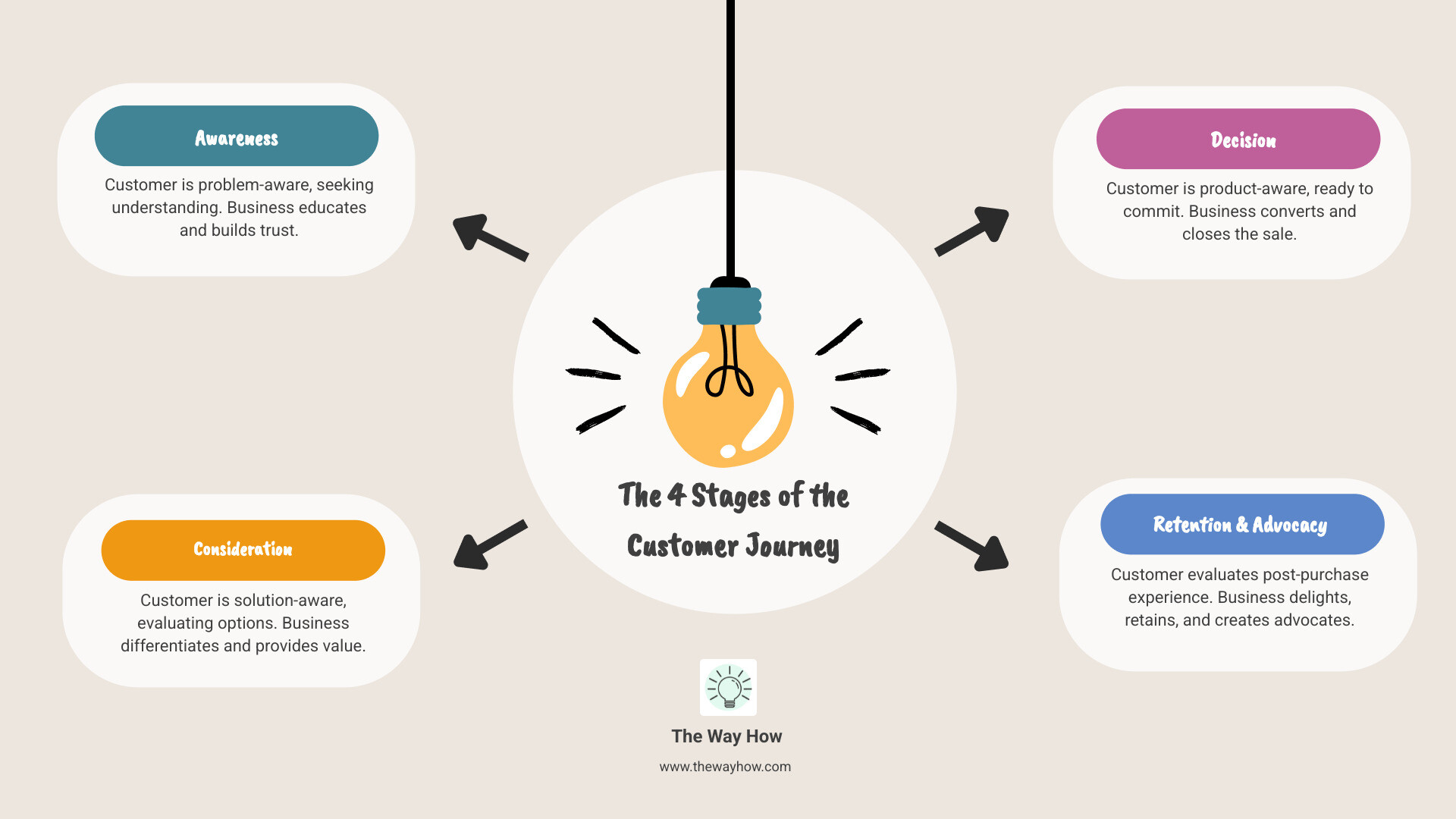
The 4 stages of customer journey are typically defined as: Awareness (recognizing a problem), Consideration (evaluating solutions), Decision (choosing a provider), and Retention & Advocacy (becoming a loyal customer and promoter).
| Stage | Customer Mindset | Business Goal |
|---|---|---|
| Awareness | Problem-aware, seeking understanding | Educate and build trust |
| Consideration | Solution-aware, evaluating options | Differentiate and provide value |
| Decision | Product-aware, ready to commit | Convert and close |
| Retention & Advocacy | Post-purchase, evaluating experience | Delight, retain, create advocates |
Here’s what most marketing advice won’t tell you: your customer’s path to purchase is not a straight line.
It’s messy. It loops back. It stalls. It accelerates without warning.
The traditional marketing funnel suggests a tidy, predictable flow from awareness to purchase. But real human behavior doesn’t work that way. People skip stages. They circle back after months of silence. They research extensively but never buy. Or they buy immediately with barely any consideration at all.
This isn’t a problem with your customers. It’s a flaw in how we’ve been taught to think about growth.
Customer journeys are not linear because decision-making is not linear. It’s psychological. It’s emotional. It’s shaped by uncertainty, trust, timing, and a dozen other variables you can’t control but can account for.
Understanding the 4 stages of the customer journey isn’t about forcing people down a predetermined path. It’s about diagnosing where certainty breaks down and building systems that restore momentum at each stage.
When you map the journey correctly, you stop guessing why growth is stalled. You see where prospects get stuck, where trust erodes, and where small changes create outsized impact.
The research backs this up: companies that help customers move through their buying journey with relevant, helpful content are three times more likely to close bigger deals with less buyer’s remorse. And businesses that increase retention by just 5% can grow profits by 25% to 95%.
This isn’t about tactics. It’s about understanding human behavior well enough to meet people where they are, with what they need, at the moment they need it.
That’s what this guide is for.
Understanding the customer journey is crucial for any business aiming for sustainable growth. It’s not just about tracking transactions; it’s about comprehending the full spectrum of a customer’s interactions and emotions with your brand. Why is this so vital? Because each stage offers unique opportunities to build trust, remove friction, and ultimately drive customer experience (CX) that leads to predictable revenue.
When we truly grasp the nuances of each stage, we can align our strategies to the customer’s evolving mindset, rather than imposing a generic sales process. This customer-centric approach helps us identify and address pain points before they escalate, turning potential frustrations into moments of delight. The customer journey, at its core, is the path your target audience takes toward becoming loyal customers. It encompasses everything from their first interaction to post-purchase engagement, shaping the entire business by influencing how customers are attracted, informed, convinced to purchase, and retained.
By optimizing this journey, we’re not just improving sales; we’re fostering deeper relationships, increasing customer satisfaction, and building a foundation for long-term business growth. As Salesforce notes, maintaining a positive customer experience helps keep the customer journey moving forward and plays a critical role in customer retention and advocacy.

In the Awareness stage, potential customers are often problem-aware but not yet solution-aware. They recognize they have a challenge, a need, or a desire, but they might not know what to call it, let alone how to solve it. Their mindset is one of initial curiosity and a search for understanding.
Once a potential customer understands their problem, they move into the Consideration stage. Now, they’re actively seeking solutions. They’re no longer just identifying the pain; they’re exploring different ways to alleviate it. Their mindset shifts from “what is this problem?” to “how can I fix this problem?“.
The Decision stage is where the customer is product-aware, or rather, service-aware, and ready to choose a provider. They’ve evaluated the different solutions and are now narrowing down their options to select the best fit. Their focus shifts to specifics: “Which specific company or product will deliver the solution I need?”
The journey doesn’t end with a purchase; it’s just the beginning of a relationship. The Retention & Advocacy stage is where customers evaluate their experience, seek to maximize value, and ideally, become loyal brand advocates. This is where we shift from acquisition to nurturing, understanding that a satisfied customer is our best marketing asset.
Leveraging customer journey mapping is where the theoretical understanding of the 4 stages of the customer journey transforms into actionable strategy. For us, customer journey mapping is more than just a visualization; it’s a diagnostic tool that helps us identify certainty gaps and diagnose stalled growth. It allows us to step into the customer’s shoes, understanding their motivations, questions, and pain points at every interaction.
A customer journey map visually represents the entire customer lifecycle, covering all customer journey stages and interactions across channels like social media, our website, email, or direct conversations. It can also include information about customer personas, making it a powerful tool for empathy.
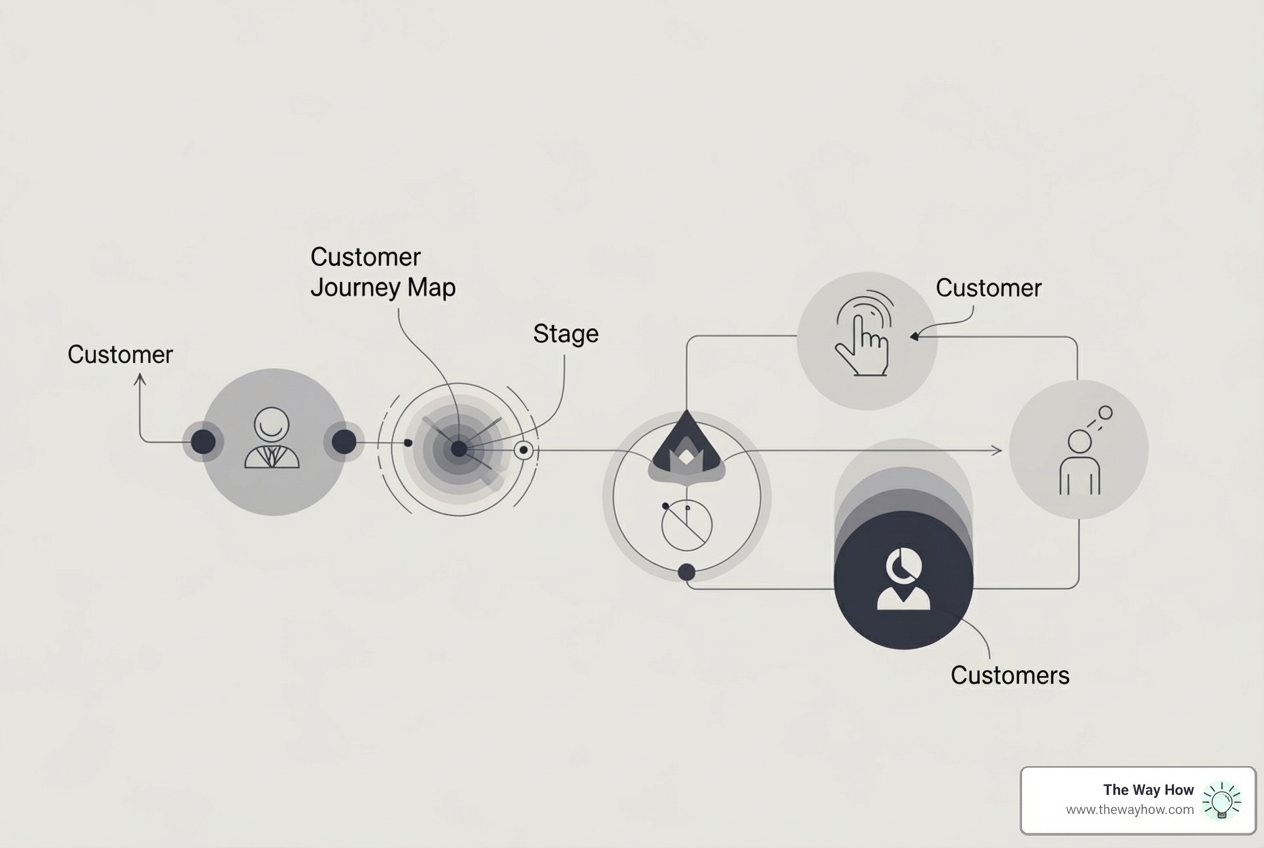
This blueprint helps us see where cross-department alignment might be lacking. When marketing, sales, and service teams all contribute to the map, it fosters a shared understanding of the customer experience and highlights areas where handoffs or communication might be breaking down. This collaborative approach leads to data-driven decisions, ensuring that our efforts are focused on what truly matters to the customer. As Qualtrics emphasizes, mapping helps unify fragmented efforts and improves customer experience.
Creating an effective customer journey map involves several key steps:
Data is the lifeblood of an optimized customer journey. Long gone are the days of one-size-fits-all mass emails. Today, customers expect personalized experiences across all channels. We use data to understand human behavior, predict needs, and tailor our interactions at every stage.
The terms “customer journey” and “buyer’s journey” are often used interchangeably, but for us, there’s a crucial distinction that impacts how we approach marketing and revenue strategy. Understanding this difference is fundamental to diagnosing where growth is stalled and building systems that create predictable revenue.
| Feature | Customer Journey | Buyer’s Journey |
|---|---|---|
| Scope | Holistic, end-to-end experience with a brand, from initial awareness to post-purchase loyalty and advocacy. | Focuses on the customer’s decision-making process leading up to a purchase. |
| Perspective | Primarily from the business’s viewpoint, mapping all interactions and touchpoints we offer. | Primarily from the potential customer’s viewpoint, detailing their internal process of identifying a problem, researching solutions, and evaluating providers. |
| Stages | Typically 4 stages: Awareness, Consideration, Decision, Retention & Advocacy (though some models expand this). | Usually 3 stages: Awareness (problem recognition), Consideration (solution exploration), Decision (vendor selection). |
| Objective | To build long-term relationships, maximize customer lifetime value (CLV), and foster advocacy. | To guide a prospect through their pre-purchase decision-making process and facilitate a sale. |
| Outcome | A loyal, satisfied customer who may become an advocate and repeat buyer. | A completed purchase. |
| Timeframe | Ongoing, extends indefinitely as long as the customer interacts with the brand. | Finite, concludes once a purchase decision is made. |
The customer journey is a broader, business-centric view that encompasses every interaction a person has with our organization. It starts with their first encounter and continues through their purchase, onboarding, ongoing use of our services, and ideally, into a relationship of loyalty and advocacy. It’s about the entire ecosystem of touchpoints and the overarching experience we provide.
The buyer’s journey, on the other hand, is a specific subset of the customer journey. It’s the path a potential client takes before making a purchase, focusing solely on their decision-making process. It’s about how they identify their problem, research potential solutions, and ultimately choose a provider. The buyer’s journey concludes once the purchase is made.
This distinction matters immensely for business growth because it clarifies our focus. If we only consider the buyer’s journey, we risk neglecting the critical post-purchase phases that drive retention, repeat business, and referrals. It’s in the Retention & Advocacy stages of the customer journey that we build true loyalty and generate the most predictable revenue. Ignoring these stages means constantly chasing new customers, which we know is significantly more expensive than nurturing existing ones.
By understanding both, we can design strategies that not only attract new buyers but also transform them into lifelong advocates. The buyer’s journey informs our acquisition efforts, while the full customer journey guides our entire relationship management, ensuring that every touchpoint contributes to a positive, cohesive experience.
The customer journey profoundly influences customer retention and loyalty because it encompasses the entire relationship a customer has with your brand, not just the initial sale. A well-managed customer journey, especially the post-purchase stages, builds trust, satisfaction, and emotional connection. When customers feel understood, supported, and valued throughout their experience, they are much more likely to stay.
A positive journey fosters loyalty by consistently meeting or exceeding expectations. This leads to satisfied customers who are not only retained but also become loyal customers, actively choosing your brand over competitors. As Forbes highlights, satisfied customers become loyal customers, and customer loyalty reduces churn while increasing profits. The statistics support this: returning customers spend 67% more than new customers, and 59% of American consumers say that once they’re loyal to a brand, they’re loyal to it for life. Focusing on the entire customer journey, particularly the retention and advocacy stages, is therefore a direct investment in long-term profitability and sustainable growth.
Personalizing the customer journey is about making each interaction feel unique and relevant to the individual. Here’s how we approach it:
No, the 4-stage customer journey model (Awareness, Consideration, Decision, Retention & Advocacy) is a foundational framework, but it’s not the only one. Many organizations and thought leaders offer variations, often expanding on these core stages or categorizing them differently.
For instance, McKinsey’s consumer decision journey consists of initial consideration, active evaluation, closure, and post-purchase loyalty loop. Gartner’s B2B buyer journey, on the other hand, breaks down into problem identification, solution exploration, requirements building, supplier selection, validation, and consensus creation. Some models might include five or even six stages, often adding “Findy” or separating “Retention” from “Advocacy.”
While these models offer different lenses, the 4-stage model provides a clear and actionable structure for most businesses to start with. It captures the essential psychological shifts a customer undergoes and the critical business objectives at each point. For us, it serves as an excellent starting point to identify certainty gaps and build robust systems, which can then be refined with more granular stages as needed. The key is not the number of stages, but the underlying psychological understanding and the ability to apply it to create a predictable and positive customer experience.
We’ve explored the customer journey not as a rigid sales funnel, but as a dynamic, psychological quest driven by human behavior and decision-making. This shift in perspective—from chasing tactics to building resilient systems—is at the heart of what we do at The Way How.
By understanding the 4 stages of the customer journey, we can diagnose why growth is stalled, identify the precise certainty gaps where trust erodes, and design systems that restore momentum. Our psychology-first approach, rooted in empathy and behavioral insight, allows us to meet customers where they are, offering clarity and value at every turn.
This isn’t about quick fixes; it’s about building a dependable growth engine. It’s about turning insights into actionable strategies that create trust, foster lasting relationships, and generate predictable revenue. We believe that when you understand the human behind the transaction, you open up true, sustainable growth.
Ready to transform your customer’s quest into a journey of loyalty and advocacy? Discover our strategic marketing services and let us help you build systems that deliver clarity, momentum, and predictable revenue.
 Jeremy Wayne Howell : Jul 22, 2026 9:48:31 PM
 Jeremy Wayne Howell : Jul 21, 2026 9:47:10 PM
 Jeremy Wayne Howell : Jul 20, 2026 9:46:47 PM