A Complete Guide to CRM Systems and Database Management
 Jeremy Wayne Howell : Jul 22, 2026 9:48:31 PM

Define go to market and you’ll find dozens of definitions that sound smart but feel vague. Most explanations treat it like a checklist. A few even make it sound like magic.
Here’s the truth: A go-to-market (GTM) strategy is an action plan that shows how you’ll bring a product or service to the right customers, at the right time, with the right message—while reducing risk and uncertainty.
It answers four questions:
A GTM strategy isn’t a marketing plan. It’s not a business plan either. It’s the blueprint that connects your product to a market in a way that builds trust, creates certainty, and drives revenue.
Most companies skip this step. They launch products based on optimism, not insight. They assume their audience will “just get it.” Then they wonder why adoption is slow, why sales cycles drag, and why growth feels unpredictable.
The problem isn’t effort. It’s clarity.
You can’t create momentum without understanding what your customer believes is true, what’s actually true, and where the gaps exist. A GTM strategy forces you to think like your buyer before you ask them to think like you.
In this guide, we’ll walk through what a GTM strategy actually is, why it matters, and how to build one that’s grounded in human behavior—not just tactics. We’ll show you the components that matter, the steps that work, and the mistakes that stall growth.
If you’ve ever felt like your launch didn’t land the way you expected, or if you’re preparing to enter a new market and want to do it right, this is where you start.
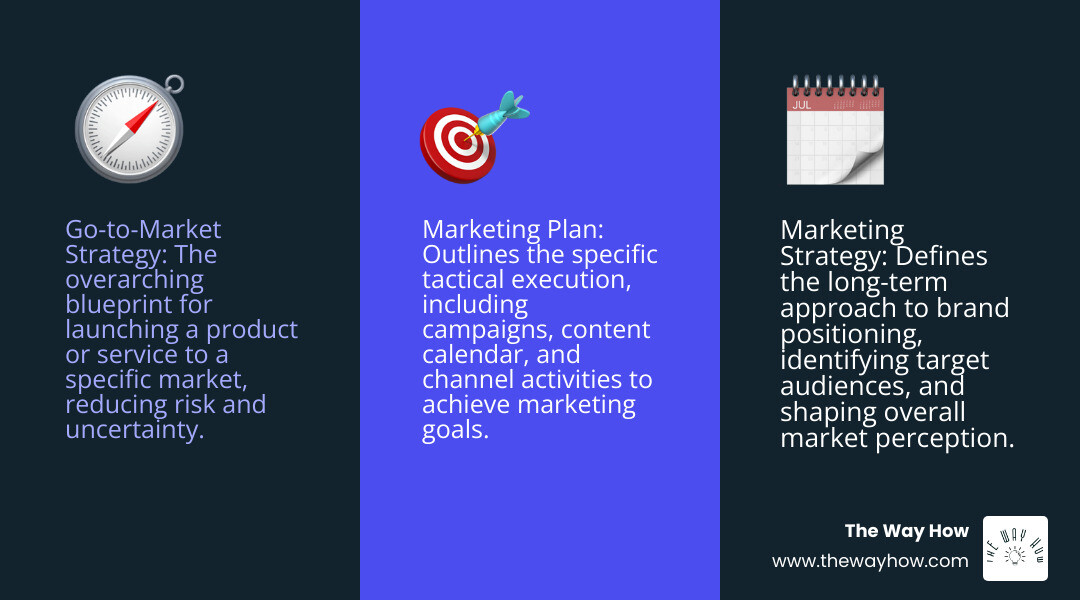
A go-to-market (GTM) strategy is a detailed blueprint outlining how a company will introduce a new product or service to a specific market. It’s a strategic roadmap that guides every step from conception to customer conversion, designed to minimize risk and maximize competitive advantage.
At The Way How, we see it as an exercise in removing uncertainty. A GTM strategy designs a system that ensures your offering resonates with human behavior, building trust and creating certainty in the customer’s decision-making process. It’s your compass toward predictable revenue and achieving product-market fit—the point where your product satisfies strong market demand. A GTM strategy aligns all resources to deliver your unique value proposition and gain a competitive edge. More on product-market fit
People often confuse a GTM strategy with a marketing strategy, but they are distinct concepts.
A GTM strategy is a holistic plan for a specific launch or market entry. Its scope is broad, covering the target market, value proposition, pricing, sales, and distribution channels for that particular launch. It’s the plan for winning a specific battle (a product launch).
A marketing strategy, in contrast, is a broader, long-term approach to building brand awareness and fostering customer relationships. It’s a continuous process focused on creating demand and covers brand positioning and overall communication themes. While a GTM strategy is launch-specific, a marketing strategy is about the enduring presence of your brand. It’s your plan for winning the war (long-term market presence).
If a GTM strategy is the launch blueprint, a marketing plan is the tactical execution. It’s an action plan for a specific campaign or period, detailing the concrete steps, budget, and timeline for marketing activities like content creation, ad campaigns, and social media.
The GTM strategy provides the “why” (this product, this market) and the “who” (our customer), while the marketing plan provides the “how” (our communication) and the “when” (our schedule). For example, Microsoft’s GTM strategy for its Surface tablet was a focused launch plan to solve a specific market problem. In contrast, Sephora’s loyalty program is a long-term marketing plan to build customer loyalty, not tied to a single launch.

Just as a successful building requires a solid blueprint, an effective GTM strategy is built upon several core components. These aren’t just checkboxes; they are interconnected pieces that, when thoughtfully assembled, create a cohesive and compelling narrative for your product. For us, these components are deeply rooted in understanding human behavior, decision-making psychology, and empathy. We don’t just ask what to do, but why it resonates with your customer’s inner world.
The five core components of a GTM strategy are:
Let’s explore each one.
This is perhaps the most critical component, yet it’s often oversimplified. Defining your target market isn’t just about demographics; it’s about understanding the deep-seated motivations, fears, and unmet needs of the people you aim to serve. We call this a “psychology-first” approach.
We need to create detailed buyer personas and Ideal Customer Profiles (ICPs). An ICP describes the type of company you want to sell to (for B2B), while buyer personas represent the specific individuals within those companies (or individual consumers in B2C) who will interact with and buy your product. These aren’t just fictional characters; they are data-driven representations built from research, customer interviews, and empathetic insights.
Ask yourself:
Market segmentation plays a vital role here. It’s the process of dividing prospective customers into different groups that share common needs and are likely to react similarly to a marketing action. This allows us to tailor our approach, ensuring our full value proposition is delivered to those who will appreciate it most. For instance, Apple’s iMac G3 launch in 1998 targeted three primary consumer groups: first-time computer buyers, loyal Apple users, and PC owners (who made up 85% of the market). This segmentation allowed them to craft specific messaging for each group.
Beyond pain points, understanding your customers’ needs is essential. For example, Apple consistently emphasizes customer experience by analyzing customer needs and designing products accordingly. This deep understanding of human behavior is what allows us to identify who we are truly selling to and why they would choose us.
Once you know who you’re selling to, the next step is to articulate why they should care about your offering. Your value proposition is a clear statement that explains what unique benefits your product provides, how it solves your customer’s problems, and why it’s better than the alternatives (including doing nothing).
It’s not enough to list features; you must translate those features into tangible and emotional benefits that resonate with your target audience. What are the desired outcomes your customer seeks? How does your product deliver on those, and how does it make them feel? Does it reduce stress, save time, improve status, or provide a sense of security?
To make this concrete, we often recommend creating a value matrix. This tool breaks down each buyer persona, their specific pain points, the value your product brings to address those pain points, and a concise key message that conveys how your product solves their unique problem. This ensures your messaging is not generic but deeply empathetic and relevant.
In a crowded market, differentiation is key. Your value proposition must clearly explain why customers should choose your solution over competitors’ offerings. As we often tell our clients, it’s about separating yourself from the crowd of products already on the market. It’s not just about solving a problem; it’s about solving it better, differently, or more empathetically than anyone else.
This component addresses the practicalities of how your product will reach your customer and what they will pay for it. These decisions are heavily influenced by your target market and value proposition, as they must align with customer expectations and perceived value.
Your pricing strategy isn’t just about covering costs; it’s a powerful statement about your product’s value and market position. Will you opt for a premium price to signal exclusivity and quality, or a competitive price to gain market share? Will you use a subscription-based model (like Adobe’s shift from Creative Suite to Creative Cloud) or a transactional model? Modern approaches often involve advanced pricing models that incorporate economic value estimation and perceived value pricing, aligning the cost with the genuine benefit the customer receives.
Next, you need to define your distribution channels—the paths your product takes to get from your company to the end-user. This could involve direct sales, e-commerce, retail partners, distributors, channel partners, or a combination. The choice depends on your product’s nature, your target audience’s buying habits, and your desired customer experience. For instance, Oatly initially focused on partnering with artisanal coffee shops in the US, going directly to where their target demographic of dairy-alternative seekers were already looking for options.
Finally, your sales strategy outlines how you will acquire customers through these channels. Will it be self-service, inside sales (telesales), field sales, or via channel partners? The goal is to make the buyer’s journey as seamless as possible, removing any friction or certainty gaps that might prevent a purchase. This requires aligning your sales process with CRM and lead nurturing systems, ensuring a smooth transition from interest to conversion.
Building a GTM strategy is an iterative process that requires cross-functional collaboration and a deep understanding of your customer. It’s a living document that guides your launch and evolves with market feedback. Here’s a simplified, actionable framework to create an effective GTM strategy:
First, understand who you’re selling to and what problem you’re solving. This is about diagnosing why a new product might not gain traction before it even launches.
Articulate how your product provides a unique solution that connects with your customer’s underlying needs.
Determine how customers will access and pay for your product. These decisions must align with your value proposition and target market.
Plan how you’ll generate demand and convert leads into customers.
Define how you’ll measure success and optimize your strategy. This is about learning, adapting, and ensuring your GTM plan creates predictable revenue.
Define Key Performance Indicators (KPIs): Select critical metrics to track if your strategy is working. Key examples include:
Establish a feedback loop: Regularly review metrics and customer feedback to iterate on your strategy. An agile approach is key to long-term success.
Understanding GTM strategies in theory is one thing; seeing them in action provides invaluable insights. These examples demonstrate how a well-executed GTM plan can lead to significant success and even disrupt entire industries.
In 1998, Apple was in financial trouble. Its go-to-market strategy for the iMac G3 wasn’t just about launching a computer; it was about saving the company and redefining personal computing.
Apple targeted a diverse audience: first-time computer buyers, loyal Apple users, and the vast 85% of the market using PCs. The strategy began with Steve Jobs’ iconic presentation, where he emphasized Apple’s renewed strength and commitment to innovation. He famously joked about the iMac’s unique, egg-shaped, transparent “Bondi blue” design: “This is incredible compared to anything else out there. It looks like it’s from another planet—and a good planet. A planet with better designers.” [3] This presentation was a masterclass in changing public perception and building anticipation.
The iMac G3’s value proposition was clear: it was simple, intuitive, and designed for the internet age (“No. 1 reason people aren’t buying computers is that they’re too complicated.”). It stood out aesthetically and functionally. Apple then backed this with a massive $100 million marketing blitz, reinforcing Jobs’ talking points. Large inflatable Macs appeared over stores, and television commercials aired during prime-time shows, ensuring widespread awareness and guiding consumers on where to purchase. This holistic approach, from product design to messaging and distribution, effectively saved Apple from financial ruin.
When the Swedish company Oatly decided to expand into the US market, oat milk wasn’t a household name. Instead of a traditional, expensive advertising campaign, Oatly employed a brilliant, psychology-first go-to-market strategy focused on building credibility and trust.
They didn’t try to convince consumers directly. Instead, they went straight to artisanal coffee shops, partnering with baristas who were already trendsetters and influencers in the dairy-alternative space. By getting baristas to use and recommend Oatly, they leveraged social proof and word-of-mouth marketing. This strategy focused on building a grassroots following and establishing the product’s quality and taste in a high-leverage environment.
This empathetic approach, understanding where their target customers (those seeking dairy alternatives) would be most receptive to a new product, paid off handsomely. Oatly’s revenue grew ten-fold between 2017 and 2018, bringing a new oat-milk craze along with it. Their success highlights the power of understanding customer context and building trust through authentic channels.
A business plan is a broad document outlining the entire company’s vision, mission, and long-term goals. A GTM strategy is a focused subset of that plan, detailing the specific actions for launching a particular product or entering a new market. If a business plan says what you’ll do (e.g., launch a new product), the GTM strategy explains how you’ll do it successfully.
Create a GTM strategy whenever you are:
Essentially, any significant change in your product or target market warrants a GTM strategy.
The most common mistakes include:
A go-to-market strategy is far more than a buzzword or a launch checklist. It’s a powerful system that, when crafted with a deep understanding of human behavior, empathy, and decision-making psychology, removes uncertainty and paves the way for predictable revenue. It’s the difference between hoping for success and strategically building it.
At The Way How, we believe that true growth doesn’t come from chasing tactics, but from diagnosing why growth is stalled, identifying certainty gaps in the customer journey, and designing systems that create trust, momentum, and predictable revenue. Your GTM plan is the perfect vehicle for this. It blends strategic clarity with behavioral insight and operational execution, changing your marketing and sales efforts into a dependable growth engine.
Ready to build a GTM strategy that’s rooted in human behavior and delivers predictable revenue? Learn how to build a revenue strategy rooted in human behavior
 Jeremy Wayne Howell : Jul 22, 2026 9:48:31 PM
 Jeremy Wayne Howell : Jul 21, 2026 9:47:10 PM
 Jeremy Wayne Howell : Jul 20, 2026 9:46:47 PM