A Complete Guide to CRM Systems and Database Management
 Jeremy Wayne Howell : Jul 22, 2026 9:48:31 PM
12 min read

A financial planning client acquisition funnel is a structured, psychology-driven system that guides prospects from first awareness of your services through to becoming clients—and eventually advocates. It transforms unpredictable, referral-dependent growth into a repeatable engine that consistently fills your pipeline with qualified leads.
Here’s how it works:
More than half of all financial advisors cite client acquisition as a significant challenge. Yet most are stuck in what we call “referral roulette”—hoping the phone rings, counting on existing clients to remember to send business your way, or throwing money at tactics that promise leads but deliver frustration.
Your business plan can’t be “hope they call me.”
The truth is, people don’t hire financial advisors impulsively. They’re making high-stakes, emotionally charged decisions about their future. They need time. They need trust. They need to feel certain that you understand them before they’ll even consider sharing their financial life with you.
That’s why the average website conversion rate across all industries hovers around 2%. Most visitors leave without taking action—not because they don’t need help, but because they don’t yet trust you enough to take the next step.
A well-designed financial planning client acquisition funnel changes that. It’s not a sales trick. It’s a behavioral map that meets prospects where they are psychologically, answers their questions before they ask them, and builds trust through consistent, empathetic engagement.
This guide will show you how to build one—not by chasing trends or buying leads, but by understanding human behavior and creating a system that makes prospects feel safe, informed, and ready to move forward.
We’ve all been there: the unpredictable peaks and valleys of client acquisition. One month, referrals are flowing; the next, the phone is silent. This emotional rollercoaster takes a toll, creating uncertainty that permeates every aspect of your practice. Ad-hoc marketing, a sporadic LinkedIn post here, a casual coffee meeting there, often feels like a necessary evil rather than a strategic lever. The hidden risks are real: inconsistent revenue, wasted time on unqualified leads, and the nagging feeling that you’re leaving growth on the table.
Relying solely on referrals, while valuable, is like betting your retirement on a single stock—significant if it works, but risky and unpredictable. It means your growth isn’t in your hands; it’s subject to the whims and memories of others. This isn’t a sustainable model for business growth.
And why do most financial advisor websites fail to convert? Because they often treat a complex, high-trust decision like a simple transaction. The average website conversion rate across B2B is just about 2%. This means roughly 98% of brand-aware accounts visiting your website leave without taking action. Why? Because the psychology behind high-trust decisions demands more than just information; it demands reassurance, empathy, and a clear, guided path forward.
We understand that you’re experts in financial advisory, not in testing marketing tactics or optimizing conversion rates. That’s precisely why we advocate for a comprehensive, behavior-driven prospecting strategy. It’s about moving from scattered, disconnected tactics to a cohesive, connected system where every touchpoint builds trust and momentum. We believe in diagnosing why growth is stalled and designing systems that create trust, momentum, and predictable revenue.
The journey a prospect takes to choose a financial advisor is rarely linear. It’s often fraught with anxiety, questions, and the fear of making the wrong decision. When your marketing and sales processes are disconnected, you exacerbate these pain points. Prospects are left to steer a confusing landscape, encountering unclear next steps and feeling like just another number.
Transactional tactics, common in many sales environments, simply don’t work in a relationship business like financial planning. People need to feel understood, valued, and safe. When their journey is fragmented, with information gaps and inconsistent messaging, they disengage. This leads to missed opportunities from a lack of follow-through, where promising leads simply fade away. The stark reality of a 2% average website conversion rate isn’t just a statistic; it’s a testament to the cost of a fragmented experience and the profound need for a more empathetic approach.
At The Way How, we see a financial planning client acquisition funnel not just as a marketing tool, but as a trust-building framework. It’s a system designed with human behavior and decision-making psychology at its core. Instead of pushing sales, we focus on guiding prospects with empathy and clarity, creating certainty at every stage of their journey.
This approach means aligning your marketing efforts with your sales process, ensuring a seamless experience where every interaction adds value and reinforces your expertise. The goal is to transform your client acquisition from a series of hopeful encounters into a predictable revenue engine. By understanding the “why” behind prospect actions and designing systems that anticipate their needs, we help you build a dependable growth engine rooted in behavioral insight and operational execution.
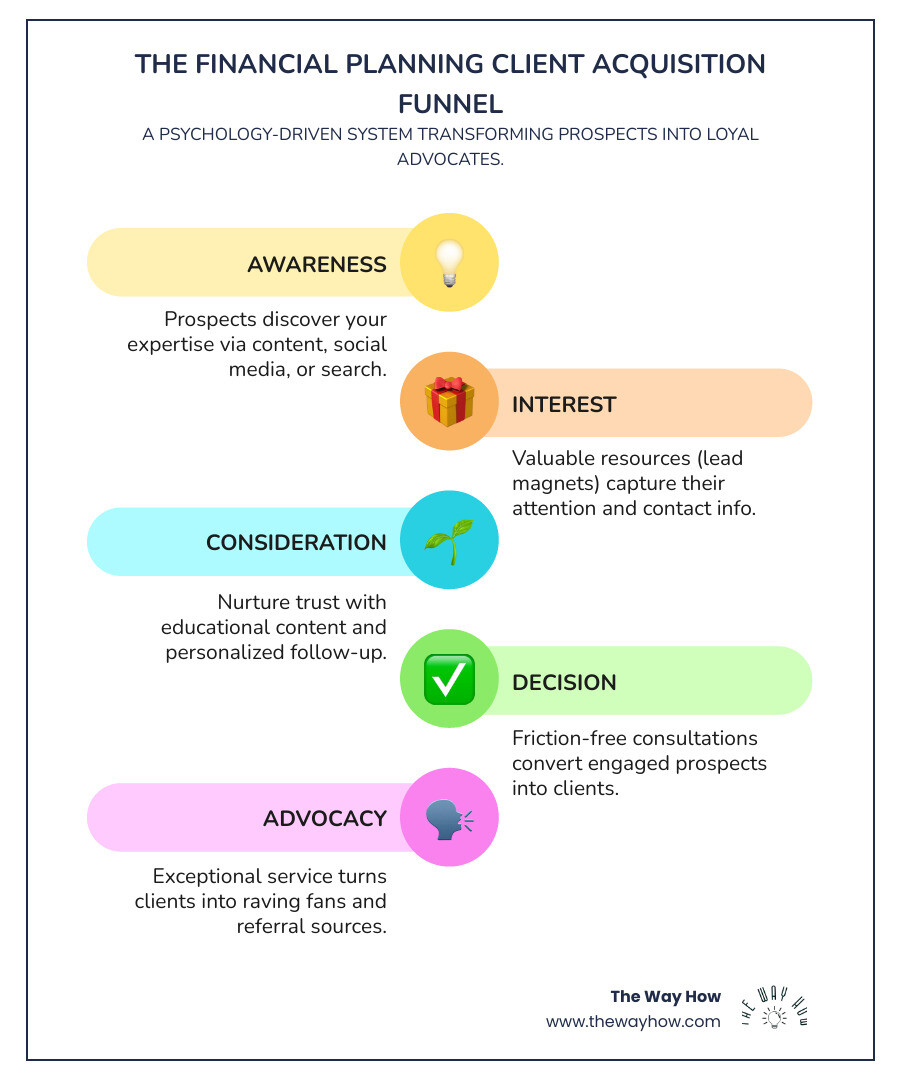
Think of the client journey not as a straight line, but as a path with five distinct milestones, each representing a crucial stage in building trust. At each milestone, your prospect has different questions, anxieties, and levels of engagement. Our goal as advisors is to meet them there, with empathy and clarity, guiding them through a series of micro-commitments that progressively deepen their trust.

In the awareness stage, prospects are just beginning to acknowledge a financial need or problem. They’re not looking for an advisor yet; they’re looking for answers. This is where you establish yourself as a trusted authority. We believe in teaching, not selling. Advisors who consistently share valuable insights, analysis, and financial planning strategies gain recognition and respect from peers and prospects. Recent research indicates that this educational approach leads to higher referrals and conversions.
Content that answers real questions—short, educational videos, insightful blog posts, or guides addressing common pain points—builds credibility. Social media platforms, especially LinkedIn, can be a goldmine for financial advisors due to active engagement with industry insights and expert advice. A Broadridge survey found that four in 10 advisors reported adding new clients via social media in 2023, with LinkedIn being the most effective platform, followed by Facebook. Your presence here should be about sharing knowledge, not pushing services.
Once prospects are aware of their problem and your expertise, they move into the interest stage. They’re now open to learning more, but they’re still cautious. This is your opportunity to capture their attention by exchanging value for their contact information.
Lead magnets, such as e-books, checklists, quizzes, video courses, or calculators, are excellent tools here. The key is to offer something that solves a specific, meaningful problem for your target audience. For instance, a “Retirement Readiness Checklist” or a “Guide to Tax-Saving Strategies for Small Business Owners” can demonstrate immediate value. This allows you to build an email list, which is crucial for ongoing trust-building and nurturing. You’re showing them what it’s like to work with you by giving them a taste of your expertise without asking for a significant commitment yet.
Now that you have their attention and permission to communicate, the consideration and evaluation stages are about nurturing trust at scale. One interaction rarely leads to a client conversion. A well-structured funnel incorporates multiple touchpoints to keep prospects engaged. This is where email nurture sequences shine. Recent research highlights that advisors who provide valuable, educational content see higher conversion rates than those who exclusively promote their services.
Your emails should educate, empathize, and consistently provide value, addressing their skepticism and concerns. Incorporate client testimonials and case studies to build credibility and demonstrate real-world success. Personalize your content to resonate with their specific needs and financial goals. In the high-trust world of financial planning, education consistently outperforms persuasion. We’re guiding them to understand their options and feel confident in your ability to help, rather than trying to hard-sell.
The decision stage is where all that trust-building culminates. Prospects are ready to make a choice, and your role is to remove any friction from this critical step. Make it easy for them to book a consultation through online scheduling tools.
The findy call, or what we like to call the “fit call,” is a crucial trust checkpoint. It’s not a sales pitch; it’s a mutual exploration to determine if there’s a good fit between their needs and your services. Use active listening to understand their goals, assets, decision-makers, and objections. If a good fit is established, present clear, expectation-setting proposals that are custom to their unique situation and clearly outline value-based outcomes and onboarding timelines.
Finally, a smooth and reassuring onboarding experience is paramount. A well-structured data intake and onboarding process is a must for establishing a positive relationship from the very beginning. This includes clarifying goals, gathering necessary documents, automating data intake (like risk tolerance assessment and statement aggregation), analyzing their portfolio, and ensuring all compliance documentation is handled digitally and efficiently. Providing ongoing education about their new portfolio and investment strategy further solidifies their decision.
The funnel doesn’t stop once a client signs on the dotted line. The advocacy stage is about client retention and turning happy clients into your most powerful growth engine. It’s far easier and more cost-effective to serve current clients than to find and convert new ones.
Long-term relationship building hinges on proactive, transparent communication. The number one reason clients leave an advisor is due to lack of quality communication. Plan regular check-ins to review portfolio performance, make necessary adjustments, and simply listen to their evolving needs. When clients feel truly cared for and understood, they become raving fans. Make it easy for them to refer you by clearly articulating who you help and why your services are unique. Asking for referrals during key moments—after a significant win, a successful annual review, or a particularly smooth onboarding—can be incredibly effective.
Building a high-performance financial planning client acquisition funnel requires a blend of strategic thinking, an understanding of human behavior, and the right tools. It’s about creating a system where digital tools support—not replace—the human connection that is so vital in financial planning. Personalization and automation, when used thoughtfully, become powerful trust multipliers.

Content is the fuel that drives your funnel, especially in the early stages. It’s how you capture attention and establish credibility.
Technology should be your co-pilot, enhancing your ability to connect with and serve prospects, not a replacement for your human touch.
Building a financial planning client acquisition funnel is an iterative process, and it’s easy to stumble. We’ve seen these common pitfalls:
Without clear visibility into your funnel’s performance, you’re essentially driving blind. Measuring what matters allows you to diagnose issues, identify bottlenecks, and make data-driven decisions for continuous improvement. This is where the art of financial planning meets the science of marketing.
To truly understand the health of your funnel, we track several key performance indicators (KPIs):
Tracking these metrics isn’t just about numbers; it’s about uncovering actionable insights into human behavior.
A financial planning client acquisition funnel operates on fundamentally different principles than a typical e-commerce or B2B sales funnel. The primary difference lies in the primacy of trust. Financial planning involves high-stakes, high-emotion decisions about an individual’s future, not a simple product purchase. This necessitates:
Effective lead magnets for financial advisors are those that provide immediate, tangible value and demonstrate your expertise without requiring a significant commitment. They should address common pain points or offer actionable insights. Here are some proven examples:
It’s important to set realistic expectations. Building a robust financial planning client acquisition funnel is an investment in a long-term asset, not a quick fix. While some initial leads might convert faster, the full journey from awareness to client can take anywhere from one month to a year.
The journey through the sales funnel can be expected to last several weeks at a minimum to several months. This is because you’re building trust and guiding complex decisions. The results compound over time. As your content builds authority, your nurture sequences become more refined, and your brand awareness grows, the funnel becomes increasingly efficient. This differs significantly from simply buying leads, which can offer immediate but often lower-quality results. A well-built system delivers sustainable, predictable growth.
The era of “referral roulette” is over. To thrive in today’s competitive landscape, financial advisors must stop gambling with their growth and start building a predictable, psychology-first client acquisition system. By understanding human behavior, diagnosing where uncertainty exists in the customer journey, and designing systems that create trust and momentum, you can transform your marketing into a dependable growth engine.
At The Way How, we specialize in helping founders and leadership teams remove uncertainty in their sales and marketing systems. We don’t chase tactics; we diagnose why growth is stalled, identify certainty gaps, and design strategies rooted in empathy and decision-making psychology. This leads to clarity, predictable revenue, and ultimately, a thriving practice.
Ready to build your own money magnet and ensure a steady stream of ideal clients?
 Jeremy Wayne Howell : Jul 22, 2026 9:48:31 PM
 Jeremy Wayne Howell : Jul 21, 2026 9:47:10 PM
 Jeremy Wayne Howell : Jul 20, 2026 9:46:47 PM