

The Leadership Gap Most Growing Companies Don’t Know They Have

Fractional chief marketing officers are senior marketing executives who work with a company on a part-time or contract basis — providing the same strategic leadership as a full-time CMO, without the full-time salary.
Here is a quick overview of what you need to know:
As businesses grow, marketing tends to outgrow whoever is currently running it. A founder stretches thin. A junior marketer gets handed strategy responsibilities they were never trained for. An agency runs campaigns with no one connecting the results to a larger business direction. Growth stalls — not because the team isn’t working hard, but because no one is steering.
That is the gap a fractional CMO is designed to fill.
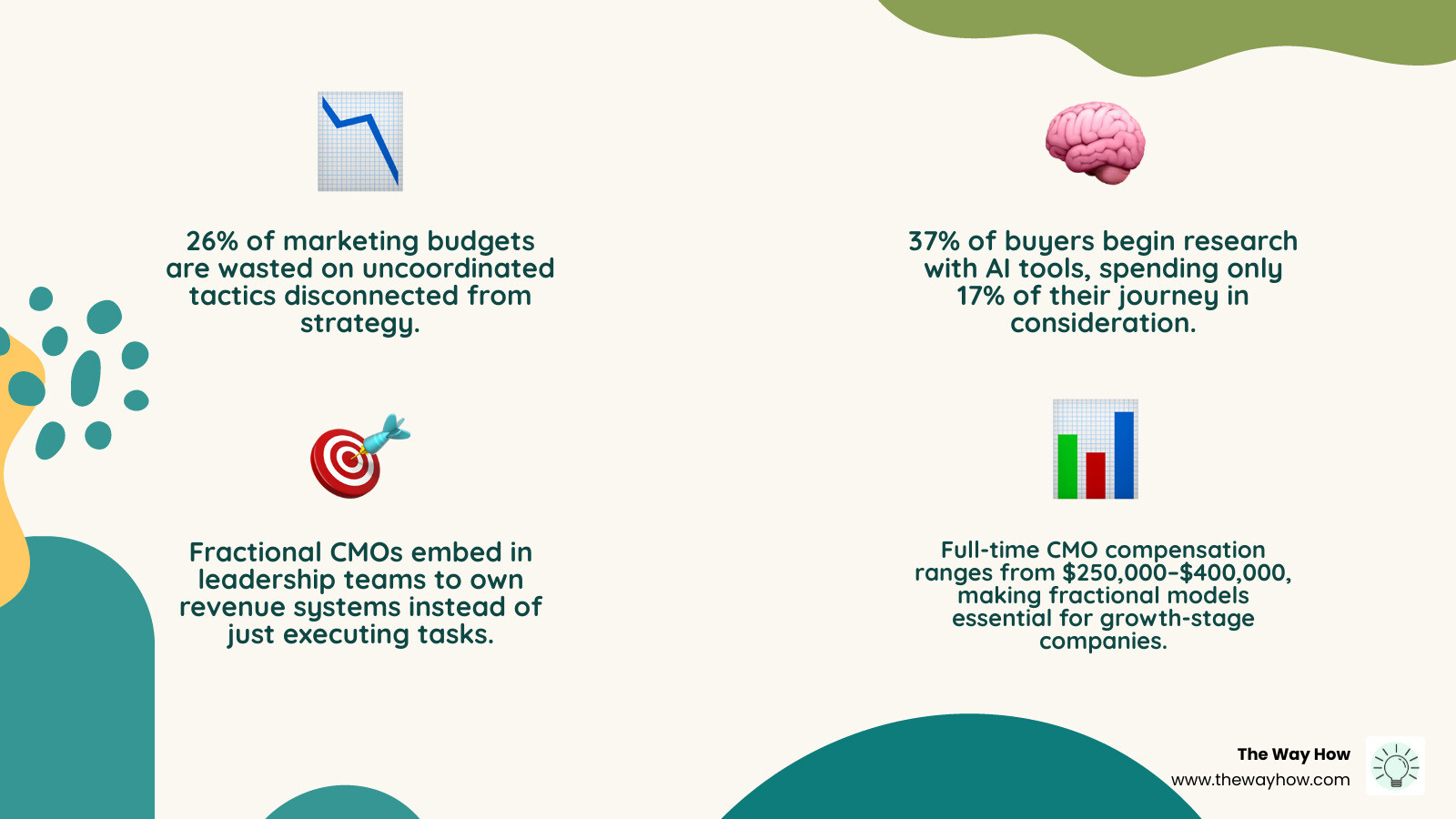
This is not a consultant who delivers a deck and disappears. It is not an agency managing your ad spend. A fractional CMO sits inside your leadership team, takes ownership of your marketing function, and is accountable for building the systems that turn marketing activity into predictable revenue.
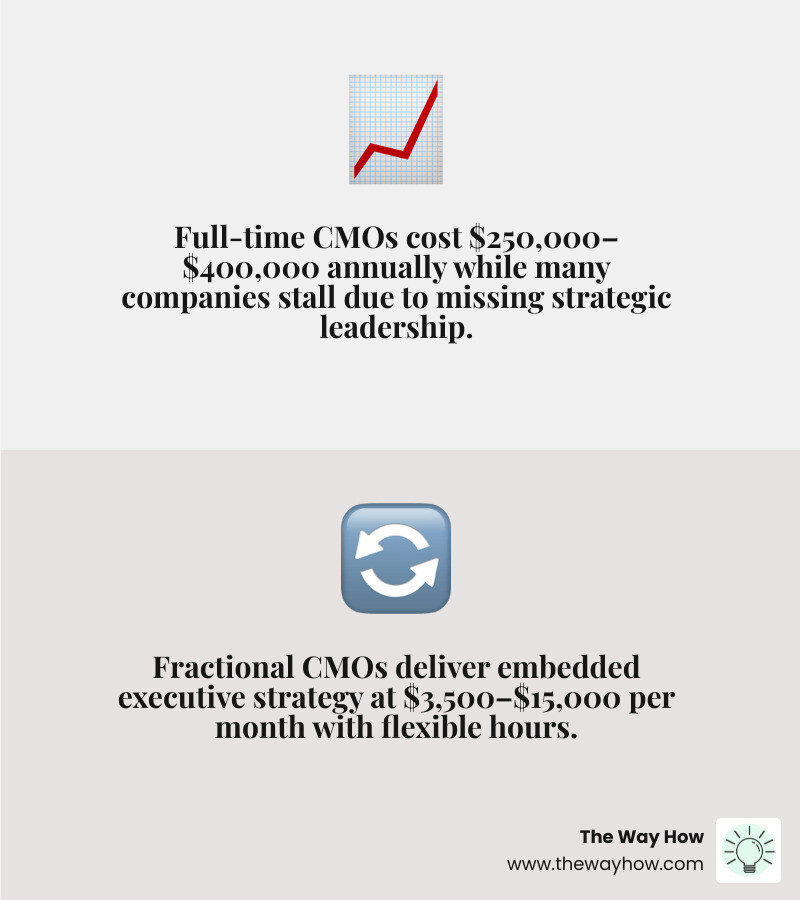
The cost difference is significant. A full-time CMO can cost $250,000–$400,000 or more annually in total compensation. Research consistently shows that companies with dedicated marketing leadership outperform those without — but most growth-stage companies cannot justify that overhead. The fractional model exists precisely to solve that tension.
I’m Jeremy Wayne Howell, founder of The Way How and a revenue growth strategist with over 20 years of experience helping founders and executive teams identify why growth is stalling and rebuild their go-to-market strategy around buyer psychology — the same principles that define how the best fractional chief marketing officers operate. In this guide, I’ll walk you through everything you need to understand this model clearly, so you can decide whether it’s the right move for your business.
The Growth Bottleneck: Why More Marketing Tactics Aren’t Solving Your Revenue Plateau
When growth stalls, the default reaction for most leadership teams is to buy more tactics. If leads are down, we assume we need more LinkedIn ads, a fresh batch of SEO blog posts, or a new cold email sequence. We treat marketing like a vending machine: insert cash, pull tactical lever, expect revenue.
When those tactics fail to deliver, frustration sets in. Sales teams blame marketing for low-quality leads; marketing teams blame sales for poor follow-up. Meanwhile, the executive team is left watching the budget drain while growth remains stubbornly flat.
What is actually happening here is a sequencing problem, not an execution problem.
The emotional toll of this cycle is heavy. Founders and CEOs find themselves pulled back into the weeds, managing social media schedules or reviewing ad copy instead of steering the company. They feel a deep sense of uncertainty because they cannot trace marketing spend to actual business outcomes. Roughly 26% of marketing budgets are wasted on ineffective, uncoordinated efforts. This waste happens because the organization is committing “random acts of marketing” — executing tactics that are completely disconnected from a cohesive strategy or a deep understanding of buyer psychology.
More marketing does not mean better marketing. If your fundamental messaging is misaligned with how your customers make decisions, running more ads only accelerates how quickly you alienate your market. To break through a revenue plateau, you must transition from tactical chaos to systematic, psychology-first growth.
What is a Fractional CMO and How Does It Solve the Certainty Gap?
To scale predictably, leadership teams must bridge the gap between what they believe is wrong and what is actually wrong.
When growth slows, founders almost always diagnose the issue as a “lead generation problem.” They believe they simply need more traffic. However, the actual bottleneck is usually a certainty gap in the customer journey. Buyers in 2026 are highly skeptical; research shows that 37% of buyers now start their research with AI tools rather than traditional search engines, and they spend only about 17% of their entire buying journey in the consideration stage. If your marketing systems do not create immediate trust and psychological safety, prospects will drop off before your sales team ever knows they exist.
A fractional CMO solves this certainty gap by stepping back to diagnose the system before prescribing solutions. They look at marketing through the lens of human behavior and decision-making psychology. By mapping the buyer’s cognitive journey, they identify where prospects experience friction, doubt, or confusion, and they design systems to replace that uncertainty with clarity.
To explore this concept further, you can read our detailed breakdowns of the Fractional CMO Meaning and the Fractional CMO Complete Definition.
Defining the Role of Fractional Chief Marketing Officers
A fractional chief marketing officer is not a part-time consultant or an outsourced project manager. They are a true executive-level leader who integrates directly into your leadership team.
While they only work a fraction of the week inside your business, their authority and accountability are absolute. They take full ownership of the marketing function, manage the marketing P\&L, report directly to the CEO or the board, and lead your internal team and external vendors. They are responsible for aligning your marketing strategy with your overall financial and operational goals.
For a deeper look at the strategic value this executive presence brings to growing organizations, see our guide on the Value of Fractional Chief Marketing Officer.
Why Traditional Agencies and Consultants Fail to Solve the Strategy Gap
Many scaling companies hire a marketing agency or an independent consultant hoping to solve their leadership gap. This almost always leads to disappointment because of a fundamental misalignment in incentives and operational structure.
Consultants are external advisors. They conduct audits, write beautiful strategic plans, hand over a deck, and exit. They do not stay to manage the messy reality of implementation, mentor your team, or take accountability for the actual revenue outcomes.
Agencies, on the other hand, are execution engines. They are built to sell and deliver specific deliverables — whether that is SEO, paid search, or social media management. While they report to you, they require someone on your side to lead them, define the strategy, and translate their activity metrics (clicks, impressions, likes) into business outcomes (pipeline, customer lifetime value, revenue). If you do not have an internal executive directing the agency, they will execute their specific tactics in a vacuum, leading to wasted spend.
An embedded fractional leader bridges this gap by combining strategic ownership with execution oversight.
| Metric | Fractional CMO | Traditional Consultant | Marketing Agency |
|---|---|---|---|
| Primary Focus | Strategic alignment and revenue systems | High-level advice and recommendations | Tactical execution and deliverables |
| Integration | Embedded in the leadership team | External advisor | External vendor |
| Accountability | Owns the marketing strategy and team performance | No execution accountability | Accountable only for campaign metrics |
The Strategic Mandate: What Do Fractional Chief Marketing Officers Actually Do?
A senior marketing leader’s primary objective is to build long-term marketing maturity within your organization, transforming marketing from a cost center into a predictable, compounding asset.
When a fractional CMO steps into your business, they do not start by changing your logo or launching new ad campaigns. They begin with a diagnostic audit of your positioning, systems, data, and team capabilities. From there, they build a structured, execution-ready roadmap designed to align your marketing engine with your business goals.

Designing the Psychology-First Customer Journey
The most critical work of a fractional leader is designing a customer journey rooted in decision-making psychology. Modern buyer behavior is driven by a search for certainty. If your marketing relies on superficial hype or high-pressure tactics, you create psychological resistance.
A fractional CMO maps the buyer’s journey to identify the “certainty gaps” — those moments where a prospect hesitates, doubts your claims, or feels overwhelmed by choice. They then design trust-building systems that address these hesitations head-on. This involves:
- Refining brand positioning to speak directly to the customer’s internal struggles, not just their external problems.
- Developing content strategies that educate and reduce friction, helping buyers feel smart and safe choosing your solution.
- Aligning sales and marketing definitions of a qualified lead to ensure a seamless, respectful transition from marketing awareness to sales conversation.
By structuring your marketing around human empathy and behavioral insights, we help you build a brand that naturally attracts and retains high-value customers. Learn more about how this strategic shift impacts business growth in our guide on the 10 Benefits of Fractional CMO.
Building Systems, Aligning Teams, and HubSpot Architecture
A beautiful strategy is useless without the infrastructure to measure and execute it. A fractional CMO ensures your marketing technology stack is designed to support, rather than complicate, your growth.
This is where systems like HubSpot architecture become vital. Many companies treat their CRM as a basic digital rolodex, leaving data siloed and attribution unclear. A fractional leader optimizes your CRM to create a single source of truth. They build lead scoring models, automate manual workflows to save your team hours of administrative work, and design clean, board-ready KPI dashboards.
This technical alignment ensures that every marketing dollar spent is directly traceable to pipeline generation and closed revenue, restoring complete clarity to your executive decision-making. For a comprehensive look at how we structure these systems, read our Fractional CMO HubSpot Ultimate Guide.
The Financial Reality: Cost, Retainers, and ROI of Fractional Leadership
Hiring a full-time, experienced marketing executive is a major financial commitment that many growth-stage companies simply cannot justify.
A seasoned, in-house CMO in 2026 commands a base salary averaging $177,000 to $253,000, with total loaded compensation (including bonuses, benefits, and equity) easily exceeding $300,000 to $400,000 annually. For a business generating $3M to $15M in revenue, allocating that much capital to a single executive salary severely limits the budget left over for actual marketing campaigns and market acquisition.
The fractional model offers a highly disciplined alternative. Instead of paying a full-time salary, you pay a monthly retainer based on the specific scope and hours your business requires.

Comparing Full-Time CMO Salaries to Fractional Retainers
Most fractional CMOs operate on a retainer model, charging between $200 and $375 per hour. Depending on your organization’s size, complexity, and growth goals, engagements typically range from 8 to 20 hours per week:
- Advisory Level (approx. 8 hours/week): Starts around $3,000 to $5,000 per month. Best for companies with an existing marketing manager who needs executive guidance, strategic oversight, and KPI accountability.
- Engaged Level (approx. 10–20 hours/week): Ranges from $6,000 to $15,000 per month. Ideal for companies needing active, embedded leadership to rebuild their go-to-market strategy, manage internal teams, optimize tech stacks, and report to the board.
This structure allows you to secure top-tier executive talent for $48,000 to $120,000 annually — saving your business hundreds of thousands of dollars in fixed overhead while keeping your contracts flexible and risk-mitigated on a month-to-month basis.
This financial efficiency is supported by academic insights, including the University of Notre Dame research on CMO business performance, which highlights that companies with dedicated, strategic marketing leadership perform 15% better on average than those operating without it.
Realizing ROI Through Marketing Maturity and Reduced Waste
The return on investment of a fractional CMO is realized in two distinct ways: cost optimization and revenue acceleration.
On the cost optimization side, an experienced leader immediately audit your existing spend to eliminate waste. They cut underperforming ad campaigns, consolidate redundant software in your tech stack, and hold external vendors accountable to strict performance metrics. It is common for a fractional CMO to save a company enough wasted budget in their first 90 days to completely offset their retainer.
On the revenue side, they build sustainable systems that compound over time. Rather than chasing short-term spikes, they focus on increasing your marketing maturity. In fact, data shows that within the first 6 to 12 months of deploying structured marketing leadership, organizations experience a 30% to 35% increase in marketing maturity. This maturity translates directly to lower customer acquisition costs (CAC), higher customer lifetime value (LTV), and a highly predictable, repeatable sales pipeline.
Diagnostic Checklist: When Should Your Business Hire a Fractional CMO?
Not every business is ready for a fractional executive. If your company is in the pre-revenue stage, still trying to find product-market fit, or has a total marketing budget of less than $5,000 per month, hiring a senior strategist is premature.
However, if you have validated your product, have active customers, and are trying to scale systematically, you may be facing a leadership gap.
Identifying the Triggers of Stalled Growth
Here are the classic organizational triggers that indicate it is time to bring in professional, part-time marketing leadership:
- The Founder Bottleneck: You are the CEO or founder, and you are still running the weekly marketing meetings, managing agencies, or trying to figure out ad copy. This is pulling you away from high-level vision and operations.
- Tactical Overwhelm: Your internal team is working incredibly hard, executing campaigns, writing posts, and launching ads, but your revenue has plateaued. You have a collection of tactics but no unifying strategy.
- Sales and Marketing Misalignment: Your sales team complains that marketing leads are “junk,” while marketing argues that sales isn’t following up fast enough. There is no shared definition of a qualified lead or a unified revenue goal.
- The “Black Box” Problem: You are spending thousands of dollars on marketing every month, but you have no clear data showing which channels are actually driving revenue. You feel completely blind to your ROI.
- Preparation for a Major Milestone: Your business is preparing for a series A/B funding round, an acquisition, or entry into a highly competitive new market, and you need board-ready strategy and attribution dashboards.
Assessing Organizational Readiness and Internal Foundations
Before hiring an external executive, you must ensure your internal foundations are ready to support their work. A fractional CMO needs a baseline of execution capability to succeed. If you do not have at least one internal marketer, a dedicated coordinator, or a trusted agency vendor, the strategist will find themselves forced into day-to-day tactical execution rather than high-level strategy, diluting the value of their executive rate.
If your business is in an earlier phase and you cannot yet support a fractional engagement, you should focus on building your internal, founder-led frameworks first. For organizations navigating these early stages, we outline alternative foundational paths in our guide: What Are the Best Fractional CMO Alternative Options for Leadership Teams Needing Strategic Marketing Guidance Without a Full Time Hire.
The Hiring Blueprint: How to Evaluate and Onboard the Right Leader
Hiring a leader who will have access to your revenue systems, P\&L, and team requires a rigorous, structured evaluation process. You cannot rely on a charismatic pitch or generic portfolio metrics; you must vet for strategic depth, operational discipline, and cultural alignment.
To help you navigate this process smoothly, we have created a step-by-step framework in our Hiring a Fractional CMO Guide.
Key Skills and Behavioral Insights to Look For
When interviewing candidates, look beyond superficial resumes and focus on these critical executive competencies:
- Systemic and Psychological Thinking: Can they explain why a customer buys your product based on human behavior, or do they immediately jump to recommending specific ad channels? Look for a leader who prioritizes understanding your buyer’s psychology first.
- Data and Attribution Mastery: They must possess a deep understanding of marketing analytics, CRM architecture, and revenue attribution. Ask them to describe how they build a board-ready dashboard that connects marketing activity directly to sales pipeline.
- Leadership and Empathy: A fractional CMO must guide, mentor, and elevate your existing team. They should have a proven track record of managing internal employees and external vendors, instilling high morale and clear accountability.
- Strategic Experience: Look for an executive with at least 15 years of marketing experience, including at least 5 years in senior in-house leadership roles. Avoid lifetime agency account managers who lack corporate executive experience.
Structuring the Contract and the First 90 Days
A successful engagement is built on a structured onboarding process and clear, near-term milestones.
We recommend starting with a flexible, month-to-month agreement that includes a standard 30-day notice period. This keeps the relationship focused on performance and agility. You can review a breakdown of standard terms and expectations in our overview of the Fractional CMO Contract.
Once the contract is signed, the first 90 days should follow a strict, highly disciplined cadence:
- Days 1–30 (The Diagnostic Phase): The CMO conducts a comprehensive audit of your positioning, customer journey, CRM data, and current team capabilities. They identify immediate revenue leaks and establish baseline KPIs.
- Days 31–60 (The Strategy & Alignment Phase): The CMO delivers a customized 90-day growth playbook. They align your sales and marketing workflows, optimize your HubSpot architecture, and define clear roles and responsibilities for your execution team.
- Days 61–90 (The Optimization & Scale Phase): The CMO oversees the launch of the new strategy, tracks initial performance data, refines campaigns based on real-time buyer behavior, and delivers the first monthly executive readout to the leadership team and board.
Frequently Asked Questions About Fractional Marketing Leadership
How many hours a week does a fractional CMO typically work?
Most fractional CMO engagements are scoped between 8 and 20 hours per week, depending on your company’s revenue size, team complexity, and growth goals. However, it is important to remember that fractional leadership is bought for impact and outcomes, not hours. A seasoned executive can accomplish more strategic planning, team alignment, and bottleneck diagnosis in 10 hours than a junior manager can in 40.
Will the fractional CMO manage our existing marketing team?
Yes. A true fractional CMO takes over direct management of your internal marketing staff, copywriters, designers, and external agency vendors. They conduct weekly 1:1s, set clear performance KPIs, run the marketing department meetings, and ensure that everyone is focused on the most critical strategic initiatives. If your team needs to grow, the fractional CMO will also lead the hiring and interviewing process to bring in the right talent.
What is the difference between a fractional CMO and an interim CMO?
An interim CMO is typically a full-time, temporary placeholder brought in during a transition period — such as when a company is searching for a permanent, full-time CMO or navigating a sudden leadership departure. They focus on maintaining the status quo.
In contrast, a fractional CMO is a long-term, part-time strategic partner. They are brought in to build foundations, scale systems, and professionalize the marketing function for growing companies that are not yet ready for a full-time executive hire.
Restoring Momentum: How to Turn Marketing Uncertainty into Predictable Revenue
Sustainable, predictable business growth is never the result of a single marketing trick, a trendy ad format, or a louder campaign. It is the natural, inevitable outcome of building robust marketing systems that respect how human beings actually make decisions.
At The Way How, we help founders and leadership teams step off the tactical hamster wheel. As a psychology-first marketing and revenue strategy firm, we specialize in diagnosing stalled growth, identifying the certainty gaps in your customer journey, and designing systems that build deep trust, momentum, and predictable revenue. Whether you need fractional leadership to steer your team, a complete overhaul of your HubSpot architecture, or a demand generation strategy rooted in human behavior, we are here to provide the strategic clarity and operational execution you need.
If you are ready to stop guessing and start scaling with absolute certainty, take the next step toward strategic clarity with our Hire Part Time CMO Complete Guide.