A Complete Guide to CRM Systems and Database Management
 Jeremy Wayne Howell : Jul 22, 2026 9:48:31 PM
8 min read

HubSpot drip campaigns are automated email sequences that send the right message to the right person at the right time — triggered by behavior, not just a calendar.
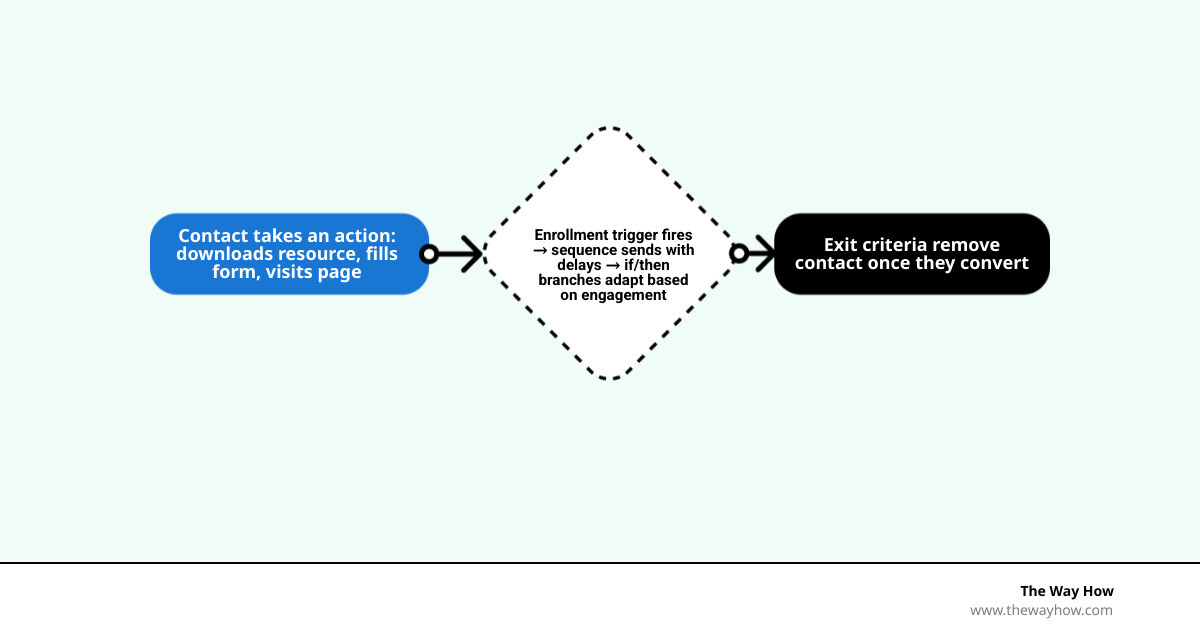
Here’s the short version of how they work:
| Step | What Happens |
|---|---|
| 1. A contact takes an action | Downloads a resource, fills a form, visits a page |
| 2. An enrollment trigger fires | HubSpot adds them to a workflow automatically |
| 3. A sequence of emails sends | Spaced out with delays — days, not minutes |
| 4. Behavior shapes what comes next | If/then branches adapt the path based on engagement |
| 5. Exit criteria remove them | Once they convert, the campaign stops |
This is different from a newsletter blast. Drip campaigns respond to what a person actually does — not just who they are on a list.
Most founders and revenue leaders set up automation expecting it to run quietly in the background, compounding leads over time. What they get instead is a sequence that feels mechanical, generates opens but not meetings, and slowly erodes the trust it was supposed to build.
The problem usually isn’t the tool. It’s that the campaign was built around timing instead of behavior.
Research backs this up. Segmented emails drive 50% more click-throughs and 30% higher open rates than unsegmented ones. Welcome emails average an 83.63% open rate — but only when they land at the right moment with the right message. And in 2025, over 70% of ecommerce customers abandoned their shopping carts, representing a massive gap that well-structured drip campaigns are built to close.
The difference between a drip campaign that converts and one that gets ignored almost always comes down to architecture — how the workflow is designed before a single email is written.
I’m Jeremy Wayne Howell, founder of The Way How and a revenue growth strategist with over 20 years of experience in marketing, sales, and go-to-market strategy — including hands-on implementation of HubSpot drip campaigns for businesses scaling from early traction to $1M+ ARR. This guide walks through not just the mechanics, but the buyer psychology that makes automated nurturing actually work.
When a prospect enters your funnel, they are rarely ready to buy. Instead, they are navigating a state of cognitive friction. They are trying to determine if your business understands their specific pain points and if you possess the capability to solve them.
Most automated campaigns fail because they ignore this psychological state. Marketers build sequences that treat every subscriber as if they are on a linear, highly motivated path to purchase. They send a rapid succession of promotional pitches, ignoring the prospect’s actual behavior. This creates an immediate misalignment. When your automated emails push for a sales demo while the prospect is still trying to define their problem, you create a certainty gap—a feeling of cognitive dissonance that causes the prospect to disengage.
Furthermore, many campaigns suffer from poor list hygiene and a lack of behavioral feedback loops. If you continue to send unengaged contacts the same generic content, your deliverability rates suffer, and your emails begin landing in the spam folder. According to classic marketing principles like the “Law of 29,” a prospect needs repeated, meaningful exposure to a brand before they are ready to convert. However, this exposure must be valuable, not annoying.
Understanding drip marketing requires looking beyond simple email scheduling. It is about building an automated system that respects the natural pace of human decision-making. By using hubspot crm marketing strategies, you can connect your automated sequences directly to real-time contact data, ensuring that every message aligns with the recipient’s current mindset.

To build trust, we must first abandon the “broadcast blast” mentality. Traditional email marketing relies on one-to-many communication, where a single, static message is sent to an entire list at a specific date and time. This approach ignores individual context.
In contrast, behavioral drips rely on real-time CRM data. When a contact takes an action—such as viewing a pricing page, opening a specific resource, or submitting a form—the CRM registers this signal instantly. A CRM-native drip campaign uses these behavioral inputs to determine the next step in the sequence. For those who are exploring hubspot for beginners, the key takeaway is that your automation should function as an adaptive decision tree, modifying its messaging and timing based on how the recipient interacts with your brand.
Every purchase decision involves a transition from uncertainty to certainty. In B2B and high-consideration B2C sales, this journey is rarely straightforward. Prospects are constantly evaluating risk, comparing alternatives, and seeking proof.
Your drip campaign should act as a guide that systematically resolves these doubts. Instead of shouting about your product’s features, your initial emails should focus on educational progression—helping the reader clearly define their problem and understand the costs of inaction. For teams implementing hubspot for small businesses, building trust means matching the pacing of your emails to the natural length of your sales cycle. If your typical sales cycle is 60 days, sending six emails in six days will only alienate your audience.
Building an effective campaign in HubSpot requires shifting your mental model. Instead of viewing a drip campaign as a static list of emails with delay timers, you must treat it as an active workflow engine.
HubSpot’s visual workflow builder allows you to use complex conditional logic, branching pathways, and real-time data updates. This ensures that your automation scales gracefully without feeling robotic. When you set up drip campaigns in CRM, you gain the ability to leverage unified data—such as lifecycle stages, custom contact properties, and past interactions—to deliver highly personalized, behavior-driven experiences. This level of precision is why sophisticated teams choose hubspot marketing automation over disconnected, third-party email tools that suffer from sync delays.
The foundation of any successful workflow lies in its boundaries. You must clearly define who enters the campaign, who is kept out, and when a participant should be removed.
True personalization goes far beyond merging a contact’s first name into a subject line. It requires using real-time CRM data to alter the actual substance of your message.
By leveraging HubSpot’s custom contact properties, you can segment your audience based on industry, job title, company size, or specific product interests. In your emails, you can implement smart content blocks that display different text, images, or calls-to-action depending on the recipient’s segment. When studying how to create successful email drip campaigns, you will find that highly segmented campaigns consistently outperform generic ones.
For a complete breakdown of how to configure these advanced segmentation rules, refer to our hubspot marketing workflows complete guide.
Different marketing goals require different campaign architectures. You cannot use the same cadence or tone for a cart abandonment sequence as you would for a long-term educational nurture.
| Campaign Type | Primary Goal | Recommended Cadence | Key Success Metric |
|---|---|---|---|
| Welcome & Onboarding | Product activation & setup | Days 1, 3, 5, 7, 10 | Activation / Setup rate |
| Lead Nurturing (MQL to SQL) | Build trust & book demos | Every 3 to 5 business days | Demo booking rate |
| Cart Abandonment | Recover lost revenue | Hours 1, 24, and 72 | Recovered revenue |
| Re-engagement / Win-back | Clean list & identify intent | Day 1, Day 7, Day 14 | Re-engagement rate |
When designing these sequences, particularly for B2B long-term nurturing, aim for 4 to 10 emails total. Sequences longer than eight emails often see sharply diminishing returns unless they are heavily branched based on behavioral signals. For a deep dive into optimizing these specific sequences, explore the HubSpot Drip Campaigns 2025 Guide.
To nurture a lead effectively, your content must match their current stage in the buyer’s journey.
To keep your campaign assets organized, you can create campaigns using campaign templates within HubSpot. This allows you to associate all emails, landing pages, and workflows with a single marketing campaign for clean reporting. Additionally, for highly critical system-generated emails, ensure you are utilizing hubspot transactional email features to guarantee delivery regardless of subscription preferences.
Too many marketing teams focus on vanity metrics like open rates and click-through rates. While these numbers are useful for testing subject lines or email layouts, they do not tell you if your campaign is actually growing your business.
To measure true ROI, you must track goal completion rates, conversion movement through your lifecycle stages, and revenue attribution. HubSpot’s multi-touch attribution reporting allows you to see exactly which drip campaigns contributed to closed-won deals. If you notice that your emails have high open rates but zero conversions, it is a clear signal that your content is misaligned with your business objectives. If you run into technical issues with your tracking or delivery, consult our guide on hubspot email troubleshooting to diagnose and fix the problem quickly.

While you can set up basic, form-triggered autoresponders on HubSpot’s free or Starter plans, sophisticated drip campaigns require advanced automation features. To build workflows with complex if/then branching logic, goal-based unenrollment, and behavioral triggers, you will need Marketing Hub Professional or higher. For detailed plan comparisons, check our breakdown of hubspot marketing hub pricing.
This is one of the most common points of confusion for teams new to HubSpot.
Using the wrong tool for the wrong audience can damage your email deliverability and create a fragmented buyer experience. For a deeper analysis, read our guide on hubspot drip campaigns.
To prevent contacts from being enrolled in multiple overlapping workflows and receiving duplicate or conflicting messages, you must implement strict exclusion rules. Use dynamic suppression lists that automatically group contacts who are already active in a nurture sequence. You can also configure your workflow settings to unenroll a contact from other workflows the moment they enter a new one. This ensures a clean, cohesive customer journey. For help setting up these global guardrails, refer to our guide on hubspot marketing hub implementation.
At The Way How, we believe that sustainable revenue growth is not about chasing the latest marketing hacks or building overly complex, robotic automation sequences. It is about understanding the psychological barriers that prevent your prospects from taking action and designing clear, empathetic systems that resolve those uncertainties.
We help founders and leadership teams build high-performing sales and marketing engines through Fractional CMO leadership, expert HubSpot architecture, and behavioral demand generation strategies. If your marketing automation feels disconnected, or if your campaigns are generating noise instead of predictable pipeline, we can help you diagnose the root cause and restore momentum.
Align your systems with human behavior and turn your HubSpot portal into a dependable growth engine that respects your buyers and builds lasting trust.
 Jeremy Wayne Howell : Jul 22, 2026 9:48:31 PM
 Jeremy Wayne Howell : Jul 21, 2026 9:47:10 PM
 Jeremy Wayne Howell : Jul 20, 2026 9:46:47 PM