A Complete Guide to CRM Systems and Database Management
 Jeremy Wayne Howell : Jul 22, 2026 9:48:31 PM

Marketing budget optimization isn’t about spending less—it’s about spending smarter. When growth stalls, the instinct is to cut. But here’s the uncomfortable truth: your budget isn’t too big. It’s too uncertain.
To optimize your marketing budget effectively:
Most leaders look at their marketing budget as a list of channels and costs. They see Facebook ads, content marketing, agencies, tools. When pressure mounts, they slash the line items that feel expensive or underperforming.
But here’s what they’re missing: marketing doesn’t fail because of bad channels. It fails because of bad certainty.
Your prospects are stuck somewhere. They don’t understand your value. They can’t differentiate you from competitors. They’re not sure if now is the right time. They don’t trust that you’ll deliver.
Every one of these moments is a leak in your funnel. And every leak is draining your budget faster than any agency fee ever could.
According to research, marketers are utilizing just one-third of the potential capabilities of their marketing technology stacks. That’s not a tool problem—it’s a clarity problem. When you don’t know why your customer hesitates, you can’t know where to invest.
This guide isn’t about tactical budget cuts. It’s about building a diagnostic framework that turns your marketing spend into a predictable growth engine. You’ll learn how to identify the psychological friction points in your customer journey, reallocate resources with surgical precision, and create a budget that doesn’t just buy impressions—it buys trust and momentum.
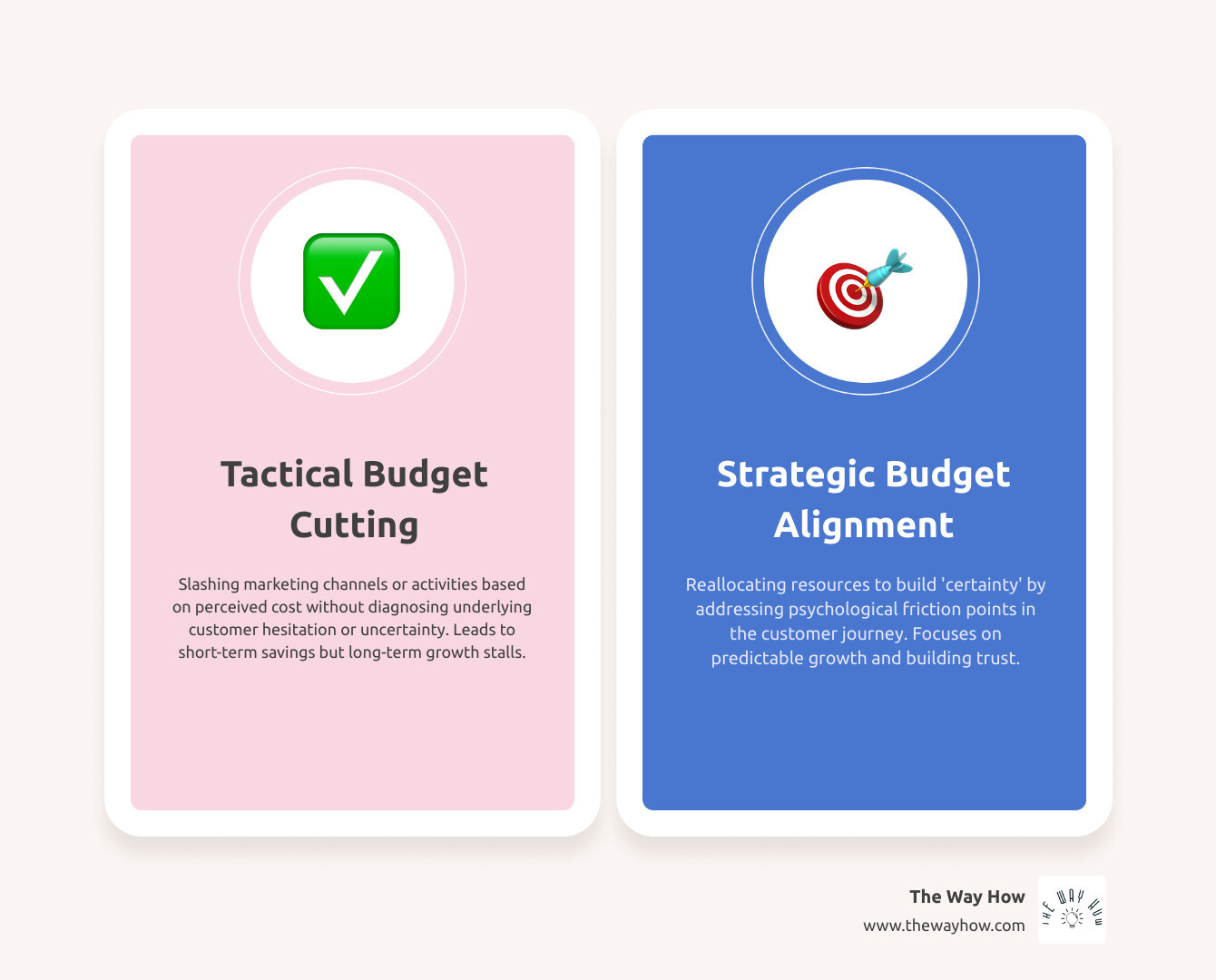
Before you can optimize a budget, you must diagnose the real problem. Most leaders look at channel ROI, but savvy marketers look at “Return on Certainty.” Where in the journey do your prospects feel confused, hesitant, or uncertain? Answering this question is the foundation of a budget that doesn’t just buy ads, but buys confidence.
We believe that true marketing budget optimization begins with a deep, empathetic understanding of your customer. We call this process identifying “certainty gaps.” These are the moments in the customer journey where a prospect feels confused, hesitant, or uncertain, causing them to pause, leave, or choose a competitor. Traditional approaches often focus on channel performance in isolation, but we know that a high bounce rate on a landing page isn’t just a “landing page problem”—it’s a sign of unmet psychological needs or unclear value.
To find these gaps, we engage in thorough customer journey mapping, behavioral psychology analysis, and empathy mapping. This involves putting ourselves in the customer’s shoes, tracing their path from initial awareness to post-purchase advocacy. We look at every touchpoint, every decision point, and every potential moment of doubt. By analyzing their behavior flow, exit pages, and conversion rates by funnel stage, we can pinpoint where uncertainty creeps in. We question assumptions about why customers behave the way they do, digging deeper than surface-level metrics. This diagnostic approach helps us identify the friction points that are secretly draining your budget. Understanding these gaps is crucial for designing systems that create trust, momentum, and predictable revenue. For more insights into our strategic services and how we diagnose these issues, explore our approach to strategic clarity.
Once we’ve identified the certainty gaps, our next step in marketing budget optimization is to align our spend with psychological triggers that build trust and create momentum. This isn’t about manipulation; it’s about understanding how people make decisions and providing the information and assurance they need, exactly when they need it.
We leverage decision-making psychology to strategically address cognitive biases and provide the right social proof, authority, or even a sense of scarcity where appropriate. For example, if prospects hesitate at the pricing stage, it might not be the price itself, but a lack of perceived value or a fear of making the wrong choice. Our budget then shifts to invest in clear value propositions, transparent success stories, or risk-reversal guarantees, rather than simply discounting. This approach shifts our focus from merely communicating “what” we offer to explaining “why” it matters to the customer’s specific needs and anxieties. By understanding and addressing these underlying psychological drivers, we can concentrate our budget on building genuine confidence, leading to more efficient spend and higher conversion rates.
Your data is telling a story about your customer’s uncertainty, but most of it goes unheard. According to research, 80% of marketing data goes unused. Instead of just tracking conversions, use your analytics to diagnose the behavioral blockages that are secretly draining your budget.
A leaky funnel is a budget drain, plain and simple. We often see businesses pouring money into the top of the funnel only to lose prospects at critical stages due to certainty gaps. Our approach to marketing budget optimization involves a rigorous analysis of your marketing funnel, not just to see where people drop off, but why.

We dive into funnel metrics, behavior flow analysis, and exit page analysis to pinpoint the exact moments of hesitation. Is it an unclear value proposition? Pricing confusion? A lack of social proof? For example, if prospects are leaving a product page without converting, we might use tools like Intercom to gather real-time feedback through live chat or questionnaires. This helps us understand their unspoken questions and concerns. By simplifying the customer journey and providing clarity at these crucial junctures, we can significantly improve conversion rate optimization. This doesn’t necessarily cost more; it’s about reallocating resources to fix the leaks, making your existing spend far more effective. Dan Ben-Nun, founder & CEO at Adspace, shared an example where they boosted revenue by 26% without increasing spend by focusing on top-of-the-funnel paid ads to drive more traffic and leads, demonstrating the power of targeted funnel optimization.
Your CRM and marketing automation systems are treasure troves of behavioral data, yet many marketers only scratch the surface of their potential. As mentioned, marketers are utilizing just one-third of the potential capabilities of their marketing technology stacks. This represents a massive opportunity for marketing budget optimization.
We leverage CRM data analysis to understand customer segmentation, lead scoring, and the effectiveness of nurture sequences. By identifying which types of leads are most likely to convert and what content moves them through the funnel, we can personalize our messaging and allocate budget more effectively. For instance, if certain segments respond better to email campaigns than paid social, we can shift resources accordingly. Our expertise in HubSpot architecture allows us to design systems that maximize the ROI of your existing technology, automating routine tasks and freeing up your team to focus on strategic initiatives. This means we’re not just using tools; we’re using them to understand and influence human behavior, turning your tech stack into a powerful engine for predictable revenue. Bassem Mostafa highlighted how attribution modeling revealed LinkedIn ads generated higher-quality leads with a 40% conversion rate, leading to a shift in budget from paid search to LinkedIn and content marketing, reducing overall CPA by 20%.
To effectively measure the success of our marketing budget optimization efforts and ensure we’re creating certainty, we focus on a specific set of crucial metrics. These go beyond vanity metrics and provide a clear picture of efficiency and impact:
By rigorously tracking and analyzing these metrics, we can continuously refine our strategies, reallocate our budget with confidence, and demonstrate the tangible value of our marketing efforts.
Once you’ve diagnosed the certainty gaps, you can allocate your budget with surgical precision. This isn’t about spreading funds across channels; it’s about concentrating resources on the moments that matter most to build trust and accelerate the buying decision.
Perhaps the most compelling argument for strategic marketing budget optimization comes from the field of customer retention. We often observe businesses hyper-focused on new customer acquisition, yet research consistently shows that acquiring new customers is 5-25 times more expensive than retaining and nurturing existing ones. This is a profound insight for anyone looking to make every marketing dollar count.
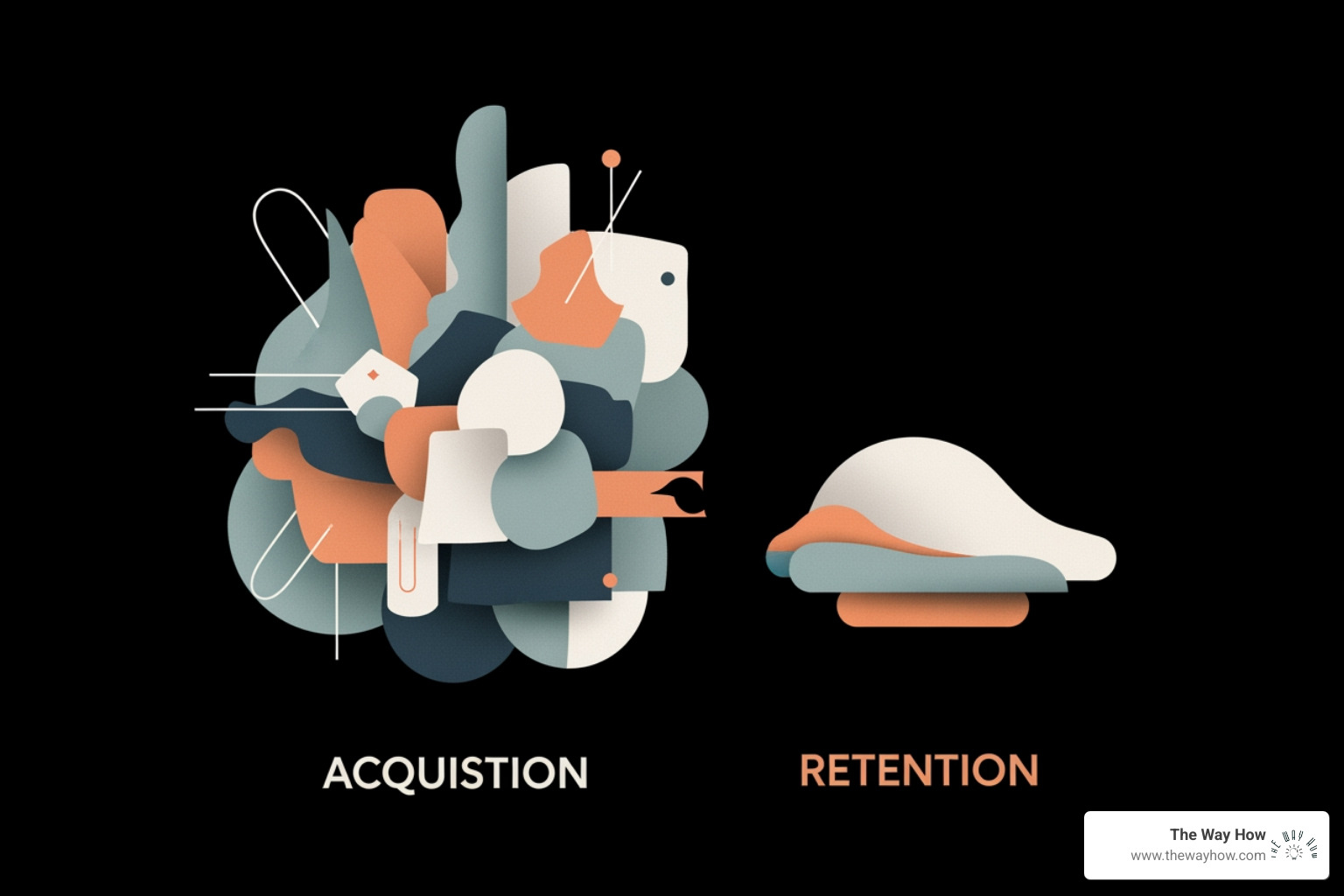
By prioritizing customer loyalty programs, strategic upselling, and cross-selling initiatives, we can significantly improve our return on investment. Tools like Net Promoter Score (NPS) help us gauge customer satisfaction and identify opportunities to deepen relationships. Focusing on community building and providing exceptional post-purchase experiences not only retains customers but also turns them into powerful advocates. This strategy aligns perfectly with our psychology-first approach: when customers feel valued, understood, and confident in their choice, they are far more likely to stay, spend more, and refer others. This creates a virtuous cycle of predictable revenue that is inherently more cost-effective than the constant churn of new acquisition.
A critical decision in marketing budget optimization is determining which tasks to keep in-house and which to outsource. This isn’t a one-size-fits-all answer; it’s a strategic choice based on your core competencies, team bandwidth, and the specific needs of your customer journey.
We encourage an ROI analysis for each marketing task. For instance, if a task requires deep, proprietary knowledge of your product and customer psychology, it often makes sense to keep it in-house. This allows your internal teams to focus on understanding and addressing certainty gaps. For tactical execution—like certain aspects of content creation, ad buying, or specialized SEO—outsourcing to agencies or freelancers can be highly efficient. The key is effective agency management and clear collaboration frameworks.
McKinsey highlights that the primary goal of insourcing should be strengthening core marketing muscles, not just cutting costs. For example, a telecom company performed programmatic digital-media buying in-house, finding it cheaper, better, and faster. Conversely, if your internal team lacks the bandwidth or specific expertise for a high-impact activity, outsourcing can provide immediate access to specialized skills. The goal is to build a lean, effective team focused on human behavior, while efficiently leveraging external partners for scale and specialized execution. This balanced approach ensures your budget is allocated where it generates the most strategic value and predictable revenue.
Partner marketing, including affiliate marketing, co-marketing, and influencer marketing, can be a powerful channel for marketing budget optimization when managed strategically. According to Forrester research, 80% of teams spend at least 10% of their marketing budget on partnerships. This underscores its importance, but also the need for meticulous planning.
Our approach starts with clear partner selection criteria. We look for partners whose audience aligns psychologically with our target customers, whose values resonate with ours, and who can genuinely build trust with their audience. This means moving beyond simple reach metrics to assess their ability to reduce certainty gaps for our prospects.
Establishing clear budget expectations with partners from the outset is crucial for transparency and collaboration. We define payment models (e.g., CPA, revenue share), performance incentives, and reporting requirements. Robust tracking partner performance is non-negotiable; we need to see not just clicks, but conversions and the quality of leads generated. This data allows us to optimize our spend by identifying high-performing partners and reallocating resources from underperforming ones. A well-structured partner program extends our reach, builds credibility through trusted third parties, and ultimately contributes to predictable revenue without overstretching our internal marketing budget.
For a macro-level view, sophisticated modeling can validate your behavioral diagnoses and forecast the impact of budget shifts. These tools are most powerful when used not as a black box, but as a way to test the hypotheses you’ve developed by understanding your customer.
When we talk about advanced marketing budget optimization, Marketing Mix Models (MMM) often come to the forefront. MMM provides a holistic measurement of how different marketing activities, along with external factors, contribute to sales or other key performance indicators. It’s a powerful tool for understanding channel contribution, analyzing ROI, and forecasting future performance.
MMM helps us move beyond last-click attribution to understand the true impact of each channel, including those with longer sales cycles or brand-building effects. It analyzes inputs like spending on TV and digital advertising, while also incorporating non-marketing variables like seasonality and the economy to get a complete picture of what drives sales. For instance, if an MMM reveals that a specific channel has diminishing returns beyond a certain spend, we can reallocate those funds to more effective areas. This allows for sophisticated budget scenario planning, helping us answer “what if” questions about different budget allocations. A decent MMM often requires at least 3 years of weekly data to be truly effective, providing the historical depth needed for accurate insights. While implementing MMM can be complex, requiring granular, time-series data, its ability to uncover deep insights into marketing effectiveness makes it invaluable for maximizing ROI and building a more predictable revenue engine.
The shift to a cookieless world presents new challenges for attribution and measurement, but it also reinforces the value of sophisticated tools like Marketing Mix Models for marketing budget optimization. In this evolving landscape, our focus shifts to first-party data strategy and aggregated data analysis.
MMM is inherently less reliant on individual-level tracking (like cookies) because it operates at a higher, aggregated level, analyzing the impact of marketing inputs on overall sales over time. This makes it a robust solution for privacy-compliant measurement. We integrate data from various sources: first-party CRM data, Google Analytics for website behavior, Google Ads conversion data, and even offline sales data. Machine learning algorithms can then be applied to these aggregated datasets for predictive analysis and attribution, providing insights without compromising user privacy.
The challenges include limited granular tracking and the complexity of data integration. However, by focusing on earning trust and data directly from our audience—a cornerstone of our psychology-first approach—we naturally build the high-quality first-party data essential for effective MMM in a cookieless world. This ensures our budget optimization strategies remain data-driven, ethical, and highly effective, even as the digital privacy landscape continues to change.
Even with the most meticulous planning and advanced models, the market can be unpredictable. That’s why a crucial element of marketing budget optimization is budgeting for the unexpected. We recommend setting aside a contingency fund, typically between 5-10% of your total budget.
This isn’t about wasteful spending; it’s about building resilience and agility into your marketing plan. A contingency fund allows us to respond to sudden market changes, competitive shifts, or unforeseen opportunities without derailing our core strategy. It also provides a dedicated budget for experimentation, allowing us to A/B test new channels or creative approaches that might yield significant returns. For instance, if a new social media platform emerges with high engagement potential for our audience, our contingency fund allows us to quickly pivot and test its effectiveness. This agile marketing principle ensures we can seize opportunities and mitigate risks, turning potential disruptions into advantages, and ultimately contributing to more stable and predictable revenue growth.
For small businesses with limited resources, marketing budget optimization is even more critical. Our advice is to focus on what you can control and be incredibly intentional. Start with deep customer interviews and user feedback to find those certainty gaps—where do your customers get stuck or confused? This qualitative data is invaluable and free.
Next, leverage free tools like Google Analytics to track behavior on your website and identify those leaky funnel stages. Prioritize high-impact, low-cost strategies. For example, focusing on customer retention, as acquiring new customers is 5-25 times more expensive, can yield significant ROI. Create one piece of pillar content that exhaustively addresses a major customer uncertainty or question; then repurpose it for various channels. Instead of trying to be everywhere, pick one or two social media channels where your audience is most active and do them exceptionally well, as the WordStream article suggests. Invest strategically in email marketing, which offers a significantly higher ROI than direct mail, and consider paid social media advertising even with small budgets, as it can drastically increase reach and engagement over organic posts.
Data privacy regulations, such as GDPR and CCPA, fundamentally shift how we approach marketing budget optimization. Far from being a hindrance, we see this as an advantage for a psychology-first approach. These regulations force a move away from reliance on third-party cookies and towards first-party data and more transparent, consent-driven marketing.
This aligns perfectly with building certainty and trust. When customers willingly share their data because they trust your brand and understand the value exchange, that data is inherently higher quality and more indicative of intent. Our budget must be allocated for compliant data infrastructure, secure data management practices, and tools that enable privacy-preserving analytics. This might include investments in CRM systems, consent management platforms, and robust data governance. While there’s an initial investment, the result is a higher-quality, more engaged audience, leading to more effective campaigns and ultimately, a better return on your marketing spend. It compels us to earn the data we use, which fosters deeper customer relationships and more predictable revenue.
In today’s digital-first landscape, a comprehensive digital marketing budget is essential for effective marketing budget optimization. Digital channels now receive 53.8% of the average marketing budget, underscoring their importance. We typically break down the crucial categories as follows:
By strategically allocating funds across these categories, we ensure a balanced approach that drives both immediate results and long-term sustainable growth, all while addressing the psychological needs of our target audience.
Effective marketing budget optimization is not a financial exercise; it’s a strategic one rooted in human behavior. By diagnosing certainty gaps, aligning spend with your customer’s psychology, and using data to validate your approach, you transform your budget from a necessary expense into your most powerful growth driver. You create a system that delivers predictable revenue and a competitive advantage that can’t be easily copied.
If you’re ready to stop guessing and start building a marketing system that creates momentum, let’s talk. Learn more about how our psychology-first services can bring clarity and predictability to your growth.
 Jeremy Wayne Howell : Jul 22, 2026 9:48:31 PM
 Jeremy Wayne Howell : Jul 21, 2026 9:47:10 PM
 Jeremy Wayne Howell : Jul 20, 2026 9:46:47 PM