

From Chaos to Clarity: A New Way to See Your Leads
Outbound marketing leads are potential customers you reach out to directly, rather than waiting for them to find you. This includes prospects contacted through cold emails, phone calls, LinkedIn messages, or targeted campaigns. Unlike inbound leads who find you organically, outbound leads require proactive effort to identify, engage, and convert.
Quick Answer: What You Need to Know About Outbound Marketing Leads
- Definition: Prospects your team contacts first, before they’ve engaged with your brand
- Key Difference: Proactive outreach vs. passive attraction (inbound)
- Main Channels: Cold email, phone calls, social selling, direct mail
- Success Factors: Personalization, timing, persistence, and empathy
- Common Challenge: Converting cold contacts into warm conversations
- Best Practice: Focus on helping before selling
If you’re reading this, you’ve probably felt it: the gap between effort and results. Your team sends hundreds of emails. Makes dozens of calls. But the pipeline stays unpredictable. Conversations feel forced. And you’re left wondering if outbound marketing even works anymore.
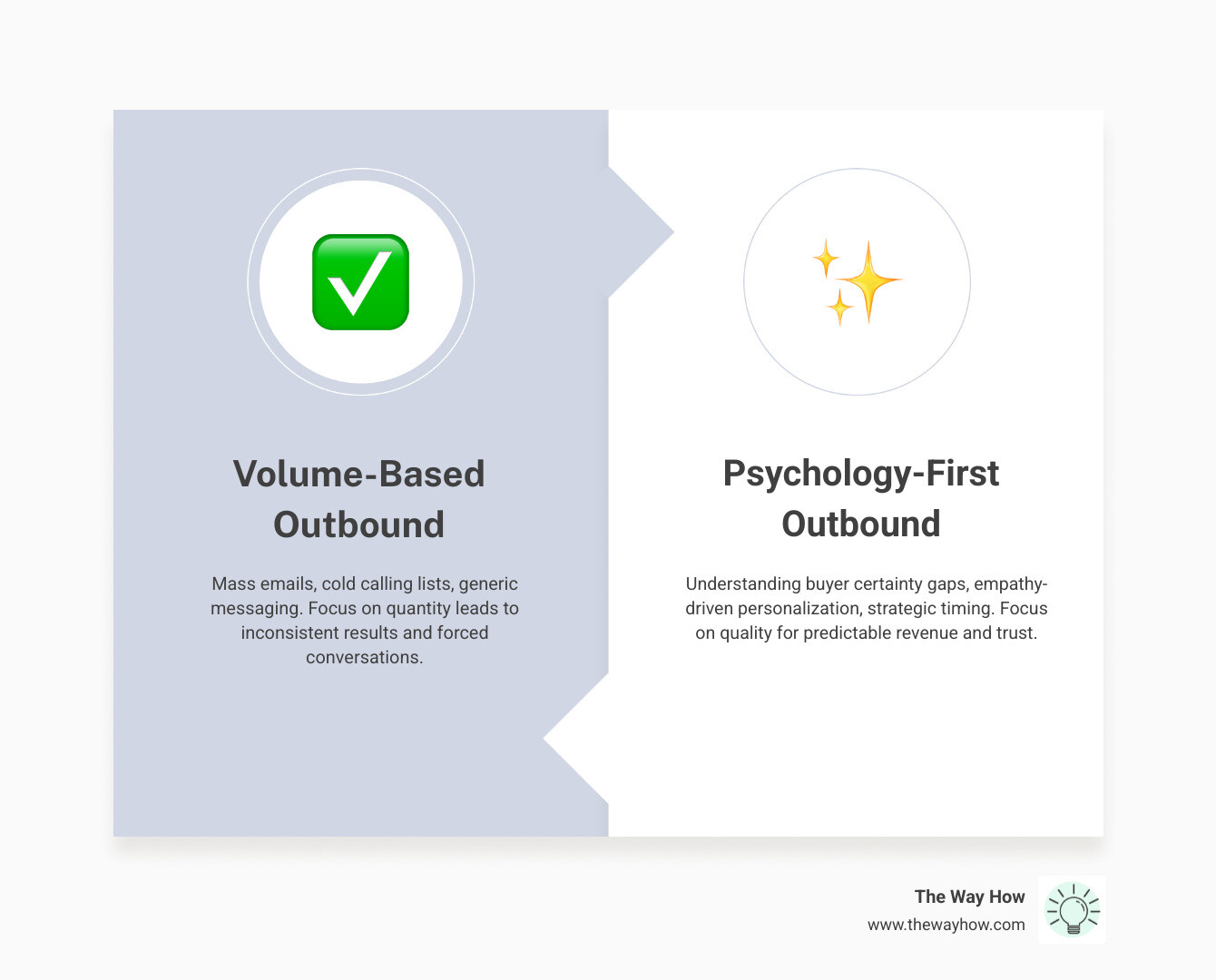
Here’s what most people get wrong: they treat outbound as a numbers game. More emails. More calls. More volume. But buyers don’t respond to volume. They respond to clarity, relevance, and genuine understanding of their problems.
The truth is, outbound marketing isn’t broken. The approach to outbound marketing is broken.
54% of sales reps say their job got harder, with low-quality leads cited as a main reason. That’s not a lead generation problem. That’s a thinking problem. When you don’t understand who you’re reaching out to, or why they should care, no amount of automation will fix it.
This guide isn’t about tactics. It’s about the system behind the tactics. About understanding human behavior, buyer psychology, and the certainty gaps that keep your leads from responding. Because when you fix what’s broken in how you think about outbound, the tactics start working again.
The Psychology of Proactive Connection: Redefining Outbound vs. Inbound
In the vast ocean of marketing, two primary approaches vie for attention: inbound and outbound. While they often appear to be in opposition, we see them as complementary forces, each rooted in a distinct psychological understanding of how people make decisions. The core difference lies in who initiates the conversation. Inbound marketing is like setting up an irresistible display that draws people in, while outbound is like thoughtfully tapping someone on the shoulder with a relevant message.
The “interruption marketing” myth often plagues discussions about outbound. Many believe it’s an outdated, aggressive tactic that annoys prospects. However, this perspective misses a crucial point: when executed with empathy and precision, outbound isn’t an interruption; it’s a proactive connection. It addresses “certainty gaps” in the buyer’s journey, reaching individuals who might not be actively searching for a solution but would significantly benefit from one.
Our approach at The Way How is to understand human behavior. We recognize that buyers, even those who initially seem “cold,” are open to meetings when the message is relevant. In fact, research found that 82% of buyers are open to meetings when salespeople reach out if the message is relevant, and 71% of buyers who accept meetings want to hear from sellers in the initial stages of their buying journey. This isn’t interruption; it’s meeting them where they are, often before they even realize they need us.
| Aspect | Inbound Marketing | Outbound Marketing |
|---|---|---|
| Psychological Stance | Attraction: Draws prospects in by providing value, addressing felt needs. Builds trust through passive engagement. | Proactive Connection: Initiates dialogue based on identified potential needs. Builds trust through relevant, empathetic outreach. |
| Initiation | Prospect finds you (pull) | You find prospect (push) |
| Approach | Permission-based, content-driven, educational | Direct, relationship-driven, targeted |
| Primary Goal | Build awareness, educate, nurture leads over time | Spark interest, qualify leads, initiate sales conversations |
| Lead Volume | Often higher volume, varying quality | Targeted, often higher quality with focused effort |
| Control | Less control over who engages and when | More control over who is targeted and when |
The Inbound Mindset: Earning Attention Through Value
The inbound mindset is about earning attention by providing value. It revolves around the idea that by creating and distributing helpful content, we can attract prospects who are actively seeking solutions or information. This approach is inherently psychology-first; it anticipates questions, solves problems, and offers guidance without a direct sales pitch.
Common inbound marketing methods include content marketing, SEO, social media, and lead nurturing. We craft valuable blog posts, whitepapers, and guides that answer our audience’s questions. We optimize our content for search engines so that when potential clients search for solutions, our expertise rises to the top. As research notes, blogging is a key component, allowing us to connect with audiences by providing valuable content and custom experiences. The goal is to help our audience, rather than immediately selling to them, fostering trust and positioning us as a reliable resource.
The Outbound Mindset: Creating Opportunity Through Empathy
Where inbound waits for the knock, outbound gently opens the door. The outbound mindset, when approached correctly, is about creating opportunities through empathy. It means understanding a prospect’s world well enough to know that your solution could genuinely improve it, even if they haven’t articulated that need yet.
Our direct outreach isn’t about pushing a product; it’s about building trust and starting meaningful conversations. We identify potential pain points and offer insights that resonate, demonstrating that we’ve done our homework. This proactive engagement can significantly shorten the sales cycle, as we’re reaching out to hyper-targeted leads who are often ready for purchase or can quickly be qualified. Moreover, outbound allows us to reach untapped markets and expand our potential customer base, engaging with potential customers who might not even know about our product or service.
Building the System for Generating Outbound Marketing Leads
Successful outbound lead generation isn’t a random act; it’s a carefully designed system. It requires understanding who you’re trying to reach, how you’ll guide them through their decision-making process, and how data will inform every step. This strategic approach, combining a clear Ideal Customer Profile (ICP), well-defined buyer personas, a structured sales funnel, a data-driven strategy, and seamless sales and marketing alignment, is what leads to predictable revenue.
Step 1: Diagnose Before You Prescribe - The Psychology of Your Ideal Buyer
Before we can even think about outreach, we must understand who we’re reaching out to. This means going beyond basic demographics and diving deep into the psychology of our ideal buyer. Our Ideal Customer Profile (ICP) defines the characteristics of our best-fit companies—industry, size, location, and key pain points. But within that ICP, we develop buyer personas, which are semi-fictional representations of the individual decision-makers and influencers.
This isn’t just about firmographics; it’s about psychographics: understanding their motivations, fears, aspirations, and decision-making triggers. What keeps them up at night? What are their professional goals? What objections might they have? By diagnosing their world before prescribing a solution, we can craft messages that resonate deeply and build trust from the first touch.

Step 2: Map the Path to Trust - The Outbound Sales Funnel
Once we understand our ideal buyer, we map their journey through the outbound sales funnel. This isn’t a linear progression but a dynamic process designed to build trust and momentum. The funnel typically consists of four stages:
- Awareness: Prospects become aware of a problem or opportunity. Our outreach aims to articulate this problem and hint at a solution.
- Consideration: Prospects are actively researching solutions. Our role is to provide relevant insights and demonstrate how our offering addresses their specific needs.
- Decision: Prospects are evaluating specific vendors. Here, we present custom proposals, address objections, and build confidence in our solution.
- Action: The prospect chooses to move forward.
Throughout this funnel, lead nurturing is critical. It’s about delivering the right content and touchpoints at the right time. For example, a study by LinkedIn found that a measly 2% of phone calls result in appointments. However, this often stems from poor calling practices rather than the channel itself. A thoughtful, value-driven approach, even in initial outreach, can transform these statistics by focusing on trust-building rather than immediate conversion.
Step 3: The Human Element in Managing Outbound Marketing Leads
Data is the compass that guides our outbound strategies, but human insight is the navigator. We leverage data analysis to identify new business opportunities, establish our total addressable market, and take full advantage of buyer intent. This involves turning raw data from lead generation tools into actionable intelligence that informs our empathetic outreach.
We use robust CRM systems to track each prospect’s interaction, making it easier to organize outreach efforts and maintain a centralized repository of accurate data. Lead scoring goes a step further by assigning value to each prospect based on their engagement level, allowing us to prioritize the outbound marketing leads most likely to convert. Tools like ZoomInfo and Apollo are invaluable here, providing detailed firmographic, demographic, and intent data, helping us identify relevant prospects who may be in the market. This data-driven approach, coupled with our understanding of human behavior, helps us consistently meet and beat sales targets by identifying best-fit clients and optimal contact times.
The Empathy-Driven Outreach Toolkit: Channels and Tactics
The success of outbound marketing lies not just in what channels we use, but how we use them. Our toolkit is designed for empathy-driven outreach, leveraging personalization and strategic sequencing across multiple channels to cut through the noise and build genuine connections.
Personalized Cold Email: Crafting Messages That Earn a Reply
Email marketing remains one of the most cost-effective methods of engaging customers online. However, generic, mass emails are quickly relegated to the spam folder. We focus on hyper-personalized cold emails, where every message feels like a thoughtful note rather than a mass broadcast. Research shows that personalizing email outreach improves conversions by 37%.
This means tailoring subject lines, introductions, and body copy to the recipient’s specific role, company, or recent activity. We include a clear, value-driven proposition and a concise call-to-action (CTA). A/B testing different elements, from subject lines to CTAs, helps us continuously optimize our approach. The goal is to make our cold emails feel warm, relevant, and directly address the prospect’s challenges.
Cold Calling: From Interruption to Insightful Conversation
Cold calling has a reputation, but when approached with purpose and empathy, it transforms from an interruption into an insightful conversation. The key is not to follow a rigid script but to use a flexible framework that guides the conversation while allowing for genuine human interaction.
We train our teams to confirm decision-makers, hook prospects with specific questions related to their pain points, deliver a targeted pitch, and address objections thoughtfully. Active listening is paramount; it allows us to uncover unspoken needs and build rapport. Even voicemail strategy plays a role, with a well-timed message offering a quick, no-frills way to connect. A separate study found that simply asking “How have you been?” can improve success rates by 10%. It’s about being human first.
Social Selling: Building Digital Rapport on LinkedIn
LinkedIn is the premier B2B networking platform, with over 900 million professionals actively engaging in business discussions. It’s an invaluable tool for social selling, which is less about direct sales pitches and more about building relationships.
We encourage our teams to create a professional brand, share valuable content, and engage thoughtfully with prospects’ posts. Using tools like LinkedIn Sales Navigator, we can find prospects that meet our established criteria, research decision-makers, and send personalized connection requests. This approach focuses on nurturing hot leads through content sharing and adding value, turning initial connections into trusted relationships.
The Power of a Multichannel Approach
In today’s interconnected world, relying on a single channel for outreach is like fishing with one line. A multichannel approach ensures our message reaches prospects where they are most comfortable, increasing touchpoints and improving conversion rates. Research shows that a multichannel approach improves conversion rates by 300% compared to single-channel strategies.
We design sales cadences that combine email, phone calls, and social media touches into a cohesive sequence. This ensures consistent follow-up without overwhelming the prospect. Sending just one follow-up message increases responses by a whopping 65.8%, highlighting the power of persistence.
Here’s a sample 7-day multichannel cadence:
- Day 1: Personalized Cold Email 1
- Day 2: LinkedIn Connection Request with personalized note
- Day 3: Cold Call 1 (leave voicemail if no answer)
- Day 4: Personalized Cold Email 2 (referencing voicemail or LinkedIn)
- Day 5: Engage with prospect’s recent LinkedIn post (comment, share)
- Day 6: Cold Call 2
- Day 7: Personalized Cold Email 3 (offering valuable resource or insight)
Measuring What Matters: From Activity to Momentum
In outbound marketing, it’s easy to get caught up in activity. But true success lies in measuring impact and understanding how those activities translate into momentum. We believe in tracking the right Key Performance Indicators (KPIs) to ensure our efforts are not just busywork, but strategically driving predictable revenue.
Activity Metrics: Measuring Your Effort
Activity metrics tell us about the effort being put in. These include:
- Emails sent: The sheer volume of outbound emails deployed.
- Calls made: The number of cold or warm calls initiated.
- LinkedIn activity: Connection requests sent, messages exchanged, posts engaged with.
- Productivity metrics: The overall volume of outreach an SDR generates.
While these are important for monitoring consistency, they don’t tell the whole story. High activity without corresponding impact indicates a flaw in strategy, not just a need for more effort.
Impact Metrics: Measuring Your Empathy and Effectiveness
Impact metrics reveal the effectiveness of our empathy-driven outreach. They show us if our efforts are resonating with prospects and moving them closer to a decision.
- Response rates: The percentage of prospects who reply to our outreach.
- Meetings booked: A critical indicator of successful initial engagement.
- Lead quality: Assessed by how well booked meetings align with our ICP.
- Conversion rates: The percentage of leads moving from one stage of the funnel to the next.
- Sales cycle length: How long it takes to convert a lead into a customer.
- Customer lifetime value (CLTV): The long-term value generated by acquired customers, often a testament to initial lead quality.
Key Metrics for Your Outbound Marketing Leads Funnel
Beyond individual metrics, we look at the overall health and efficiency of the outbound marketing leads funnel.
- Pipeline velocity: How quickly leads move through the sales pipeline.
- Demo-to-close ratio: The percentage of demos that result in a closed deal.
- Monthly Recurring Revenue (MRR): For subscription-based businesses, a key financial metric tied directly to sales.
- Cost per lead: The total cost divided by the number of leads generated. This helps us understand the efficiency of our channels and tactics.
We empower our teams to track these KPIs, providing them with a clear understanding of their performance and areas for continuous improvement. This data-driven approach allows us to optimize our strategies, ensuring every effort contributes to predictable revenue.
Avoiding Pitfalls and Embracing the Future of Outreach
Even the most well-intentioned outbound efforts can stumble. We’ve identified common mistakes that erode trust and effectiveness, and we’re constantly looking to the future, embracing technology like AI to improve, not replace, the human element in outreach.
Common Mistakes: Why Most Outbound Efforts Erode Trust
Many businesses, despite good intentions, fall into traps that undermine their outbound success:
- Lack of personalization: Generic messages signal a lack of genuine interest, leading to low response rates.
- Poor targeting: Reaching out to prospects who aren’t a good fit wastes resources and damages reputation.
- Inconsistent follow-up: Many leads are lost simply because sales teams don’t persist enough. The average salesperson only makes two attempts to reach prospects generated from inbound efforts, despite research showing it takes more than nine touchpoints for an incoming web lead to convert to a sales meeting.
- Misaligned sales and marketing teams: If marketing generates leads that sales deems unqualified, or sales fails to nurture leads effectively, the entire system breaks down.
- Ignoring buyer feedback: Failing to listen and adapt based on how prospects respond (or don’t respond) prevents continuous improvement.
The Human + AI Hybrid: Using Technology to Improve Connection
The rise of digital tools and AI is not making outbound marketing obsolete; it’s making it smarter. The future of outreach is a human + AI hybrid, where technology amplifies our ability to connect meaningfully.
AI can revolutionize cold outreach practices by analyzing vast amounts of data to identify patterns, helping sales teams predict which leads are more likely to convert. This enables more accurate prospect targeting and personalized outreach campaigns. Tools like Regie use AI to generate customized messages, research prospects, and automate sequences, freeing up our human teams to focus on what they do best: building relationships and closing deals. As Sahil Kakkar, CEO of Rankwatch, puts it, generative AI boosts personalization by helping create customized content and analyze data, but over-automation risks generic messages and privacy concerns; a balance with human interaction is crucial.
Automation handles repetitive tasks, but the human touch remains irreplaceable. Our role is to ensure AI serves empathy, allowing our teams to engage in complex problem-solving and nurture leads with genuine care.
Ethical Outreach: Building a Reputation, Not a Blacklist
In an age of increasing data privacy concerns, ethical outreach is non-negotiable. We adhere strictly to regulations like GDPR and CAN-SPAM, ensuring transparency in our practices and respecting prospects’ privacy. This isn’t just about compliance; it’s about building a reputation for trustworthiness.
We focus on providing genuine value in every interaction, rather than intrusive advertisements. This means offering insights, helpful resources, or relevant solutions, always with clear opt-out options. Our goal is to make every interaction a positive one, fostering long-term relationships rather than short-term gains that could land us on a blacklist.
Turning Connections into Predictable Growth
At The Way How, we believe that effective outbound marketing leads generation is a cornerstone of predictable growth. It’s not about chasing tactics; it’s about designing a system rooted in human behavior, empathy, and strategic clarity. We diagnose the certainty gaps in your customer journey and build robust, psychology-first systems that create trust, momentum, and ultimately, predictable revenue.
By blending strategic insight with operational execution, we transform your marketing into a dependable growth engine. If you’re ready to move from inconsistent lead flow to a clear, predictable path, we’re here to guide you.