
Beyond Tactics: Why Your Lead Generation Isn’t Working

A lead generation strategy is the systematic approach a business uses to identify, attract, and convert potential customers into qualified leads. It’s not just about collecting contact information — it’s about designing a predictable, scalable system that consistently brings the right people into your pipeline at the right time.
Here’s what an effective lead generation strategy includes:
- Understanding buyer psychology — knowing what drives decision-making, where uncertainty exists, and what makes someone ready to act
- Choosing the right channels — content marketing, SEO, email, social media, paid ads, webinars, or direct outreach
- Creating value exchanges — offering something useful (guides, tools, demos) in return for contact information
- Qualifying leads systematically — using frameworks like lead scoring to identify who’s ready to buy
- Measuring what matters — tracking metrics like cost per lead, conversion rates, and revenue impact, not just vanity numbers
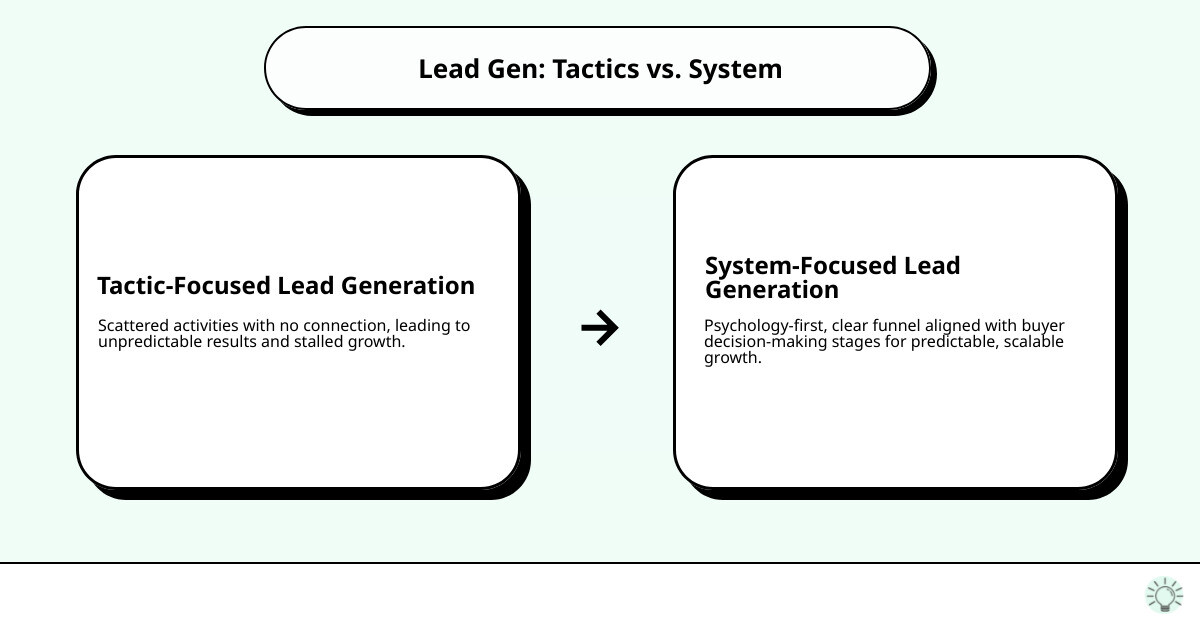
Most companies treat lead generation as a collection of tactics. They run ads, publish blog posts, host webinars, and wonder why none of it adds up to predictable growth.
The problem isn’t effort. It’s the lack of a coherent system built around how buyers actually think and decide.
When growth stalls, it’s rarely because a tactic failed. It’s because the strategy didn’t account for the human on the other side of the form. What were they uncertain about? What did they believe was true? What made them trust you enough to share their information?
I’m Jeremy Wayne Howell, founder of The Way How, and I’ve spent over 20 years helping companies diagnose why their lead generation strategy isn’t working and rebuild it around buyer psychology, not just best practices. In this guide, I’ll walk you through how to design a lead generation strategy that creates certainty for both your team and your customers.
Key lead generation strategy vocabulary:
At The Way How, we believe that effective lead generation strategy is the lifeblood of modern sales and marketing. It replaces outdated cold-calling tactics with a strategic, customer-friendly approach, focusing on attracting prospects and converting them into customers. However, simply doing lead generation isn’t enough; we need to understand why it’s crucial and why it often fails.
Many businesses treat lead generation as a series of disconnected actions. They chase the latest trends, implement tactics without a clear understanding of their audience, and then wonder why their growth has stalled. The real issue, we’ve found, isn’t a lack of effort, but a lack of a clear, psychology-first system.
A lead is any person who indicates interest in a company’s product or service. This interest is typically expressed by them opening communication, such as submitting personal information for an offer, a trial, or a subscription, rather than receiving an unsolicited cold call. This fundamental shift in timing – allowing prospects to raise their hands on their own terms – is where the power of modern lead generation lies.
Why is this so critical for businesses? For B2B businesses especially, lead generation is vital due to often long and complex sales cycles. Research shows that over 30% of B2B sales take one to three months to close, and 48% of companies report that leads require a long cycle before purchasing. This means we have a significant window to influence a potential customer’s decision-making process. Without an intentional lead generation strategy, we risk losing these potential customers to competitors who are actively guiding them through their journey.
In fact, 61% of marketers identify generating traffic and leads as their biggest challenge. This isn’t surprising when we consider the crowded media landscape and the sheer volume of distractions buyers face today. Our goal is to cut through that noise, not add to it. We don’t just want any leads; we want qualified leads. An effective lead generation strategy helps us build a predictable sales pipeline, reduce customer acquisition costs, gain valuable customer insights, and establish brand authority and trust. It’s about engineering certainty into your growth engine.
The Foundation: Diagnosing Your Customer’s Decision-Making Journey
Before we even think about tactics, we must understand the human on the other side of the screen. This means diving deep into target market research and crafting detailed buyer personas. Our belief is that winning brands owe their success not just to product quality, but to the superiority of the customer journeys they create. Most customers begin researching their purchase long before they ever talk with a company representative. This creates a significant opportunity for us to become a trusted guide in their research process.
To effectively inform our lead generation efforts, we need to ask ourselves: Who are our best customers? What are their similarities? Are they in a specific industry? What are their job roles, and are the users and decision-makers the same or different?
We need to understand their pain points, motivations, and the decision triggers that prompt them to seek solutions. Where do “certainty gaps” exist in their current understanding or process? What information do they need to feel confident moving forward? This deep understanding allows us to map out the buyer’s journey and tailor our approach accordingly.

How to Define Your Ideal Customer Profile
Defining your ideal customer profile (ICP) and buyer personas is not a one-time exercise; it’s a continuous process of empathetic inquiry. We combine quantitative data (like demographics, company size, revenue) with qualitative data (like challenges, desires, and the exact language they use).
We can extract qualitative data through customer interviews and surveys. Most importantly, we leverage existing customer support, business development, and sales channels to understand our buyers’ precise expressions, words, and ideas. This helps us identify their “job-to-be-done” – the fundamental problem they’re trying to solve – and any unmet needs they have.
For example, if your product helps people generate leads, you’d look for keywords that indicate interest in lead generation strategies, tools, or best practices. We have a comprehensive HubSpot Personas Guide that can help you create detailed profiles of your target audience. By understanding who we’re trying to reach and what truly moves them, we lay a solid foundation for a lead generation strategy that actually resonates.
Designing a Human-Centered Lead Generation Strategy
Once we understand our audience, we can design a lead generation strategy that aligns with their natural decision-making process. This typically involves a blend of inbound and outbound methodologies, each playing a distinct role in earning trust and creating awareness.
Traditionally, outbound sales push unsolicited messages to broad audiences. Modern lead generation, however, focuses on an inbound methodology. This means creating valuable content and experiences that attract qualified prospects, then building credibility before a sales conversation even begins.
The choice between inbound and outbound isn’t always clear-cut; it depends on your market, goals, offer structures, deal sizes, and available resources. For a B2B startup with limited marketing resources, cold outreach might be prioritized over expensive advertising. We’ve compiled a complete guide to outbound lead generation to help you steer this.
Here’s a psychological comparison of inbound versus outbound:
| Feature | Inbound Lead Generation | Outbound Lead Generation |
|---|---|---|
| User State | Actively seeking solutions, problem-aware, information-gathering | Passive, unaware of problem or solution, potentially interruptible |
| Goal | Attract prospects by providing value, build trust, establish authority | Proactively reach out to prospects, generate immediate interest, create awareness |
| Key Emotion | Curiosity, trust, relief (finding solution) | Intrigue (if message resonates), slight annoyance (if irrelevant), skepticism |
| Psychological Barrier | Finding relevant information, trusting the source | Overcoming interruption, building initial rapport, proving relevance |
| Primary Mechanism | Attraction through helpful content, permission-based engagement | Direct outreach, targeted messaging, initiating conversation |
| Long-Term Impact | Builds brand equity, sustainable growth, higher customer loyalty | Can generate quick wins, but risks brand perception if not executed carefully |
Attracting Intent: A Content and SEO Lead Generation Strategy
Content marketing and SEO are the dynamic duo for attracting leads who are already interested in what you offer. As Ryan Robinson, founder and CEO of RightBlogger, explains, content marketing and SEO teams should attract leads who are already interested in an offering, rather than interrupting people.
Our content marketing strategy focuses on creating customized, relevant, interactive, and engaging content for each step of the research process. This can include blog posts, ebooks, whitepapers, videos, and case studies. The content needs to tap into an unmet need or problem your audience has.
For SEO, the goal is to optimize this content so it ranks high in search engine results. This means defining a set of keywords, creating quality content around them, and optimizing it for search engines. We use tools like Google Keyword Planner, Ahrefs, and SEMrush to identify keywords with a good balance of search volume and competitiveness. Once you have your keywords, you need to create something better than what’s currently ranking, focusing on internal and external links. For a deeper dive, our guide on What is On-Page SEO Complete Strategies for Success can help.

A key part of this is offering “lead magnets” – valuable pieces of content (like ebooks or webinars) that prospects can download in exchange for their contact information. These are crucial for converting organic traffic into leads and moving them into the next stage of the funnel.
The Role of Social, Email, and Paid Channels in the Journey
While content and SEO attract organic interest, social media, email marketing, and paid advertising provide powerful ways to reach and nurture leads through more direct channels.
Social Media Marketing: Social platforms offer direct reach to potential leads and opportunities for both organic promotion and paid advertising. For B2B organizations, LinkedIn lead generation is particularly popular and effective. Nearly 85% of B2B teams use LinkedIn during the buying process, and it boasts over 1 billion users, with millions in senior-level and decision-making positions. Our HubSpot Social Media guide provides more insights. Platforms like Facebook, Instagram, and YouTube are also widely used; 69.56% of marketers use Facebook, 60.31% use Instagram, and 58.77% use YouTube in their marketing strategy.
Email Marketing: Email remains a highly effective lead generation channel, with 34.49% of companies leveraging it. As Noel Griffith, CMO at SupplyGem, shared, their email newsletter became the top source of new leads within months. Email marketing is excellent for nurturing relationships, delivering consistent, helpful information, and guiding leads through the sales funnel. This is where HubSpot Drip Campaigns and other nurturing sequences become invaluable for delivering personalized content at the right time.
Paid Advertising (PPC): Paid ads on search engines (PPC) and social media put your business in front of users actively searching for your solutions. Google alone gets 8.5 billion searches a day, making it prime real estate. Jason Hunt, co-founder and CMO at Merged Media, notes that “the real power of social media advertising lies in its ability to segment audiences very precisely and test different messages.” This ensures your message reaches a highly relevant audience. Paid ads offer immediate results and allow for precise audience segmentation and rapid testing of different messages.
From Interest to Action: The Psychology of Conversion and Qualification
Attracting leads is only half the battle. The next crucial step in our lead generation strategy is to effectively convert those leads into prospects and, ultimately, customers. This involves reducing friction, managing cognitive load, and building trust at every touchpoint. We focus on Conversion Rate Optimization to ensure that every interaction moves the prospect closer to a decision.
Optimizing the Exchange: Forms, Landing Pages, and Interactive Tools
When a potential customer is ready to exchange their information for value, we need to make that exchange as seamless and trustworthy as possible. This is where well-designed landing pages, optimized forms, and engaging interactive tools come into play.
Landing Page Best Practices: A dedicated landing page should focus solely on the offer, minimizing distractions. Key elements include a clear goal, a compelling headline, engaging visuals, concise copy, social proof, and a prominent call-to-action (CTA). Our HubSpot Landing Pages guide can help. We also recommend continuous A/B testing to refine these elements.
Here are some best practices for creating effective landing pages:
- Clarity is King: A clear, concise message that immediately communicates value.
- Compelling Headline: Grabs attention and highlights the main benefit.
- Strong Visuals: Relevant images or videos that support the message without distracting.
- Concise Copy: Focus on benefits, not just features.
- Clear Call-to-Action (CTA): Prominent and action-oriented (e.g., “Download Now,” “Get Your Free Guide”). Personalized CTAs convert 202% better than basic ones.
- Minimal Distractions: Remove navigation menus and external links.
- Social Proof: Testimonials, reviews, or trust badges to build credibility.
- Mobile Responsiveness: Ensures a seamless experience on all devices.
- Fast Loading Speed: Reduces bounce rates and improves user experience.
Form Optimization: The goal is to reduce friction. While the average lead capture form has five fields, several studies show that fewer fields lead to higher conversions. LinkedIn Lead Gen Forms, for instance, are designed for maximum convenience. They pre-populate fields with user profile data, drastically cutting the effort needed to fill them out and improving conversion rates. Over half of marketers (53%) running a Lead Gen Form ad use a LinkedIn Marketing Partner for CRM integration and campaign optimization. They are optimized for mobile and can be integrated with CRM systems for seamless lead management.
Interactive Tools and Webinars: Webinars are a proven way to capture leads, especially when registration is required. You can boost reach by promoting your webinar on social media, or stream it directly on LinkedIn Events. Interactive tools, like quizzes or calculators, are also powerful. There’s a reason BuzzFeed was so successful with quizzes like “which Harry Potter house would you be in?” People love personalized results, and these tools offer an engaging way to gather information while providing immediate value.
A Human-Centered Approach to Your Lead Qualification Strategy
Not all leads are created equal. A crucial part of our lead generation strategy is lead qualification – identifying who is genuinely interested and a good fit for our offerings. This ensures our sales team focuses their efforts on the most promising prospects. 50% of qualified leads aren’t ready to purchase at first contact, and 67% of lost sales result from not properly qualifying leads.
We use methods like:
- Lead Scoring: Assigning a numerical value to leads based on their actions (website visits, content downloads) and demographic information. This helps us prioritize.
- Persona Matching: Assessing how well a lead aligns with our defined buyer personas.
- BANT Framework: Evaluating leads based on their Budget, Authority, Need, and Timeline.
- User Actions: Qualifying leads based on specific behaviors, such as visiting a pricing page or requesting a demo.
Marketing and sales teams need to be aligned on the definitions and the process of moving a lead from Marketing Qualified Lead (MQL) to Sales Qualified Lead (SQL) to opportunity. A Customer Relationship Management (CRM) platform like HubSpot is an excellent way to close the gap between your marketers and salespeople. Modern tools, including chatbots, can also play a significant role in lead qualification. Our guide on How do Chatbots Qualify Leads in HubSpot a Complete Guide explores this further.
Measuring What Matters: From Vanity Metrics to Revenue Momentum
A robust lead generation strategy isn’t complete without a clear system for measuring its effectiveness. We believe that if you can’t measure it, you can’t improve it. This means moving beyond vanity metrics to focus on key performance indicators (KPIs) that directly impact revenue momentum.
Key metrics for measuring the success of lead generation campaigns include:
- Conversion Rate: The percentage of visitors who complete a desired action (e.g., fill out a form).
- Cost per Lead (CPL): The total cost of a campaign divided by the number of leads generated.
- Customer Acquisition Cost (CAC): The total cost of sales and marketing efforts needed to acquire a new customer.
- Lead-to-Customer Ratio: The percentage of leads that ultimately convert into paying customers.
- Return on Investment (ROI): The revenue generated from leads relative to the cost of acquiring them.
According to HubSpot’s 2025 State of Marketing Report, top channels for conversion ROI include:
- Website/blog/SEO (23.21%)
- Social media shopping tools (22.74%)
- Email marketing (22.35%)
- Paid social media content (21.39%)
- Content marketing (20.81%)
We use advanced tools for marketing data analysis and analytics platforms like HubSpot Analytics to track performance, demonstrate ROI, and confidently report pipeline outcomes. This data-driven approach allows for continuous optimization, ensuring we always boost marketing ROI and refine our strategies based on what truly works.
From Uncertainty to Momentum: Building Your Growth Engine
Building a strong brand awareness is an often-overlooked but crucial component of a successful lead generation strategy. It’s the bedrock upon which trust and recognition are built, making all other lead generation efforts more effective. When potential customers are already familiar with your brand, they are more likely to engage with your content, fill out your forms, and trust your solutions.
Brand awareness is cultivated through consistent messaging, valuable content, and a strong presence across relevant channels. This isn’t just about being seen; it’s about being known and respected for your expertise.
We also need to consider the advantages and disadvantages of strategies like referral programs and influencer marketing.
- Referral Programs: These leverage the power of existing, satisfied customers to bring in new leads. Daniel Nyquist, CMO at Crosslist, highlights their effectiveness because marketers are asking satisfied customers to refer the brand to their network. The advantage is high trust and often lower CAC; referrals accounted for over 40% of new business within six months for one company. The disadvantage can be the effort required to set up and manage a compelling program, and ensuring the quality of referred leads.
- Influencer Marketing: Partnering with influencers can expose your brand to new, engaged audiences. Mike Falahee, owner of Marygrove Awnings, found success collaborating with micro-influencers. The advantage is reaching niche audiences with built-in trust; the disadvantage can be finding the right influencers, ensuring authenticity, and measuring direct ROI.
At The Way How, our goal is to help you move from the uncertainty of stalled growth to the momentum of predictable revenue. We achieve this by designing a comprehensive lead generation strategy that is rooted in human behavior, empathy, and decision-making psychology. We don’t just provide tactics; we build systems that create trust, clarify decision-making, and drive sustainable growth.
Ready to transform your lead generation from a chaotic scramble into a dependable growth engine? Find how our psychology-first approach can help you diagnose certainty gaps, design intelligent systems, and open up predictable revenue.