Why Your Data Isn’t Driving Growth (and How to Fix It)
Marketing data analysis is the process of collecting, measuring, and interpreting data from your marketing activities to understand what’s working, what’s not, and why—so you can make smarter decisions that directly impact revenue.
To perform effective marketing data analysis:
- Define your North Star Metric – the one number that connects marketing activity to business growth
- Collect both quantitative data (traffic, conversions, CAC, CLV) and qualitative data (surveys, session recordings, interviews)
- Use the right tools – web analytics (Google Analytics), CRM (HubSpot), BI platforms (Tableau), and behavioral analytics (Mixpanel)
- Analyze the customer journey – identify where people drop off and why
- Act on insights – test, optimize, and reallocate budget based on what the data tells you
You have data. Probably too much data.
Your Google Analytics shows thousands of sessions. Your CRM tracks hundreds of leads. Your email platform reports open rates and click-throughs. Your social media dashboard lights up with likes and shares.
But when the CEO asks, “Is marketing working?”—you hesitate.
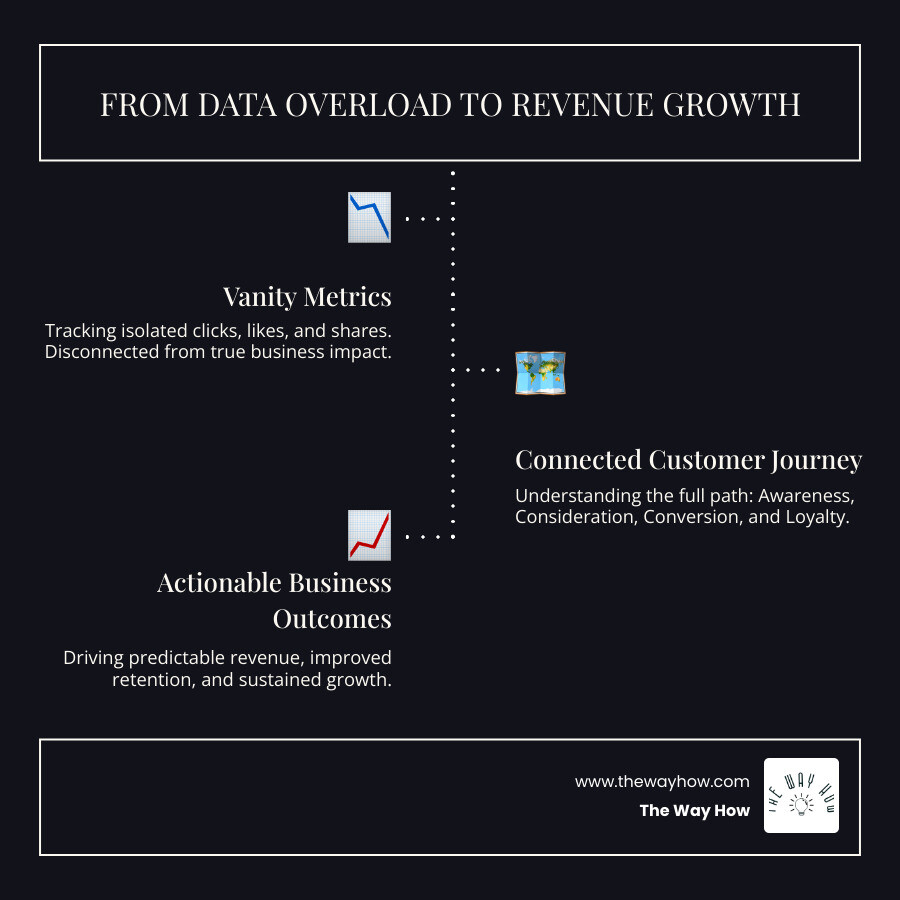
Because the truth is, most marketing teams are drowning in metrics but starving for insight. They track vanity numbers that feel productive but don’t explain why growth stalled, where trust breaks down, or what actually moves people from “just looking” to “ready to buy.”
64% of marketing executives believe data-driven initiatives are crucial—yet many still can’t connect their dashboards to revenue with confidence. The problem isn’t a lack of data. It’s a lack of clarity about what to measure, how to interpret it, and how to turn analysis into action.
Marketing data analysis isn’t about collecting more numbers. It’s about asking better questions. Questions that connect marketing activity to human behavior. Questions that reveal certainty gaps in your customer journey. Questions that show you exactly where momentum dies—and how to restore it.
This guide will show you how to move from tracking disconnected metrics to building a data system that explains behavior, predicts outcomes, and drives predictable revenue growth.
The Foundation: Asking Questions That Connect Marketing to Revenue
At The Way How, we believe true marketing data analysis begins not with collecting data, but with asking the right questions. Before we dive into tools and metrics, we need to understand what we’re trying to achieve. What are your overarching business objectives? How do your marketing goals tie into them?
This is where your North Star Metric comes in – a single, crucial metric that best captures the core value your product delivers to customers and, in turn, drives your business growth. For example, for a SaaS company, it might be “active users,” or for an e-commerce store, “repeat purchases.” This metric provides clarity, cuts through the noise of countless data points, and ensures everyone is pulling in the same direction.
Once your North Star is defined, we can identify the Key Performance Indicators (KPIs) that act as checkpoints along the customer journey. These aren’t just any metrics; they are the vital signs that indicate progress toward your North Star. We differentiate between leading indicators (which predict future outcomes, like website traffic or engagement rates) and lagging indicators (which measure past results, like revenue or customer churn). Understanding this distinction helps us diagnose issues proactively rather than reactively.
When we approach marketing data analysis, we’re not just looking at numbers; we’re looking for the difference between business analysis and analytics. Business analysis focuses on understanding business needs and recommending solutions, while analytics focuses on extracting insights from data. For us, it’s about identifying “certainty gaps”—those points in the customer journey where we lack clear understanding of user behavior or intent. By mapping the customer journey and pinpointing these gaps, we can then strategically apply marketing data analysis to fill them, creating trust and momentum.
What is marketing analytics and why is it important?
Marketing analytics is the process of analyzing marketing data to measure performance, find opportunities, and optimize return on investment (ROI). It goes beyond reporting what happened to explain why it happened and predict what will happen next.
This discipline is crucial because it allows businesses to:
- Make evidence-based decisions instead of relying on gut feelings.
- Prove ROI by directly tying marketing activities to revenue, justifying its role as a growth driver. 64% of marketing executives believe data-driven initiatives are crucial for this reason.
- Optimize campaigns by reallocating resources to the best-performing channels.
- Understand customer behavior, motivations, and needs.
- Gain a competitive advantage by identifying trends and personalizing experiences.
Without marketing data analysis, you’re flying blind, unable to understand your audience or measure your effectiveness.
The evolution of marketing analytics
The evolution of marketing analytics mirrors the evolution of technology itself. Early analysis involved ledgers and manual calculations to gauge the success of print and TV ads. The digital age, however, caused a seismic shift, moving the focus from broad demographics to granular, individual consumer behavior.
Initially, digital analytics was siloed, tracking single-device interactions like website visits. As customers began using multiple devices and channels, a more holistic view became necessary. This led to multi-touch attribution, which credits each touchpoint along the customer journey, moving beyond simplistic “last-click wins” models. Today, AI and machine learning are pushing the frontier further, enabling predictive analysis and personalization at scale. This evolution has transformed marketing data analysis from a reporting function into a strategic imperative for understanding human behavior.
Defining your key marketing data analysis process
A structured, repeatable process is essential for turning data into actionable insights. Here is our five-step guide:
- Pick Your Metrics: Before collecting data, know what you want to measure. Start with your North Star Metric and cascade down to specific KPIs that answer your key business questions and help close certainty gaps.
- Select Tools and Collect Data: Choose the right tools for the metrics you’ve defined. This includes web analytics, CRMs, and ad platforms. Ensure data collection is accurate and consistent.
- Analyze Your Data: Look for patterns, trends, and anomalies. This involves segmenting data, comparing performance over time, and correlating different metrics to find the story in the numbers.
- Share Your Findings: Insights are only valuable when communicated effectively. Create clear reports and visualizations that highlight key takeaways and recommendations. Tools like Looker Studio are invaluable for making insights digestible. You can learn how to create beautiful Looker Studio dashboards for your stakeholders.
- Plan Your Next Steps (Activate Insights): The goal of analysis is action. Based on your findings, decide what to change—optimize a campaign, refine an audience, or adjust an offer. This creates a feedback loop (analyze, act, measure) that drives continuous improvement and predictable revenue.
This systematic process translates raw data into a coherent narrative, ensuring every analysis contributes to strategic growth.
From Numbers to Narratives: Gathering Data That Explains Behavior

To truly understand your customers and drive growth, you need to collect both the “what” (quantitative data) and the “why” (qualitative data). The numbers tell us where people are going, but the stories behind those numbers reveal their motivations, frustrations, and desires. This holistic view is crucial for identifying friction points and building trust signals along the customer journey.
Crucial quantitative data types
Quantitative data provides the measurable facts about your marketing performance. These are the numbers that tell us how many, how often, and how much.
Key quantitative metrics we frequently track include:
- Website Traffic: Sessions, users, page views, bounce rate, time on page. These metrics tell us about the volume and initial engagement with your digital properties.
- Conversion Metrics: Conversion rates for various actions (e.g., lead forms, sign-ups, purchases). This shows us how effectively your marketing is turning visitors into prospects or customers.
- Revenue Data: Total revenue, average order value (AOV), and customer lifetime value (CLV). These are critical for understanding the financial impact of your marketing efforts.
- Customer Acquisition Cost (CAC): The total cost of sales and marketing divided by the number of new customers acquired. Essential for understanding efficiency.
- Return on Ad Spend (ROAS): Revenue generated for every dollar spent on advertising. Crucial for optimizing paid campaigns.
- Channel Performance: Metrics specific to each marketing channel (e.g., email open rates, social media engagement, organic search rankings). This helps us understand which channels are delivering the best results.
We often use tools like Google Analytics to monitor these metrics, and we can even set up Google Analytics alerts for KPIs to stay informed of critical changes in real-time. These metrics paint a clear picture of marketing effectiveness and efficiency, helping us make data-driven decisions.
Uncovering the ‘why’ with qualitative data
While quantitative data tells us what is happening, qualitative data tells us why. This is where we tap into human behavior and decision-making psychology, which is core to our approach at The Way How. Understanding the “why” helps us uncover the true motivations and pain points of your audience, allowing us to build marketing systems that resonate deeply.
Essential qualitative data types include:
- Customer Surveys and Feedback Forms: Directly asking customers about their experiences, preferences, and challenges provides invaluable insights.
- Session Recordings: Tools that record actual user sessions on your website or app allow us to observe user behavior firsthand, revealing points of confusion or delight.
- Heatmaps: Visual representations of user interaction on a webpage, showing where users click, move their mouse, and scroll. Heatmaps are fantastic for identifying areas of interest or neglect. You can learn how to implement and analyze heatmaps to gain deeper insights into user engagement.
- User Interviews: One-on-one conversations with customers or prospects to understand their needs, goals, and decision-making processes in depth. This is a powerful way to get into the mind of your ideal customer.
- Social Listening: Monitoring social media conversations, forums, and review sites to understand public sentiment, brand perception, and emerging trends.
- Buyer Personas: Detailed profiles of your ideal customers, built from both quantitative and qualitative data. Creating buyer personas to target the right audience helps us empathize with your customers and tailor marketing messages that truly connect.
By combining these qualitative insights with your quantitative data, we can move beyond mere numbers to create compelling narratives about your customers, diagnose certainty gaps, and design marketing strategies rooted in genuine understanding.

In today’s complex digital landscape, marketers are faced with an overwhelming array of tools. The average enterprise uses 120 martech tools, a number that keeps rising year on year. While this offers incredible power, it also creates challenges like data fragmentation and siloed information. Effective marketing data analysis requires a robust toolkit, but more importantly, it requires a strategy for integrating these tools to create a unified view of your marketing performance.
Essential platforms for every analyst
To manage the complexity and extract meaningful insights, we categorize essential marketing data analysis platforms into several key areas:
- Web Analytics Platforms: These are foundational for understanding website traffic, user behavior, and conversion funnels.
- CRM & Marketing Automation Platforms: Crucial for managing customer relationships, automating marketing tasks, and tracking lead progression.
- Business Intelligence (BI) Platforms: For aggregating data from multiple sources, visualizing trends, and creating custom dashboards for comprehensive reporting.
- SEO Tools: To monitor search engine performance, conduct keyword research, and analyze competitor strategies.
- Behavioral Analytics Platforms: For deep dives into user interactions within websites and applications, often providing session recordings and heatmaps.
A closer look at key tools
While the market is vast, some tools stand out for their capabilities and widespread adoption:
- Google Analytics: Often the entry point for millions of websites, Google Analytics is a powerful, free platform for understanding website traffic, user demographics, and conversion paths. With the shift to GA4, understanding how to set up a Google Analytics 4 account is more important than ever for modern tracking.
- HubSpot Marketing Hub: As a psychology-first firm, we deeply appreciate HubSpot’s integrated approach. HubSpot Marketing Hub is an all-in-one platform covering CRM, marketing automation, content management, and sales tools. It allows for a holistic view of the customer journey, from initial contact to conversion and beyond. Understanding HubSpot analytics is key to leveraging its full potential for lead nurturing and customer retention.
- SEMRush: For SEO and content marketing professionals, SEMRush is an indispensable tool. It provides comprehensive data on keyword rankings, competitor analysis, backlink profiles, and content performance, helping us optimize organic visibility.
- Tableau: A household name in big data analytics, Tableau is a robust self-service BI platform. It excels at data visualization, allowing us to transform complex datasets into interactive dashboards and reports that reveal insights quickly. It’s particularly useful for enterprise-level companies dealing with large, diverse data sources.
- Mixpanel: Specializing in product analytics, Mixpanel helps product managers and marketers understand how users interact with their SaaS products. It provides granular visibility into user behavior, funnels, and retention, offering a powerful lens for optimizing product engagement.
Integrating your tools to create a single source of truth
The biggest challenge with a diverse martech stack is data silos—information trapped in individual platforms, making a unified view impossible. This fragmentation hinders effective marketing data analysis and makes it difficult to connect marketing efforts directly to revenue.
To overcome this, we focus on integration:
- API Connections: Many modern platforms offer Application Programming Interfaces (APIs) that allow them to “talk” to each other, sharing data programmatically.
- Integration Platforms: Tools like Zapier, or native integrations within platforms like HubSpot integrations, can automate data transfer between different systems.
- Unified Data Warehouse: For more advanced setups, creating a central data warehouse (like those offered by Snowflake) where all your marketing, sales, and customer data is consolidated provides a single source of truth. This eliminates discrepancies and enables comprehensive analysis across the entire customer lifecycle.
By integrating your tools, you move from a fragmented view to a coherent narrative, allowing for more precise marketing data analysis and better-informed strategic decisions.
Activating Insights: From Analysis to Action and Growth
The true value of marketing data analysis isn’t in the reports themselves, but in the actions they inspire. Our goal is to transform insights into tangible improvements that drive growth and predictable revenue. This means using data to understand and optimize the entire customer journey, from initial awareness to loyal advocacy.
Understanding customer behavior and improving the customer journey
A powerful use of marketing data analysis is dissecting the customer journey to identify friction points and drop-offs.
- Funnel Analysis: Tracking users through predefined steps (e.g., visit > view product > add to cart > purchase) shows exactly where they abandon the process. Using Funnels to visualize user journeys is key.
- Identifying Drop-Off Points: Qualitative data (session recordings, interviews) helps explain why users leave. Is a form too long or a CTA unclear?
- Path Analysis: Exploring the various routes users take reveals common but unexpected journeys that can be optimized.
- Reducing Friction: Addressing pain points streamlines the user experience, making it easier for users to achieve their goals and building trust.
- A/B Testing: After forming a hypothesis, how to prioritize and run A/B tests validates which version of a page or ad performs better, ensuring optimizations are effective.
Continuously refining the customer journey creates a smoother experience that guides users toward conversion and builds lasting relationships.
Optimizing campaigns and resource allocation
Effective marketing data analysis is the backbone of campaign optimization and smart resource allocation. It allows us to invest strategically for maximum impact.
- Attribution Modeling: This helps attribute conversions to the right marketing touchpoints. Modern multi-touch models (e.g., linear, time decay) provide a more nuanced view than outdated “last-click” attribution, ensuring early-stage awareness campaigns get proper credit.
- Media Mix Modeling (MMM): On a broader, strategic level, MMM analyzes historical data to determine the optimal budget allocation across channels. As McKinsey notes, integrating MMM with other analytical approaches can free up 15-20% of marketing spend by identifying inefficiencies.
- Channel ROI Analysis: Calculating the ROI for each marketing channel identifies which are most profitable, allowing you to reallocate budget from underperforming channels to top performers.
- Forecasting Performance: Using historical data and predictive analytics, we can forecast future campaign performance for more proactive adjustments and accurate budgeting.
- Justifying Marketing Spend: With clear data on ROI, marketers can confidently justify their budgets, demonstrating marketing’s direct contribution to business growth, as highlighted by BCG research.
By carefully analyzing and optimizing campaigns, we ensure every marketing dollar is working as hard as possible, creating a dependable growth engine for your business.
Overcoming common challenges in marketing data analysis
Despite its power, marketing data analysis has common challenges:
- Data Fragmentation: Data spread across disparate tools creates an incomplete customer view. The solution is a robust integration strategy, often involving a centralized data warehouse to create a single source of truth.
- Lack of Skills: Many teams lack the expertise to analyze complex data. This skills gap can be filled through training, hiring specialists, or partnering with external experts like us.
- Analysis Paralysis: Too much data without clear objectives leads to inaction. Defining your North Star Metric and key questions upfront ensures you focus on insights that drive decisions.
- Proving Causation vs. Correlation: It’s easy to mistake correlation for causation. True analysis requires experimentation (like A/B testing) to ensure your actions genuinely cause the desired outcomes.
- Building a Data-Driven Culture: The biggest challenge is often organizational. It requires leadership buy-in and a commitment to learning. As BCG notes, 70% of the measurement battle is people and process. We help foster this culture by diagnosing before we prescribe, making data a shared language for growth.
By proactively addressing these challenges, we can transform marketing data analysis from a daunting task into a powerful driver of strategic clarity and predictable revenue.
The Future of Marketing Analytics: AI, Privacy, and Trust
The landscape of marketing data analysis is constantly evolving, driven by technological advancements and shifting consumer expectations. Looking ahead, several key trends will shape how we approach data:
- AI-Powered Analysis and Predictive Analytics: Artificial intelligence is changing how we analyze data. AI automates collection, identifies complex patterns, and generates predictive models to forecast customer behavior. This enables hyper-personalization, delivering relevant content at the optimal time. As Google’s insights show, AI is crucial for open uping the full potential of data, changing media buying, and rethinking ROI. This technology is a key driver of growth across the analytics market.
- The Cookieless Future and First-Party Data Strategy: The deprecation of third-party cookies is forcing a significant shift in how marketers track and target users. This “crumbling cookie” era emphasizes the importance of first-party data—data collected directly from your customers with their consent. As SAS suggests, the crumbling cookie could improve customer experience by pushing brands to build direct relationships and earn consumer trust through transparency and value exchange. We help our clients develop robust first-party data strategies that respect privacy while enabling powerful personalization.
- Ethical Data Use and Trust: With increasing data collection capabilities comes a greater responsibility for ethical data handling. Consumers are more aware of their data privacy, and regulations like GDPR and CCPA reflect this. The future of marketing data analysis demands transparency, consent, and a commitment to using data in ways that build, rather than erode, customer trust. For us, this aligns perfectly with our psychology-first approach: empathy and ethical behavior are not just compliance requirements, but fundamental drivers of long-term customer relationships and predictable revenue.
These trends underscore that the future of marketing data analysis is not just about more data or more sophisticated algorithms; it’s about using these tools wisely, ethically, and with a deep understanding of human behavior to create genuine value and foster trust.
Conclusion: From Uncertainty to Predictable Revenue
In the dynamic world of marketing, the ability to effectively leverage marketing data analysis is no longer a luxury—it’s a necessity. We’ve seen how moving beyond a deluge of disconnected metrics to a focused, question-driven approach can transform your marketing efforts. It’s about shifting your mindset from simply reporting numbers to understanding the human behavior behind them, diagnosing certainty gaps in your customer journey, and designing systems that build trust and momentum.
By asking the right questions, embracing both quantitative and qualitative data, utilizing integrated toolkits, and activating insights into strategic action, you can move from a state of uncertainty to one of predictable revenue. This isn’t just about optimizing campaigns; it’s about turning marketing into a dependable growth engine for your business.
At The Way How, we specialize in helping founders and leadership teams achieve this change. We remove uncertainty in your sales and marketing systems by blending strategic clarity, behavioral insight, and operational execution.
Learn how our psychology-first approach can build your growth engine.
 Jeremy Wayne Howell : Jul 22, 2026 9:48:31 PM