
Beyond the Click: Why Your Ad Strategy is Stalled
Paid advertising platforms are digital services that let businesses pay to show ads to targeted audiences — and in 2026, there are more options than ever.
Here are the top platforms most businesses should consider:
| Platform | Best For | Avg. CPC |
|---|---|---|
| Google Ads | High-intent search traffic | ~$3.67 |
| Meta Ads (Facebook/Instagram) | Awareness, B2C, retargeting | ~$0.50–$2.00 |
| Microsoft Advertising | Budget-conscious search buyers | 30–50% less than Google |
| LinkedIn Ads | B2B decision-makers | ~$5–$12 |
| Amazon Ads | E-commerce, product discovery | Pay-per-click, varies |
| TikTok Ads | Gen Z, brand awareness | CPM ~$1–$10 |
| YouTube Ads | Video reach, 18–49 demo | ~$0.10–$0.30/view |
The short answer: start with one search platform and one social platform, match them to where your buyers actually spend time, and optimize from there.
But here’s the uncomfortable truth most platform comparisons skip.
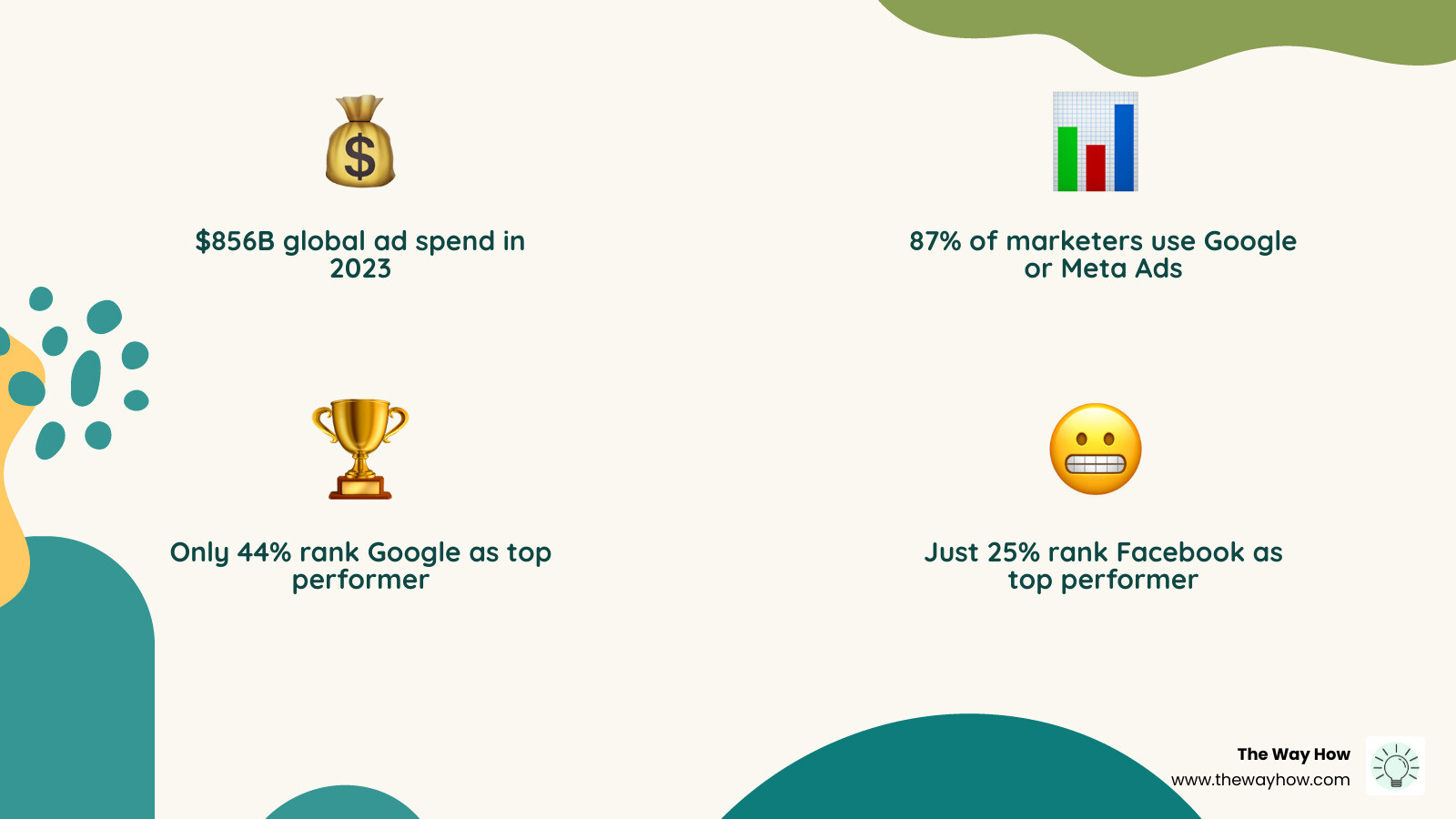
Global ad spend crossed $856 billion in 2023. Yet a survey of 1,440 marketers found that while 87% use Google or Meta Ads, only 44% say Google is their top performer — and just 25% say the same for Facebook. The money is flowing. The results often aren’t.
That gap isn’t usually a platform problem. It’s a clarity problem.
Most businesses choose platforms based on what’s popular, what an agency recommended, or what a competitor appears to be doing. They skip the harder question: who is this buyer, what do they already believe, and where are they in their decision?
When that question goes unanswered, even the best platform wastes your budget.
I’m Jeremy Wayne Howell, founder of The Way How — a psychology-first revenue strategy firm where I’ve spent over 20 years helping founders and revenue leaders align their paid advertising platforms with actual buyer behavior, not just channel benchmarks. In this guide, I’ll help you cut through the noise and make a more confident, better-informed choice.

When we look at a marketing dashboard and see plenty of clicks but no revenue, our instinct is to blame the algorithm. We tweak the keywords, swap the creative, or jump to a new platform entirely. But at The Way How, we’ve found that growth usually stalls because of “certainty gaps.”
A certainty gap occurs when the information provided by the ad doesn’t match the internal psychological state of the buyer. Human behavior is driven by a need for safety and clarity. If your ad promises a solution but your landing page creates cognitive load—through slow speeds, confusing navigation, or a “message mismatch”—the buyer’s brain defaults to “no.”
Statistics show that a mere one-second delay in mobile page load time can reduce conversions by up to 20%. This isn’t just a technical glitch; it’s a psychological friction point. When a page is slow or the message doesn’t align with the ad, the prospect loses trust. In 2026, where the average cost per lead has climbed to over $70, you cannot afford to pay for clicks that die on the vine because of a lack of buyer empathy.
The Heavy Hitters: Comparing Top Paid Advertising Platforms in 2026
Choosing between paid advertising platforms requires balancing reach with intent. While Google processes over 8 billion searches daily, offering unparalleled “pull” marketing, Meta platforms like Facebook and Instagram boast 3.74 billion monthly active users, making them the kings of “push” or discovery marketing.
The landscape in 2026 is increasingly shaped by privacy changes and the shift toward first-party data. As third-party cookies phase out, platforms that own their own “walled garden” of data—like Amazon and Google—become even more valuable.
Search Intent and Google: The King of Paid Advertising Platforms
Google Ads remains the foundational platform for most businesses because it targets users at the moment of highest intent. When someone searches for a solution, they are actively looking to bridge a gap in their lives.
In 2026, Google has leaned heavily into AI-driven optimization through Performance Max. This allows businesses to reach customers and sell more with online advertising by letting Google’s AI find the most effective ad combinations across Search, YouTube, Display, and Gmail. While the average CPC is $3.67, the ROI can be substantial—some businesses report up to a 675% return on ad spend when their systems are properly aligned.
If you are just starting, learning how to create a google ads account is your first step toward capturing that high-intent traffic.
Social Connection and Meta: Building Awareness through Empathy
If Google is the yellow pages, Meta (Facebook and Instagram) is the community center. These platforms excel at building awareness through visual storytelling and behavioral targeting. With over 77% of internet users active on Meta properties, the reach is undeniable.
The strength of Meta Ads lies in its ability to target based on interests and life stages. However, since the iOS privacy changes, the platform has moved toward broader targeting and automated placements. Success here requires a deep understanding of your buyer’s psychology—you aren’t answering a search query; you are interrupting a scroll. Your creative must lead with empathy. To ensure you are tracking these interactions accurately, configuring your facebook ads conversion events is critical for feeding the algorithm the right data. You can explore their tools further at Facebook.
Specialized Networks for B2B and E-commerce Growth
Not every business belongs on every platform. For B2B companies and e-commerce giants, specialized networks often provide a higher signal-to-noise ratio.
LinkedIn Ads is the gold standard for B2B. With over 930 million users, it allows you to target decision-makers by job title, industry, and company size. While the CPCs are higher ($5–$12), the lead quality is often superior because you are reaching people in a professional mindset.
For e-commerce, Amazon Ads is no longer optional. Amazon accounts for 47% of all U.S. e-commerce spend. Advertisers using Sponsored Products see an average of 34% more sales growth within just four weeks of adoption. It’s a high-intent platform where the “search” is almost always a “search to buy.”
Don’t overlook Microsoft Advertising either. By starting with search, display, and video ads, you can often access the same type of high-intent searchers as Google but with 30–50% lower CPCs. This is especially effective for reaching an older, wealthier demographic on the Microsoft Search Network. Managing these diverse streams is often easier when integrated with your CRM, such as using hubspot ads to track the full lifecycle of a lead.
Emerging Opportunities: TikTok and Niche Paid Advertising Platforms
TikTok has disrupted the advertising world with over 1.4 billion monthly active users. It is the go-to platform for reaching Gen Z and younger Millennials. The secret to TikTok isn’t high-production commercials; it’s User-Generated Content (UGC) that feels authentic.
To succeed on TikTok, you need to understand the “pixel” and how it tracks engagement. Learning how to install the tiktok pixel on your site is vital for optimizing for conversions rather than just views.
Other niche platforms include:
- Reddit: Ideal for targeting hyper-specific communities (subreddits), though it requires a “give-first” content strategy to avoid being rejected by the community.
- Pinterest: A discovery engine where 450 million users go to plan future purchases. It has a long “pin lifespan” compared to the fleeting nature of a tweet or post.
- Snapchat: Still a powerhouse for reaching 13–24 year olds with immersive AR filters and short-form video.
When considering these, it’s helpful to review how to run a social media campaign that integrates these diverse touchpoints into a cohesive strategy.
The Psychology of the Post-Click Experience: Why Ads Fail
The most common reason ads fail isn’t the targeting—it’s the “post-click” experience. If your ad promises a “Free 14-Day Trial” but your landing page leads with a generic “Platform Built for Growth” headline, the buyer experiences a moment of subconscious “dissonance.” Their brain asks, “Am I in the right place?”
To maximize ROI on paid advertising platforms, you must ensure:
- Message Match: The headline on your landing page should mirror the text in your ad.
- Trust Signals: Include testimonials or certifications that reduce the perceived risk of the transaction.
- Friction Reduction: Remove unnecessary navigation links that might distract the user from the primary call to action.
For Shopify owners, this often starts with the technical basics, like how to add a facebook pixel to a shopify store to ensure your retargeting ads are showing the exact products people just viewed.
Frequently Asked Questions About Paid Advertising
Which platform has the lowest cost per click?
Generally, Microsoft Advertising and TikTok offer lower CPCs compared to Google Ads. Microsoft CPCs can be 30–50% lower due to less competition for similar keywords. TikTok also offers very competitive CPMs ($1–$10), making it an affordable way to generate massive brand awareness. However, “lowest cost” doesn’t always mean “highest value.” A $10 click on LinkedIn that results in a $50,000 contract is “cheaper” than a $0.50 click on Facebook that never converts.
How do I choose a platform based on my business type?
- B2B: Start with LinkedIn for targeting and Google Search for intent.
- E-commerce: Amazon Ads is a must, supplemented by Meta for discovery and Google Shopping for searchers.
- Local Services: Google Local Services Ads (pay-per-lead) and Google Search Ads are the most effective for “emergency” or high-intent local needs.
- Brand Awareness: TikTok, YouTube, and Meta are superior for reaching large audiences quickly.
Before diving in, you might want to setup a social listening campaign to see where your audience is already talking about your industry.
Why are my ads getting clicks but no conversions?
This usually stems from one of three issues:
- Audience Misalignment: You are targeting people who aren’t actually qualified to buy.
- Offer Friction: Your offer (e.g., “Book a Consultation”) is too high-commitment for someone who just discovered you.
- Landing Page Mismatch: The page they land on is slow, confusing, or doesn’t deliver on the ad’s promise.
Restoring Momentum to Your Revenue Engine
At The Way How, we believe that marketing shouldn’t be a gamble. It should be a dependable growth engine rooted in behavioral insight and strategic clarity. Choosing the right paid advertising platforms is just one piece of the puzzle.
If your growth has stalled, we don’t just suggest new tactics. We diagnose the certainty gaps in your customer journey and design systems that create trust and momentum. Whether through Fractional CMO leadership or HubSpot architecture, we help you turn uncertainty into predictable revenue.
Ready to remove the guesswork from your marketing? Learn more about our services and let’s build a system that works as hard as you do.