
Beyond the Pay-to-Play Panic: Restoring Certainty to Your Growth Engine

A solid paid advertising strategy is a documented plan for reaching the right people, on the right platforms, at the right moment — without bleeding budget on guesswork.
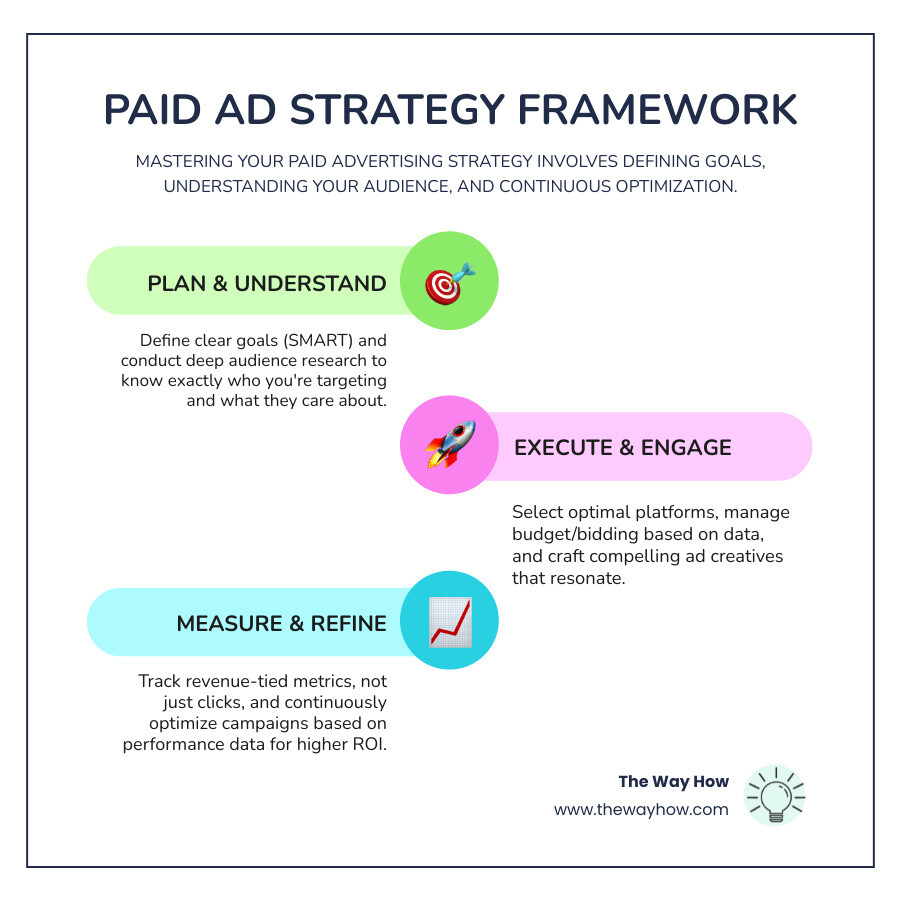
Here is what a strong paid advertising strategy covers:
| Component | What It Means |
|---|---|
| Goal setting | Define what success looks like (leads, sales, awareness) before spending a dollar |
| Audience research | Know exactly who you are targeting and what they care about |
| Platform selection | Choose channels based on where your buyers actually spend time |
| Budget and bidding | Allocate spend based on data, not gut feel |
| Ad creative | Build messaging that speaks to real pain points, not generic features |
| Measurement | Track metrics tied to revenue, not just clicks |
| Optimization | Continuously test and improve based on what the data shows |
Most businesses do not have a strategy problem on the surface. They have campaigns running. They have budgets approved. They have ads live.
What they have is a certainty gap — a disconnect between what the ads promise and what the buyer actually needs to feel confident enough to act.
That gap is where money disappears.
Organic reach has declined sharply. In competitive markets, you often cannot appear above the fold on Google without paying for it. And yet, simply paying more does not fix the underlying problem. Campaigns that are not grounded in buyer psychology, clear goals, and honest measurement tend to degrade over time — not because the platform changed, but because the available demand gets exhausted and no new demand was ever created to replace it.
This guide is built to close that gap.
I’m Jeremy Wayne Howell, founder of The Way How and a revenue growth strategist with over 20 years of experience building and rebuilding paid advertising strategy for founders and revenue teams who are tired of tactics that look good on paper but stall in practice. My work starts with understanding the human on the other side of the decision before we ever talk about channels or budgets.
The Psychology of the Paid Advertising Strategy: Why Most Campaigns Fail to Build Trust
We often see businesses treat paid ads like a vending machine: insert coins, receive leads. When the leads stop falling out, they assume the machine is broken. In reality, the “machine” is a series of human interactions. Most campaigns fail because they ignore the fundamental certainty gaps that exist in a buyer’s mind.
A certainty gap occurs when a prospect has a problem but doesn’t yet trust that your solution is the right bridge to their desired future. If your paid advertising strategy focuses solely on “buy now” messaging, you are likely shouting at people who aren’t ready to listen. Building trust requires empathy—understanding the friction your audience feels before they ever click your ad.
This is where a Disruption Marketing Complete Guide becomes invaluable. We must understand that we are often interrupting a user’s flow. If that interruption doesn’t offer immediate value or psychological resonance, it is viewed as a nuisance rather than a solution. Working with a Disruptive Advertising Agency mindset means shifting from “how do I get them to click?” to “how do I help them decide?”
Integrating Psychology into Your Paid Advertising Strategy
To win in 2026, we must master the “pattern interrupt.” Humans are experts at filtering out digital noise. A successful ad breaks the habitual scrolling behavior by addressing a deep-seated pain point or an unspoken desire.
However, breaking the pattern is only half the battle. We must also manage cognitive load. If your ad or landing page is too complex, the brain’s “safety” mechanism kicks in, causing the user to retreat to the familiar. By reducing the effort required to make a decision, we increase the likelihood of action. This Disruption in Advertising isn’t about being loud; it’s about being clear and relevant when everyone else is being noisy.
The Difference Between Demand Capture and Demand Creation
One of the most common mistakes we see is a total reliance on demand capture. Demand capture is bidding on high-intent keywords like “best payroll software.” It is efficient but limited. Once you’ve reached everyone actively searching, your growth stalls.
Demand creation, on the other hand, is about priming the market. It’s about reaching people who have the problem you solve but aren’t looking for you yet. Research shows that 3 to 7 exposures over a 2 to 4-week period are the standard for breaking the awareness barrier. When a buyer recalls both a brand-building ad and a direct response ad, they are significantly more likely to put that product on their shortlist. You can see this in action through various Disruptive Marketing Examples where brands “plant seeds” months before the harvest.
Building a High-Yield Paid Advertising Strategy: From Demand Capture to Demand Creation
A balanced paid advertising strategy addresses every stage of the marketing funnel. We categorize these as:
- TOFU (Top of Funnel): Building awareness and creating demand.
- MOFU (Middle of Funnel): Educating and nurturing those who are considering solutions.
- BOFU (Bottom of Funnel): Capturing intent and converting it into revenue.
As noted by experts like Shane Barker, paid ads are the most effective way to amplify content distribution when organic reach hits its ceiling. To succeed, you need a comprehensive plan that aligns these stages so the transition from “stranger” to “customer” feels like a single, seamless conversation.
Defining Goals for Your Paid Advertising Strategy
We cannot optimize what we do not measure. Every campaign must be rooted in SMART goals (Specific, Measurable, Achievable, Relevant, and Time-bound).
Key Performance Indicators (KPIs) should be tiered. While your team might look at Click-Through Rate (CTR) to judge creative health, leadership should focus on Return on Ad Spend (ROAS) and Cost Per Acquisition (CPA). A high-ROI strategy connects these technical metrics back to actual pipeline contribution. If your ads are generating “cheap leads” that never turn into revenue, your strategy is failing, regardless of what the dashboard says.
Identifying and Researching Your Target Audience
The “who” is more important than the “where.” We start by defining an Ideal Customer Profile (ICP) using firmographics (company size, industry) and psychographics (motivations, fears).
In 2026, broad targeting is a recipe for wasted spend. Narrowing your focus to specific segments can generate up to 3x more high-quality leads per dollar spent. This level of Marketing Disruption requires us to look past basic demographics and understand the professional and personal pressures our audience faces daily.
Navigating the 2026 Ad Landscape: Choosing Platforms Based on Human Behavior

In 2026, the platform you choose is a proxy for user intent. People go to Google to solve a problem; they go to LinkedIn to advance their careers; they go to Meta or TikTok to be entertained or inspired. Your paid advertising strategy must respect these behavioral contexts.
Google Ads and Search Intent in 2026
Google Ads has evolved into a machine-learning environment. Traditional manual bidding is largely a relic. To get the maximum ROI, we now set “intelligent constraints” for Google’s AI.
This involves using Smart Bidding and Performance Max campaigns, but with a heavy emphasis on first-party data. Since the deprecation of third-party cookies, your own customer data is your greatest asset. If you are just starting, the first step is knowing how to create a Google Ads account properly, ensuring your tracking pixels and conversion events are set up from day one.
According to AdLibrary’s 2026 guide, the key to reducing wasted spend in this automated era is a rigorous negative keyword list and a focus on “Ad Scent”—ensuring the promise made in the search result is perfectly matched on the landing page.
Social Media and Professional Networks
For B2B organizations, LinkedIn remains the gold standard, with 97% of B2B marketers using it for content distribution. It allows for precision targeting based on job title, industry, and even specific company lists.
When you run a social media campaign, success depends on more than just the ad; it depends on the infrastructure behind it. This includes configuring your Facebook Ads conversion events to ensure the platform’s algorithm understands what a “good” lead looks like for your business.
The Science of Scaling: Bidding, Creative, and the 70-20-10 Rule
Scaling a paid advertising strategy is not about doubling the budget overnight. It is a systematic process of testing and validation. We recommend the 70-20-10 rule for creative resources:
- 70% of your budget goes to “proven winners” (ads that consistently hit your KPI targets).
- 20% goes to “adjacent ideas” (variations of your winners).
- 10% goes to “wild ideas” (experimental formats or platforms to find the next winner).
| Bidding Model | Best Used For | Key Metric |
|---|---|---|
| CPC (Cost Per Click) | Driving traffic and testing new headlines | CTR |
| CPM (Cost Per Mille) | Brand awareness and demand creation | Impressions / Reach |
| Target ROAS | eCommerce and direct sales | Revenue / Spend |
Before you scale, ensure your tracking is airtight. For Shopify users, for example, knowing how to add a Facebook Pixel is a foundational step that cannot be skipped.
Crafting Compelling Ad Copy and Visuals
In 2026, authenticity beats high-production value. Statistics show that 55% of consumers trust user-generated content (UGC) more than traditional advertising. Whether you are using HubSpot Ads or native social formats, your creative should lead with the “hook”—the specific pain point or benefit that stops the scroll in the first three seconds.
A/B Testing and Continuous Optimization
Optimization is a permanent state, not a one-time event. We use split testing to compare headlines, visuals, and calls-to-action (CTAs). A high Quality Score on platforms like Google can actually lower your costs, meaning you can outrank competitors who are bidding more but providing a poorer user experience. Always optimize for the “macro-conversion” (the sale or qualified lead) while keeping an eye on “micro-conversions” (video views or page scrolls) to gauge engagement.
Synergizing Paid and Organic: Creating a Unified Customer Journey
Paid and organic marketing should not live in silos. They are two halves of the same growth engine. Paid ads provide the speed and control, while organic content builds long-term authority and compounds over time.
A unified paid advertising strategy uses paid ads to amplify high-performing organic content. If a blog post is getting great organic traction, putting a small ad spend behind it can skyrocket its reach. Conversely, the data we get from paid ad headlines can be used to optimize SEO meta titles and email subject lines.
The Role of Retargeting in Closing Certainty Gaps
Retargeting (or remarketing) is perhaps the most underutilized tool for building certainty. Most people will not buy on the first visit. Retargeting allows us to stay top-of-mind, providing the 3-7 exposures needed for trust.
By using pixel tracking, we can serve specific ads based on what the user did on our site. Did they read a blog post? Show them a case study. Did they visit the pricing page? Offer a demo or a free trial. This accelerates the buying journey by addressing specific doubts as they arise.
Measuring Success Beyond Vanity Metrics
Clicks and impressions are “vanity metrics” if they don’t lead to revenue. To truly understand the impact of your paid advertising strategy, we must look at:
- Customer Lifetime Value (LTV): Is the cost to acquire this customer justified by their long-term value?
- Pipeline Contribution: How much potential revenue did these ads put into the sales team’s hands?
- Branded Search Lift: Are more people searching for your company by name after seeing your awareness ads?
Frequently Asked Questions about Paid Advertising Strategy
How much should a small business spend on their first paid campaign?
A common starting point in 2026 is a budget that allows for 100-200 clicks to gather sufficient data, often ranging between $1,000 and $2,000 per month, depending on industry CPCs. This “data tax” is necessary to teach the platform’s algorithm who your buyers are.
What is the most important metric for B2B paid advertising?
While CTR and CPC are helpful for diagnostic purposes, the most critical metrics for B2B are Cost Per Acquisition (CPA) and Pipeline Contribution, as these align directly with revenue growth. In B2B, a high click-through rate is meaningless if those clicks are coming from people who can’t actually sign the contract.
How long does it take for AI-driven bidding strategies to optimize?
In the current 2026 landscape, most smart bidding algorithms require a “learning period” of 2 to 4 weeks and a minimum of 30-50 conversions per month to reach peak efficiency. Making major changes during this period can reset the learning process and lead to unstable performance.
From Tactical Noise to Strategic Momentum
At The Way How, we believe that marketing shouldn’t feel like a gamble. When growth stalls, it’s rarely because you aren’t spending enough on ads; it’s because there is a lack of strategic clarity in the customer journey.
We help founders and leadership teams move away from chasing the latest “hack” and toward building a revenue engine rooted in human behavior and decision-making psychology. Whether through Fractional CMO leadership or optimizing your HubSpot architecture, our goal is to help you see the problem clearly so you can solve it permanently.
If you are ready to stop guessing and start growing with a predictable paid advertising strategy, let’s build something that lasts.