
The Certainty Gap in the Machine Age

An AI ML tech stack is the complete, layered set of tools, frameworks, and infrastructure that powers an AI system — from raw data all the way to a live, monitored application.
If you want the short answer before diving deeper, here it is:
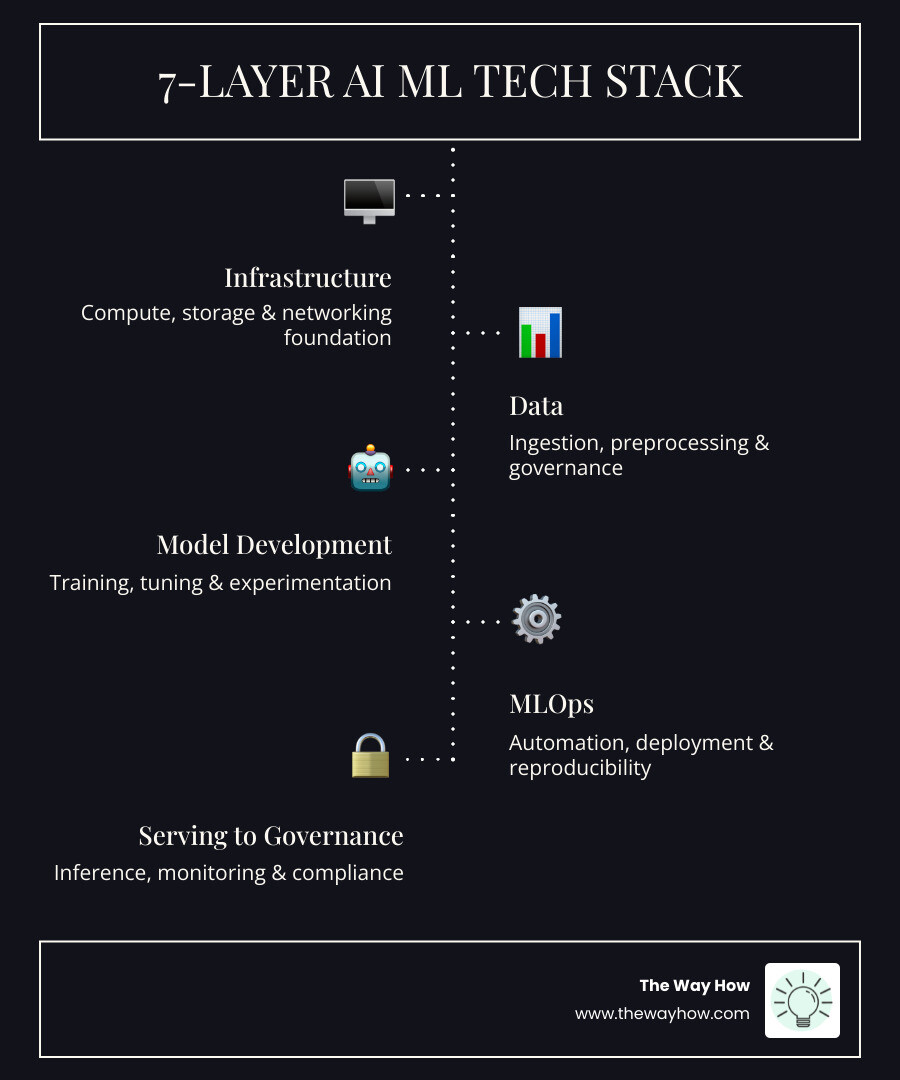
The 7 core layers of an AI ML tech stack:
| Layer | What It Does | Example Tools |
|---|---|---|
| 1. Infrastructure | Compute, storage, networking | AWS, GCP, Azure, GPUs |
| 2. Data | Ingestion, preprocessing, governance | Kafka, Spark, Pandas |
| 3. Model Development | Training, tuning, experimentation | PyTorch, TensorFlow, JAX |
| 4. MLOps | Automation, deployment, reproducibility | MLflow, Kubeflow, DVC |
| 5. Serving | Inference, APIs, model hosting | FastAPI, Triton, BentoML |
| 6. Observability | Monitoring, drift detection, logging | Evidently, Langfuse, W\&B |
| 7. Governance | Security, compliance, ethics | GDPR controls, audit logs |
Here is what most founders and technical leaders actually experience: they hear “you need an AI strategy,” start researching tools, and within 48 hours they are drowning in acronyms, competing frameworks, and vendor claims that all sound equally urgent.
That is not a knowledge problem. It is a certainty problem.
AI adoption has jumped from roughly 50% to 72% in just a few years, according to McKinsey’s 2024 Global Survey. But 70% of organizations still report serious struggles with data governance, integration, and getting models to actually work in production. Most teams aren’t failing because they picked the wrong tool. They are failing because they started building before they understood the structure underneath.
The stack is not the strategy. But without understanding the stack, you cannot make a sound strategic decision.
I’m Jeremy Wayne Howell, founder of The Way How — a psychology-first revenue strategy firm — and while my work centers on buyer behavior and go-to-market clarity, I’ve spent years helping founders and revenue leaders navigate the human side of building and adopting an AI ML tech stack: what creates decision paralysis, what builds internal confidence, and what separates teams that ship from teams that stall. This guide is built to give you structural clarity first, so every tool decision that follows actually makes sense.
Ai ml tech stack terms to know:
Deconstructing the Modern AI ML Tech Stack
Building an AI system in 2026 feels different than it did even two years ago. We have moved away from monolithic, “black box” solutions toward modular layers. This modularity is your best defense against technical debt; it allows us to swap out a model or a database without tearing down the entire house.
When we look at a Modern AI Stack in 2026: The Ultimate Guide, we see that the most successful organizations prioritize ROI alignment over “cool” features. They ask: “Does this component help us make better decisions or serve customers faster?” If the answer is no, the tool is just noise.
The Infrastructure Layer: Compute and Storage
The bottom of the stack is where the heavy lifting happens. For deep learning and large-scale models, CPUs aren’t enough. We rely on GPUs (Graphics Processing Units) and TPUs (Tensor Processing Units) to handle the massive parallel mathematical operations required for training.
Most of us will choose between the “Big Three” cloud providers: AWS, Azure, or GCP.
- AWS is often the “safest” default for enterprise workloads due to its massive ecosystem.
- Azure is the go-to for those already deep in the Microsoft 365 environment, especially with its robust OpenAI integrations.
- GCP remains a favorite for teams focused heavily on data analytics and BigQuery.
Storage also requires a strategic split. We use S3 (Simple Storage Service) or HDFS (Hadoop Distributed File System) for raw data lakes, but for the actual training phase, we need low-latency networking to ensure the data moves as fast as the processors can think.
The Data Foundation: Solving the GIGO Problem
“Garbage In, Garbage Out” (GIGO) is the oldest rule in computing, but in AI, it is the most expensive. If your data foundation is shaky, your 2026 model will simply hallucinate with more confidence.
Data handling involves several high-friction steps:
- Collection: Pulling from CRMs, web logs, and IoT devices.
- Preprocessing: Cleaning, normalizing, and handling missing values.
- Annotation: Labeling data so the model knows what is “correct.”
- Security: Ensuring compliance with GDPR, HIPAA, and the EU AI Act.
For many organizations, the hurdle isn’t the model—it’s the data pipeline. This is where AI Application Development Services become vital, helping bridge the gap between messy raw data and a clean feature store. We also see the rise of vector databases (like Pinecone or Weaviate) which store data as high-dimensional embeddings, allowing AI to understand context rather than just matching keywords.
Choosing Your Weapons: Frameworks and IDEs for 2026
If the infrastructure is the engine, the framework is the steering wheel. In 2026, the landscape is dominated by a few heavy hitters that have reached a level of maturity where they are both powerful and (relatively) user-friendly.
| Framework | Best For | Key Stat |
|---|---|---|
| PyTorch | Research & Production flexibility | 55% production share (Q3 2025) |
| TensorFlow | Large-scale, stable enterprise deployments | Undisputed heavyweight for mobile/edge |
| JAX | High-performance research & XLA | Rapidly growing in Google-centric stacks |
| Hugging Face | NLP and pre-trained transformers | 3M+ daily pip installations |
PyTorch has emerged as the industry favorite because it feels like writing standard Python. It allows for dynamic computation graphs, which means we can change how the model behaves on the fly during development. Meanwhile, Hugging Face has become the “App Store” of AI, providing access to thousands of pre-trained models that save us from having to train from scratch.
Development Environments in an AI ML Tech Stack
Where you write your code matters. Python remains the undisputed king of AI, holding a 28.11% share on the PYPL Index. This dominance is fueled by a massive library support system—if you have a problem, someone has already written a library to solve it.
For the actual coding experience, we see a shift in 2026:
- VS Code remains the standard for general development.
- Cursor has become the “king” of AI-native IDEs, integrating LLMs directly into the coding workflow to suggest entire blocks of logic.
- Jupyter Notebooks are still the gold standard for prototyping and data visualization, allowing us to see results immediately after running a cell.
The goal here is prototyping speed. In a high-uncertainty environment, the team that can iterate three times faster usually wins.
From Demo-ware to Production: MLOps and Serving
There is a tragic phenomenon in AI development: the “Laptop Legend.” This is a model that works perfectly on a data scientist’s computer but breaks the moment it hits the real world. MLOps (Machine Learning Operations) exists to kill the Laptop Legend.
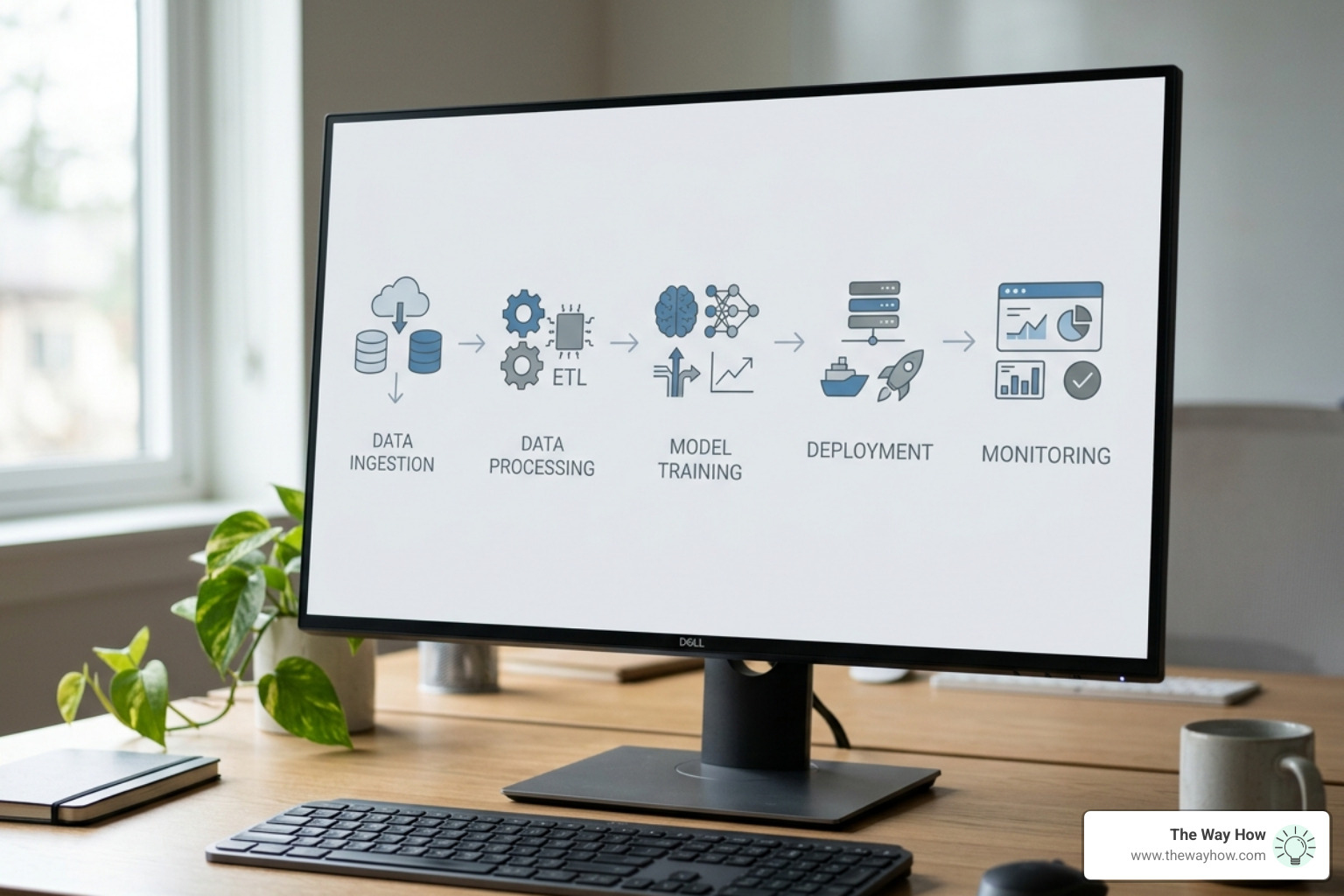
Tools like MLflow, Kubeflow, and Weights & Biases (W\&B) provide the “glue” for the ai ml tech stack. They handle:
- Experiment Tracking: Remembering which version of the data produced which result.
- Reproducibility: Using Docker and Kubernetes to ensure the model runs the same way in the cloud as it does locally.
- Versioning: Using DVC (Data Version Control) to track changes in datasets just like we track changes in code.
The Role of MLOps in Your AI ML Tech Stack
Why bother with the complexity of MLOps? Because it saves money. Timely adoption of a proper MLOps pipeline can drop AI infrastructure spending by 30 to 50 percent. By using containerization and autoscaling, we only pay for the compute we actually use, rather than keeping expensive GPUs running 24/7.
More importantly, MLOps provides observability. Once a model is deployed, it begins to “drift.” The world changes, and the model’s accuracy slowly decays. Tools like Evidently AI monitor this drift in real-time, alerting us when it is time to retrain.
The Generative Shift: Vector Databases and LLM Orchestration
The rise of Generative AI has introduced new components to the ai ml tech stack. We are no longer just building predictive models; we are building reasoning engines.
According to research on AI Tech Stack: Components, AI Frameworks, and Best Practices for 2026, the “RAG” (Retrieval-Augmented Generation) pattern has become the standard for enterprise GenAI. Instead of retraining a massive model on your private data (which is slow and expensive), you store your data in a vector database and “retrieve” the relevant parts to give the model context when it answers a question.
Key tools in this layer include:
- LangChain & LlamaIndex: Orchestrators that connect your model to your data sources.
- Pinecone & Weaviate: Specialized databases for high-speed semantic search.
- DSPy: A newer framework that focuses on optimizing prompts programmatically rather than through manual “prompt engineering.”
Open-Source vs Closed-Source Models
One of the biggest decisions we face is whether to use a closed API (like GPT-4.5 or Claude 3.7) or an open-source model (like Llama 3 or Mistral).
- Closed-Source: Best for speed to market and ease of use. You don’t have to manage infrastructure, but you do have to deal with “API tokenomics” (costs that scale with usage) and potential privacy concerns.
- Open-Source: Best for privacy and cost-efficiency at massive scales. You can host these models on your own servers, ensuring your data never leaves your environment.
In 2026, the performance gap is closing. Many fine-tuned open-source models now rival the giants in specific domain tasks, providing a much higher ROI for specialized enterprise applications.
Scaling Without Friction: Enterprise Integration and ROI
For a tech stack to be successful, it cannot live in a vacuum. It must integrate with the systems your team already uses—HubSpot, Salesforce, or custom CPQ (Configure, Price, Quote) platforms.
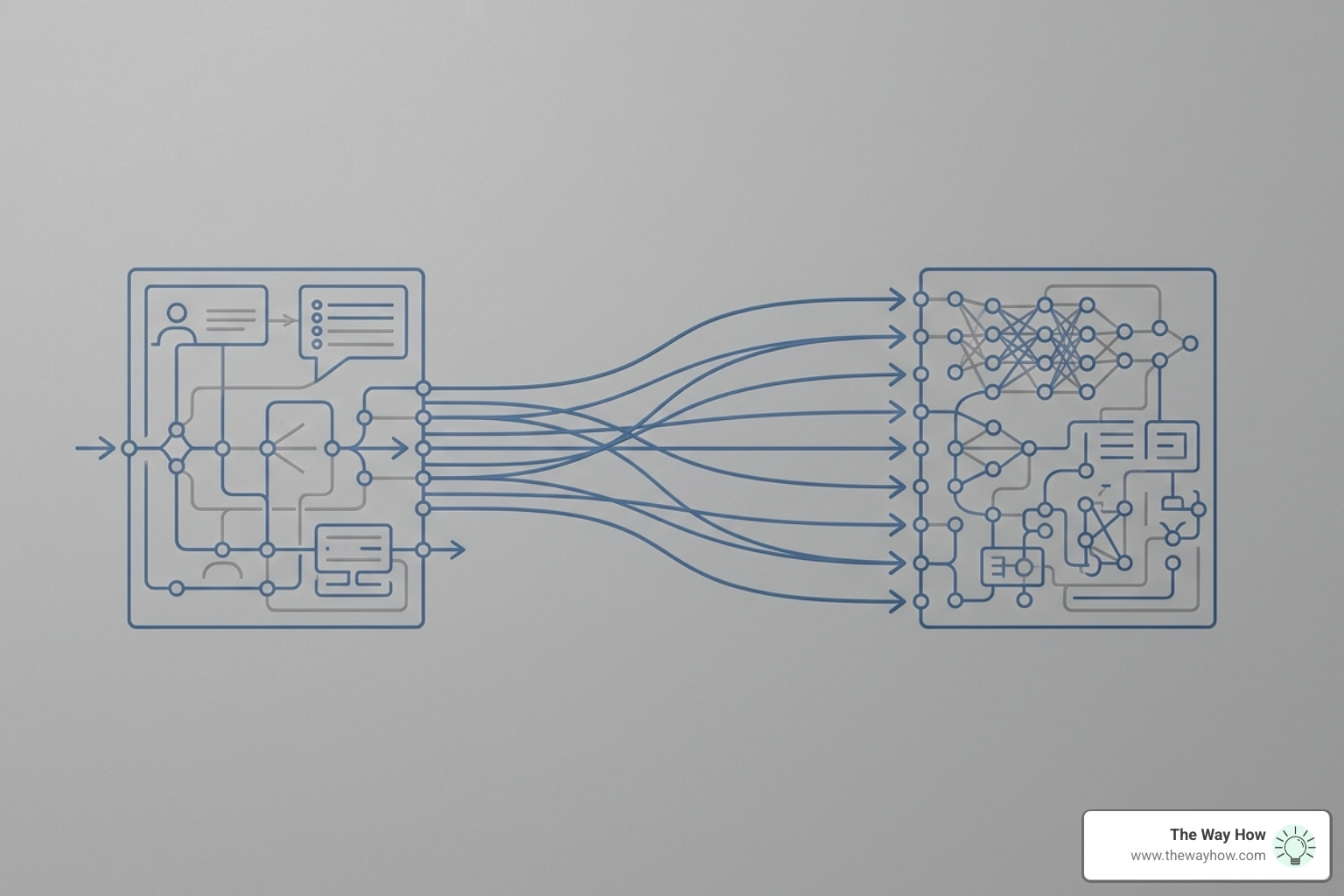
With AI adoption at 72%, the bottleneck is no longer the technology; it is the integration. We see a “certainty gap” where leadership teams are afraid to pull the trigger because they aren’t sure how these tools will impact their predictable revenue.
Optimizing Your Stack for Business Momentum
To restore momentum, we focus on strategic clarity. This means:
- Needs Assessment: Don’t build a Ferrari if you only need to cross the street. Start with the simplest stack that solves the problem.
- Team Skills: Ensure your stack matches your talent. If your team knows Python, don’t force them into a specialized C++ framework.
- Green Computing: As energy costs rise, optimizing model size (through quantization and distillation) isn’t just ethical—it’s a financial necessity.
The goal is to move from “experimenting with AI” to “operating with AI.” This requires a shift from chasing tactics to designing systems that create trust and momentum.
Common Friction Points in AI Development
Even with the best tools, you will hit bumps in the road. Maintenance and technical debt are the “silent killers” of AI projects. A model that isn’t documented or a data pipeline that relies on a single person’s custom script will eventually fail.
What is the best AI tech stack for beginners?
If you are just starting, keep it “boring.” Boring ships.
- Language: Python.
- Libraries: Pandas (for data) and Scikit-learn (for classic ML).
- Model: Start with an API (like Claude or GPT) to prove the value before building your own.
- Infrastructure: Managed services like AWS SageMaker or Google Vertex AI to handle the “plumbing” for you.
How do I calculate the ROI of my AI infrastructure?
We look at four main levers:
- Manual Task Hours: How many hours are saved by automating a workflow?
- API Costs vs. Engineering Time: Is it cheaper to pay OpenAI or to pay an engineer to maintain a custom Llama instance?
- Productivity Gains: Are your developers or sales reps 20% faster?
- Accuracy Improvements: In fields like fraud detection, a 1% increase in accuracy can mean millions in saved revenue.
Can I change my tech stack once development has started?
Yes, provided you have built with modularity in mind. By using clear interfaces (APIs) between your layers and maintaining rigorous documentation, you can swap your vector database or your LLM provider without a total rebuild. The cost of migration is always lower when your system is decoupled.
Restoring Momentum Through Structural Clarity
At The Way How, we believe that the biggest obstacle to growth isn’t a lack of tools—it’s a lack of certainty. When founders and leaders look at the ai ml tech stack, they often see digital chaos. Our job is to remove that uncertainty by diagnosing why growth has stalled and identifying the gaps in the customer journey.
We apply behavioral insight and strategic clarity to help you build systems that aren’t just “technically sound,” but are designed to create trust and predictable revenue. Whether you are building your first model or scaling an enterprise-grade system, the principles remain the same: diagnose before you prescribe, and prioritize human behavior over the latest trend.
If you are ready to stop chasing tactics and start building a dependable growth engine, we can help you design a path forward that aligns your technology with your revenue goals.