
The Paradox of the Modern Tech Stack
The PointMore tools, worse outcomes. That gap is not a technology problem. It is a clarity problem: a systems problem dressed up as a software problem.

Sales enablement tools are software platforms that give sales teams the content, training, and data they need to close deals more effectively.
Here are the most widely used and highly rated options in 2026:
| Tool | Best For |
|---|---|
| Salesforce Sales Cloud | Mid-market & enterprise |
| HubSpot Sales Hub | Small business & mid-market |
| Seismic | Enterprise content management |
| Highspot | Mid-market & enterprise enablement |
| Mindtickle | Sales training & coaching |
| Showpad | Content & training combined |
| Allego | Learning, coaching & digital selling |
There is something quietly broken about how most sales teams operate today.
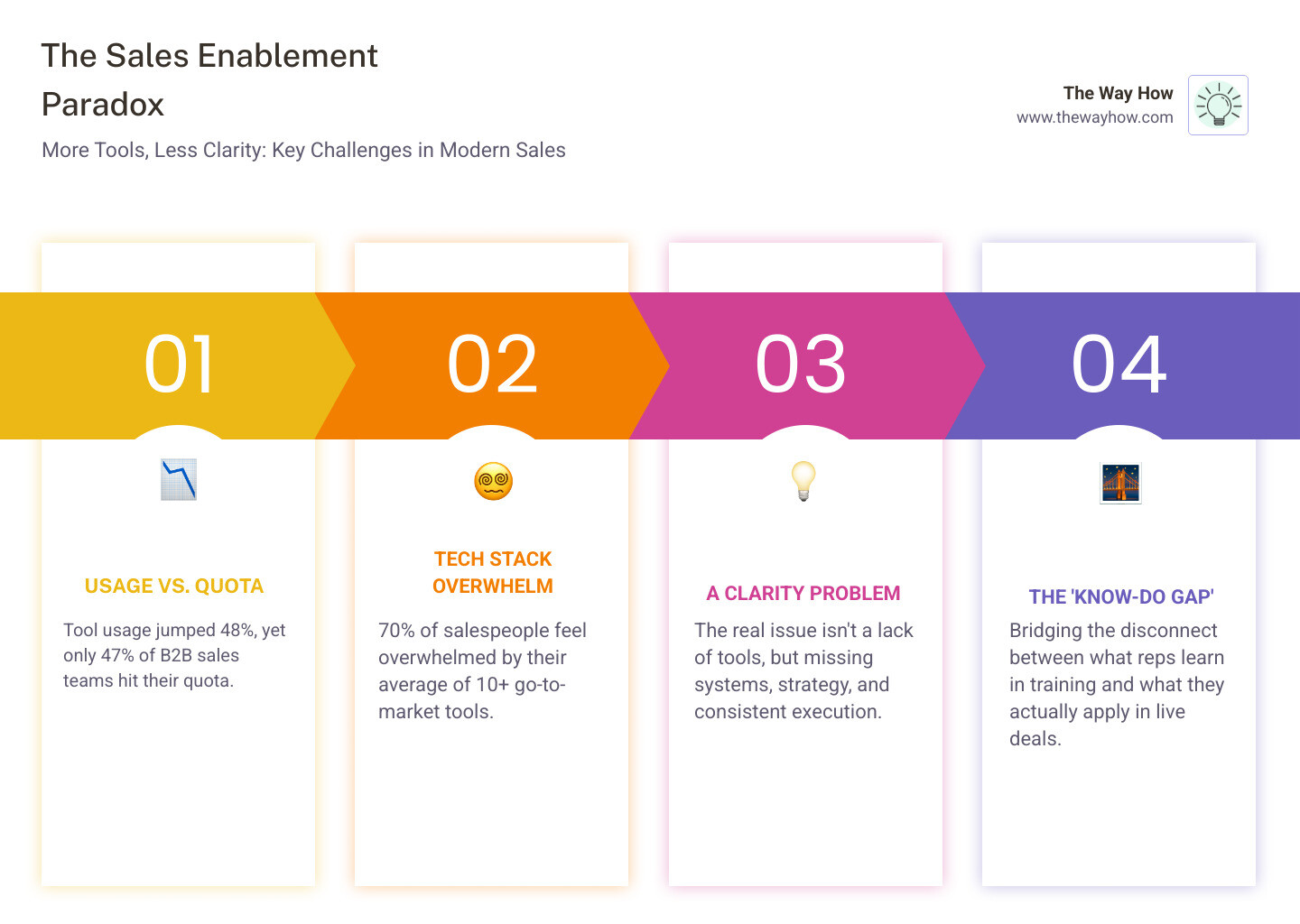
More teams are buying more sales software than ever before. And yet Forrester puts average quota attainment for B2B sales organizations at 47% (2023).
Your Company's Quota Attainment Is Probably Around 50%, And That's Not A Bad Thing. Forrester, 2023-03. Read the Source →More tools. Worse outcomes.
That gap is not a technology problem. It is a clarity problem.
42% of sales reps feel overwhelmed by too many tools, and sellers use an average of 8 tools to close deals, according to Salesforce’s 2026 State of Sales report. Yet one Reddit thread from a Sales Director at a Series A startup captures what so many revenue leaders quietly feel:
State of Sales, Seventh Edition: Sales Statistics. Salesforce, 2026. Read the Source →State of Sales, Seventh Edition: Sales Statistics. Salesforce, 2026. Read the Source →“I have HubSpot, Google Docs, Jira how-to guides… and it’s just a bit all over the place now.”
That is not a tools shortage. That is a systems problem dressed up as a software problem.
The instinct is always to add another tool. But before you can choose the right tool, you need to understand what is actually broken — and why your current stack is not producing the certainty and consistency your team needs.
I’m Jeremy Wayne Howell, founder of The Way How and a revenue growth strategist with over 20 years of experience helping founders and sales teams use sales enablement tools as part of a broader, psychology-first go-to-market strategy. In the sections below, I’ll walk you through how to evaluate, compare, and choose the right platform — starting with the human problem underneath the performance problem.
The Best Sales Enablement Tools for 2026
The PointA tool that exists in a vacuum is just another tab for a rep to close. True enablement happens when your content and training live where your reps work, in the CRM.
When we look at the landscape of sales enablement tools in 2026, we see a shift away from simple document storage toward “revenue enablement” platforms. These are systems designed to close the “Know-Do Gap”—the distance between what a rep learns in training and what they actually execute during a live deal.
The Foundation: Salesforce and HubSpot
For many, the journey begins with the CRM.
- Salesforce Sales Cloud: Often viewed as the enterprise standard, it is an AI-powered intelligence platform designed to speed up the sales process. While some users find it complex, its ability to manage leads and predict deal closure rates makes it a powerhouse for mid-market and enterprise teams.
- HubSpot Sales Hub: We often recommend HubSpot for its user-friendly interface and seamless integration. It is particularly effective for small to mid-market businesses that need to track a contact’s position in the pipeline while automating outbound tasks without the steep learning curve of more “bulky” CRMs.
The Specialists: Content and Coaching
Beyond the CRM, specialized sales enablement tools focus on the psychology of the buyer journey and the readiness of the seller.
- Seismic: As a global leader in enablement, Seismic excels at automating reporting materials and providing a centralized resource for enterprise teams. It focuses on engaging customers through highly tailored content.
- Highspot: This platform is frequently cited for its flexibility and design. It helps teams organize, search, and share information through “Plays” and templates that reps actually enjoy using.
- Mindtickle: If your bottleneck is rep performance, Mindtickle offers a multimedia platform for training with gamified progress. It is built to ramp reps faster and ensure they stay “on-message” through AI-driven role plays.
- Allego: Allego unifies learning, coaching, and content. It is unique in its focus on “practical agentic AI,” providing real-time guidance inside everyday workflows rather than just shipping features.
- Showpad: A strong contender for teams that need a blend of content management and training, helping sellers find the right collateral at the exact stage of the sales cycle where it’s needed.
- EnableU: For those looking to generate custom assets quickly, EnableU uses an “AI Brain” to transform company-specific content into personalized messaging guidance.
Tool Capability Comparison
| Feature | Small Business | Mid-Market | Enterprise |
|---|---|---|---|
| Primary Focus | Ease of use & automation | Integration & scalability | Compliance & deep analytics |
| Content Management | Basic folder structures | Tagging & metadata | AI-driven content recommendations |
| Training | Onboarding checklists | LMS integrations | AI role-plays & “everboarding” |
| Analytics | Email opens & clicks | Pipeline velocity | Content ROI & revenue influence |
Integrating Sales Enablement Tools with Your CRM
A tool that exists in a vacuum is just another tab for a rep to close. True enablement happens when your content and training live where your reps work.
Integrating platforms like Enablix with your CRM allows you to decouple content from filenames. Instead of searching for “CaseStudyV3_Final.pdf,” reps can find assets based on the deal stage, industry, or persona directly within Salesforce or HubSpot. This synchronization ensures that marketing knows exactly which assets are actually driving revenue, and sales leaders can see if a rep’s failure to close is linked to a lack of training or a lack of the right collateral.
The Role of AI in Modern Sales Enablement Tools
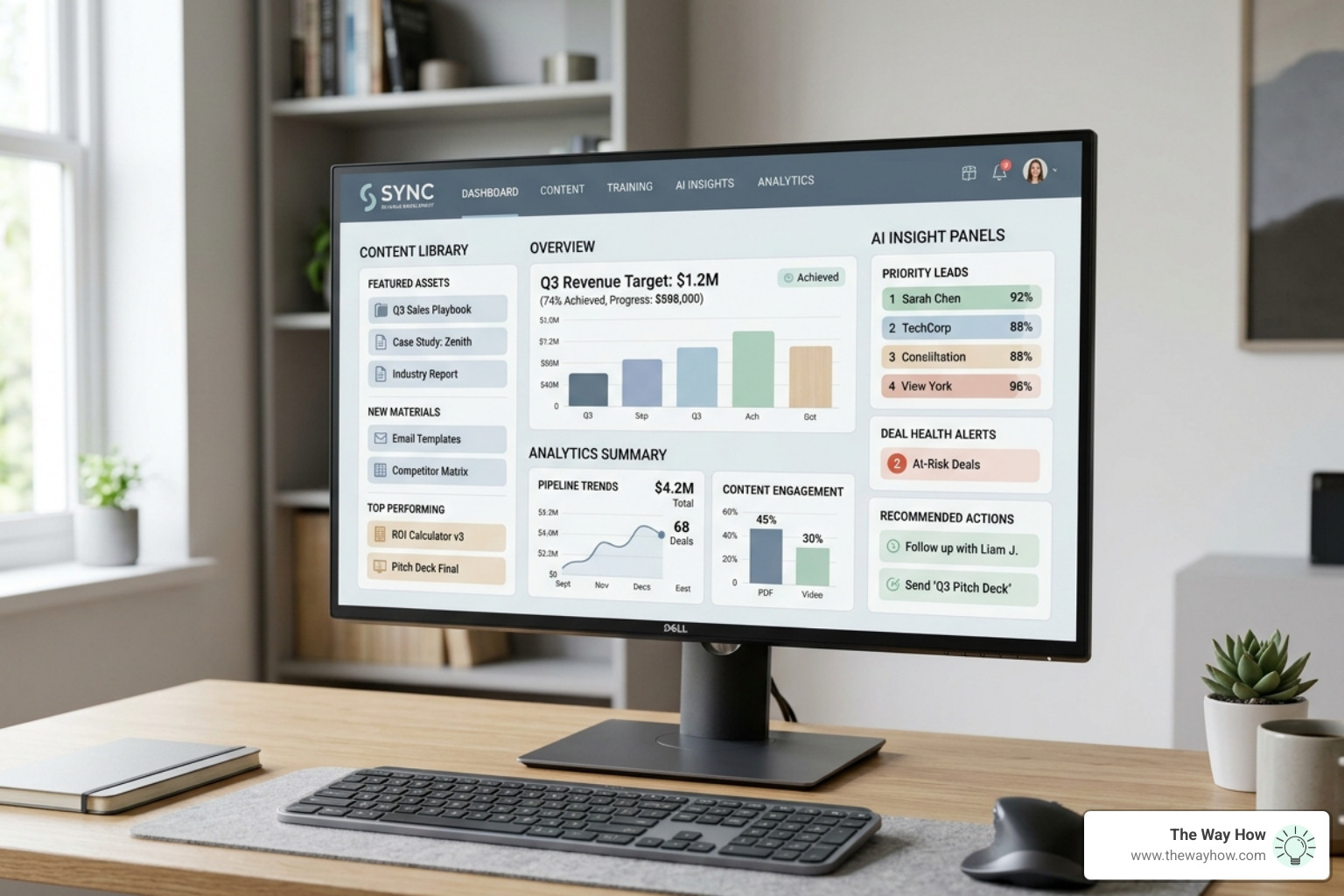
In 2026, AI has moved past simple chatbots. Modern sales enablement tools now offer “contextual intelligence.”
Platforms like Revspace utilize AI CoPilots to provide instant answers to sales questions based on internal playbooks. If a rep is preparing for a meeting with a CFO, the AI doesn’t just give them a generic script; it analyzes the company’s specific value narrative and suggests ROI-focused language.
Furthermore, AI-driven conversation intelligence (found in tools like Mindtickle and Allego) analyzes sales calls to coach reps on their talk-to-listen ratios and competitive mentions. This creates a feedback loop that doesn’t depend on a manager being present for every call, effectively scaling sales excellence across the entire org.
Key Features to Look for in Sales Enablement Platforms
The PointLook for content findability through metadata, training built into the daily workflow, digital sales rooms, conversation intelligence, and analytics tied to win rates.
Choosing between sales enablement tools can feel like a scavenger hunt. To find a system that actually removes uncertainty, look for these core pillars:
- Content Findability (Metadata and Tagging): Filenames are a trap. Look for tools that use metadata to make content discoverable by context (e.g., “competitor battlecard” + “healthcare industry”).
- Learning Management (The Know-Do Gap): It isn’t enough to have a library of videos. The best platforms address the “Know-Do Gap” by integrating training into the daily workflow. This includes “bite-sized” sales plays and AI-powered role plays.
- Buyer Engagement (Digital Sales Rooms): Modern buyers are overwhelmed. Digital sales rooms allow reps to create a single, personalized link where a prospect can find all relevant documents, videos, and next steps.
- Conversation Intelligence: This feature records and analyzes calls, providing real-time coaching and identifying buyer signals that a human might miss.
- Analytics that Measure Impact: You don’t just want to know if a rep opened a file. You want to know if that file influenced the win rate. Mindtickle and similar platforms help connect training completion to actual revenue outcomes.
Measuring the ROI of Your Sales Enablement Strategy
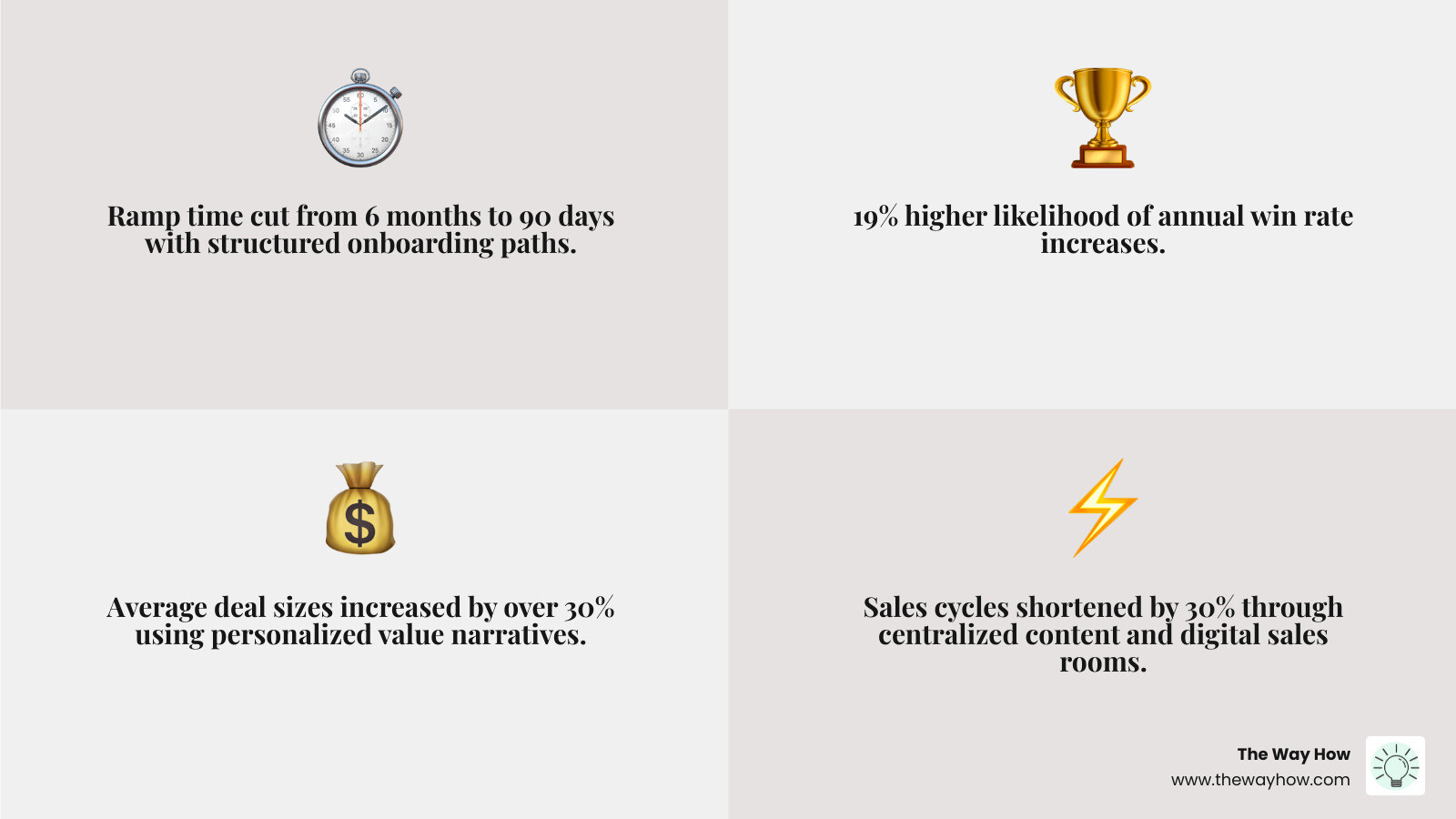
We believe that if you can’t measure it, you shouldn’t build a system around it. The ROI of sales enablement tools is found in four key metrics:
- Ramp Time: How quickly can a new hire become a productive member of the team? Structured onboarding paths are built to shorten it.
- Win Rates: Track whether win rates rise year over year after rollout.
- Deal Size: By equipping reps with better “value narratives” and personalized content, enablement tools aim to lift average deal size.
- Sales Cycle Length: Centralizing content and using digital sales rooms reduces the friction in the buyer’s journey, which can shorten sales cycles.
Beyond the numbers, these tools provide behavioral insights. They tell you why growth is stalled. Is it because the messaging isn’t resonating, or because the reps aren’t using the messaging at all?
How to Choose the Right Sales Enablement Tools for Your Team
The PointDefine the business outcome before you buy, involve both marketing and sales, and choose the tool your reps will actually use.
Before you sign a contract, you must diagnose the specific certainty gaps in your customer journey.
- Assess Team Size and Budget: Enterprise leaders (Seismic, Highspot) offer deep functionality but come with higher price tags and implementation complexity. Small teams might find more value in the “all-in-one” nature of HubSpot or specialized tools like Guru or Spekit.
- Define Business Outcomes First: Don’t buy a tool because it’s trendy. Buy it because you need to solve a specific problem, like “our reps can’t find the right pitch decks” or “our SDRs don’t know how to handle objections.”
- Cross-Functional Alignment: Sales enablement is the “connective tissue” between marketing and sales. Ensure both teams are involved in the RFP (Request for Proposal) process. If marketing builds content that sales won’t use, the tool is a wasted investment.
- User Adoption: The best tool is the one your reps actually use. Look for an intuitive interface. 42% of reps already feel overwhelmed by too many tools; don’t add to that burden with a complex, “clunky” system.State of Sales, Seventh Edition: Sales Statistics. Salesforce, 2026. Read the Source →
If you are unsure where to start, our revenue strategy services can help you audit your current stack and identify the systems that will actually drive momentum.
Frequently Asked Questions about Sales Enablement
What is the main purpose of a sales enablement platform?
The primary goal is to equip sales teams with the knowledge, content, and technology they need to engage buyers effectively. It serves as a single source of truth, ensuring that every rep has the right information at the right time to move a deal forward.
How do sales enablement tools improve marketing and sales alignment?
These tools create a feedback loop. Marketing can see which assets are being used and which are actually helping to close deals. This allows marketing to stop guessing and start producing content that has a measurable impact on the pipeline, while sales gains confidence that they are using the most up-to-date messaging.
What are the differences between tools for small businesses and enterprises?
Small business tools focus on ease of use, quick setup, and basic automation (like HubSpot). Enterprise tools (like Seismic or Mindtickle) offer advanced features like deep security compliance, hierarchical content organization, complex integrations, and AI-driven “agentic” coaching designed to scale across thousands of reps.
Restoring Momentum Through Clarity
At The Way How, we often find that when growth stalls, leadership’s first instinct is to buy a new tool. But software cannot fix a broken strategy.
We take a psychology-first approach to marketing and revenue. We look at the human behavior, empathy, and decision-making psychology that drives your buyers. Sales enablement tools are powerful, but they are only as effective as the systems they support.
Our mission is to help you remove uncertainty. Whether through fractional CMO leadership or HubSpot architecture, we help you diagnose why your growth has slowed and design a system—backed by the right technology—that creates trust and predictable revenue.
Don’t just add to your tech stack. Build a system that allows your people to do their best work.