A Complete Guide to CRM Systems and Database Management
 Jeremy Wayne Howell : Jul 22, 2026 9:48:31 PM

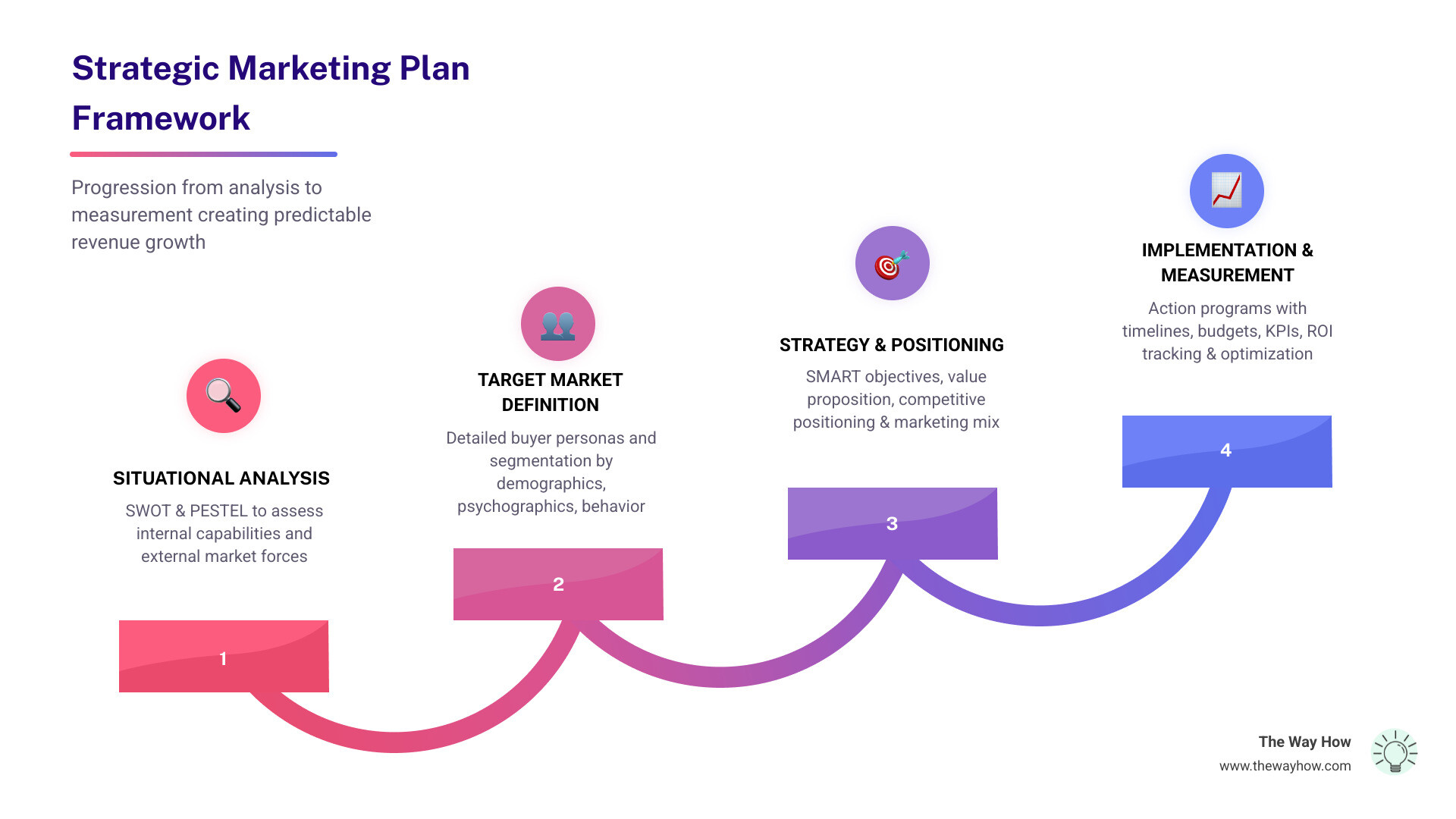
A strategic marketing plan is a comprehensive, long-term roadmap that aligns your marketing efforts with your business objectives to create sustainable competitive advantage. Unlike tactical marketing focused on short-term campaigns, strategic marketing planning involves systematic market research, target audience segmentation, competitive analysis, and measurable goals that guide all marketing activities toward predictable revenue growth.
Core components of a strategic marketing plan include:
You’ve tried the tactics. You’ve hired the agencies. You’ve invested in the tools.
And yet, revenue isn’t moving the way you expected.
The problem isn’t effort. It’s not even execution. The problem is that tactics without strategy become a hamster wheel — lots of motion, no momentum.
For many physicians, marketing is simply putting an advertisement in the local newspaper. But this haphazard approach accomplishes little more than draining the marketing budget. The same principle applies across every industry: when you focus on what to do before understanding why it matters, you end up with a pile of disconnected activities that don’t compound into growth.
According to research, practices in competitive markets may spend 10 percent or more of their annual gross income on marketing in the first year — yet many still struggle because they’re executing tactics without a strategic foundation. Apple, by contrast, has won the CMO Survey Award for Marketing Excellence for seven consecutive years, not because they run more campaigns, but because every marketing move serves a clear, long-term strategic vision.
The gap between strategy and tactics is where certainty breaks down — for your team, for your budget, and for your buyers. When your marketing isn’t grounded in a strategic plan, you’re asking people to make decisions without understanding the human behavior driving those decisions.
A strategic marketing plan doesn’t just organize your activities. It diagnoses what’s broken, identifies where uncertainty exists in your buyer’s journey, and builds a system that creates predictable, compounding growth. It’s the difference between reacting to the market and shaping it.
I’m Jeremy Wayne Howell, founder of The Way How, and over the past 20 years I’ve helped businesses grow from early traction to over $1M in annual recurring revenue by building strategic marketing plans rooted in buyer psychology and behavioral clarity, not just campaign calendars. This guide will show you how to build one that actually works.
Easy Strategic marketing plan glossary:
Many leadership teams confuse “marketing” with “marketing tactics.” They see a competitor’s Facebook ad and want one too. They hear about a new social platform and feel they must be on it. This is the tactical trap.
According to the American Marketing Association, strategic marketing focuses on creating value for customers, building sustainable competitive advantage, and achieving organizational objectives through market-oriented strategic planning. Strategy is about the “why” and the “who,” while tactics are the “how.”
Strategy is a set of choices about winning. It is an integrated set of choices that uniquely positions your firm in its industry to create superior value relative to the competition. When you skip the strategic marketing plan, you leave your business decisions to chance or intuition—an approach that is far more costly than the time spent planning.
For founders who find themselves buried in the day-to-day “doing” of marketing without seeing the “results,” bringing in high-level leadership can bridge the gap. Whether through a Fractional CMO or outsourced CMO services, the goal is to move from haphazard activities to a structured roadmap that drives long-term growth and efficient resource allocation.
Before we decide where we are going, we must honestly assess where we are. This begins with a situational analysis. We use frameworks like SWOT (Strengths, Weaknesses, Opportunities, Threats) and PESTEL (Political, Economic, Social, Technological, Environmental, Legal) to look both inward and outward.
A thorough situational analysis includes:
At The Way How, we go deeper than surface-level data. We look at the psychology of the buyer. Why do they choose your product? What motivates them to buy, and more importantly, what keeps them away? Understanding these “certainty gaps” allows us to boost marketing ROI by addressing the actual barriers to purchase.
When you understand the human behavior behind the data, marketing budget optimization becomes much easier. You stop spending money on segments that don’t convert and start investing in the ones that do.

A strategic marketing plan functions like a playbook. It breaks your long-term vision into actionable plays.
Your mission statement should succinctly answer four questions: what you do, how you do it, who you do it for, and why. It should be customer-focused and ambitious yet realistic.
Once the mission is set, you must establish SMART objectives. For example, instead of saying “we want to grow,” a SMART goal would be: “Increase pediatric patient mix from 15% to 25% within 12 months.”
Many entrepreneurs think all their customers are the same, but that is rarely true. Refining your segments is often the “a-ha” moment for growth. By using a HubSpot Personas Guide, you can create semi-fictional profiles like “On-the-go-Evan,” which help your team understand the specific needs and habits of your ideal buyers.
Your positioning statement then defines how you want to be perceived relative to competitors. It’s your unique value proposition—the one thing that makes you better for your specific target audience. This is a critical step in the go-to-market process.
Marketing isn’t a single event; it’s a journey. We look at the 4 stages of the customer journey—Awareness, Consideration, Decision, and Delight—to identify where prospects are falling out of your system.
To fix these leaks, we build sales funnels that provide the right information at the right time. Sales funnel optimization is about removing friction and building trust at every touchpoint. If your buyer persona is a Gen Z male looking for outdoor gear, your funnel should look very different than if you are selling B2B security software.
The marketing mix—the 4Ps (Product, Price, Place, Promotion) or the expanded 7Ps (adding People, Process, and Physical Evidence)—is how you deliver your strategy to the world.
Once these are defined, you create action programs. These specify exactly what will be done, when it will happen, who is responsible, and how much it will cost. This is where tools like the HubSpot Marketing Hub and proper HubSpot marketing implementation become invaluable for keeping the plan on track.
A strategic marketing plan is not a static document; it’s a living blueprint. We must measure what matters to ensure we are moving toward our business objectives.
| Strategic KPIs | Tactical Metrics |
|---|---|
| Market Share | Social Media Likes |
| Customer Lifetime Value (CLV) | Email Open Rates |
| Customer Acquisition Cost (CAC) | Website Hits |
| Marketing ROI | Click-Through Rate |
| Net Promoter Score (NPS) | Ad Impressions |
Strategic KPIs tell you if the business is healthy; tactical metrics tell you if a specific ad is working. Both are necessary, but the former should always guide the latter.
Digital transformation has changed the speed of planning. With HubSpot marketing automation, we can nurture prospects over long periods and personalize communications at scale. This allows for agile planning—regularly reviewing performance and making adjustments based on real-time data. Marketing strategies with HubSpot allow us to see exactly how our strategic choices are impacting the bottom line.
The biggest challenge in strategic planning is often the disconnect between strategy and execution. This usually happens for three reasons:
Overcoming these hurdles requires leadership buy-in and a culture of data literacy. For teams transitioning to new systems, following HubSpot onboarding tips and HubSpot onboarding strategies can reduce initial friction and ensure the technology supports the strategy rather than complicating it.
Look at Apple. Their strategic marketing plan isn’t about selling computers; it’s about a mission of innovation. They use premium pricing to signal quality, a first-to-market strategy for new categories, and a closed ecosystem to build intense customer loyalty.
In professional services, a medical practice might shift its strategy from general care to a pediatric focus. By training staff, redesigning the waiting room to be child-friendly, and networking with local schools, they align every “P” of their marketing mix with their new strategic goal.
In tech, a company might position itself as the most secure cloud provider. Their strategy focuses on trust. They don’t just run ads; they invest in certifications, publish white papers on security, and use testimonials from high-security industries to prove their value.
Strategy is your long-term vision and the set of choices you make to achieve a sustainable competitive advantage. It focuses on the “who” and the “why.” A tactical plan is the specific list of actions—the “how” and “when”—required to execute that strategy. Strategy without tactics is a dream; tactics without strategy is a nightmare.
While the core strategy may stay the same for 18–24 months, the plan should be reviewed quarterly. This allows you to evaluate your progress against KPIs and adjust your tactics based on market changes. A good plan is fluid, not frozen.
Standard practices in open markets often spend 3% to 5% of their annual gross income on marketing. However, if you are a new business or operating in a highly competitive market, you should expect to spend 10% or more in your first year to establish a foothold and build momentum.
At The Way How, we believe that growth doesn’t stall because of a lack of effort. It stalls because of uncertainty. When you don’t know why your customers are leaving or why your ads aren’t converting, you lose momentum.
Our approach blends strategic clarity with behavioral insight. We don’t just give you a list of things to do; we diagnose the certainty gaps in your customer journey and design systems that create trust and predictable revenue. We turn marketing from a cost center into a dependable growth engine.
If you’re ready to stop chasing tactics and start building a system that compounds over time, we can help. Work with a psychology-first strategy firm to restore your momentum and gain the clarity you need to lead.
 Jeremy Wayne Howell : Jul 22, 2026 9:48:31 PM
 Jeremy Wayne Howell : Jul 21, 2026 9:47:10 PM
 Jeremy Wayne Howell : Jul 20, 2026 9:46:47 PM