

The Black Box of Modern Marketing Leadership

A chief marketing officer is the senior executive responsible for leading an organization’s entire marketing strategy — from brand and demand generation to customer experience and revenue growth.
Quick answer: What does a CMO do?
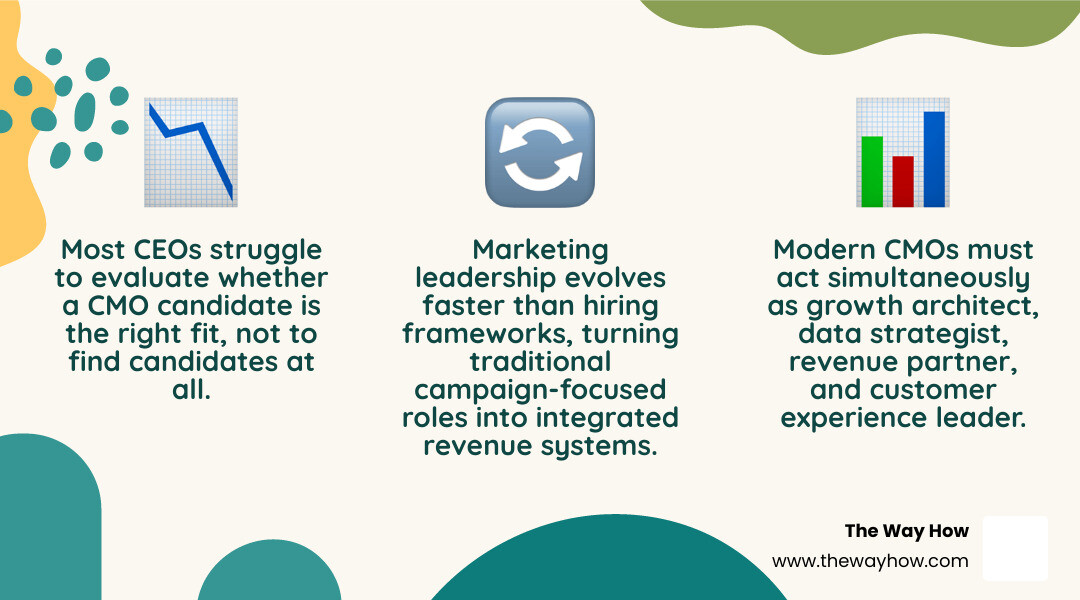
Most founders and CEOs don’t struggle to find a CMO candidate. They struggle to know whether they’re hiring the right one.
Marketing leadership has changed faster than most hiring frameworks have kept up. The role that existed five years ago — focused on campaigns, brand awareness, and creative oversight — looks almost nothing like what high-growth organizations need today.
Today’s CMO is expected to be a growth architect, a data strategist, a revenue partner, and a customer experience leader — all at once. That’s not a job description. That’s four jobs wrapped in one title.
And when the hire doesn’t work, the cost isn’t just the salary. It’s lost time, misaligned strategy, broken team trust, and a pipeline that quietly stalls while everyone wonders why.
This guide is built to close that gap. Whether you’re hiring your first CMO, replacing one who didn’t work out, or rethinking your marketing leadership model entirely — you need clarity before you post the job.
I’m Jeremy Wayne Howell, a revenue growth strategist and founder of The Way How, where I help founders and executive teams diagnose the human and systemic problems underneath stalled revenue — including how to identify, evaluate, and structure chief marketing officer leadership that actually fits how their buyers think and behave. The frameworks in this guide come directly from that work.
What is a Chief Marketing Officer in the Age of AI?
To understand the modern CMO Position Meaning, we have to look past the historical definition of a creative director with a bigger budget. Today, as we navigate 2026, the chief marketing officer operates at the intersection of business strategy, behavioral psychology, and advanced data systems.
As outlined in our Chief Marketing Officer (CMO) Explained guide, this executive serves as the ultimate bridge between your product and your market. They do not just generate leads; they design the systems that build trust and remove customer uncertainty.
In an era defined by rapid technological adoption, the responsibilities of this role have bifurcated. On one hand, a CMO must master technical systems, data privacy, and revenue operations. On the other, they must possess a deep, empathetic understanding of human behavior to ensure that technology serves the customer experience rather than alienating it.
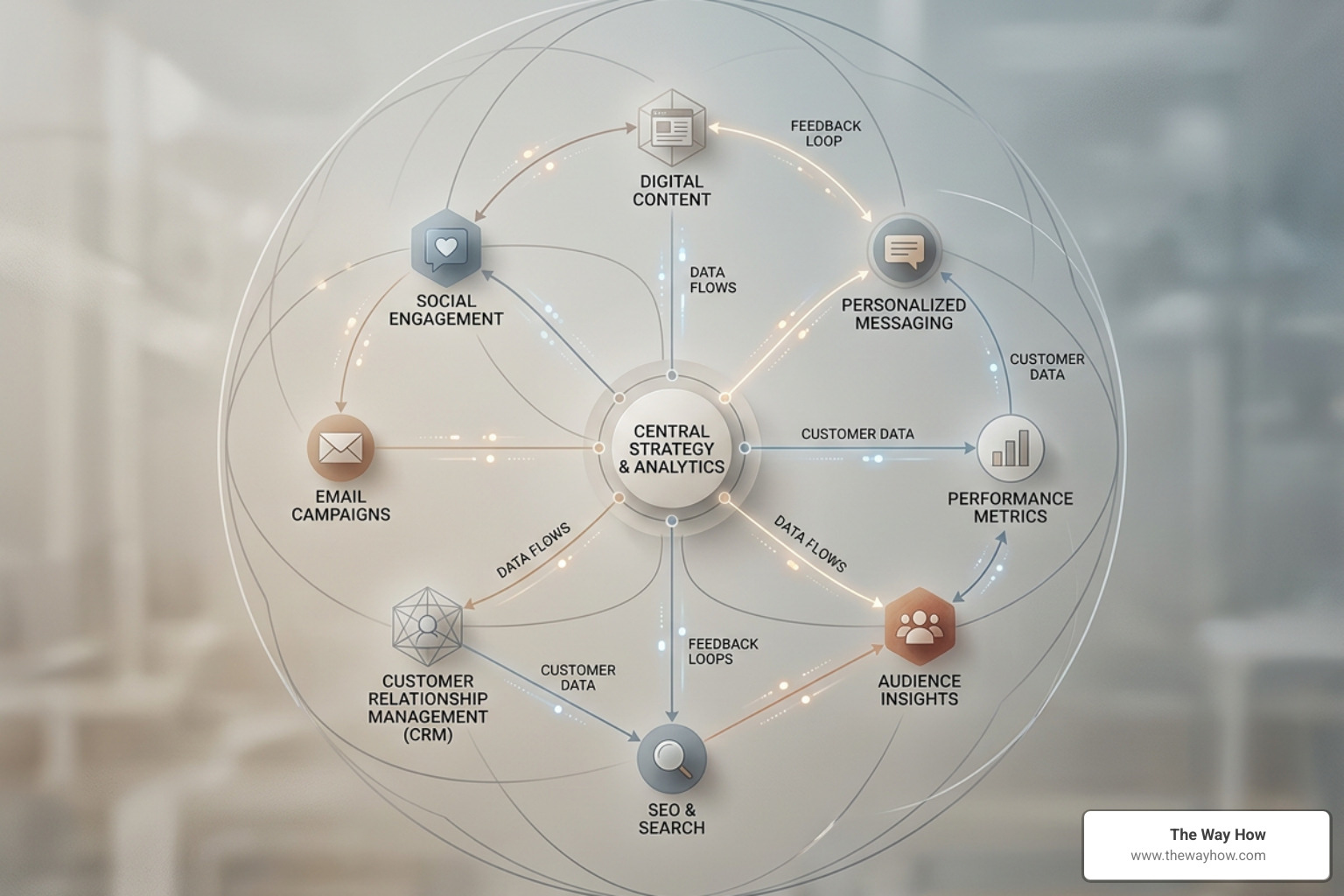
To help visualize this transition, consider how the role has shifted across key business dimensions:
| Dimension | Traditional CMO | Modern Growth-Architect CMO |
|---|---|---|
| Primary Focus | Brand awareness and creative campaigns | Revenue generation and customer lifetime value |
| Data Strategy | Retrospective reporting on marketing spend | Predictive analytics and behavioral insight orchestration |
| Technology | Marketing tools managed in isolation | Integrated martech architectures and AI collaboration systems |
| C-Suite Role | Creative service provider to other departments | Strategic growth partner driving business-wide transformation |
| Customer View | Targets to be reached via advertising | Human relationships built on trust and psychological safety |
Core Responsibilities of a Modern Chief Marketing Officer
The day-to-day duties of a modern chief marketing officer go far beyond approving ad copy or choosing brand colors. A highly effective CMO is responsible for several critical pillars within the organization:
- Strategic Revenue Operations: Designing end-to-end buyer journeys that convert attention into predictable, recurring revenue.
- Brand and Market Positioning: Cultivating a distinct, emotionally resonant brand identity that answers why your company is the only logical choice for your ideal customer.
- Martech and AI Integration: Selecting and managing the right CMO Marketing Tools to build a scalable, compliant, and highly automated marketing engine.
- Customer Experience (CX) Architecture: Mapping the customer journey to identify and eliminate “certainty gaps” — those moments of hesitation where potential buyers drop off due to friction or lack of trust.
- Cross-Functional Alignment: Partnering closely with the Chief Technology Officer (CTO) or Chief Information Officer (CIO) to manage data ecosystems, and with the Chief Sales Officer (CSO) to ensure marketing-sales alignment.
This cross-functional integration is more critical than ever. Years ago, Gartner analysts predicted that CMOs would eventually spend more on technology than their CIO counterparts. In 2026, this prediction is a lived reality. Marketing is now a data-driven discipline where technology adoption must align perfectly with human-centric brand strategy.
How the Chief Marketing Officer Role Has Evolved
The evolution of marketing leadership is deeply tied to how we interact with technology. We have moved past the era of isolated digital campaigns. Today, we live in a world of continuous, real-time engagement.
Industry pioneers like Linda Boff have pointed out that modern marketing leadership requires driving growth, trust, and transformation simultaneously. The focus has shifted from building short-term campaigns to maintaining long-term momentum through connected content systems.
Similarly, leaders like William White have demonstrated how critical digital transformation and omnichannel strategy are when scaling brands and deepening customer loyalty in highly competitive environments.
This shift is particularly evident in how marketing leaders approach artificial intelligence. According to a study by the CMO Council, AI alone does not deliver growth; the real magic happens when you pair advanced technology with human judgment.
Organizations that successfully integrate AI with human marketers are three times more likely to achieve measurable ROI. Furthermore, 73% of these integrated “Power Partners” exceed their ROI expectations, compared to just 22% of their peers who rely on technology alone.
The modern CMO knows that while AI can process data at scale, it cannot feel empathy, understand human nuance, or build genuine brand trust.
The Psychology of the CMO Tenure Crisis
Despite the strategic importance of the role, the chief marketing officer position is plagued by a systemic crisis: short tenure. Historically, the average CMO tenure has hovered around 40 months — the lowest in the C-suite — while the average CEO tenure sits at approximately seven years.
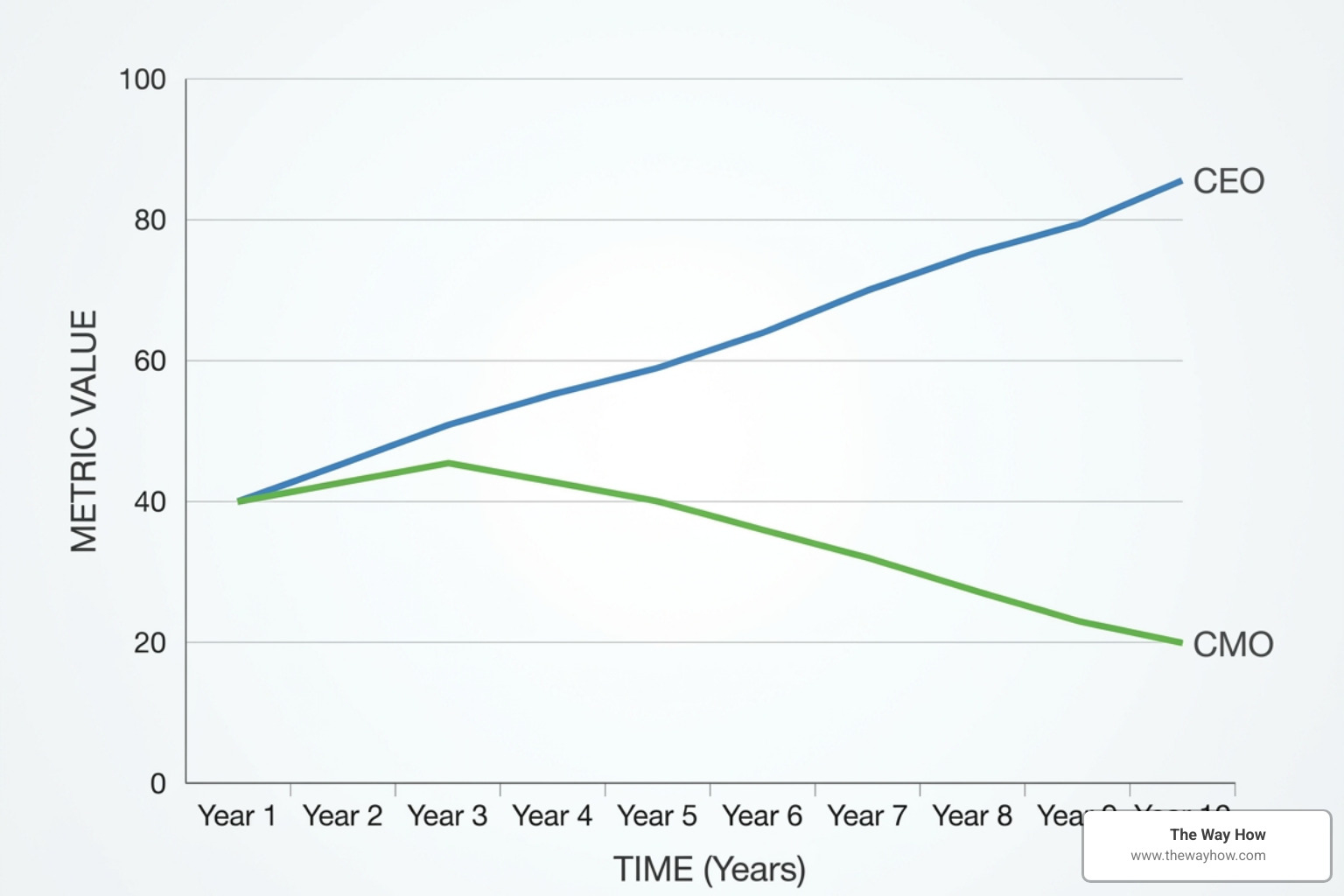
Why does this disconnect exist? From a behavioral psychology perspective, the tenure crisis is driven by a fundamental “certainty gap” between CEOs and CMOs.
CEOs often view marketing as a black box. When growth stalls, they experience anxiety and look for immediate, tactical solutions. This leads to a mismatch in key performance indicators (KPIs). A CEO might demand instant lead generation, while the CMO is trying to build the foundational brand equity and customer journey architecture required for sustainable, long-term growth.
When marketing metrics are disconnected from core business outcomes, trust erodes. The CMO begins to feel undervalued, and the CEO begins to feel that marketing is simply a cost center rather than a revenue generator.
To break this cycle, organizations must stop hiring for short-term tactics and start hiring for systemic alignment. A successful CMO hire requires clear agreement on what success looks like, realistic timelines for building brand trust, and a shared understanding of buyer psychology.
Designing the Ideal CMO Job Description and Compensation Package
Hiring a chief marketing officer is one of the most significant investments an organization can make. To attract the right talent, you must design a role that reflects the true strategic weight of modern marketing leadership.
Typically, employers look for candidates with 10 to 20+ years of progressive marketing experience, with a strong preference for those holding an MBA or an equivalent advanced degree in business or behavioral psychology.
We can learn a great deal from top-tier executives who have shaped some of the world’s most recognizable brands. For example, Carla Hassan has demonstrated the immense scale of modern marketing leadership, managing global teams of thousands to oversee performance marketing, analytics, and brand strategy at the highest levels of financial services.
In the technology sector, Carrie Palin has shown how high-performing CMOs drive global go-to-market strategies, lead digital transformations, and build world-class B2B brands.
Meanwhile, leaders like Drew Panayiotou highlight the value of cross-industry expertise, proving that a deep understanding of consumer behavior and creative vision can drive massive growth across both consumer goods and technology sectors.
When it comes to compensation, packages for a chief marketing officer vary widely based on company size, industry complexity, and geographic scope. In 2026, competitive compensation packages often include:
- Base Salary: Typically ranging from $230,000 to $260,000+ for mid-market organizations, and significantly higher for global enterprises.
- Performance Bonuses: Tied directly to strategic KPIs such as customer acquisition cost (CAC) optimization, customer lifetime value (CLV) growth, and overall revenue targets.
- Long-Term Incentives & Equity: Designed to align the CMO’s personal success with the long-term valuation and growth of the company.
Organizations with complex, global operations or those undergoing major digital transformations naturally offer higher compensation packages to match the broader scope of strategic accountability.
Beyond the Full-Time Hire: Exploring Alternative Leadership Models
For many mid-market companies and fast-growing startups, hiring a full-time, enterprise-level chief marketing officer is a high-risk, high-cost move. If your marketing systems are currently unstructured, bringing in an expensive executive to “figure it out” can often accelerate your cash burn without solving the underlying problems.
This is where alternative leadership models offer an elegant solution.
By utilizing our Fractional Chief Marketing Officer Guide, business leaders can discover how to access executive-level strategy without the overhead of a full-time C-suite hire.
The Value of Fractional Chief Marketing Officer services lies in risk mitigation and rapid diagnosis. Instead of spending six months searching for a permanent executive, a fractional leader can step in immediately to:
- Diagnose Stalled Growth: Audit your existing marketing systems to identify why your pipeline has slowed down.
- Optimize Your Martech Stack: Clean up your HubSpot architecture, CRM systems, and data pipelines to ensure you have a single source of truth for your customer data.
- Build Demand Generation Engines: Design marketing strategies rooted in human psychology that build trust and move buyers naturally through the decision-making process.
This model allows organizations to build a stable, predictable marketing foundation first, ensuring that when they are ready to make a permanent hire, the incoming CMO steps into a system designed for success.
Frequently Asked Questions About Marketing Leadership
What is the average salary range for a CMO in 2026?
In 2026, the average base salary for a chief marketing officer at a mid-sized to high-growth company typically ranges between $230,000 and $260,000 per year. However, total compensation is often significantly higher when factoring in performance bonuses, equity, and long-term incentives. For large, global enterprises or highly regulated industries, base salaries can easily exceed $350,000, reflecting the increased complexity and scale of the role.
How do you measure the ROI of a newly hired CMO?
Measuring the success of a marketing leader requires looking beyond vanity metrics like social media impressions or website traffic. True marketing ROI should be measured through business-level outcomes, including:
- Customer Acquisition Cost (CAC) Efficiency: Is the cost to acquire a customer decreasing or stabilizing as marketing channels mature?
- Customer Lifetime Value (CLV) Growth: Is the marketing team successfully driving customer loyalty and repeat business?
- Pipeline and Revenue Contribution: What percentage of closed-won revenue can be directly traced back to marketing-initiated or marketing-influenced touchpoints?
- Certainty Gap Reduction: Has the sales cycle shortened because buyers are entering the sales process with higher levels of trust and fewer objections?
What is the difference between a CMO and a VP of Marketing?
While the terms are sometimes used interchangeably, they represent different levels of leadership:
- Chief Marketing Officer (CMO): A C-suite executive who owns the long-term business strategy, holds board-level accountability, manages the overall marketing budget, and aligns marketing with sales, technology, and operations to drive enterprise growth.
- VP of Marketing: A highly strategic tactical leader who focuses on the execution of the marketing plan. The VP typically oversees the day-to-day operations of the marketing team, manages specific channel managers, and ensures that the CMO’s broader vision is executed flawlessly.
Restoring Certainty to Your Growth Engine
At The Way How, we believe that marketing should never feel like a gamble. When growth stalls, it is rarely because you are using the wrong tactics; it is because there is a fundamental disconnect between how you sell and how your customers actually think, feel, and make decisions.
We help founders and leadership teams remove this uncertainty. By combining Fractional CMO leadership with robust HubSpot architecture and demand generation strategies rooted in behavioral psychology, we help you build systems that foster deep trust and predictable revenue.
If you are ready to stop guessing and start building a marketing engine that works, explore our Chief Marketing Officer Complete Guide or read our foundational breakdown on Chief Marketing Officer (CMO) Explained to clarify your leadership needs.
Let us help you see the problem clearly, design the right system, and restore momentum to your business.