

Beyond the Acronym: Why Marketing Leadership Feels Like a Gamble

Understanding the cmo position meaning starts with a simple definition — and then gets complicated fast.
CMO stands for Chief Marketing Officer. Here’s what that means at a glance:
| Term | Definition |
|---|---|
| Full title | Chief Marketing Officer |
| Reports to | Chief Executive Officer (CEO) |
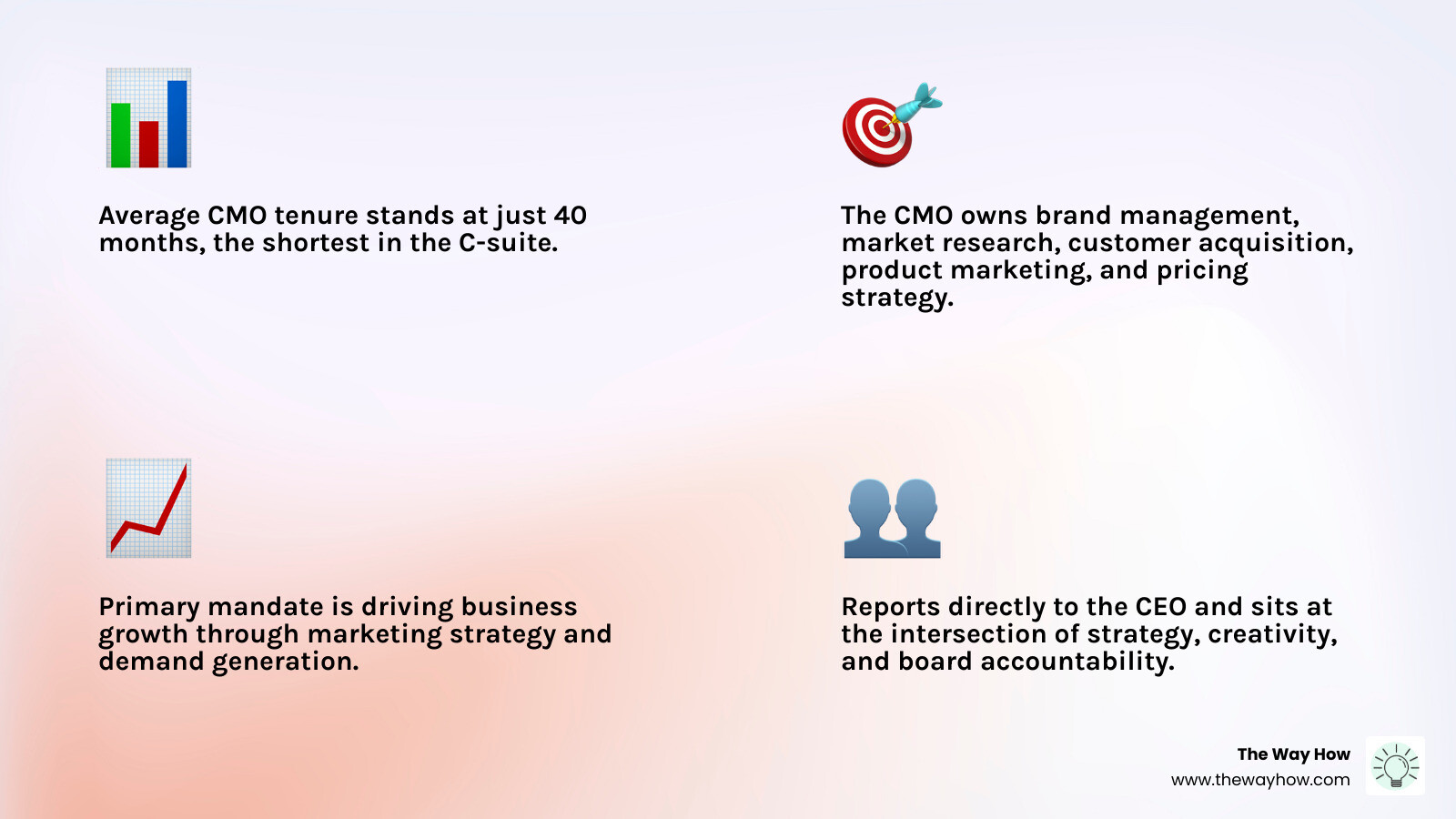
| Primary mandate | Drive business growth through marketing strategy, brand, and demand generation |
| Scope | Brand management, market research, customer acquisition, product marketing, pricing, customer success |
| Seniority | Highest-ranking marketing executive in the organization |
That’s the dictionary answer. But if you’re a founder or CEO trying to decide whether to hire one — or trying to figure out why the one you hired isn’t moving the needle — the definition alone won’t help you.
The CMO role is one of the most misunderstood positions in the C-suite. It sits at the intersection of strategy and execution, creativity and analytics, customer empathy and board-level accountability. And yet, the average CMO tenure as of 2020 was just 40 months — the lowest of any C-suite role, and less than half the average CEO’s seven-year tenure.
That gap isn’t a coincidence. It reflects something real: most companies hire a CMO before they understand what they actually need one to do.
I’m Jeremy Wayne Howell, founder of The Way How, and my work over 20 years in revenue growth strategy has put me directly inside the gap between what companies expect from senior marketing leadership and what the cmo position meaning actually requires to deliver results. This guide is built to close that gap before you make a costly hire.
Decoding the CMO Position Meaning in 2026
As we navigate May 2026, the Chief marketing officer role has moved far beyond its origins in traditional advertising. Today, a CMO is a top-level executive responsible for the entire lifecycle of how a customer perceives, interacts with, and remains loyal to a brand.
In our work at The Way How, we view the Chief Marketing Officer (CMO) Explained through the lens of psychology and revenue. It is no longer enough to “do marketing”; a CMO must own the revenue mandate. This includes overseeing brand management, conducting deep-dive market research, and increasingly, ensuring customer success. If the product is the engine, the CMO is the one ensuring the right people want to get in the car and that they enjoy the ride enough to stay.

The Core CMO Position Meaning and Primary Mandate
The primary mandate of a CMO is to be the organization’s growth driver. According to TechTarget’s definition, this involves overseeing the planning and execution of all marketing and advertising initiatives. However, the modern reality is more nuanced.
A successful CMO optimizes ROI by ensuring that every dollar spent is an investment in the customer journey. They bring customer-centricity to the boardroom, translating raw data into human stories. They aren’t just managing campaigns; they are managing the collective belief the market has in your company.
Alternative Titles and the CMO Position Meaning in Small vs. Large Firms
Depending on the size of your organization, the cmo position meaning can shift. In a large enterprise, the CMO is a strategist with board-level accountability and significant P\&L ownership. They might have several VPs reporting to them, such as a VP of Performance Marketing or a VP of Communications.
In smaller firms or startups, you might see titles like Chief Growth Officer or even just VP of Marketing. While the JobDescription.org outlook notes that these roles often overlap, the distinction usually lies in scope. A true CMO is an architect of the future, while a VP is often the foreman of the present. A CMO’s eyes are on the three-year horizon; the VP’s eyes are on this quarter’s lead goal.
The Four Archetypes of Modern Marketing Leadership
Not all CMOs are created equal. Research from Deloitte suggests that modern marketing leaders typically fall into four archetypes. Understanding which one your company needs is the difference between momentum and stagnation.
- The Growth Driver: Focused on revenue, pipeline, and market share.
- The Innovation Catalyst: Uses customer insights to create new products and experiences.
- The Brand Storyteller: Masters of the narrative, ensuring the company’s “why” resonates globally.
- The Capability Builder: Focused on the internal “marketing engine” — the tech stack, the data, and the people.
Analytical vs. Creative: The Daily Balancing Act
The most common “certainty gap” we see in hiring is the search for a “unicorn” who is equally creative and analytical. In reality, a CMO must be a translator between these two worlds.
They use data-driven marketing to justify budgets and behavioral psychology to guide fractional marketing services. Their daily work involves shifting from a spreadsheet (analyzing CAC by channel) to a storyboard (ensuring the brand voice feels human) without losing sight of the interpersonal leadership required to keep their team motivated.
The CMO as the Ambassador of the Customer
At The Way How, we believe the value of a Chief Marketing Officer is highest when they act as the “Ambassador of the Customer.” They represent the buyer’s psychology at the C-suite table.
By understanding the decision-making psychology of your audience, the CMO can design an empathy-driven strategy that increases customer lifetime value. They identify where trust is being lost in the buyer journey and build systems to restore it.
Bridging the Gap: How CMOs Align with the C-Suite
The CMO cannot operate in a vacuum. Their success is tied to their ability to collaborate across the hall.
- With the CEO: They are a strategic partner, aligning marketing goals with the overall business vision.
- With the CFO: They must speak the language of finance, proving that marketing is a revenue generator, not a cost center.
- With the CIO/CTO: They co-manage the “Martech” stack.
| Function | CMO | CIO | CTO |
|---|---|---|---|
| Primary Focus | Customer & Revenue | Internal Systems | Product Tech |
| Tech Ownership | HubSpot, CRM, Analytics | ERP, Security, Infrastructure | Product Architecture |
| Goal | Market Growth | Operational Efficiency | Technical Innovation |
Collaborating with the CIO and CTO on Technology
In 2026, the role of an outsourced CMO or a full-time leader often involves spending more on IT than the CIO does. Whether it’s implementing a HubSpot architecture or leading AI adoption, the CMO must ensure the data infrastructure supports real-time marketing decisions. They turn “big data” into “usable insights.”
Legal, Regulatory, and Ethical Considerations
The modern CMO must also be a guardian of ethics. From ensuring HIPAA compliance in healthcare marketing to navigating data privacy laws like GDPR, the benefits of experienced leadership include protecting the brand from regulatory risk. Ethical advertising isn’t just a moral choice; it’s a brand safety requirement in an era where consumers demand transparency.
The Tenure Trap and the Reality of Marketing Accountability
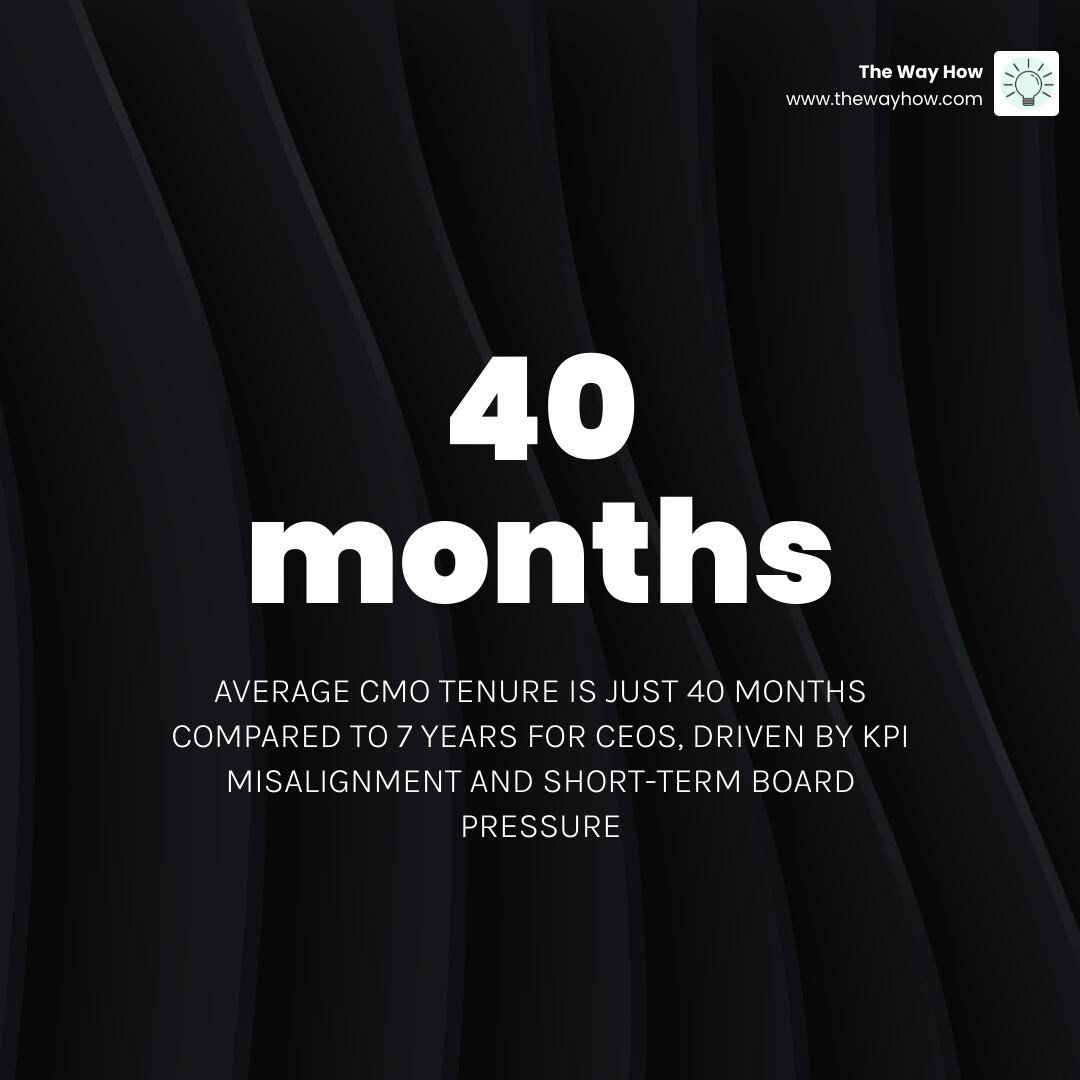
Why do CMOs leave so often? The 40-month tenure average (compared to 7 years for CEOs) is often a result of “short-termism.” Boards often demand immediate results from brand-building activities that naturally take time.
To survive, a CMO must own the numbers. This means moving beyond “vanity metrics” (likes and impressions) and taking ownership of the pipeline.
Why CMO Tenure is the Lowest in the C-Suite
Tenure is often cut short by a misalignment of KPIs. If the CEO expects a brand overhaul but the Board expects an immediate drop in CAC (Customer Acquisition Cost), the CMO is set up to fail. This is why many companies are turning to fractional CMO alternatives to bridge the gap before committing to a permanent hire.
Additionally, we are seeing shifts in demographics; while women made up 47% of CMO roles in 2020, diversity in the highest marketing ranks still faces hurdles, impacting how leadership teams approach global markets.
When a Full-Time Hire is the Wrong Prescription
For many founders, the cmo position meaning shouldn’t necessarily lead to a $300k+ full-time hire. If your revenue is under $20M, a full-time CMO might be overkill.
The Fractional CMO meaning is simple: you get the same strategic brain for a fraction of the time and cost. It’s about strategic output over time commitment.
The Strategic Advantage of Outsourced Leadership
Engaging outsourced CMO services allows a company to access specialized expertise without the overhead. Whether you need a part-time CMO to fix your go-to-market execution or someone to manage a complex fractional CMO contract, this model provides significant benefits for startups and mid-market companies alike.
Frequently Asked Questions about the CMO Role
What is the difference between a CMO and a VP of Marketing?
The CMO is a C-suite executive with board visibility and strategic authority. They focus on the “why” and the “where are we going.” A VP of Marketing is usually more focused on the “how” and the “what are we doing today.” In many hiring guides, the CMO is defined by their seat at the leadership table, whereas the VP is defined by their management of the marketing department.
Can a CMO eventually become a CEO?
Absolutely. CMOs are increasingly seen as viable CEO candidates because they understand the most critical part of the business: the customer. Their experience in operational oversight, combined with their strategic business acumen, makes them well-rounded leaders.
How has the CMO role changed post-pandemic?
The post-pandemic landscape accelerated digital transformation. CMOs are now “Chief Physician Communicators” in some sectors, responsible for crisis communication and rapid shifts in consumer behavior. They must lead remote teams and implement agile marketing strategies that can pivot in a matter of days, not months.
Restoring Momentum Through Strategic Clarity
At The Way How, we don’t just help you find a marketing leader; we help you find the right strategy. Our psychology-first approach to revenue strategy removes the uncertainty that plagues most C-suite hires.
By identifying the certainty gaps in your customer journey, we help you build a marketing engine that doesn’t just look good on paper but delivers predictable revenue growth. Whether you need a Fractional CMO to steady the ship or a full architecture of your revenue systems, we are here to provide the clarity you need.