A Complete Guide to CRM Systems and Database Management
 Jeremy Wayne Howell : Jul 22, 2026 9:48:31 PM

Marketing strategy fractional is a flexible engagement model where experienced marketing executives work with your business part-time or on contract, delivering senior-level strategic guidance without the full-time cost or long-term commitment of a traditional hire.
Quick Answer for “Marketing strategy fractional”:
Your marketing probably isn’t broken because you picked the wrong tactics.
It’s broken because no one with real strategic experience is looking at the whole picture.
You’ve got scattered campaigns. Siloed channels. A team (or founder) doing their best with limited bandwidth. Maybe you’ve hired agencies that delivered reports but not results. Or consultants who gave advice but didn’t stick around to see it through.
The data backs this up. Marketing budgets have fallen to just 7.7% of overall company revenue in 2024—a 15% drop from the previous year. Meanwhile, B2B buyers now spend only 17% of their journey with sales, and 75% prefer to avoid sales reps entirely. The buyer’s journey has become longer, more complex, and almost entirely self-directed.
Your buyers are doing more research than ever. But your marketing isn’t built to meet them where they are.
This isn’t a failure of effort. It’s a failure of structure.
Most mid-sized companies can’t afford a $250K+ CMO. And most don’t need one full-time. What they need is someone who can diagnose what’s actually broken, build a strategy that aligns with how buyers think, and guide execution without becoming a permanent overhead burden.
That’s where fractional marketing leadership comes in.
Between 2020 and 2025, demand for fractional leadership has increased by 57%. Today, 25% of US businesses use fractional executives, and that number is projected to hit 35% by 2025. Companies using fractional marketing strategies during growth phases have seen 67% faster time-to-market and 43% higher marketing ROI compared to traditional models.
This isn’t a cost-cutting trend. It’s a smarter way to access the strategic thinking your business needs when you need it.
I’m Jeremy Wayne Howell, founder of The Way How, and I’ve spent two decades helping companies unstick their revenue engines by diagnosing the human problems underneath the performance problems—often through marketing strategy fractional engagements that restore clarity and momentum without the overhead of full-time leadership. Before founding The Way How, I worked inside sales and marketing teams that were asked to execute without direction, which is why I now focus on building psychology-first strategies that create certainty for both internal teams and the buyers they’re trying to reach.
Marketing strategy fractional vocab explained:
When growth stalls, the natural instinct is to do more. More ads, more emails, more content. But for many founders and CEOs, this “frantic activity” phase is a symptom of a deeper issue: a lack of strategic clarity.
According to data from McKinsey, achieving consistent revenue growth is remarkably difficult; only one in eight companies realized over 10% annual revenue growth between 2010 and 2019. Most organizations struggle because their marketing efforts are disjointed, reactive, and disconnected from the actual psychology of their buyers.

The modern B2B buyer journey is no longer a linear funnel. It is a messy, self-directed exploration where Gartner research reveals that 75% of B2B buyers prefer not to deal with a sales rep at all. If your marketing isn’t providing the information and psychological safety they need to make a decision, they simply move on to a competitor who does. This uncertainty—not knowing which lever to pull or why a campaign failed—is the silent killer of mid-sized firms.
At its core, Fractional marketing is a modern business solution that allows you to rent the brain of a senior-level executive. It is the bridge between “doing it yourself” and the massive financial commitment of a full-time C-suite hire.
Understanding the Fractional CMO Meaning requires looking beyond the “part-time” label. A fractional leader is not a freelancer or a consultant who hands over a slide deck and disappears. They are an integrated part of your leadership team, owning outcomes and providing the same level of strategic rigor as a full-time CMO.
The Outsourced CMO Benefits are centered on high-level expertise and scalability. You gain access to someone who has seen your specific problems dozens of times across different industries. They bring “pattern recognition” to your business, allowing you to bypass the expensive trial-and-error phase that plagues internal teams led by generalists.
The economic landscape of 2024 and 2025 has placed a squeeze on traditional marketing departments. Gartner’s 2024 CMO Spend Survey shows that marketing budgets have plummeted to 7.7% of revenue.
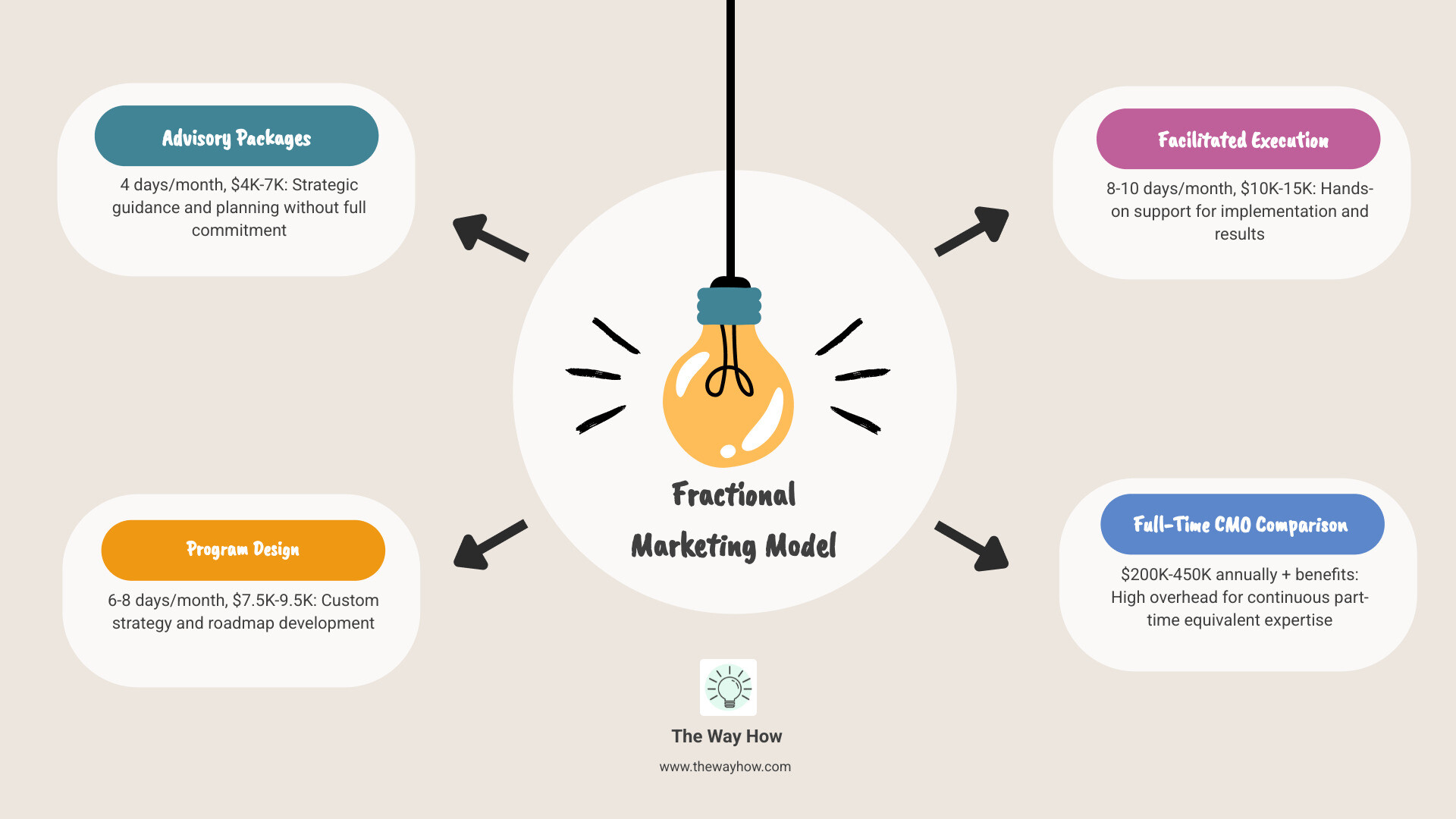
When budgets shrink, the cost of a “bad hire” becomes catastrophic. A full-time CMO in the US can cost between $200,000 and $450,000 when you factor in benefits, bonuses, and equity. For a mid-sized B2B company, that salary often eats up the entire execution budget, leaving no money left for actual advertising or content production.
A B2B Fractional CMO solves this by providing the strategy at a fraction of the cost, freeing up capital to actually run the programs they design. This agility is your competitive edge. While your competitors are bogged down in long hiring cycles or administrative overhead, a fractional leader can be onboarded in days and delivering results in weeks.
Marketing is not just about “brand awareness”; it is about the psychology of decision-making. When Gartner says today’s buyers only spend about 17% of their journey with sales, your marketing is your sales force.
Buyers are looking for certainty. They are looking to remove the risk of making a bad purchase. A fractional leader looks at your customer journey to identify “certainty gaps”—places where the buyer feels confused, ignored, or pressured. By applying behavioral insights, we can design systems that build trust through self-service information, educational content, and transparent messaging.
How do you actually pay for and structure these engagements? Most fractional leaders move away from hourly billing because you aren’t paying for their time; you’re paying for their years of experience and frameworks.
When following a Hiring a Fractional CMO Guide, you will typically see three main tiers of engagement:
One of the greatest strengths of the fractional model is the “Resource Multiplier Effect.” Instead of hiring one full-time generalist, you can use those funds to hire a fractional strategist who then manages a “village” of specialists.
With thousands of algorithm changes a year, you need an SEO expert. You also need a content developer, a paid search specialist, and a CRM architect. A Fractional Marketing Director Guide would emphasize that the director’s job is to ensure all these specialists are playing the same sheet of music. This workflow acceleration allows you to execute complex, multi-channel strategies that a single in-house hire could never manage alone.
Success doesn’t happen by accident. According to the Forbes 2024 Fractional Leadership Report, organizations that implement structured onboarding processes experience 78% faster time-to-productivity.
At The Way How, we use a phased approach to ensure the marketing strategy fractional engagement delivers immediate value:
An agency is often a “black box” where you send money and get deliverables (ads, blogs, reports). A fractional leader provides strategic ownership. They sit on your side of the table, managing the agencies and ensuring they are actually contributing to revenue growth. They are an internal advocate, not an external vendor. This Role of Outsourced CMO is about integration and accountability.
As mentioned, you can expect to pay 30-50% less than a full-time hire. Most fractional CMOs cost between $60,000 and $175,000 annually. The Value of Fractional Chief Marketing Officer is even higher when you consider the lack of “hidden costs” like health insurance, 401k matching, and the $50k-$100k in benefits that typically accompany an executive salary.
We don’t look at “vanity metrics” like impressions or likes. We focus on strategic KPIs:
At The Way How, we believe that marketing is a psychology problem, not just a technical one. If your growth is stalled, it’s likely because there is a gap in the trust or certainty your buyers feel when they interact with your brand.
We specialize in Fractional CMO leadership, HubSpot architecture, and demand generation strategies that are rooted in human behavior. We don’t just give advice; we design systems that create predictable revenue. Our goal is to turn your marketing from a source of stress into a dependable growth engine.
If you are ready to remove the uncertainty from your sales and marketing systems, we invite you to explore our Fractional marketing services. Let’s stop chasing tactics and start building a strategy that actually moves the needle.
 Jeremy Wayne Howell : Jul 22, 2026 9:48:31 PM
 Jeremy Wayne Howell : Jul 21, 2026 9:47:10 PM
 Jeremy Wayne Howell : Jul 20, 2026 9:46:47 PM