A Complete Guide to CRM Systems and Database Management
 Jeremy Wayne Howell : Jul 22, 2026 9:48:31 PM
6 min read


A conversion funnel in digital marketing is the step-by-step journey a potential customer takes from first awareness to final action—and beyond. It’s called a funnel because the number of people decreases at each stage, typically by 30–80% per step, as visitors drop off or decide not to proceed.
Quick definition:
You’ve probably been told your funnel needs more traffic. Or better CTAs. Or a new tool.
But here’s what’s actually happening: your prospects are walking away because they don’t feel certain. Not about your product—about themselves. About whether this is the right time, the right fit, or the right risk to take.
That uncertainty lives in the gaps between funnel stages. And most marketing never acknowledges it.
I’m Jeremy Wayne Howell, founder of The Way How, and I’ve spent two decades diagnosing why conversion funnels in digital marketing stall—not because of tactics, but because companies skip the psychology and jump straight to execution. This guide will help you see the funnel not as a reporting tool, but as a map of human decision-making.
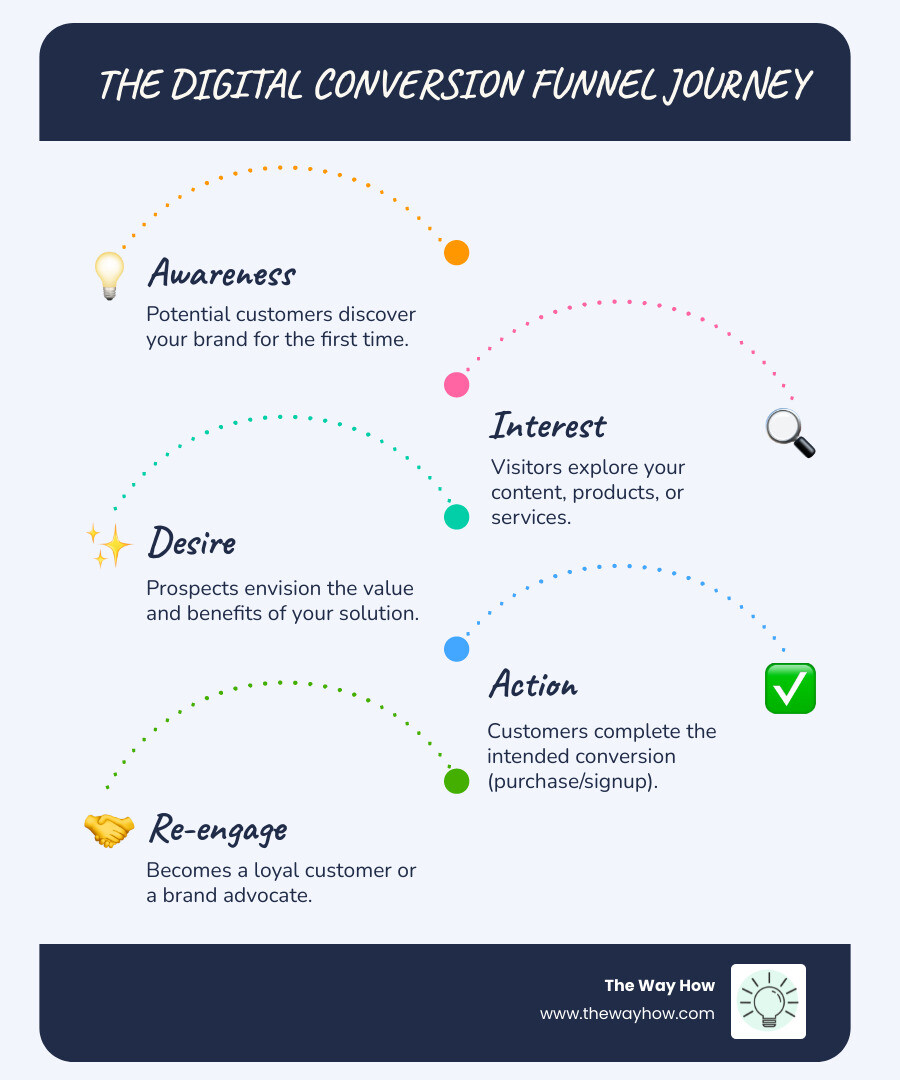
Quick conversion funnel in digital marketing definitions:
At its core, a conversion funnel in digital marketing is a distillation of the buyer’s journey. It begins when a visitor first finds your brand and ends when they either abandon the process or convert into a paying customer. Unlike a physical funnel used in baking, where everything poured in at the top eventually comes out the bottom, a digital funnel is designed to filter.
Research on Bidding on the Buying Funnel for Sponsored Search Campaigns highlights that consumers steer search systems and websites with specific intent that changes as they move deeper. This progressive reduction is natural; not everyone who sees an ad is a fit for the solution. In fact, statistics show that between 0.5% and 6% of users reached by an ad will actually convert.
We often talk about “conversion” as a single event—the purchase. However, a high-performing funnel is built on micro-conversions. These are the small yeses: clicking a link, signing up for a newsletter, or viewing a pricing page. Each micro-conversion is a signal of increasing certainty.
While people often use these terms interchangeably, they serve different strategic purposes:
| Funnel Type | Primary Focus | Objective |
|---|---|---|
| Conversion Funnel | Any desired action | Guiding a user toward a specific goal (signup, download, or purchase) |
| Sales Funnel | Revenue generation | The direct path to a transaction and closing a deal |
| Marketing Funnel | Brand relationship | The broad journey from first touch to post-purchase advocacy |
To build a system that works, we must understand the emotional state of the user at every level. We use a framework often referred to as the AIDA model, which has been the gold standard since 1898, though we’ve added a modern twist to account for the long-term relationship.
Customer journey mapping helps us visualize these stages from the buyer’s perspective rather than our own internal metrics. It allows us to see where the narrative of their experience breaks down.
If we don’t measure, we’re just guessing. To move from tactical chaos to predictable revenue, we track specific indicators that tell us the health of our system.
When growth stalls, most leaders assume they have a “top of funnel” problem—they think they just need more leads. But often, the bucket is simply leaky. Typical visitor attrition is between 30% and 80% per page. If you double your traffic but don’t fix a 70% drop-off at the checkout page, you are simply wasting half of your new budget.
We use data to find the “holes” where certainty is lost. This involves looking at behavioral data to see where users hesitate.
Tools for deep diagnosis include:
By benchmarking your performance against industry standards—such as the 2% e-commerce conversion standard—you can identify which stage deviates most from the norm. That deviation is usually where a “certainty gap” exists.
Optimization isn’t just about changing button colors; it’s about addressing the psychological needs of the buyer at each stage.
At this stage, people don’t want to be sold to; they want to be understood. Optimization here relies on smart keyword strategy and educational content.
Here, the prospect is evaluating you against competitors. They need proof that you can deliver.
This is the moment of truth. Any friction here—a slow-loading page, a confusing form, or an unexpected fee—will cause the user to flee.
The traditional linear funnel—where a user goes from A to B to C in a straight line—is becoming a myth. Modern consumer behavior is messy. A user might find you on TikTok, visit your site three days later via a Google search, sign up for an email, and then finally convert after seeing a retargeting ad on Instagram.
This is why How Conversion Funnels Create a Better Customer Journey emphasizes the need for omnichannel tactics and multi-touch attribution. We must be present wherever the customer is, maintaining a consistent narrative across every touchpoint.
We are also seeing the rise of the “Flipped Funnel.” Instead of focusing solely on acquisition, this model starts with your existing customers. By turning them into brand evangelists, you create a referral engine that feeds the top of your funnel more efficiently than any paid ad. Marketing automation allows us to nurture these relationships at scale, ensuring that the “Action” stage is just the beginning of the journey, not the end.
A conversion funnel is broader in its goal orientation. It focuses on any specific action you want a user to take, such as downloading a whitepaper or signing up for a trial (micro-conversions). A sales funnel is specifically focused on the direct path to a purchase and revenue. While they share the same structure, the conversion funnel is often used by marketing and UX teams to optimize the entire digital experience.
While benchmarks vary by industry, a 2% conversion rate is often cited as a standard for e-commerce. However, “good” is relative. A 20% conversion rate on a high-intent landing page might be expected, while a 0.5% rate on a cold traffic ad could be considered successful. You should always compare your data against your own historical performance and specific business goals.
The biggest hurdle is often sales-marketing misalignment. If marketing is bringing in leads that sales can’t close, the funnel is broken. Other challenges include skill gaps within the team, limited resources, and data silos where different departments aren’t sharing insights. Rapid market changes also mean that what worked six months ago may no longer resonate with your audience’s current psychology.
Understanding the conversion funnel in digital marketing is the first step toward removing the uncertainty that plagues most growth strategies. It’s not about doing more; it’s about seeing the journey more clearly.
At The Way How, we help leadership teams move past the “tactic of the month” and build systems rooted in behavioral insight. Whether through Fractional CMO leadership or optimizing your HubSpot architecture, our goal is to turn your marketing into a dependable growth engine that respects the psychology of your buyer.
If your growth has stalled and you aren’t sure where the leak is, it’s time to stop guessing. We can help you diagnose the certainty gaps in your customer journey and design a path to predictable revenue.
Learn more about our revenue strategy services and how we can help you crack the code for your business.
 Jeremy Wayne Howell : Jul 22, 2026 9:48:31 PM
 Jeremy Wayne Howell : Jul 21, 2026 9:47:10 PM
 Jeremy Wayne Howell : Jul 20, 2026 9:46:47 PM