A Complete Guide to CRM Systems and Database Management
 Jeremy Wayne Howell : Jul 22, 2026 9:48:31 PM
7 min read

What is digital disruption in marketing is one of the most searched — and most misunderstood — questions in business today.
Here’s the short answer:
Digital disruption in marketing is what happens when new digital technologies and business models change the value of existing products, services, and marketing channels — forcing companies to rethink how they reach, understand, and serve customers.
At a glance:
| Element | What It Means |
|---|---|
| What causes it | New tech (AI, mobile, data), new business models, shifting consumer behavior |
| What it disrupts | Traditional ads, channels, customer relationships, revenue models |
| Who it affects | Every industry — retail, media, finance, transportation, and more |
| What it demands | Faster adaptation, better data use, customer-first thinking |
| The risk of ignoring it | Lost revenue, irrelevance, and displacement by faster competitors |
This isn’t about technology for its own sake. It’s about the fact that your customers moved — and most marketing systems weren’t built to follow them.
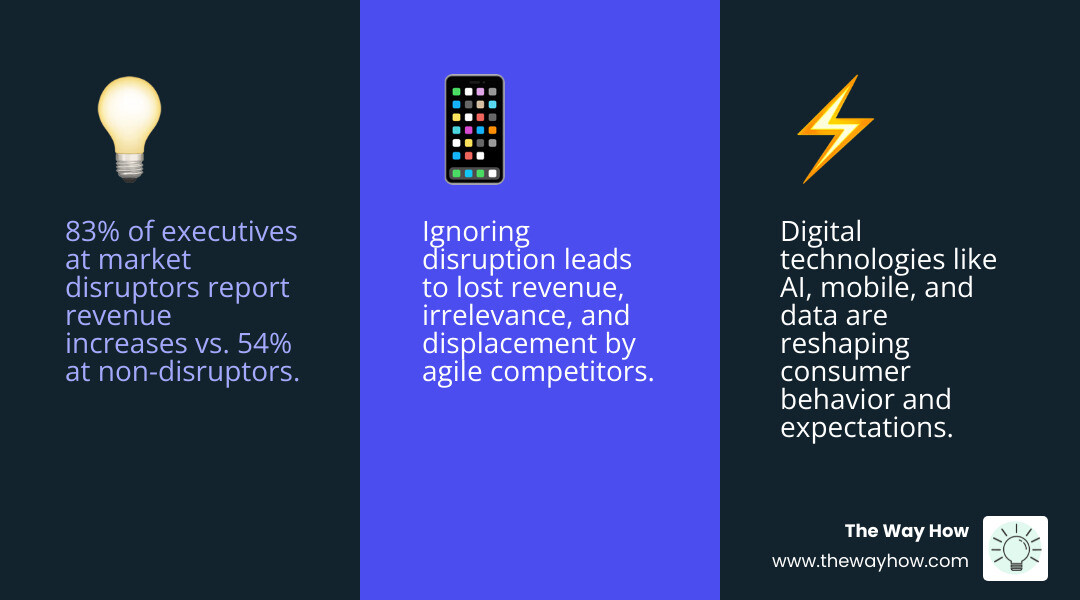
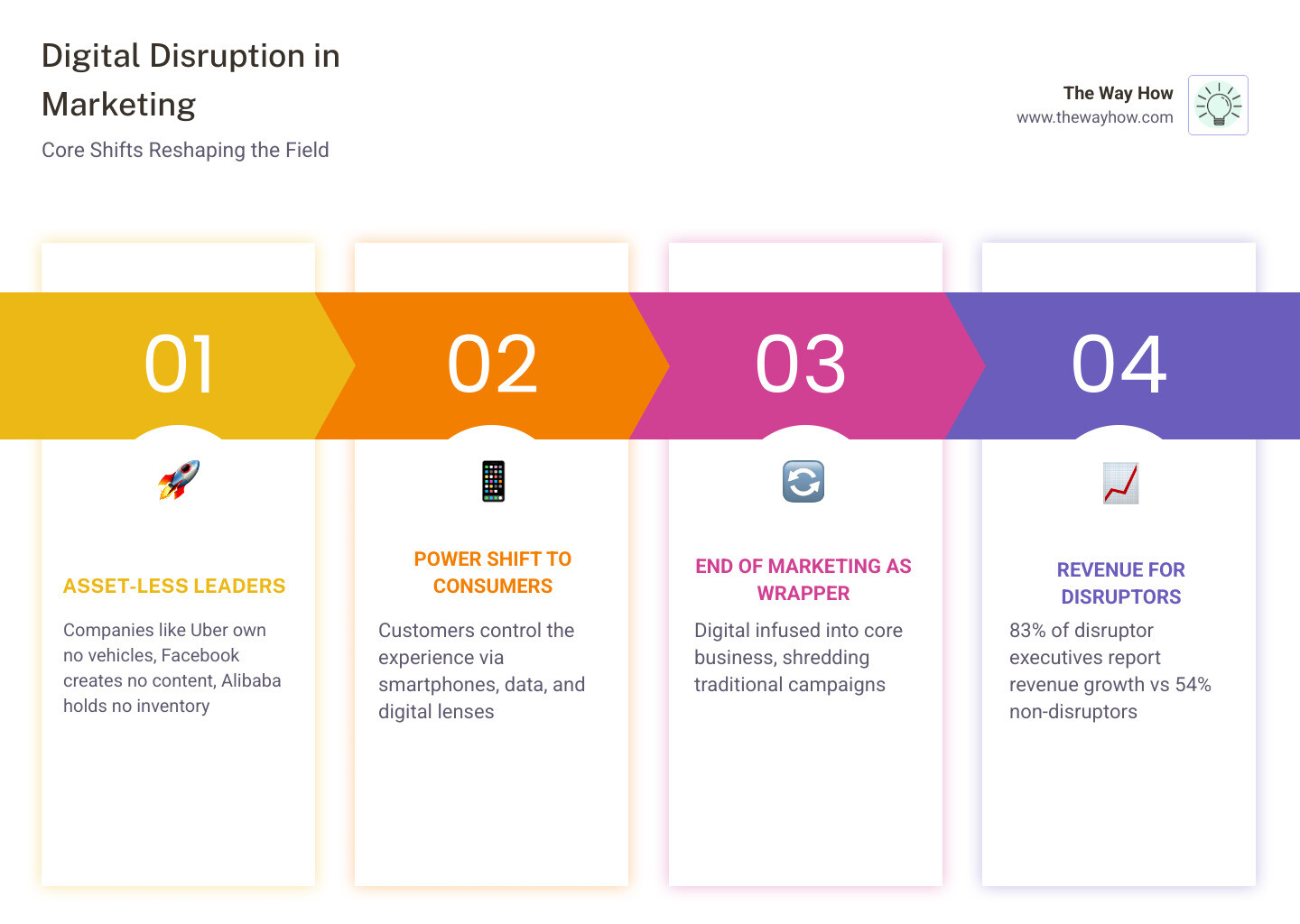
83% of executives who see their organizations as market disruptors report increased revenue over the past three years, compared to just 54% at non-disruptive companies. That gap isn’t accidental. It reflects a fundamental difference in how those businesses understand and respond to change.
The companies winning today aren’t necessarily the ones with the biggest budgets. They’re the ones who understood why their customers’ expectations shifted — and rebuilt their marketing around that reality.
I’m Jeremy Wayne Howell, a revenue growth strategist with over 20 years of experience helping founders and executives diagnose what’s actually stalling growth — including the buyer psychology and decision-making gaps that sit underneath digital disruption in marketing. What follows is the clearest, most practical breakdown I know how to give you.
Simple what is digital disruption in marketing glossary:
For decades, marketing functioned as a “wrapper” around a business. You built a product, then you handed it to the marketing department to wrap it in a clever campaign and buy some attention. Digital disruption has effectively shredded that wrapper.
Today, digital is no longer a peripheral channel; it is infused into the core of how business happens. When we talk about what is digital disruption in marketing, we are talking about a fundamental shift in power. The consumer now holds the remote, the smartphone, and the data. They don’t just see your ads; they experience your entire business model through a digital lens.
This creates a massive amount of uncertainty for leadership teams. If the old playbook of “spend more on TV and print” is broken, what replaces it? We believe this shift is actually a gift. It forces us to stop chasing surface-level tactics and start looking at the human behavior underneath. When the “noise” of traditional advertising fades, what remains is the need for trust, momentum, and clarity in the customer journey.
To truly uncover the secrets of digital disruption in marketing, we have to look past the gadgets. It is the change that occurs when new digital technologies and business models affect the value proposition of existing goods and services.
Think about “asset-less leaders.” The world’s largest taxi company owns no vehicles (Uber). The most popular media owner creates no content (Facebook). The most valuable retailer has no inventory (Alibaba). These companies didn’t just use better tech; they used technology to solve a human problem—like the friction of hailing a cab or the frustration of finding a specific product—more elegantly than the incumbents.
The “consumerization of IT” means that your customers now expect the same ease of use from a B2B software provider that they get from Netflix. If your marketing or sales process feels like a chore, you are being disrupted not by a competitor’s product, but by your own customer’s rising expectations.
Statistically, the stakes are high. Only 12% of the digitization potential has been used in Europe, compared to 18% in the USA. This suggests a massive “certainty gap” where businesses know they need to change but haven’t yet built the systems to do it.
At its heart, digital disruption is a psychological event. It happens when a new way of doing things creates more “certainty” for the buyer than the old way.
We use a disruption marketing complete guide approach to help founders see that disruption isn’t an attack; it’s a signal. When a customer switches to a disruptive competitor, they are moving toward a path of least resistance. They are looking for empathy-led strategies that respect their time and reduce the cognitive load of making a decision.
It is easy to confuse these two, but they are distinct.
Innovation is about making a better lightbulb. Transformation is about realizing people don’t want lightbulbs; they want to see in the dark—and then finding a completely new way to provide that “vision.” You can see more disruptive marketing examples here to see how this plays out in the wild.
If you feel like your marketing is shouting into a void, it’s likely because the drivers of disruption have moved your audience to a different frequency.
Consider the sheer volume of data and intelligence now available. Between 1982 and 2020, experts reviewed over 1,580 research papers about AI in marketing. This isn’t a “future trend”; it’s the current engine of the economy. From the 200 sensors festooned on a new car monitoring driving style to the “social signals” search engines use to rank content, the environment is now “live.”
5 Disruptions to Marketing, Part 1: Digital Transformation highlights that digital has moved from a “wrapper” to being infused into sales, service, and product. If your marketing department is siloed away from your product team, you are essentially trying to run a race with your shoelaces tied together.
The traditional linear funnel—Awareness, Consideration, Decision—is effectively dead. Digital disruption has replaced it with a messy, real-time loop.
During the global shifts of 2020, US online spending increased by about 80%. This wasn’t just a temporary spike; it was a permanent rewiring of how people find certainty before they buy.
We often talk about Kodak as the “dinosaur” of digital disruption. It’s a common misconception that they didn’t see digital photography coming—they actually invented the first digital camera! Their failure wasn’t a lack of tech; it was a lack of psychological agility. They were so committed to the “chemistry” of film that they couldn’t embrace the “memory” of digital.
Contrast that with the “asset-less” or “data-first” models:
| Industry | Traditional “Dinosaur” Model | Digital Disruptor Model |
|---|---|---|
| Media | Cable packages, fixed schedules | Netflix: Personalization, on-demand |
| Transport | Owned fleets, dispatchers | Uber: Matching idle supply with demand |
| Music | Physical sales, ownership | Spotify: Usership, royalties, discovery |
| Health | Doctor visits, generic labs | 23andMe: Data-driven, personalized insights |
Amazon didn’t just disrupt retail by selling books; they disrupted it by changing the psychology of “waiting.” By making shipping speedy and returns simple, they set a new “certainty floor” that every other retailer is now forced to stand on. If you are a disruptive advertising agency or a brand trying to compete, you aren’t just competing with your neighbor; you’re competing with the best experience your customer had this morning.
So, how do we stop reacting and start leading? It begins with a shift in management support and organizational culture. 70% of change programs fail, usually because of employee resistance or a lack of top-down clarity.
To turn marketing into a dependable growth engine, we recommend these shifts:
Attending events like the MarTech conference series can help your team stay ahead of the evolving intersection of technology and management.
The most immediate risk is obsolescence. If a competitor finds a way to deliver your value with 50% less friction, your customers will leave, and they won’t look back. You face revenue loss, competitor displacement, and an internal culture of fear as employees realize the company is falling behind.
Don’t just look at “likes” or “clicks.” Measure incremental revenue, customer retention rates, and the value of your data assets. Are you gaining market share in new segments? Is your ROI on new channels (like social commerce or influencer partnerships) outperforming your traditional spend?
AI is the “great accelerator.” It handles the automation of knowledge work—which experts predict will have a $5 trillion to $7 trillion impact on white-collar jobs. In marketing, AI allows for hyper-personalization at scale, predictive analytics (knowing what the customer wants before they do), and chatbots that provide instant certainty to browsing shoppers.
At The Way How, we see digital disruption not as a threat to be managed, but as the ultimate diagnostic tool. If your growth has stalled, it is rarely because you aren’t using enough “tech.” It is usually because there is a certainty gap in your customer journey—a place where the buyer feels confused, unappreciated, or ignored.
We specialize in removing that uncertainty. Whether through Fractional CMO leadership, optimizing your HubSpot architecture, or designing demand generation strategies rooted in human behavior, our goal is to help you see the problem clearly before we ever talk about solutions.
Digital disruption has stripped away the gimmicks, leaving only what matters: the human connection between your brand and your buyer. If you’re ready to stop chasing tactics and start building a system that creates trust and predictable revenue, get in touch with our team today. Let’s turn the “tsunami of change” into your greatest competitive advantage.
 Jeremy Wayne Howell : Jul 22, 2026 9:48:31 PM
 Jeremy Wayne Howell : Jul 21, 2026 9:47:10 PM
 Jeremy Wayne Howell : Jul 20, 2026 9:46:47 PM