A Complete Guide to CRM Systems and Database Management
 Jeremy Wayne Howell : Jul 22, 2026 9:48:31 PM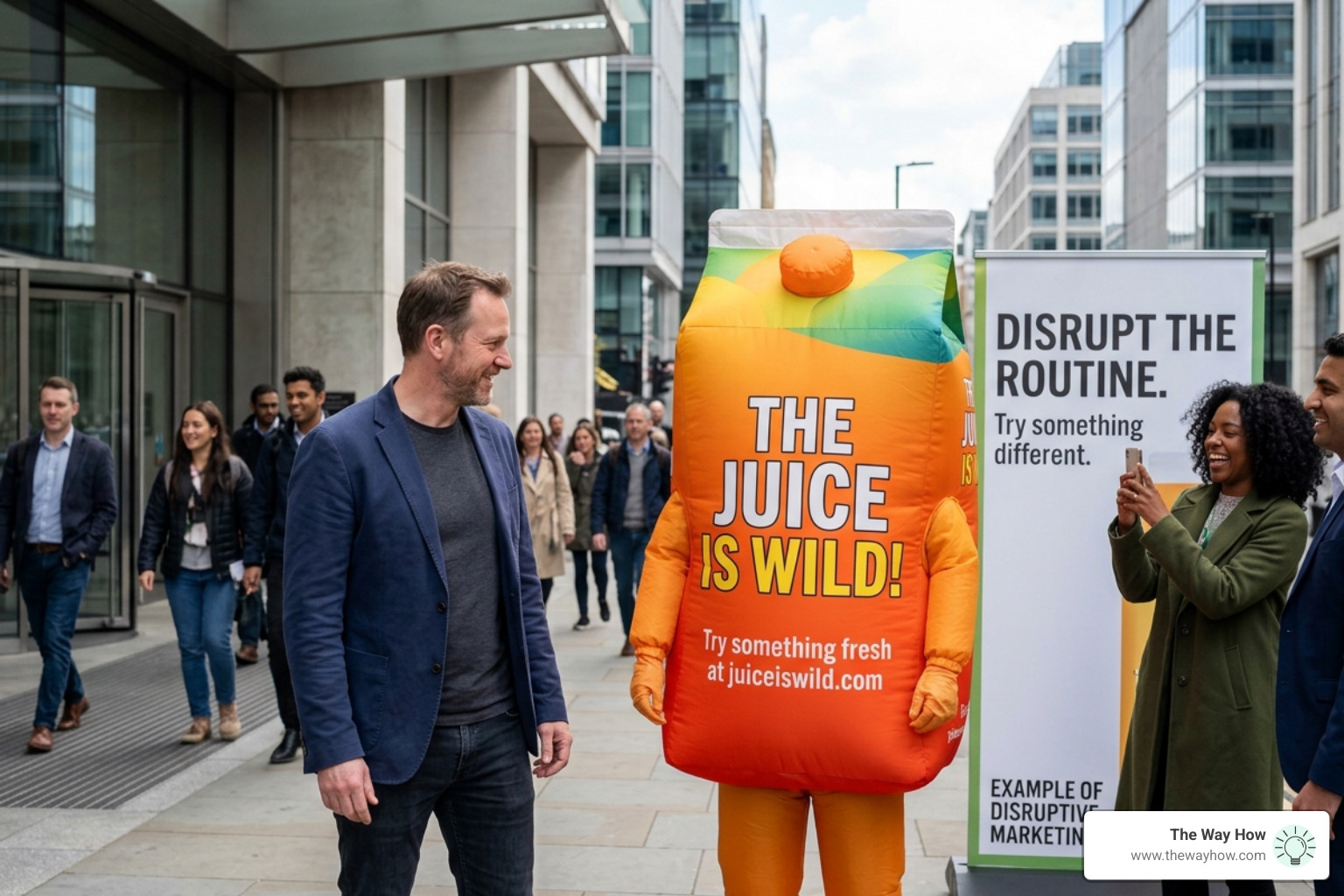
An example of disruptive marketing isn’t hard to find — but understanding why it works is where most brands get stuck.
Here are some of the most iconic examples, at a glance:
| Campaign | Brand | What Made It Disruptive |
|---|---|---|
| Whopper Detour | Burger King | Geofenced McDonald’s to unlock a $0.01 Whopper via app |
| Don’t Buy This Jacket | Patagonia | Ran an anti-purchase ad on Black Friday |
| Moldy Whopper | Burger King | Showed a burger rotting to prove no preservatives |
| The Ordinary Pop-Up | The Ordinary | Displayed fake cash to expose celebrity markup costs |
| #OptOutside | REI | Closed stores on Black Friday, paid staff to go outside |
| Diamond Shreddies | Kraft | Rotated cereal 45° and called it a new product |
| Liquid Death | Liquid Death | Sold canned water with punk branding and dark humor |
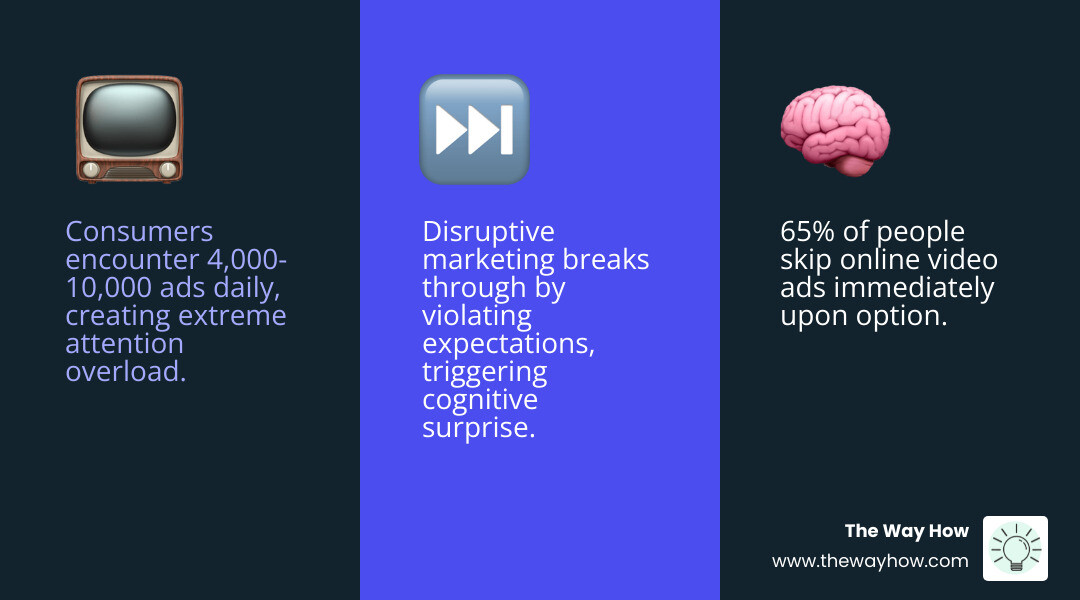
Right now, the average person is hit with somewhere between 4,000 and 10,000 ads every single day. And 65% of people skip online video ads the moment they can. Add over 6 billion daily Instagram posts to that picture, and you start to understand why most marketing feels like shouting into a void.
The problem isn’t budget. It’s not creative either.
It’s that most marketing plays by the same rules everyone else is playing by. When every brand looks, sounds, and behaves the same way, nothing registers. Consumers don’t consciously tune you out — their brains do it automatically, as a survival mechanism against the noise.
Disruptive marketing works because it does something different: it violates an expectation the audience didn’t even know they had. That moment of cognitive surprise — “wait, did they really just do that?” — is exactly when attention locks in.
But here’s what the best campaigns have in common that most breakdowns miss: they aren’t just creative stunts. They’re grounded in a deep understanding of buyer psychology, industry tension, and what people actually want but aren’t being given.
I’m Jeremy Wayne Howell, founder of The Way How and a revenue growth strategist with over 20 years of experience helping companies diagnose what’s stalling their growth — including when a well-chosen example of disruptive marketing is the right lever to pull. In the sections ahead, I’ll break down exactly how these campaigns work and how you can apply the same thinking, without a Super Bowl budget.
Similar topics to example of disruptive marketing:
To build a campaign that actually moves the needle, we have to look past the surface-level “shock factor.” True disruption is an intentional challenge to the status quo. It targets a deeply held industry norm and flips it on its head.
When we work with clients at The Way How, we look for “certainty gaps”—those places where a customer feels hesitant because the industry feels dishonest or outdated. Disruptive marketing fills that gap by using psychological levers like the framing effect (changing how a choice is presented) and identity play (connecting a product to a person’s sense of self).
Understanding this requires a shift from traditional tactical thinking to a Disruption Marketing Complete Guide mindset. It’s about fighting the status quo bias, where consumers stick to what they know simply because it’s familiar. A Disruptive Advertising Agency doesn’t just make ads; they design behavioral interventions that force a re-evaluation of value.
It is easy to confuse disruptive marketing with guerrilla marketing, but they serve different strategic masters. Guerrilla marketing is often about tactical surprise—think of the 3M bus shelter filled with millions of dollars behind “unbreakable” glass. It’s a stunt designed for immediate buzz.
Marketing Disruption, however, often mirrors Clayton Christensen’s theory of “new-market disruption.” This happens when a brand targets “non-consumption”—reaching people who weren’t even in the market because existing options were too expensive or complex. Think of how personal computers disrupted mainframes by being “good enough” and affordable for the average person. While guerrilla tactics seek a moment of your time, disruptive strategies seek a permanent place in your behavior.
The most effective example of disruptive marketing often costs 30-50% less than traditional campaigns. Why? Because creativity and psychology do the heavy lifting that media spend usually tries to buy.
Take the concept of “reactance.” When people feel like they are being sold to, they naturally push back. But if you frame an ad as a “mischievous hack” or a mission, you flip that reactance into engagement. In the Peak rivalry: Burger King turned McDonald’s into a coupon machine case, the rival became the trigger. Every time a customer saw a McDonald’s, they were reminded of Burger King’s deal. This creates a behavior loop that generates its own impressions through social sharing and “social currency,” rather than relying solely on paid reach.
To see how this works in the wild, we need to look at the brands that took calculated risks to break industry patterns.

Burger King faced a massive challenge: nobody wanted to download another fast-food app. Instead of running standard “download now” ads, they created a geofencing stunt. By “detouring” customers to a McDonald’s to unlock a one-cent Whopper, they turned 14,000 competitor locations into their own distribution points.
The result? Over 1.5 million downloads in just nine days. This worked because it wasn’t a discount; it was a game. It gave users a story to tell, resulting in 150,000 redemptions and a massive shift in app adoption.
On Black Friday 2011, Patagonia did the unthinkable: they took out a full-page ad in the New York Times telling people not to buy their products. This Patagonia Don’t Buy This Jacket: Why It Worked analysis shows it wasn’t a gimmick. It was backed by decades of operational truth, including their 1% for the Planet commitment and the Common Threads Initiative.
While it appeared to be commercial self-sabotage, it actually deepened long-term loyalty. It signaled to consumers that Patagonia cared more about the environment than a quick sale, which, ironically, led to sustained revenue growth by attracting value-aligned customers.
The beauty industry is notorious for high markups driven by celebrity endorsements—often accounting for 30-100% of the product cost. The Ordinary disrupted this by focusing on clinical ingredients and radical transparency.
In a 2025 pop-up, they used stacks of fake money to visualize the $10 million cost of a single celebrity post, showing customers exactly how much they save when they aren’t paying for “hype.” This How a Pile of Fake Money Built Unshakeable Brand Trust | Case Study — Psychology-Driven Consumer Brand Studio | Ainoa demonstrates that when you expose an industry’s “ugly” secret, you build unshakeable trust.
Most fast-food ads show “perfect” burgers that never seem to age. Burger King leaned into the “ugly truth” with a time-lapse of a Whopper rotting over 34 days to prove they had removed artificial preservatives.
Despite being visually “gross,” the Moldy Whopper Marketing Campaign by Burger King was a triumph of transparency. It earned over 8.4 billion impressions—the equivalent of $40 million in earned media—and led to a 14% increase in sales. It proved that in an era of skepticism, brutal honesty is a powerful differentiator.
During the Super Bowl, when competitors were spending $5 million for 30 seconds of airtime, Volvo ran a Twitter contest. They asked people to tweet #VolvoContest every time they saw another car commercial.
This Disruption In Advertising tactic effectively hijacked the conversation. Instead of watching the competitors’ ads, people were looking at their phones, thinking about Volvo. This social interception led to a 70% sales increase for the XC60 model in the month following the game.
Sometimes, an example of disruptive marketing doesn’t require a product change at all—just a shift in perception. Kraft’s Diamond Shreddies campaign simply rotated the square cereal 45 degrees and marketed it as “new” diamond-shaped Shreddies.
This utilized the “framing effect” to perfection. By creating a playful debate over squares vs. diamonds, they increased market share by 18%. It’s a classic lesson in Disruptive Sales Strategies: psychological value is often just as impactful as functional value.
Water is the ultimate commodity, but Liquid Death disrupted the category by using “identity play.” They packaged mountain water in tallboy cans with punk-rock aesthetics and the tagline “Murder Your Thirst.”
By leaning into a “cult following” and dark humor—like auctioning a casket cooler for $68,200—they addressed a What Is Digital Disruption In Marketing tension point: people who want to stay hydrated at a concert or bar without looking like they’re holding a boring plastic bottle.
You don’t need millions to be disruptive. In fact, resource constraints often force the kind of creative thinking that leads to the best Disruptive Sales Strategies.

The first step is a diagnostic one. Ask yourself: What do customers secretly hate about your industry? Is it the confusing pricing? The outdated buying experience? The fake “perfection” in the advertising?
Disruption lives in these friction points. When you solve an unspoken problem or address an industry flaw that everyone else is ignoring, you create an immediate market gap that you can own.
Modern technology has democratized disruption. You can use:
As we discuss in our guide on What Is Digital Disruption In Marketing, the goal is to use digital tools to create a more human, accessible experience than the incumbents.
Disruption is not without risk. The biggest danger isn’t that your campaign will fail—it’s that it will be perceived as a gimmick.
If Patagonia had run their “Don’t Buy This Jacket” ad but didn’t actually have a repair program or sustainable sourcing, they would have been shredded for greenwashing. Authenticity is the only shield against reputational scrutiny. Your operational reality must match your marketing message. When you lean into radical transparency, you invite the “service recovery paradox”—the idea that a brand that admits a flaw and fixes it is often more trusted than one that claims to be perfect.
Guerrilla marketing is a tactical surprise designed for a quick burst of attention (a stunt). Disruptive marketing is a strategic shift that often creates a new market segment or fundamentally changes how a consumer perceives value in a category. One is a flash in the pan; the other is a change in the system.
Absolutely. In fact, B2B is ripe for disruption because it is often plagued by “corporate speak” and friction-heavy sales cycles. Disruptive B2B marketing focuses on thought leadership that challenges industry dogmas. While B2C might see results in days, B2B disruption typically shows meaningful impact in 3-6 months as it builds a new foundation of trust.
The “brand-value gap.” If your disruptive message doesn’t align with your core brand values, it will feel like a hollow gimmick. This leads to customer backlash and a loss of credibility that can take years to recover.
At The Way How, we believe that the best example of disruptive marketing is one that restores momentum to a stalled business. We don’t just chase “viral” moments; we diagnose the behavioral psychology behind why your customers aren’t buying and design systems to fix it.
Whether it’s through Fractional CMO leadership, optimizing your HubSpot architecture, or building a demand generation engine rooted in empathy, we help you remove the uncertainty from your growth strategy.
Ready to stop shouting into the void? Let’s build a system that creates genuine trust and predictable revenue.
 Jeremy Wayne Howell : Jul 22, 2026 9:48:31 PM
 Jeremy Wayne Howell : Jul 21, 2026 9:47:10 PM
 Jeremy Wayne Howell : Jul 20, 2026 9:46:47 PM