
Your Funnel Isn’t Leaking, It’s Disconnected
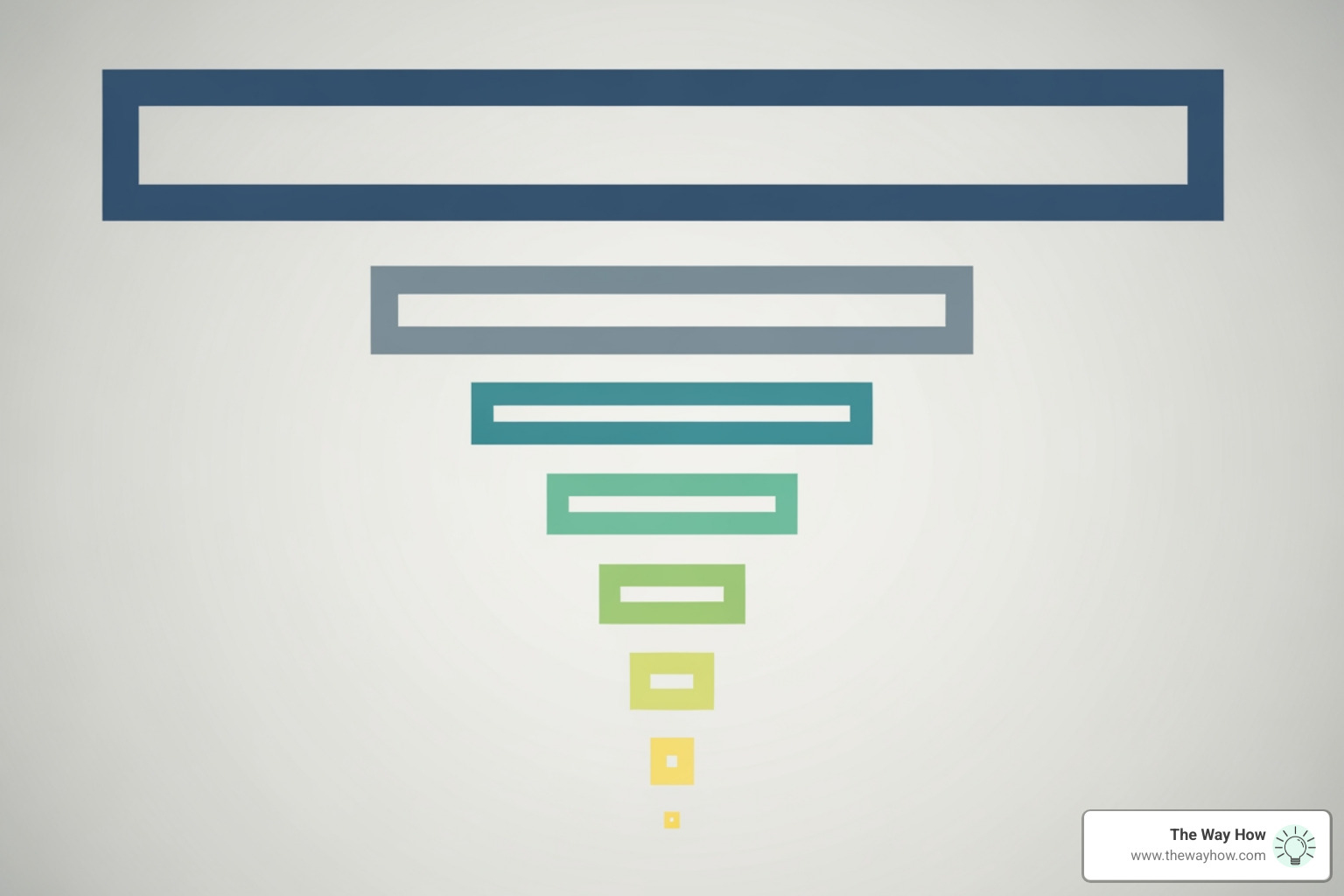
Funnel optimization is the process of systematically improving each stage of your conversion path to increase the percentage of prospects who complete a desired action—whether that’s signing up, purchasing, or becoming a customer.
Quick Answer: What Is Funnel Optimization?
- Definition: Analyzing and improving each stage of your customer’s journey to reduce drop-off and increase conversions
- Key Focus: Identifying where prospects exit and why they’re not moving forward
- Core Approach: Using data, behavioral insights, and testing to remove friction and build certainty
- Primary Goal: Converting more of your existing traffic into customers without spending more on acquisition
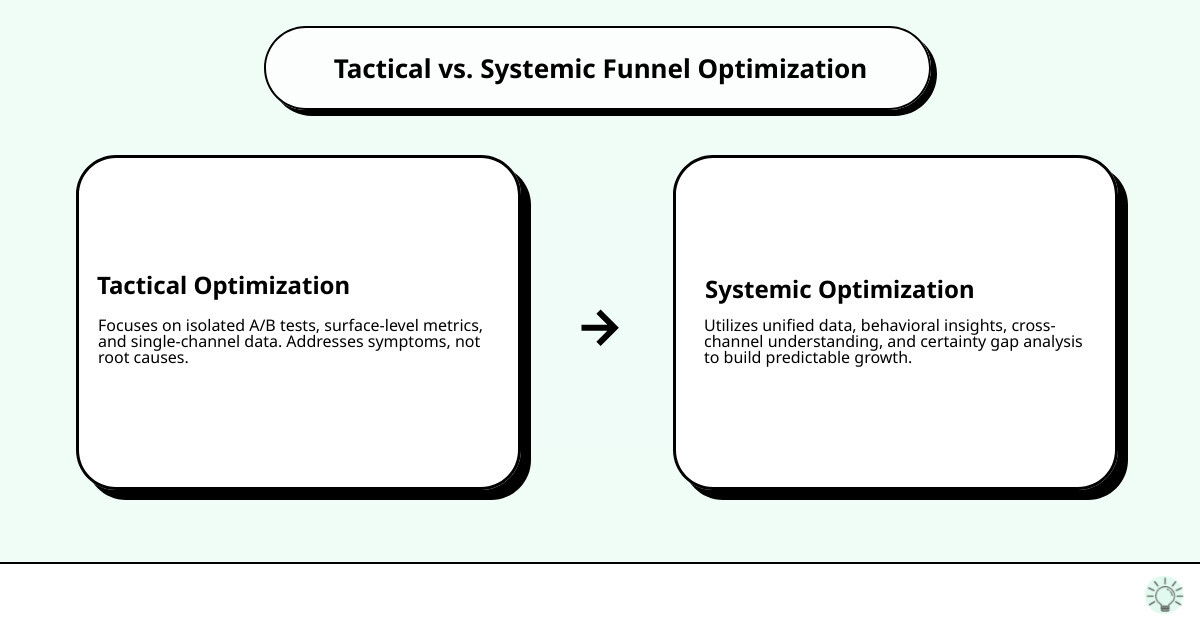
Most companies treat funnel optimization like fixing a leaky pipe—patch the checkout page, tweak the landing page headline, adjust the CTA color. But when those changes don’t move the needle, they’re left wondering why.
The real problem isn’t that your funnel is leaking. It’s that it’s disconnected.
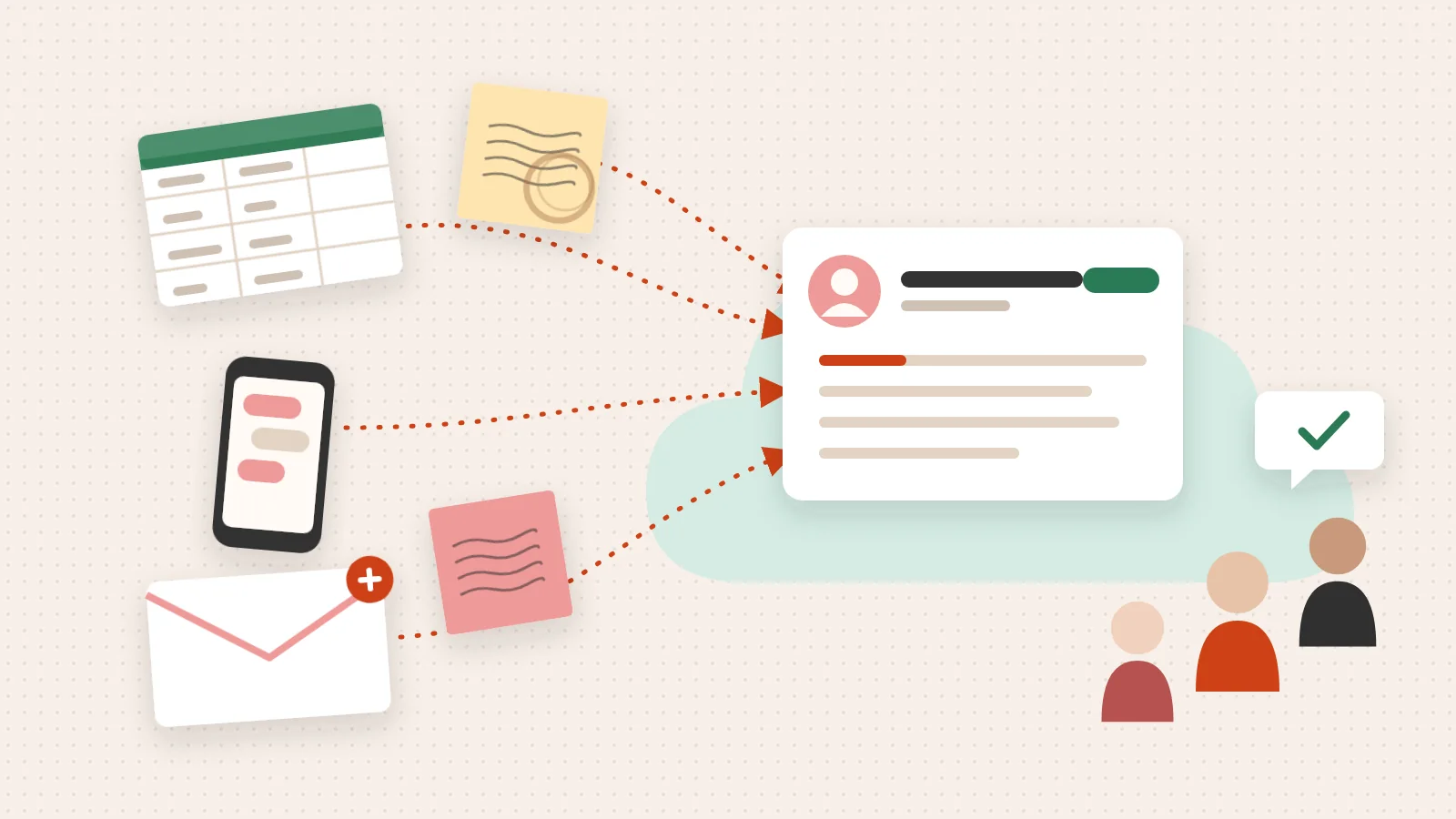
According to recent research, 60% of consumers take six or more actions before deciding to buy from a new brand. They’re bouncing between channels, consuming content, and evaluating options in ways your analytics can’t fully track. When your data lives in silos—web analytics here, CRM there, ad platforms somewhere else—you’re trying to optimize based on partial snapshots. You’re making decisions about what’s broken without seeing how the pieces actually connect.
This creates a cycle of surface-level fixes that address symptoms, not causes. You improve a landing page conversion rate by 10%, but overall revenue stays flat. You add social proof, but qualified leads don’t increase. You run test after test, but you’re not sure what’s actually driving the results.
The truth is, 71% of marketers say improving their website conversion rate is their top priority, yet most are optimizing in the dark. They’re chasing tactics without understanding the human behavior underneath—the certainty gaps, the emotional friction, the moments where a buyer thinks “I’m not sure yet” and clicks away.
I’m Jeremy Wayne Howell, founder of The Way How, and I’ve spent over 20 years helping companies diagnose why growth stalls and rebuild systems that create predictable revenue through psychology-first funnel optimization. This guide will show you how to move beyond patchwork tactics and build a connected system that addresses the real reasons prospects don’t convert.
From AIDA to ROI: Understanding the Anatomy of a Modern Conversion Funnel
At its core, a conversion funnel is a conceptual model that illustrates the journey a prospect takes from their first interaction with your brand to becoming a customer or completing a desired action. Think of it as a strategic map that visualizes the steps buyers steer, allowing us to identify where they might get lost or drop off.
This model is distinct from a broader customer journey, which encompasses the entire holistic experience, from initial findy to long-term loyalty. While the customer journey is the “grand, sprawling epic” of a customer’s experience, the conversion funnel is a “gripping short story” specifically focused on the path to a singular goal—a conversion.
Similarly, it’s important to distinguish between conversion, sales, and marketing funnels. A marketing funnel takes a broader view, encompassing the entire customer experience from first touch to post-purchase engagement. A sales funnel is often narrower, zeroing in on the journey to making a purchase and generating revenue, particularly in B2B or high-consideration sales. A conversion funnel, however, can apply to any desired action, whether it’s a sign-up, a download, or a purchase.
The traditional roadmap for this journey is often based on the AIDA model—Awareness, Interest, Desire, Action—first introduced by Elias St. Elmo Lewis. This model lays out the sequential psychological stages buyers move through:
- Awareness (TOFU - Top of Funnel): Prospects become aware of a problem or need, and of your brand as a potential solution.
- Interest (MOFU - Middle of Funnel): They show interest in your offerings, seeking more information and comparing options.
- Desire (MOFU): They develop a preference for your solution, envisioning how it can solve their problem.
- Action (BOFU - Bottom of Funnel): They decide to purchase or convert.
Modern funnels often add a crucial fifth stage: Re-engagement or Loyalty. This acknowledges that the journey doesn’t end at conversion; repeat buyers are where the real ROI is, with returning customers spending 67% more than new customers.
Why the Funnel Metaphor Still Matters
Despite its age, the funnel metaphor remains incredibly powerful because it helps us:
- Visualize the customer path: It provides a clear, structured way to see how prospects move through your digital landscape.
- Identify drop-off points: By segmenting the journey, we can pinpoint exactly where users abandon the process, like finding leaks in a boat.
- Focus marketing efforts: It allows for strategic allocation of resources and tailoring of messages to the specific mindset of prospects at each stage.
- Align sales and marketing: It fosters a shared understanding and collaborative effort between teams, ensuring a consistent buyer experience.
- Understand buyer psychology: For us at The Way How, this is paramount. The funnel helps us map the emotional and cognitive shifts buyers undergo, revealing the “certainty gaps” that cause friction and prevent conversion.
The Key Stages of Buyer Decision-Making
Understanding the psychological underpinnings of each stage is critical for effective funnel optimization:
- Awareness: This is where prospects first encounter your brand or realize they have a problem your solution might address. Content here is educational, designed to inform and attract.
- Interest: Once aware, prospects begin actively seeking information. They’re curious, looking for details, features, and benefits. Our goal is to deepen that curiosity and provide relevant answers.
- Desire: This stage is about emotional connection. Prospects start to envision themselves using your product or service, seeing it as the ideal solution. We move beyond facts to highlight unique value propositions and resonate with their aspirations.
- Action: The moment of truth. Prospects are convinced and ready to convert, whether by making a purchase, signing up for a service, or booking a demo. Our job is to make this step as frictionless as possible.
- Loyalty and Advocacy: The journey extends beyond the first purchase. Satisfied customers become repeat buyers and, ideally, brand evangelists. Since 90% of prospects trust suggestions from family and friends, nurturing loyalty is vital for sustainable growth.
Diagnosing the Disconnect: The Metrics and Mindsets for Effective Funnel Optimization

Many businesses struggle with funnel optimization because they’re looking at the wrong data, or rather, fragmented data. They see conversion rates plummeting, but the root cause isn’t just checkout friction or ad copy; it’s often data fragmentation. When your team lacks a unified, trustworthy view of how customers move across channels, you’re essentially flying blind.
This reliance on single-channel insights leads to misleading conclusions. You might see high engagement on a social media campaign, but if that engagement doesn’t translate to qualified leads or sales, it’s a vanity metric. Google’s consumer insights confirm that the customer journey is messy, with 60% of consumers taking six or more actions before deciding to buy from a new brand. Without connected data, we only see fragments of this reality, making reliable funnel analysis impossible. We need a unified data view to truly understand what’s happening.
Moving Beyond Vanity Metrics
To move beyond surface-level fixes, we must shift our mindset from measuring activity to measuring effectiveness. This means aligning our Key Performance Indicators (KPIs) with overarching business goals for each stage of the funnel.
Key metrics for effective funnel optimization include:
- Conversion Rate: The percentage of visitors who complete a desired action. This is a primary indicator of funnel health.
- Customer Lifetime Value (LTV): The total revenue a business can reasonably expect from a single customer account. Optimizing for LTV means focusing on long-term relationships, not just initial conversions.
- Cost Per Acquisition (CPA): The cost associated with convincing a customer to buy a product or service. We aim to keep CPA lower than LTV for sustainable growth.
- Average Order Value (AOV): The average amount of money spent per order. Optimizing AOV often involves upselling and cross-selling strategies.
Aligning these KPIs with business goals means understanding that a high click-through rate (CTR) on an ad is a vanity metric if it doesn’t lead to qualified leads downstream. We must measure the impact of top-of-funnel efforts on downstream conversions, not just engagement metrics.
Using Analytics to Uncover Friction
The first step in effective funnel optimization is to properly set up your analytics. We consider it non-negotiable to set up a goal in Google Analytics. Without this, you’re missing critical data on where users are abandoning your funnel.
Beyond basic goal tracking, we leverage tools and techniques to uncover friction points:
- Goal Flow analysis: In Google Analytics, this tool helps us visualize the path users take and identify unexpected exits or loops within your defined funnel.
- Heatmaps and session recordings: Tools like Hotjar and Microsoft Clarity provide invaluable qualitative data. Heatmaps show where users click, move, and scroll, while session recordings allow us to watch anonymized user sessions, revealing exactly where they get confused, frustrated, or stuck.
- Identifying user drop-off points: By analyzing these tools together, we can pinpoint specific pages, sections, or form fields where users are abandoning the funnel.
- Combining quantitative and qualitative data: Quantitative data (numbers) tells us what is happening, while qualitative data (user behavior, feedback) tells us why. This combined approach is essential for forming accurate hypotheses.
The Role of A/B Testing in Funnel Optimization
Once friction points are identified and hypotheses are formed, A/B testing becomes our scientific method for validation. This involves creating two (or more) versions of a page element (A and B) and showing them to different segments of your audience to see which performs better.
Key considerations for effective A/B testing:
- Hypothesis-driven testing: Every test should start with a clear hypothesis: “If [change], then [result], because [reason].” This ensures we’re testing assumptions, not just making random tweaks.
- Statistical significance: Ensure your test runs long enough and gathers enough data to produce statistically significant results, preventing premature conclusions.
- Testing one element at a time: To accurately attribute changes in performance, we isolate variables. Testing multiple elements simultaneously can lead to misleading results.
- Avoiding misleading results: Without proper setup and analysis, A/B tests can confirm biases rather than reveal true insights. This is why a unified data view is so critical—it prevents us from optimizing one part of the funnel at the expense of another.
Here’s how we differentiate between tactical and strategic A/B testing:
| Feature | Tactical A/B Test | Strategic A/B Test |
|---|---|---|
| Focus | Button color, headline wording, image placement | Value proposition, core offer framing, user workflow |
| Goal | Incremental conversion rate increase | Deeper understanding of buyer psychology, certainty gaps |
| Hypothesis | “Green button will convert better than red.” | “Emphasizing X benefit will resonate with Y persona.” |
| Impact | Short-term, localized improvements | Long-term, systemic improvements, potentially cross-funnel |
| Data Required | Page-level metrics | Cross-channel, unified behavioral data |
Closing Certainty Gaps: Stage-by-Stage Strategies to Build Momentum and Trust
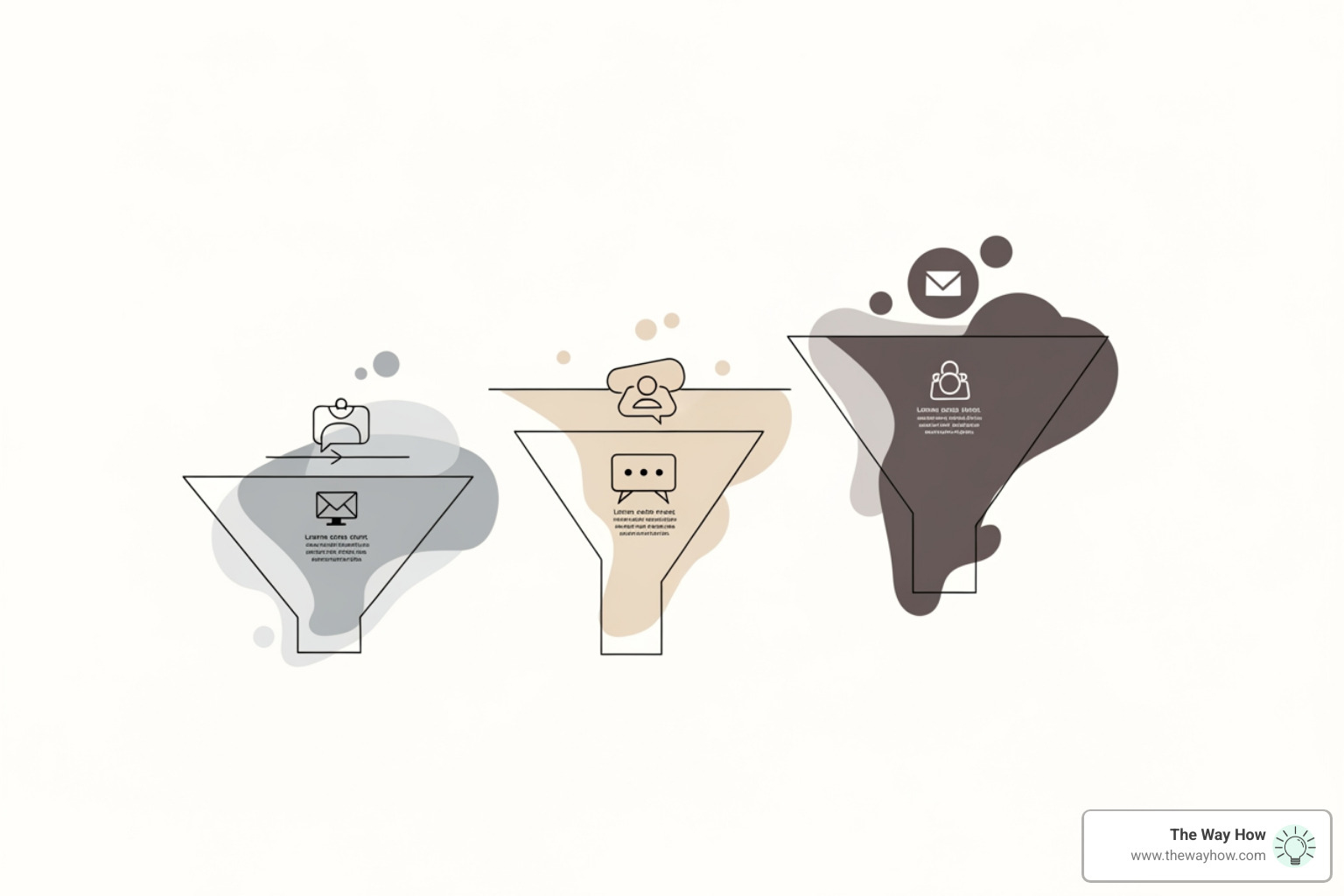
Effective funnel optimization isn’t about applying generic tactics; it’s about understanding and addressing the unique psychological needs and “certainty gaps” at each stage of the buyer’s journey. We leverage content marketing, landing pages, and calls-to-action (CTAs), infused with social proof and trust signals, to guide prospects seamlessly.
Top-of-Funnel (TOFU): Building Awareness and Trust
At the TOFU, prospects are just beginning their journey. They might be aware of a problem but not yet a solution, or they’re simply finding your brand. Our goal here is to attract attention, educate, and position your brand as a helpful authority.
- Educational Content: This is the bedrock of TOFU. Think blog posts, guides, and informative articles that address common questions and pain points without being overtly promotional. For example, this video we created at Matomo is a prime example of awareness-stage content, grabbing attention and educating viewers about Matomo.
- SEO: Optimizing your content for search engines ensures that when prospects search for answers, your brand appears as a credible source.
- Social Media: Platforms like LinkedIn, X, and others are excellent for initial brand exposure and sharing valuable content.
- Answering Questions & Building Authority: By consistently providing value and expertise, you build trust and establish your brand as a thought leader, setting the stage for deeper engagement.
Middle-of-Funnel (MOFU): Nurturing Interest and Desire
In the MOFU, prospects have moved beyond initial awareness. They’re actively researching solutions, comparing options, and considering how different products or services might meet their specific needs. Here, we focus on nurturing their interest and building desire.
- Lead Magnets: Offer valuable, gated content like ebooks, whitepapers, templates, or webinars in exchange for contact information. This helps qualify leads and deepens their engagement.
- Case Studies & Webinars: These formats showcase your expertise and demonstrate how your solution has helped others, addressing the “how will this work for me?” question.
- Email Nurturing: Personalized email sequences, triggered by specific actions (e.g., downloading a lead magnet), can guide prospects through their consideration process. Tailor content based on their expressed interests.
- Personalized CTAs: Generic CTAs are a missed opportunity. Research shows that personalized CTAs can increase conversion rates by up to 202%.
- Interactive Demos & Product Tours: Modern buyers prefer to “sell themselves.” 70% of B2B buyers prefer a sales experience that doesn’t involve talking with a sales rep. Providing interactive demos or product tours allows prospects to explore your solution on their own terms, building confidence and internal consensus.
- Social Proof & Testimonials: At this stage, prospects are looking for validation. 90% of prospects trust suggestions from family and friends. Highlight customer reviews, testimonials, and case studies to reinforce credibility.
Bottom-of-Funnel (BOFU): Driving Action and Conversion
The BOFU is all about removing the final barriers to conversion. Prospects are ready to act; our role is to make that action as easy, secure, and compelling as possible.
- Optimizing Sign-Up Forms & Checkout Processes: Simplify these critical touchpoints. Reduce the number of fields, offer guest checkout options, and ensure a clear progress indicator. While it might seem counterintuitive, fewer text boxes don’t necessarily mean more conversions; sometimes, collecting more relevant information upfront can lead to higher quality conversions later. The key is balance and relevance.
- Trust Logos & Security Seals: Displaying recognized trust signals like BBB and VeriSign logos reassures prospects about the security and legitimacy of your site, especially during payment.
- Retargeting and Remarketing: Not every lead converts on the first visit. 44% of salespeople may stop after one follow-up, but 80% of sales happen after at least five follow-ups. Retargeting ads and remarketing email sequences can re-engage prospects who showed interest but didn’t convert, bringing them back to complete the action.
- Urgency and Scarcity Cues: When used credibly and ethically, subtle cues like “limited stock” or “offer ends soon” can provide the final nudge, stimulating action by leveraging the fear of missing out.
The Modern Marketer’s Toolkit: Leveraging Technology for Systemic Improvement
In today’s complex digital landscape, effective funnel optimization requires more than just good strategy; it demands the right technology. We leverage a robust toolkit that integrates analytics, CRO, and AI-powered solutions to build connected systems, moving beyond the common challenges of data fragmentation and manual processes.
Core Analytics and User Behavior Tools
These tools form the foundation of our diagnostic process, helping us understand what is happening and why:
- Google Analytics 4 (GA4): GA4 is indispensable for tracking website performance, user interactions, and conversion rates across different touchpoints. It provides a comprehensive view of your digital ecosystem.
- Heatmap and Session Recording Tools: Platforms like Hotjar and Microsoft Clarity offer invaluable qualitative insights. They allow us to visualize user behavior, identify points of confusion or friction, and understand the “why” behind quantitative data.
- Product Analytics Tools: For products and SaaS businesses, tools like Userpilot, Fullstory, Mixpanel, Amplitude, Pendo, and Heap provide deep insights into how users interact with the product itself, revealing in-app friction points that impact activation and retention.
Experimentation and Personalization Platforms
Once we have a clear understanding of user behavior, these tools allow us to test hypotheses and deliver custom experiences:
- A/B Testing Tools: Platforms such as Optimizely and VWO enable us to run rigorous experiments, testing different elements of your funnel to determine which variations lead to higher conversion rates.
- Personalization Engines: These tools use data to deliver customized content, offers, and experiences to individual users or segments, enhancing relevance and driving engagement.
- AI-Powered Copy Tools: Artificial intelligence can assist in generating and optimizing headlines, ad copy, and landing page content, speeding up the experimentation process and suggesting high-performing variations.
The Rise of Buyer Enablement Technology
The modern buyer demands control and self-service. Our approach to funnel optimization accepts this shift, leveraging technology to empower buyers:
- Interactive Demo Platforms: These tools allow prospects to explore your product on their own terms, receiving a personalized, on-demand experience without the need for a sales rep. This is critical as 70% of B2B buyers prefer a sales experience that doesn’t involve talking with a sales rep.
- Digital Sales Rooms (DSRs): DSRs provide a centralized, collaborative space where buyers can access all relevant information, demos, and communication, fostering internal consensus within their buying committee.
- The Role of Sales Engineers (SEs): With buyers doing more self-findy, the role of SEs is evolving. Rather than repetitive introductory calls, they can focus on complex technical validations and strategic insights. This is crucial given that 80% of SEs experience some symptoms of burnout from repetitive tasks; technology can alleviate this by automating basic walkthroughs.
- Self-Service Tools: Empowering buyers with intuitive tools for pricing, configuration, and product exploration reduces friction and accelerates their journey. This aligns with our Automated Client Acquisition Funnel Guide 2026, which focuses on building systems that facilitate buyer autonomy.
From Patchwork to Predictable Growth
True funnel optimization is not a one-time fix; it’s a commitment to continuous improvement. User behaviors change, market conditions shift, and new technologies emerge. This necessitates a consistent data flow and an agile mindset to identify new bottlenecks and test fresh signals.
At The Way How, we believe in building robust systems over chasing fleeting tactics. We diagnose why growth is stalled, identify certainty gaps in the customer journey, and design systems that create trust, momentum, and predictable revenue. Our approach is rooted in understanding the psychology of decision-making, ensuring that every optimization effort is meaningful and contributes to long-term success.
We help businesses build sales funnels that are not just efficient, but empathetic and aligned with how people actually make decisions. This allows you to move beyond simply improving conversion rates to driving true business impact.
If you’re ready to transform your disconnected funnel into a predictable growth engine, it’s time to rethink your approach. Let’s build a growth system that creates clarity and momentum.