
Beyond the Buzzword: Why Your Growth Has Stalled

If you’re reading this, something isn’t working.
You’ve hired agencies, launched campaigns, and invested in tools. But your growth is still stuck.
The problem isn’t your effort. It’s that most companies approach growth backward. They chase tactics before understanding the human behavior that drives them. They optimize funnels without knowing where the certainty gaps exist in their customer’s journey.
Growth hacking isn’t about tricks. The term was coined by Sean Ellis in 2010 to describe a mindset of relentless experimentation focused on one metric: growth. But it’s often been reduced to a buzzword.
Real growth hacking is a discipline. It’s the practice of hypothesizing, testing, measuring, and repeating—quickly. It sits at the intersection of marketing, product development, and data analysis. When done right, it doesn’t just bring in users; it builds systems that compound over time.
Traditional marketing asks: How do we build awareness?
Growth hacking asks: What’s stopping someone from taking the next step?
That shift changes everything. Instead of running campaigns that feel like they should work, you run experiments that prove what works. You identify where users drop off, why they hesitate, and what would make them move forward with confidence.
This isn’t about going viral overnight. Companies like Dropbox, Airbnb, and Hotmail grew explosively not because they got lucky, but because they designed systems that turned every user into a potential growth lever. They understood human psychology first, built growth into the product experience, and measured relentlessly.
But here’s what most articles won’t tell you: growth hacking can fail spectacularly if you don’t understand why growth has stalled. You can’t A/B test your way out of a broken value proposition or gamify onboarding if users don’t understand what problem you solve.
That’s where most businesses get stuck. They’re executing tactics without diagnosing the actual problem.
I’m Jeremy Wayne Howell, founder of The Way How. I’ve spent over 20 years helping companies diagnose why their growth has stalled and rebuild systems that create predictable momentum. We do this by identifying the psychological gaps in the customer journey before implementing any Growth hacking strategies. This guide will walk you through a framework for thinking about growth as a system, not a series of disconnected tactics.
Growth hacking strategies terms you need:
The Mindset Before the Method: Deconstructing the Growth Hacker’s Approach
Before diving into tactics, it’s crucial to understand the underlying philosophy of growth hacking. At The Way How, we believe true growth stems from a deep understanding of human behavior and a relentless commitment to learning. This approach is built on several key pillars.
Our data-first principle means every decision is rooted in evidence. Research by Harvard Business School suggests that startups using A/B testing scale more quickly, which highlights the power of data-guided iteration. This leads directly to fast testing cycles, using a “hypothesize, test, measure, repeat” loop to quickly validate or invalidate assumptions.
Cross-functional collaboration is non-negotiable. Growth doesn’t fit neatly into one department. We bring together insights from marketing, product, engineering, and customer support to see the entire customer journey and identify opportunities a siloed approach would miss.
Crucially, we must acknowledge the importance of product-market fit. No amount of growth hacking can salvage a product that doesn’t solve a user’s problem. Growth hacking strategies amplify what’s already working.
As Sean Ellis, who coined the term, described it, a growth hacker is someone “whose true north is growth.” This singular focus means every action is evaluated by its potential impact on growth. At its heart is a profound understanding of user psychology: What motivates a user? What creates certainty? What drives a decision?
What is growth hacking and how does it differ from traditional marketing?
Growth hacking uses creative, resource-light strategies to drive fast, measurable growth. Unlike traditional marketing, which often focuses on broader goals like brand awareness with longer planning cycles, growth hacking is singularly obsessed with scalable growth. It takes a full-funnel approach, optimizing every stage of the customer journey, from acquisition to referral. Key differentiators include a reliance on rapid experimentation, data analysis, and A/B testing over intuition and large budgets.
The Core Principles of Effective Growth Hacking
Effective growth hacking strategies are built on a set of core principles:
- Creativity: Finding unconventional opportunities to reach users and drive engagement.
- Scalability: A successful hack is a repeatable system, not a one-off stunt.
- User-centricity: Growth happens when we deliver genuine value and remove friction from the user’s journey.
- Retention focus: Sustainable growth hinges on keeping customers. Your existing customers are 60 to 70% more likely to close a sale than new ones.
- Measurement: If we can’t measure it, we can’t grow it. Every initiative must have clear, trackable metrics.
- Iteration: Growth hacking is an ongoing process of testing, learning, and adapting strategies based on data.
Building Your Growth Engine: A Framework for Repeatable Success
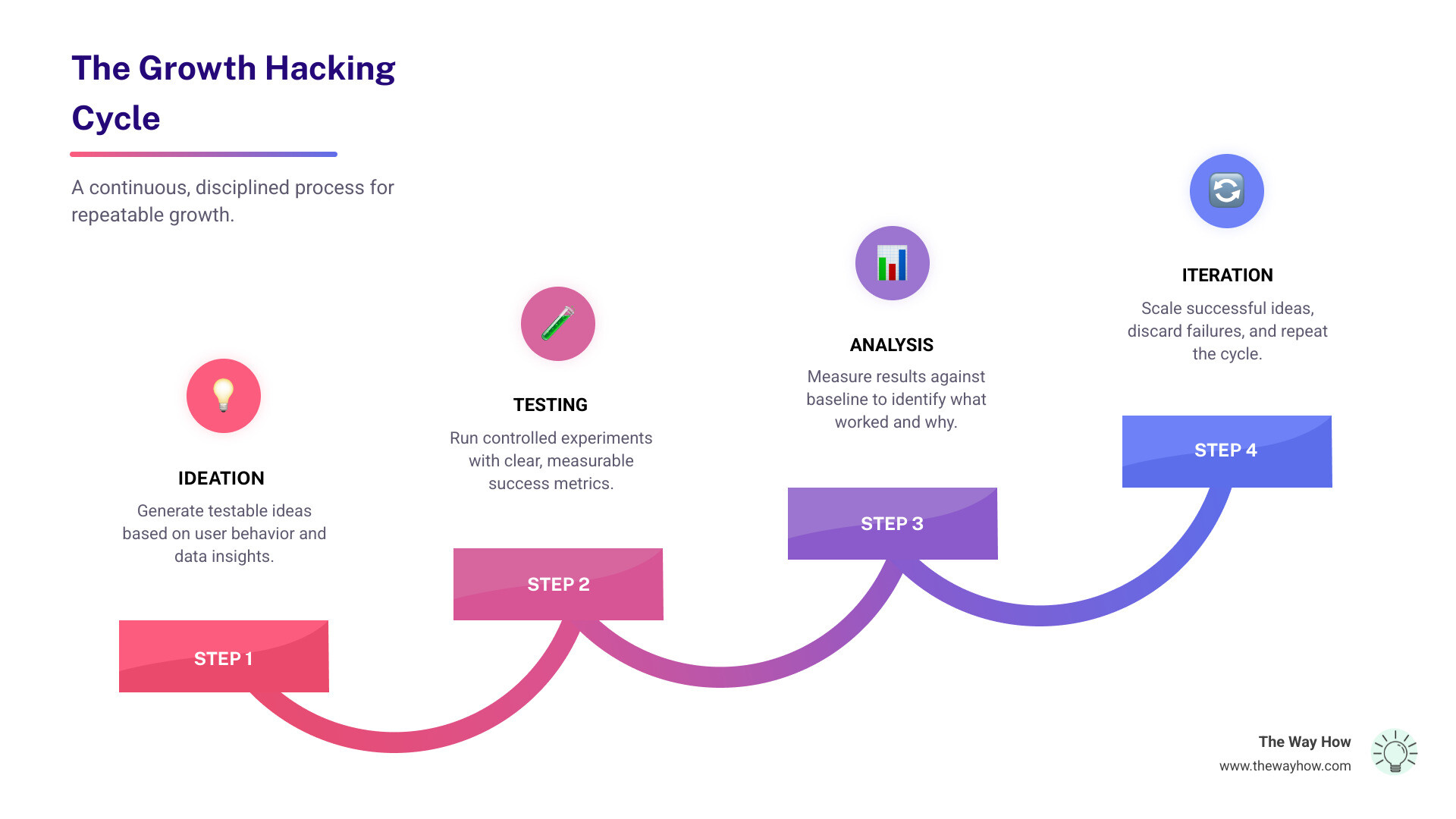
Many businesses treat growth as a series of disconnected campaigns. We see it as a predictable system—an engine you can tune and optimize. This requires a disciplined approach: brainstorm ideas, prioritize them, test small, scale what works, and analyze the results. This cycle creates a continuous loop of improvement.
How to Identify and Prioritize Growth Experiments
Identifying the right growth hacking strategies is about systematic diagnosis. We start by looking for “certainty gaps” in your customer’s journey—points where they hesitate or drop off.
Funnel analysis is our compass. By mapping the customer journey, we can pinpoint where users disengage. High traffic but low sign-ups, for example, indicates a bottleneck that needs addressing.
To prioritize ideas, we use frameworks like the Impact, Confidence, and Ease (ICE) framework. The ICE Score Model helps rank ideas by considering:
- Impact: How significant would the positive outcome be?
- Confidence: How sure are we that this will work?
- Ease: How much effort will this require?
This ensures we focus our efforts where they’ll have the most profound effect. We also integrate user feedback into this process. Metrics tell us what is happening, but user feedback tells us why.
The Critical Role of Data in the Growth Hacking Process
Data is the lifeblood of growth hacking strategies. We use it to diagnose problems and illuminate the path forward.
- A/B testing is a cornerstone. It allows us to compare two versions of a webpage, email, or feature to see which performs better, removing bias and providing clear evidence.
- Cohort analysis helps us understand the long-term impact of our initiatives by tracking groups of users over time. This reveals if growth is compounding or if we’re just acquiring users who churn.
- Key Performance Indicators (KPIs) are the vital signs of our business health, defined to align directly with growth objectives.
- User behavior tracking goes beyond clicks. We use analytics to understand how users steer our platforms and where they encounter friction.
It’s vital to distinguish between actionable metrics and “vanity metrics.”
| Vanity Metrics (Misleading) | Actionable Metrics (Insightful) |
|---|---|
| Page views | Conversion rate |
| Total registered users | Customer Lifetime Value (LTV) |
| Social media likes | Churn rate |
| App downloads | Daily/Monthly Active Users |
| Email open rates | Email click-through rate |
Tools like Google Analytics are essential for gathering this data, but the real power comes from turning it into actionable insights.
The AARRR Funnel: Actionable Growth Hacking Strategies for Every Stage
The AARRR framework, or “Pirate Metrics” (Acquisition, Activation, Retention, Referral, Revenue), provides a lens to optimize the entire customer journey. We use it to systematically address certainty gaps at each stage.

Acquisition: Attracting the Right Users
Acquisition is about attracting the right users who will find value in your offering.
- Content marketing & SEO: Create valuable content that your audience is searching for. This builds trust and drives sustainable organic traffic.
- Viral loops: Build mechanisms into your product that encourage users to invite others.
- Social media: Engage with your target market where they congregate online. In 2017, Facebook drove 20% of referral traffic, highlighting its potential.
Here are other acquisition channels to test for your growth hacking strategies:
- Paid social media advertising (Facebook, Instagram, LinkedIn)
- Search engine marketing (Google Ads)
- Guest blogging on industry sites
- Building a pre-launch email list
- Appearing on podcasts
- Participating in niche online communities
- Influencer marketing
Activation: Creating the “Aha!” Moment
Activation is when a new user experiences your product’s core value—the “Aha!” moment. If this doesn’t happen quickly, they’re likely to churn.
- Onboarding gamification: Duolingo uses points and streaks to make learning feel like a game, keeping users engaged.
- UX optimization: A seamless onboarding process reduces friction and builds trust.
- Free trials and freemium models: These lower the barrier to entry, allowing users to experience value without commitment. One study found freemium products convert customers 25% more often than a free trial model without sales intervention.
- Product tutorials: Clear tutorials help users achieve their desired outcomes quickly.
Retention: The Key to Sustainable Growth
Retention is the bedrock of sustainable growth. Acquiring a new customer is far more expensive than keeping an existing one. The importance of customer retention in growth hacking cannot be overstated, as existing customers are 60-70% more likely to close a sale.
- Community building: Create a space where users can connect and support each other. Elementor and Jasper have massive Facebook groups that serve as invaluable feedback loops and sources of advocacy.

- Email marketing: A $1 investment in email marketing can bring $44 in revenue. Personalized campaigns nurture relationships and keep users engaged.
- Personalization: Tailoring the user experience makes users feel understood and valued.
- Customer feedback loops: Actively soliciting and acting on feedback builds trust and improves the product.
Referral: Turning Customers into Advocates
Referrals leverage word-of-mouth psychology. We trust recommendations from people we know. A Nielsen report found that 88% of people trust recommendations from those they know over any other advertising channel.
Effective referral programs offer valuable incentives to both the referrer and the referred.
- Hotmail: One of the earliest growth hacks involved adding a simple line to every outgoing email: “Get your own free Hotmail at www.hotmail.com.” This propelled them to 12 million users in 18 months.
- Dropbox: They offered free extra storage for referrals, aligning the incentive with their product’s core value. This strategy led to 3,900% growth in 15 months, going from 100,000 to 4 million users.
- Robinhood & Monzo: These fintech companies gamified their waitlists, allowing users to jump ahead in the queue by referring friends. This created scarcity and social proof, driving massive pre-launch sign-ups.
Revenue: Connecting Growth to the Bottom Line
Growth hacking strategies must ultimately connect to the bottom line.
- Lifetime Value (LTV): This metric represents the total revenue expected from a single customer. Maximizing LTV is a key goal.
- Monetization strategies: Explore various income models, such as subscriptions, one-time purchases, or advertising.
- Upselling and cross-selling: Offer higher-tier products or complementary services to activated customers.
- Pricing experiments: A/B test different pricing models to find the optimal strategy for maximizing revenue.
Navigating the Pitfalls: Risks and Limitations to Consider
While growth hacking strategies can deliver incredible results, they are not without risks. At The Way How, we emphasize diagnosing why growth has stalled before prescribing tactics, because blindly implementing “hacks” can cause significant problems.
What are the potential risks and limitations associated with growth hacking?
- Short-term thinking: The pressure for rapid growth can lead to tactics that yield quick wins but damage long-term brand reputation.
- Focusing on vanity metrics: Getting caught up in numbers that look good but don’t reflect business health (like page views instead of conversions) leads to misguided strategies.
- Acquiring without retaining: The “leaky bucket” problem. If you’re pouring resources into acquisition but users are churning, you’re not growing sustainably.
- Losing user trust: Aggressive growth hacks can feel manipulative, leading to a loss of user trust that is difficult to regain. Ethical considerations must be paramount.
How to Measure the True Success of Your Initiatives
Measuring success requires a disciplined approach that aligns with business objectives.
- Setting SMART goals: Ensure every initiative has goals that are Specific, Measurable, Achievable, Relevant, and Time-bound.
- Tracking AARRR metrics: Use the Acquisition, Activation, Retention, Referral, and Revenue metrics to get a holistic view of your funnel’s health.
- Key metrics to watch: Beyond AARRR, closely monitor Conversion rates, Customer Lifetime Value (LTV), Churn rate, and Net Promoter Score (NPS) to understand customer satisfaction and long-term value.
Essential Tools for Growth Hacking
For businesses looking to implement their own growth hacking strategies, here is a list of essential tools:
- Google Analytics: For user behavior and website performance tracking.
- OptinMonster: For A/B testing and conversion rate optimization.
- Constant Contact: An email marketing service for list building.
- Zoom: For hosting webinars to engage and convert attendees.
- SEMrush: For SEO, competitive research, and keyword analysis.
- Hunter: To find email addresses for outreach.
- Buzzsumo: For content research and identifying influencers.
- RafflePress: A WordPress plugin for running giveaways and contests.
- ManyChat: For building Facebook Messenger bots.
- YouTube: For hosting product tutorials and video content.
- CoSchedule Headline Analyzer: For crafting compelling headlines.
From Hacking to System: Building Your Predictable Growth Engine
We’ve explored how growth hacking strategies are more than just tactics; they’re a mindset rooted in data-driven experimentation, cross-functional collaboration, and a deep understanding of user psychology. From acquisition to revenue, each stage of the AARRR funnel presents opportunities to remove certainty gaps and build momentum.
The true power lies not in finding a single, magical “hack,” but in building a system for continuous improvement. This means embedding the principles of growth hacking into your organizational culture, fostering a relentless curiosity about your users, and a commitment to learning from every experiment.
At The Way How, we specialize in helping founders and leadership teams diagnose why their growth has stalled. We don’t just offer tactics; we identify the psychological and emotional gaps in your customer journey and design robust systems that create trust, momentum, and predictable revenue. Our work blends strategic clarity, behavioral insight, and operational execution to turn your marketing into a dependable growth engine.
To understand how we can help you build your own predictable growth engine and bridge those certainty gaps, please find out more about our strategic services.