
Beyond the Demographic Myth: Why Your Audience Targeting is Stalled

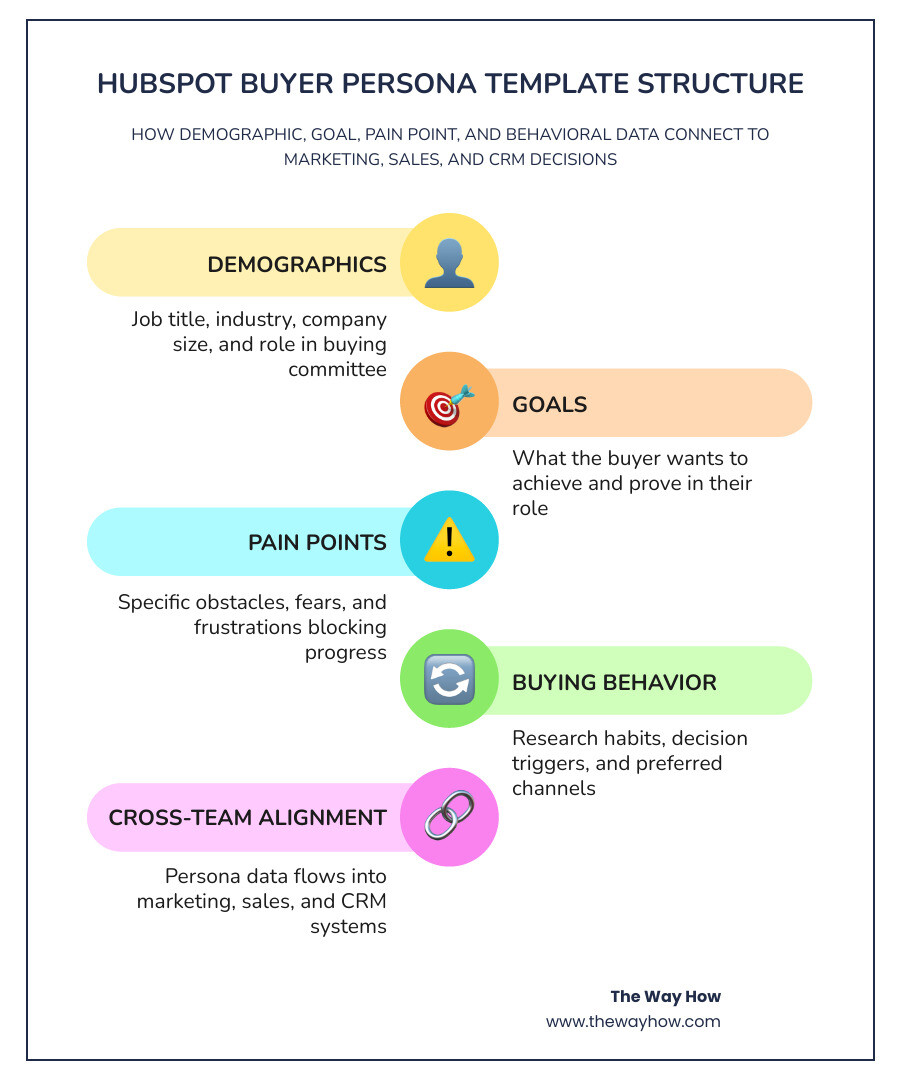
HubSpot buyer persona templates give marketers and revenue teams a structured way to document who their ideal customers really are — beyond job titles and age ranges.
Here’s a quick breakdown of what they are and how to access them:
| What | Details |
|---|---|
| What they are | Pre-built frameworks for capturing demographics, goals, pain points, and buying behavior in one shareable document |
| Free templates | HubSpot offers downloadable persona templates (PowerPoint/PDF) at no cost |
| AI tool | HubSpot’s Make My Persona generates a structured persona from a plain-language description in minutes |
| Cost | Both the templates and the AI tool are completely free — no credit card, no subscription |
| How many to create | Most businesses maintain 3–5 core personas representing distinct customer segments |
| Where to start | hubspot.com/make-my-persona or HubSpot’s free resource library |
Most companies think their targeting problem is a channel problem. It isn’t.
When campaigns underperform, when ad spend disappears without results, when sales and marketing can’t agree on who they’re actually selling to — the root cause is almost always the same: the team doesn’t have a clear, shared picture of the human on the other side of the decision.
That’s what buyer personas fix. Not by adding another document to a shared drive, but by forcing a team to get honest about who their customer actually is — what they fear, what they’re trying to prove, what would make them say yes.
The data backs this up:
- Companies using buyer personas see websites that are 2–5x more effective
- Personalized emails built around personas drive a 14% higher click-through rate
- Over 90% of companies that exceed revenue goals actively use buyer personas
But the template is just the container. What you put inside it — and whether your whole team actually uses it — is what determines whether it changes anything.
I’m Jeremy Wayne Howell, founder of The Way How, a psychology-first marketing and revenue strategy firm with over 20 years of experience helping founders and revenue leaders diagnose why growth stalls — including hands-on implementation of HubSpot buyer persona templates inside CRM and go-to-market systems that actually reflect how buyers think. This guide walks you through everything you need to build personas that don’t just sit in a folder, but drive real decisions across marketing, sales, and service.
Decoding the Layers: Target Audience, ICPs, and HubSpot Buyer Persona Templates
To build a go-to-market strategy that actually works, we must first clear up the terminology. Far too often, we see marketing teams use “target audience,” “ideal customer profile,” and “buyer persona” interchangeably. This confusion creates a massive certainty gap. When your team uses the same words to describe different strategic concepts, execution fractures.
Let us break down these three distinct layers of customer definition:
| Attribute | Target Audience | Ideal Customer Profile (ICP) | Buyer Persona |
|---|---|---|---|
| Focus | Broad Market Segment | The Target Organization | The Individual Human |
| Key Metrics | Demographics, geography, age, general interest | Industry, revenue, employee count, tech stack, budget | Motivations, fears, daily tasks, decision triggers |
| Primary Use | High-level media buying and brand awareness | Sales prospecting, account-based marketing (ABM) | Content creation, sales scripts, customer service |
| Example | B2B technology decision-makers in North America | SaaS companies with $10M-$50M ARR using HubSpot | “Operations Olivia” who fears losing data during a migration |
Understanding these layers prevents you from treating a company like a person, or a person like an entire market segment. We use behavioral clustering to group buyers by how they make decisions rather than just their firmographic profile.
If you need a starting point for defining the account level, you can download HubSpot’s free Ideal Customer Profile Template to map out your target organizations before diving into individual buyer psychology.
The Strategic Difference Between ICPs and Buyer Personas
The simplest way to separate these two is through the lens of B2B buying committees. An ICP tells you which companies to target; a buyer persona tells you how to speak to the individual stakeholders within those companies.
In B2B sales, a single purchase decision rarely rests on one person’s shoulders. Modern buying committees typically involve six to ten stakeholders, each with their own unique motivations, biases, and decision triggers.
For instance, while your ICP might target mid-market healthcare organizations, your marketing and sales teams must navigate different personas within that organization:
- The Champion wants to solve an operational headache and save time.
- The Decision Maker (often the CFO or VP) cares about ROI, cost reduction, and financial predictability.
- The Blocker (often IT or Security) cares about data privacy, implementation friction, and risk mitigation.
If you treat every stakeholder the same, your message will fall flat. By using targeted HubSpot buyer persona templates, we can map out the specific psychological profiles of each committee member, ensuring our content addresses their unique concerns. For a deeper look at this targeting methodology, read our guide on Buyer Personas to Target the Right Audience.
Why Static Demographics Lead to Wasted Ad Spend
Many traditional marketing agencies will tell you that a buyer persona is simply a collection of demographics: “Marketing Manager, age 30-45, lives in Chicago, makes $85,000 a year.”
This is a dangerous myth. Demographics tell you who might buy, but they do not tell you why they buy.
When we rely solely on static demographics, we ignore the cognitive biases and purchasing drivers that actually control human behavior. Two people can share the exact same age, income, and geographic location, yet make purchasing decisions for completely opposite reasons. One might be driven by status and the desire to be an early adopter, while the other is highly risk-averse and only buys proven, established solutions.
If you target both with the same demographic-based ad copy, you waste half your ad budget. To write copy that converts, we must focus on psychographics: their core anxieties, their biggest professional frustrations, and the internal narrative they tell themselves when they feel stuck. You can find excellent real-world examples of how to shift from demographics to psychographics in HubSpot’s article on Buyer persona essentials: My top tips & examples to inspire yours.
Manual vs. AI: Navigating HubSpot’s Persona Creation Ecosystem
Once you commit to building deep, psychology-first profiles, you must choose how to document them. HubSpot offers two primary paths: their classic, downloadable templates and their AI-powered Make My Persona tool.
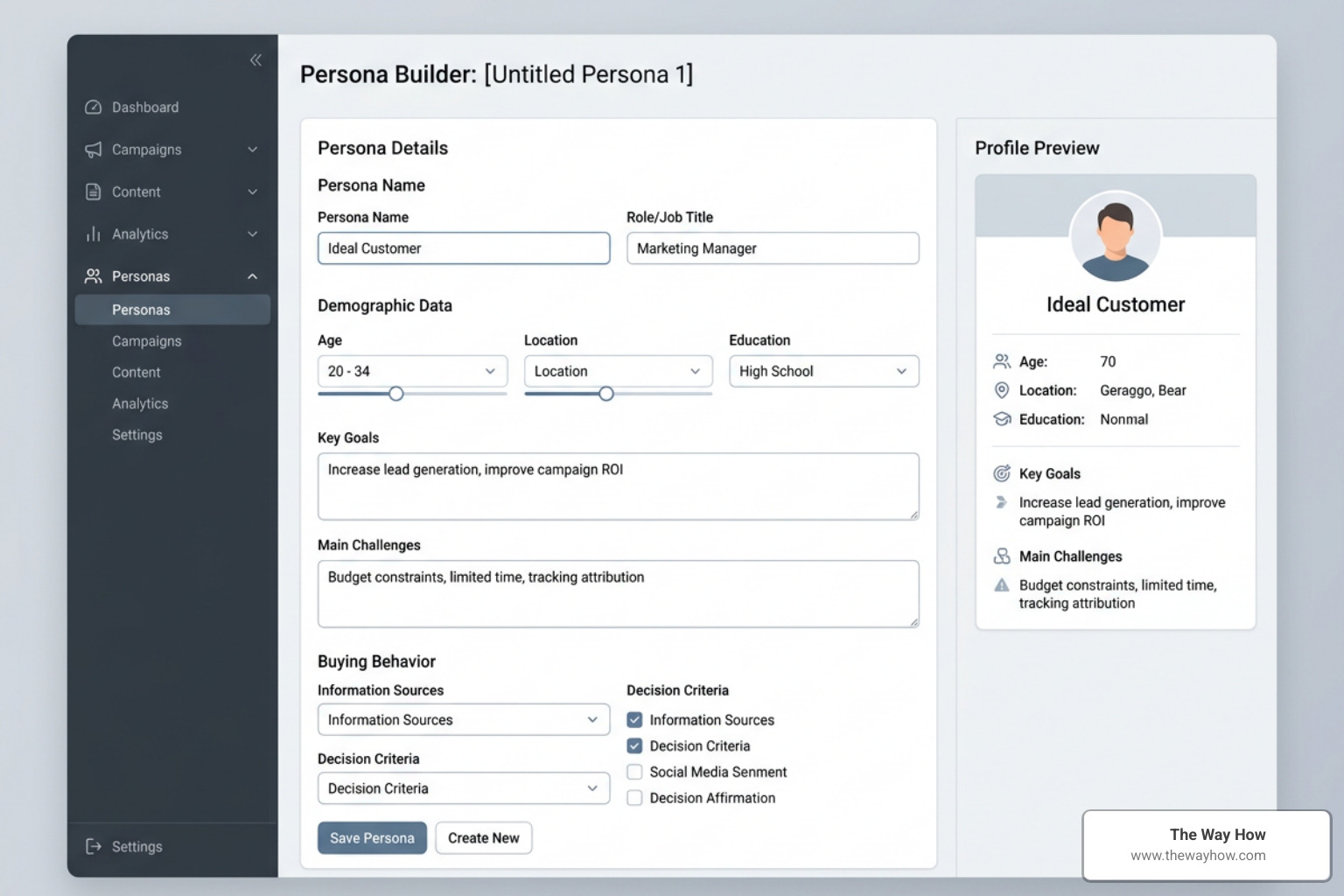
Both paths are completely free, require no credit card, and allow you to build an unlimited number of profiles. However, they serve different stages of your strategic journey. Understanding how to navigate this ecosystem is key to implementing your personas effectively. For a comprehensive overview of how HubSpot handles these profiles, check out our HubSpot Personas Guide.
How HubSpot’s Make My Persona AI Tool Generates Actionable Profiles
HubSpot’s Make My Persona - Free AI Buyer Persona Template Generator (2026) is an outstanding tool for teams that want to move quickly without sacrificing structure.
The AI generator works by taking plain-language descriptions of your ideal customer and transforming them into a highly organized, professional, and shareable persona document in under five minutes. Instead of staring at a blank page, you simply describe your buyer’s day-to-day responsibilities, their goals, and their challenges. The AI then processes this input to populate critical demographic and psychographic data fields, including:
- Job title and reporting structure
- Industry and company size
- Tools they use daily
- Preferred communication channels and information sources
- Core professional goals and obstacles
This tool eliminates the need for expensive consultants or complex design software, giving small-to-medium businesses immediate access to professional-grade customer documentation.
When to Use Free HubSpot Buyer Persona Templates Over AI
While the AI generator is fantastic for speed and consistency, there are times when manual, customizable templates are superior.
If your business operates in a highly niche B2B vertical, or if you have already conducted extensive qualitative research (such as direct customer interviews and surveys), the standard templates offer more flexibility.
HubSpot’s downloadable PowerPoint and PDF templates allow you to completely customize the sections to match your specific industry. For instance, you can add blocks for specialized technographics, regulatory compliance requirements, or specific stages of a complex buyer journey. You can download these customizable frameworks directly from HubSpot’s resource library via How to Create Buyer Personas for Your Business [Free Template].
The Psychology-First Framework for Researching and Building Personas
At The Way How, we believe that the best marketing does not come from clever tactics; it comes from a deep, empathetic understanding of your audience. To build a persona that actually changes team behavior, you must base it on real human interaction, not boardroom assumptions.

To help you structure this qualitative research, we recommend using a balanced framework. A great example of this is the Buyer Persona Template (Free 4-Block Framework) | 2026, which breaks your research down into four distinct quadrants:
- Demographics & Firmographics: Who they are and where they work.
- Psychographics & Motivations: What they want, what they fear, and what drives them.
- Behavioral & Buying Patterns: How they research, evaluate, and purchase solutions.
- Negative Persona Flags: The traits that indicate they are a bad fit for your business.
How to Customize HubSpot Buyer Persona Templates for Behavioral Insights
To turn a standard HubSpot template into a psychology-first powerhouse, you must look beyond basic job descriptions. You need to uncover the emotional drivers and core anxieties that keep your buyers awake at 2:00 AM.
When customizing your template, we recommend adding specific fields that capture these behavioral insights:
- The Status Quo Bias: What is keeping them from making a change right now, even if their current situation is painful?
- The Fear of Failure: What are they afraid will happen if they buy your solution and it fails? (e.g., losing their job, looking foolish to their boss, wasting budget).
- The Internal Dialogue: What is the literal language they use when complaining about their problems? (Use exact quotes from your interviews).
By structuring your templates around these psychological triggers, your copywriters can write messages that make prospects feel deeply understood. You can see how to model these deep behavioral profiles by exploring HubSpot’s 7 Persona Examples for Modeling Your Ideal Customer - HubSpot.
Validating and Updating Your Personas to Prevent Decay
A buyer persona is not a monument; it is a living document. The moment you export your persona as a PDF, it begins to decay. Market conditions shift, new competitors emerge, and customer behaviors evolve.
To keep your personas accurate and actionable, establish a regular validation loop:
- Quarterly Win/Loss Analysis: Review your CRM data for the last 10 closed-won and closed-lost deals. Did the actual buyers match your persona profiles? Why did the lost deals walk away?
- Sales and Support Feedback: Set up a quarterly meeting with your sales and customer success teams. Ask them if they are seeing new pain points, objections, or buying triggers in their daily conversations.
- Continuous Customer Interviews: Commit to interviewing 2 to 3 active customers every quarter. Ask them about their current challenges and how their daily workflows have changed.
Operationalizing Your Personas: Aligning Marketing, Sales, and Service
A beautiful buyer persona is completely useless if it sits forgotten in a shared Google Drive folder. To drive revenue, your personas must be operationalized across your entire organization.
When your marketing, sales, and customer service teams are aligned around the same customer profiles, you create a seamless, low-friction customer journey. This cross-functional alignment is the foundation of a successful HubSpot CRM Strategy.
Step-by-Step: Activating HubSpot Buyer Persona Templates in Your CRM
To make your personas actionable, you must build them directly into your CRM database. HubSpot makes this incredibly simple by providing a default “Persona” contact property.
Here is how to set it up and put it to work:
- Create the Personas in HubSpot: Navigate to your property settings, search for the “Persona” property, and add your documented personas (e.g., “Operations Olivia,” “Finance Frank”) along with their descriptions.
- Segment Your Database: Use the Persona property to build active lists. For example, you can create a list of all contacts matching “Operations Olivia” who have not booked a meeting yet.
- Personalize Your Marketing Automation: Use these active lists to trigger tailored email nurturing workflows. An email sent to “Finance Frank” should focus on cost savings and ROI, while an email to “Operations Olivia” should focus on ease of use and time saved.
- Use Personas in Forms: You can include the Persona property on your landing page forms. Instead of displaying the internal persona name, HubSpot allows you to display a user-friendly description (e.g., “Which of these best describes your daily role?”).
To learn more about setting up these advanced segments and automation workflows, read our guides on HubSpot Marketing Hub Implementation and HubSpot Marketing Automation.
Turning Persona Insights into Actionable Prospect Lists
Once your personas are built into your CRM, you can combine them with real-time intent signals to build highly targeted outbound prospect lists.
By mapping your persona’s key technographics, job titles, and industry focus to your database filters, you can instantly identify high-value prospects who are actively searching for a solution. Instead of sending generic cold outreach, your sales team can use the psychographic insights from your persona templates to craft highly personalized, empathetic cold emails that address the exact challenges those prospects are facing today.
Frequently Asked Questions About HubSpot Buyer Persona Templates
How many buyer personas should my business create?
We strongly recommend starting with 1 to 3 core personas. It is a common mistake to build too many profiles too quickly. When a company maintains more than five active personas, they often dilute their marketing messaging and overwhelm their sales team. Focus on validating and mastering your top two or three customer segments before attempting to expand.
Can I build a useful buyer persona without direct customer interviews?
While you can start by analyzing CRM data, support tickets, and sales team feedback, a truly impactful persona requires direct customer interviews. Quantitative data can tell you what your customers are doing, but only qualitative interviews can reveal the why behind their behavior. If budget is an issue, even interviewing 5 to 10 of your best customers can provide massive clarity.
What is a negative persona and why does HubSpot include it?
A negative (or exclusionary) persona represents the types of leads you do not want to acquire. This might include students researching your industry, competitors, or prospects who lack the budget or technical capability to succeed with your product. Defining who you are not selling to is just as important as defining who you are selling to. It saves your marketing team from wasting ad spend on low-intent clicks and prevents your sales team from wasting time on unqualified leads.
Restoring Certainty to Your Go-To-Market Strategy
Building buyer personas is not an academic exercise. It is a diagnostic process designed to remove uncertainty from your revenue systems and align your entire team around how your customers actually think, feel, and make decisions.
At The Way How, we help founders and leadership teams move past tactical guessing games. We design psychology-first marketing, demand generation, and sales systems that build trust, create momentum, and deliver predictable revenue. Whether you need Fractional CMO leadership to guide your go-to-market strategy or expert HubSpot architecture to operationalize your buyer profiles, we are here to help you see your path to growth clearly.
If you are ready to build a reliable marketing engine, start by setting up your foundational database. Explore our guide on HubSpot CRM for Small Businesses to learn how to structure your CRM for long-term growth.