
Why Your UX Maps Are Lying to You

A user journey persona is a research-backed, semi-fictional character that represents a real segment of your users — capturing their goals, behaviors, frustrations, and emotional state at every stage of interacting with your product or service.
Here’s what that means in practice:
| Element | What It Tells You |
|---|---|
| Who they are | Role, context, and life situation — not just age and job title |
| What they want | Goals and motivations driving their decisions |
| What blocks them | Pain points and friction across each stage |
| How they feel | Emotional highs and lows at every touchpoint |
| What they do | Actual behaviors, not assumed ones |
Together, these elements form the backbone of a user journey map — a visual blueprint showing exactly how that person moves through your product or service to reach their goal.
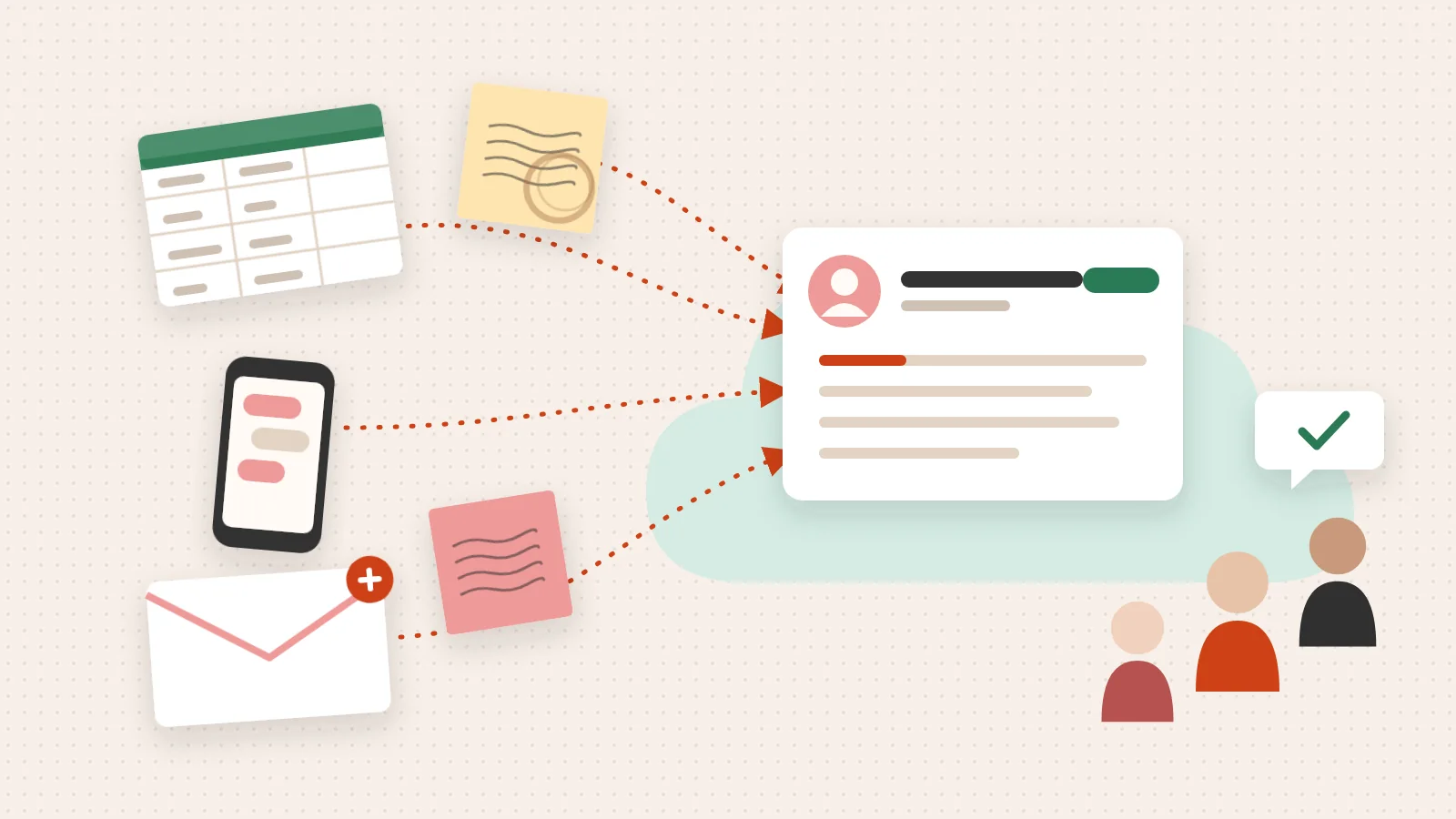
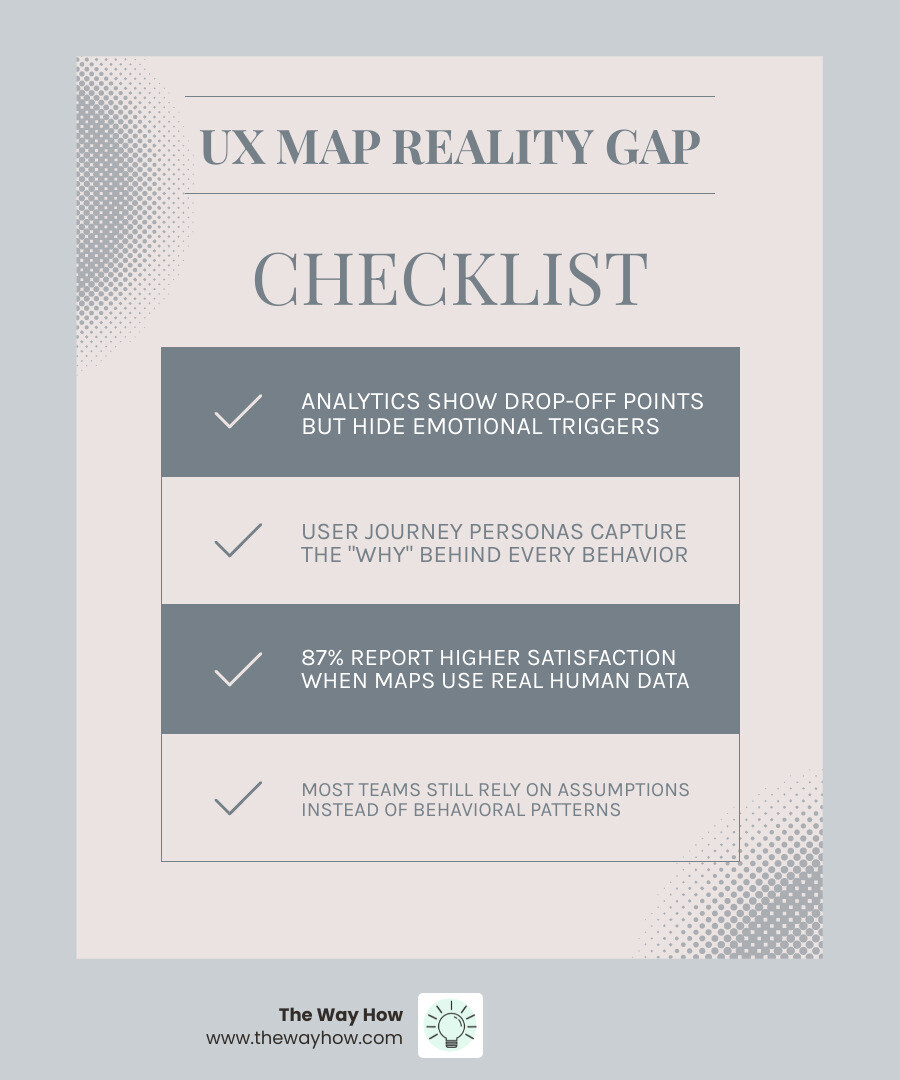
Most teams already have data. Analytics dashboards. Heatmaps. Funnel reports. But here’s the problem: data tells you where users drop off. It doesn’t tell you why.
That gap — between what the numbers show and what the human is actually experiencing — is where most UX strategies quietly fail. Teams build maps based on internal assumptions, not real behavioral patterns. They design for the user they imagine, not the user who actually exists.
The result? Products that look polished but feel wrong. Onboarding flows that confuse. Messaging that doesn’t land. Revenue that stalls without an obvious reason.
87% of organizations that use customer journey mapping report improved customer satisfaction. But that stat only holds when the map is grounded in real human behavior — not templates filled in during a one-hour workshop.
I’m Jeremy Wayne Howell, founder of The Way How, a psychology-first revenue strategy firm, and I’ve spent over 20 years diagnosing exactly this kind of problem — where teams invest in user journey persona work but never connect it to the human psychology driving buyer decisions. In this guide, I’ll walk you through how to build personas and journey maps that actually change how you design, sell, and grow.
Relevant articles related to user journey persona:
Demystifying the User Journey Persona: Beyond Demographics to Behavioral Psychology
To build systems that convert and retain, we must first dismantle a common industry mistake: treating personas as demographic summaries and journey maps as system flowcharts.
Traditional marketing segments group people by external traits like age, gender, geographic location, or job title. While this is helpful for media buying, it is practically useless for product design and user experience. A 35-year-old developer in London and a 55-year-old operations manager in Chicago might share the exact same frustration when a software interface forces them to switch tools repeatedly. Their behavior is driven by their cognitive load and psychological friction, not their demographic bracket.
Similarly, a dry process diagram or system flowchart outlines the technical steps required to complete a task. It shows the happy path from a database perspective. What it completely ignores is the human operating the screen. It doesn’t capture the anxiety of entering credit card details on an unfamiliar page, the confusion of navigating a poorly labeled menu, or the motivation that keeps a user engaged.
This is where the user journey persona becomes our primary tool. Instead of focusing on who the user is on paper, we focus on behavioral clustering. We group users by how they think, make decisions, and interact with technology. By understanding the underlying behavioral psychology, we can design experiences that align with their mental models rather than forcing them to adapt to our internal systems.
To explore how to build these behavioral profiles, you can read our guide on Buyer Personas To Target The Right Audience. For teams operating with limited resources, focusing on lean, behavioral frameworks is especially critical, as outlined in this guide on User Persona Design for Startups & Lean Product Teams.
The Anatomy of a High-Impact User Journey Persona
An effective, decision-ready persona does not care about fictional hobbies or favorite foods unless they directly impact product usage. Instead, it focuses on five core pillars:
- Background and Context: The real-world situation the user operates in. Are they using your app on a crowded subway with spotty internet, or at a quiet dual-monitor desk?
- Goals and Motivations: What is the user trying to achieve? What is the internal trigger driving them to use your solution?
- Frustrations and Pain Points: What currently stands in their way? What makes them want to close the tab or delete the app?
- Behaviors and Habits: How do they naturally interact with technology? Do they prefer keyboard shortcuts, or do they need clear, visual step-by-step guidance?
- Product Expectations: What does success look like in their eyes? What value must you deliver in the first 30 seconds to keep them around?
By structuring your profiles this way, you create an actionable framework that your product, design, and marketing teams can reference daily. To get started with structuring these profiles, you can reference the Hubspot Personas Guide to build a solid foundation.
The Symbiotic Relationship: How Personas and Journey Maps Co-Create Certainty
A persona without a journey map is a static portrait; a journey map without a persona is an empty road. They are designed to work together.
When we combine the two, we create a dynamic simulation of the user experience. The persona provides the character, goals, and emotional baseline. The journey map provides the timeline, the obstacles, and the touchpoints. Together, they reveal the hidden friction points where users drop off and identify the exact “moments of truth” where a small design change can dramatically increase conversion rates.
This combination gives organizations a holistic view of the user experience. It bridges the gap between different departments. Instead of marketing looking at acquisition funnels, product looking at feature adoption, and support looking at ticket volume, everyone looks at the same human story. We can see how a promise made in an ad campaign directly impacts the frustration a user feels during onboarding.
To understand how to map this entire ecosystem from start to finish, you can consult our Customer Journey Mapping Complete Guide. For a foundational look at the mapping process, you can also explore Creating User Journey Maps: A Guide | Coursera.
Mapping the Customer Journey Stages and Touchpoints
To build an accurate map, we must break the experience down into distinct chronological phases. While the exact steps vary by industry, a standard journey typically spans several critical phases:
[Discovery/Awareness] ---> [Evaluation/Consideration] ---> [Onboarding/Purchase] ---> [Retention/Daily Use] ---> [Advocacy]Across these stages, we map several layers of information:
- Actions: What is the user physically doing at this step?
- Touchpoints: What channel or interface are they interacting with?
- Thoughts: What questions are they asking themselves?
- Emotions: Are they feeling confident, confused, anxious, or excited?
- Opportunities: How can we remove friction and make this step easier?
Mapping these emotional transitions is what turns a dry diagram into a strategic tool. If you want to dive deeper into structuring these steps, read our Complete Guide 5 Stages Customer Journey Map or check out our breakdown of the 4 Stages Of Customer Journey.
Choosing Your Blueprint: The Five Types of Journey Maps
Not all journey maps serve the same purpose. Depending on your goals, you will need to choose the right model to diagnose your specific challenge.
| Map Type | What It Focuses On | When to Use It |
|---|---|---|
| Current-State (As-Is) | Documenting the actual, existing user experience, including all current pain points and friction. | Auditing an existing product, identifying drop-offs, and diagnosing support issues. |
| Future-State (To-Be) | Designing an idealized journey that does not exist yet, focusing on how users should interact. | Launching a new product, planning a redesign, or aligning teams around a shared vision. |
| Day-in-the-Life | Mapping the user’s entire daily routine, including activities unrelated to your specific product. | Uncovering broad unmet needs and understanding how your product fits into their lifestyle. |
| Service Blueprint | Connecting the frontstage user experience with the backstage internal processes and systems. | Diagnosing operational bottlenecks and aligning product, support, and engineering teams. |
| Experience Map | A broad, non-linear map of a general human experience, independent of a specific product or brand. | Early-stage research, exploring new market opportunities, and understanding high-level behavior. |
Aligning Your User Journey Persona with the Right Map Type
Selecting the right map depends entirely on the complexity of your audience and your business model.
In B2C environments, journeys are often more linear, emotional, and transactional. You might focus heavily on a Current-State map to optimize a mobile checkout flow or a Day-in-the-Life map to find new engagement opportunities.
In B2B environments, the journey is rarely a solo adventure. You are dealing with buying committees, where the person who buys the software (the buyer persona) is often not the person who uses it daily (the user journey persona). Here, Service Blueprints and complex Current-State maps are essential to balance the needs of multiple stakeholders across long sales cycles.
To see how this works in practice, you can examine our collection of B2B Customer Journey Map Examples. To understand how to align these maps with your revenue goals, you can read the Online Buyer Persona & Customer Journey Guide 2026.
From Research to Reality: A Step-by-Step Framework for Teams
Building these assets requires a structured, collaborative approach. We cannot design them in isolation; we must involve the people who build the product, the people who sell it, and the people who support it.

Here is the step-by-step framework we use to turn raw research into actionable maps:
- Set Clear Goals: Define exactly what you want to learn. Are you trying to reduce checkout abandonment, improve onboarding retention, or design a new municipal strategy?
- Conduct User Research: Gather quantitative data from your analytics platforms and CRM. Then, conduct qualitative research through interviews, surveys, and support ticket analysis. Ground your maps in what users actually do and say.
- Draft Your Personas: Cluster your research into distinct behavioral patterns. Create simple, one-page profiles that focus on goals, frustrations, and expectations.
- Map the Current State: Document every touchpoint, action, and emotion across the journey stages. Look for the discrepancies between how you think the product works and how users actually experience it.
- Identify Pain Points and Opportunities: Pinpoint where users get stuck, confused, or anxious. Brainstorm solutions to remove this friction.
- Validate and Iterate: Share your draft maps with real users and front-line staff to ensure accuracy. Keep them updated as your product and market evolve.
This collaborative approach is incredibly powerful. It is used not just by SaaS startups and enterprise software companies, but also by Business Analysts, UX designers, and city planners to design citizen-centred strategies. Whether you are mapping the journey of a customer buying a subscription or a remote worker navigating city infrastructure, the human-centric principles remain exactly the same.
Overcoming the Certainty Gap: Empathy Mapping and Pain Point Diagnosis
The biggest challenge in this process is moving from observation to empathy. It is easy to write down what a user does; it is much harder to understand what they feel.
This is where empathy mapping comes in. An empathy map forces us to look at the user’s world through four quadrants: what they say, what they do, what they think, and what they feel. By mapping these elements, we can diagnose the underlying psychological friction that causes users to abandon our products.
To master this diagnostic process, you can read our Empathy Mapping Guide 2026. Once you have captured these insights, you can organize them visually using a Pain Point Map to prioritize which issues to solve first.
Scaling the Human Touch: Leveraging Modern Tools and AI
In the past, user research and journey mapping were incredibly time-consuming. Teams spent months conducting interviews, manually clustering data on physical sticky notes, and designing beautiful but static PDF maps that were quickly forgotten in a shared drive.
Today, collaborative platforms like Miro, Lucidchart, and UXPressia allow teams to build dynamic, living maps that can be updated in real time.
More importantly, AI and data-driven systems are changing how we analyze user behavior. Tools like Automatic Persona Generation (APG) can ingest raw data from Google Analytics, CRM platforms, and customer support databases to identify behavioral trends in minutes. Rather than replacing human empathy, these tools act as an accelerator. They handle the heavy lifting of data synthesis, allowing your team to focus on what matters most: designing creative solutions to real human problems.
For instance, you can learn how to Build customer personas | Claude by feeding raw research data, customer support tickets, and interview transcripts into AI models to find hidden behavioral patterns. To see how modern platforms are evolving, check out this guide on User Personas in 2026: How to Build Research-Backed Personas | Koji.
Turning Insights into Actionable Product Improvements
A journey map is not a deliverable; it is an operating system. If your map sits on a wall or in a digital folder without changing your product backlog, it has failed.
The true value of a user journey persona and journey map lies in how you translate those insights into real-world changes:
- Optimizing Onboarding Flows: Identify where new users get confused and trigger contextual, in-app guidance to help them reach their “Aha!” moment faster.
- Prioritizing Features: Stop building features based on the loudest internal opinion. Build what your behavioral research shows will actually solve your core persona’s frustrations.
- Refining Policy and Support: Use journey insights to change customer-facing policies, update help documentation, or restructure support queues.
By connecting your maps directly to your product development process, you can dramatically increase user retention and speed up time-to-value. To learn how to design these high-converting experiences, read our Customer Journey Design Complete Guide. For a deep dive into turning friction into better products, you can also explore the User Journey Map Guide: Definition, Steps & Examples.
Common Pitfalls in Persona and Journey Mapping (And How to Avoid Them)
Even well-intentioned teams can run into common traps when building these strategic assets. Here is how to keep your mapping efforts on track:
- Pitfall 1: Relying on Internal Assumptions. A map built from what your team thinks users do is simply a visualization of your own biases. Always ground your personas in real qualitative and quantitative data.
- Pitfall 2: Making Maps Too Complex. If your journey map looks like a giant, unreadable spiderweb of every possible edge case, no one will use it. Keep your scope narrow and focus on the primary path.
- Pitfall 3: Listening Only to Happy Users. If you only interview your most loyal customers, you will miss the critical friction points that cause others to churn. Make sure to interview low-engagement and lapsed users as well.
- Pitfall 4: Treating Them as Static Documents. Your users’ behavior, expectations, and market conditions change constantly. Review and update your maps at least twice a year.
By using data-driven personas and keeping your maps simple, focused, and actionable, teams can reduce user research time by up to 80% compared to traditional manual methods.
Frequently Asked Questions about User Journey Personas
What is the difference between a user persona and a buyer persona?
A buyer persona represents the individual with purchasing authority who decides whether to acquire your product or service. Their decision-making criteria focus on ROI, pricing, implementation, security, and business value.
A user persona (or user journey persona) represents the person who actually uses the product daily. Their focus is on usability, efficiency, cognitive load, and how easily they can complete their tasks. In B2B environments, these are often completely different people, and you must design your marketing for the buyer while designing the product experience for the user.
How often should we update our user journey personas and maps?
We recommend reviewing your personas and journey maps at least twice a year. However, you should also trigger an immediate update whenever you launch a major product update, enter a new market, experience a significant shift in customer acquisition costs, or receive a sudden spike in customer support tickets.
How do we measure the ROI of journey mapping and persona development?
While empathy can feel abstract, its impact is highly measurable. You can track the ROI of your mapping efforts by monitoring before-and-after metrics such as:
- Conversion Rates: Are more users completing your sign-up or checkout flows?
- Time-to-Value: How quickly do new users complete their first key action?
- Churn and Retention: Are users staying active in your product longer?
- Support Ticket Volume: Have clear design improvements reduced the number of basic help requests?
Restoring Momentum: Designing for Real Human Behavior
At The Way How, we believe that growth stalls when there is a certainty gap in your customer journey. When you do not deeply understand the behavioral psychology of your users, you default to chasing generic marketing tactics, copying competitors, and building features that nobody actually wants.
We help founders and leadership teams remove this uncertainty. By blending strategic clarity, deep behavioral insight, and operational execution, we help you diagnose why your growth has stalled, design systems that build trust, and turn your customer journey into a predictable revenue engine.
If you are ready to stop guessing and start designing for real human behavior, let’s work together. Explore The Way How Services to see how we can help you build momentum.