
Beyond the Funnel: Why Your Growth is Stalled
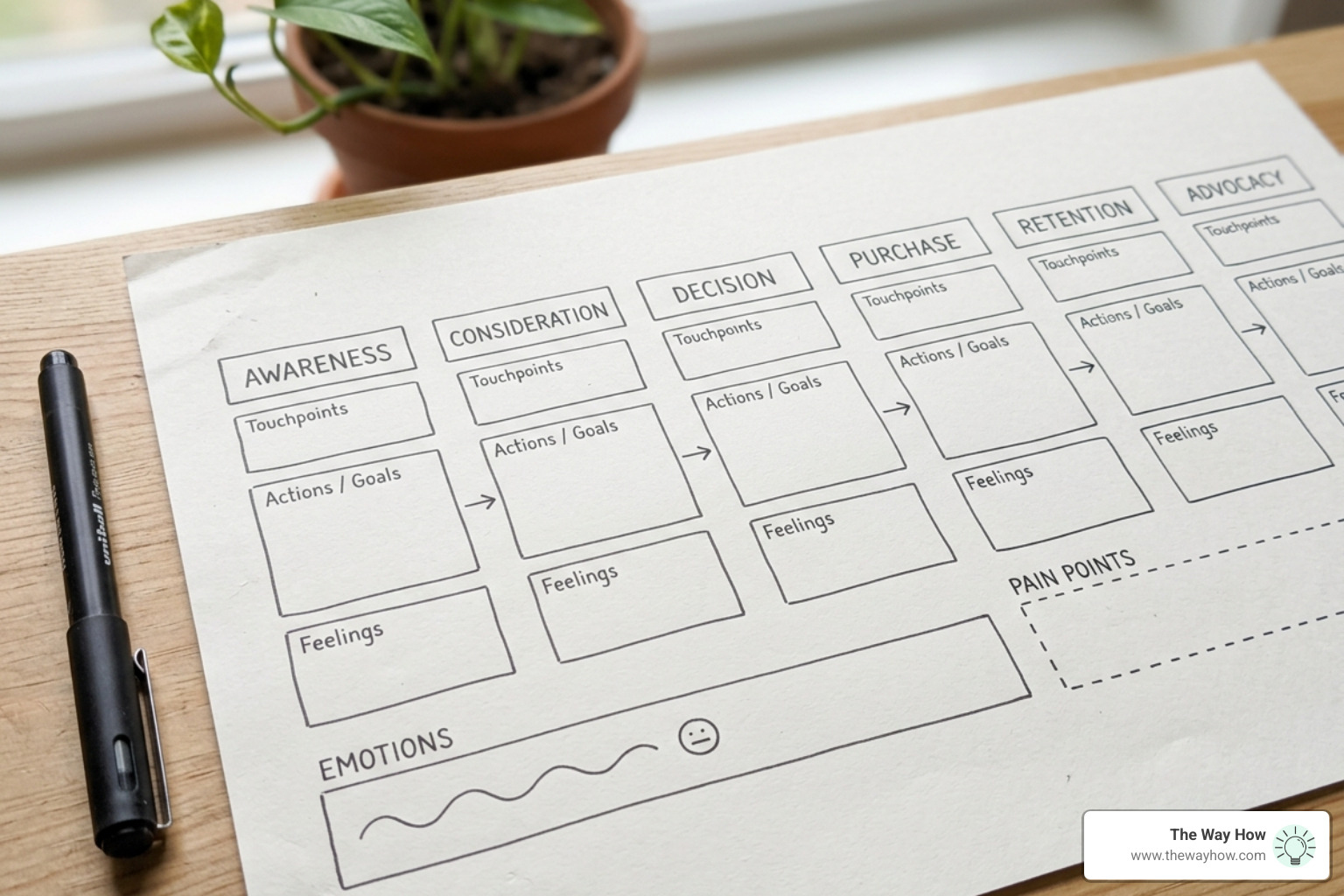
Customer journey mapping steps are the structured actions you take to visualize every interaction a customer has with your business — from the moment they first hear about you to the moment they become a loyal advocate (or quietly leave).
Here is a quick overview of the core steps:
- Define your objective — Know what problem you’re trying to solve before you map anything.
- Build your customer persona — Ground the map in a real, specific type of buyer.
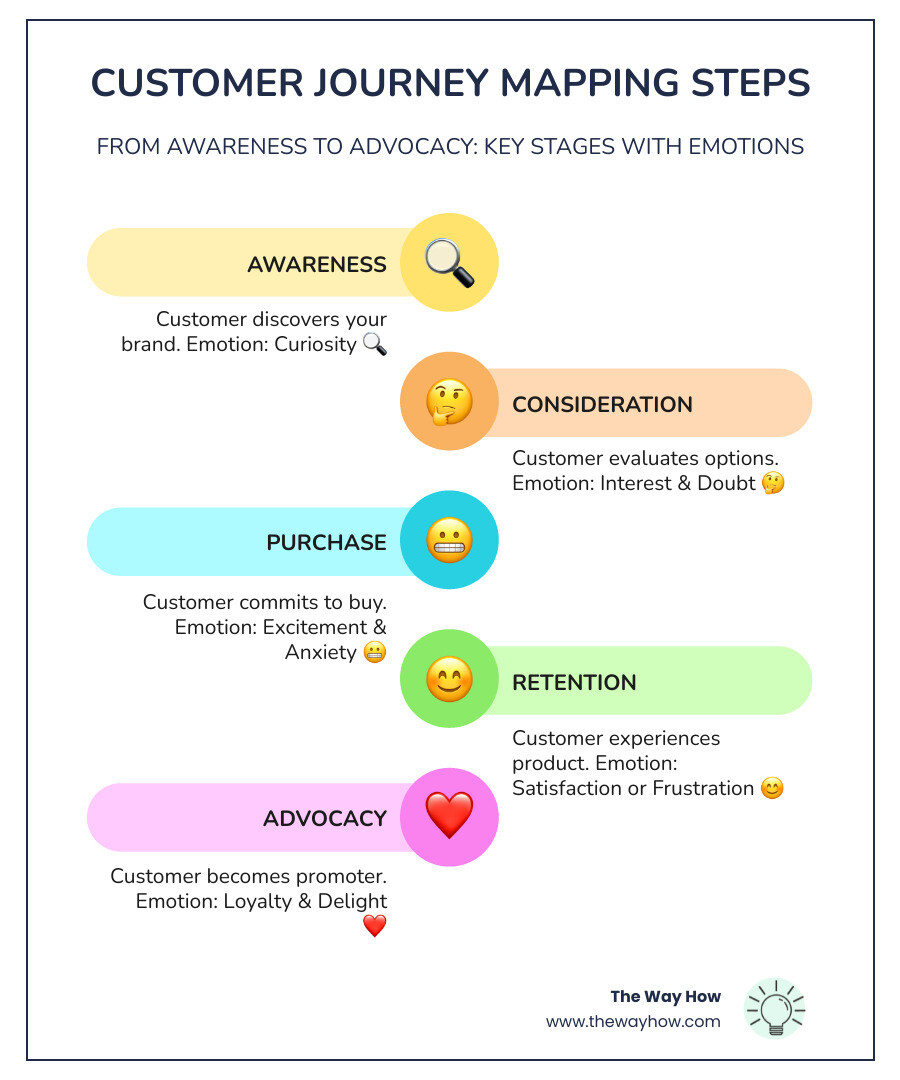
- Identify journey stages — Typically: Awareness, Consideration, Purchase, Retention, Advocacy.
- Map all touchpoints — Every place the customer interacts with your brand, online or offline.
- Capture emotions and pain points — What the customer feels at each stage, not just what they do.
- Validate with real data — Test your assumptions against actual customer behavior.
- Identify opportunities — Where can friction be reduced or experience improved?
- Act, share, and iterate — Put the map to work and keep it updated as things change.
Most businesses that struggle with growth aren’t missing more traffic or a better ad strategy. They’re missing a clear picture of what their customers actually experience — and where that experience quietly breaks down.
Think about this: 79% of companies that invest in customer journey mapping report becoming more customer-centric. Yet most revenue teams are still making decisions based on internal assumptions, org chart logic, or last quarter’s data — not on how buyers actually think and feel as they move toward a decision.
That gap between what you think the customer experiences and what they actually experience is where growth stalls. It’s where leads go cold, conversions drop, and loyal customers quietly walk away without explanation.
The good news is that a well-built customer journey map doesn’t just diagnose the problem — it shows you exactly where to fix it.
I’m Jeremy Wayne Howell, founder of The Way How, and over 20 years of working with founders and revenue teams, I’ve seen how mapping the customer journey mapping steps with behavioral precision — not just process logic — can increase close rates by 20–40% and dramatically reduce churn. If you’re ready to stop guessing and start seeing your business the way your buyers actually experience it, this guide is built for you.
When growth plateaus, the instinct is often to pour more fuel on the fire—more ads, more cold outreach, more content. But if your engine has a leak, more fuel won’t fix the underlying problem. In our work at The Way How, we find that growth usually stalls because of “certainty gaps.” These are moments where a buyer feels a flicker of doubt, confusion, or friction, and because they lack the certainty to move forward, they simply stop.
A traditional sales funnel suggests a linear, gravity-fed process. In reality, modern buyer psychology is far more complex. Research shows that 80% of consumers believe the experience a brand provides is just as important as its products or services. Furthermore, a positive customer experience (CX) alone drives over two-thirds of loyalty—more than price and brand combined.
Mapping the journey allows you to move beyond the funnel and into the “loyalty loop.” This is a continuous cycle of engagement where the post-purchase experience is just as vital as the initial sale. The stakes are high: a high-quality customer experience can generate, on average, three times the returns to shareholders. By investing in customer journey mapping steps, 79% of companies successfully shift their internal culture to be more customer-centric, moving away from “what we want to sell” toward “how they want to buy.”

The Anatomy of a High-Certainty Journey Map
A journey map is not just a flowchart; it is a visual narrative of a human being trying to solve a problem. To create one that actually drives revenue, you must include several core components that bridge the gap between your operational reality and the customer’s emotional reality.
- Touchpoints: These are the specific moments of contact between the customer and your brand. This includes everything from a social media ad or a Google search result to a conversation with a support agent or an automated invoice.
- Moments of Truth: These are pivotal interactions that have a disproportionate impact on the customer’s perception. For example, the first time they use your software after buying it is a “moment of truth” that determines whether they feel regret or relief.
- Pain Points: These are the friction spots. Perhaps your pricing is unclear, or your mobile site takes too long to load. Identifying these is the first step toward restoring momentum.
- Customer Perspective: This is the most critical element. Most maps fail because they are “inside-out”—they reflect the company’s internal processes. A high-certainty map is “outside-in,” focusing on the customer’s thoughts, feelings, and questions.
For a deeper dive into the strategic framework behind these elements, you can explore our customer journey design complete guide. Additionally, this customer journey mapping: A step-by-step guide provides excellent context on how these components interact in a live environment.
Distinguishing Current State vs. Future State Maps
Not all maps serve the same purpose. Depending on your goals, you may need to create different variations to visualize different aspects of the experience.
| Map Type | Focus | Primary Use Case |
|---|---|---|
| Current State | How customers interact with you right now. | Identifying existing friction, bugs, and “ouch” moments. |
| Future State | The ideal journey you want to create. | Strategic planning, product innovation, and vision setting. |
| Day in the Life | The customer’s entire daily routine, including interactions with competitors. | Understanding latent needs and broader context beyond your product. |
| Service Blueprint | Connects the customer journey to your internal “backstage” processes. | Operational efficiency and identifying which internal silos are breaking the CX. |
Real-World Success: Lessons from Spotify and Uber
To understand the power of these maps, look at how industry leaders use them to remove uncertainty.
- Spotify: By mapping the “sharing” journey, Spotify identified that users felt a social risk when sharing music. They optimized the experience to make sharing feel seamless and low-friction, turning a personal utility into a viral growth engine.
- Uber: Uber famously mapped the “waiting” portion of the journey. They realized that the uncertainty of when a car would arrive was more painful than the wait itself. By providing real-time visual tracking, they solved a psychological pain point without actually making the cars drive faster.
- T-Mobile: In the contact center space, T-Mobile used journey mapping to identify that customers hated being transferred between departments. They restructured their support into “Teams of Experts,” ensuring a human-centered, end-to-end resolution that boosted loyalty significantly.
The 8 Essential customer journey mapping steps for Predictable Revenue
Creating a map that stays on the wall and gathers dust is easy. Creating one that changes how you do business requires a disciplined approach. Follow these customer journey mapping steps to ensure your map becomes a strategic asset.
- Define Objectives: Start with the “Why.” Are you trying to reduce churn? Increase the conversion rate on your pricing page? Align your sales and marketing teams? Without a clear goal, your map will be too broad to be useful.
- Gather Data: Do not rely on “room-of-experts” assumptions. Use quantitative data (Google Analytics, CRM logs) and qualitative data (customer interviews, support tickets, recordings).
- Profile Personas: You cannot map “the” customer journey because different people have different journeys. Focus on one specific behavioral persona at a time.
- Identify Stages: Break the journey into logical phases. While every business differs, most follow the customer journey stages of Awareness, Consideration, Purchase, Retention, and Advocacy.
- Map Touchpoints: List every interaction. Be exhaustive. Include “dark” touchpoints like third-party review sites or peer recommendations.
- Track Emotions: At every touchpoint, ask: “What is the customer feeling?” Are they anxious? Excited? Confused? This reveals the “why” behind the data.
- Validate: Take the journey yourself. Sign up for your own newsletter. Call your own support line. Does the reality match the map?
- Take Action: A map is a diagnostic tool. Use the insights to prioritize your roadmap, change your messaging, or fix broken processes.
For contact center-specific applications, this Step-by-step Guide to Creating the Perfect Customer Journey Map | Five9 offers specialized insights into managing high-volume human interactions.
Critical customer journey mapping steps for Identifying Friction
Friction is the enemy of momentum. To find it, you have to look where the data drops off. For instance, with 79% of smartphone users making purchases on their phones and the average American spending 5-6 hours on their device daily, a “small” mobile navigation glitch is actually a massive revenue leak.
Friction often hides in “latent needs”—things customers struggle with but don’t explicitly complain about. By mapping the 4 stages of customer journey with an eye for these hidden hurdles, you can identify why a buyer might abandon their cart or go silent after a demo.
Advanced customer journey mapping steps for B2B Complexity
B2B journeys are rarely linear. They involve multiple stakeholders, long sales cycles, and complex decision-making committees. In this environment, your map must account for the “internal sale”—how your primary contact convinces their boss or the IT department.
Mapping the b2b customer journey requires looking at how information is shared between stakeholders. You aren’t just mapping one person’s experience; you are mapping an organizational consensus-building process. For inspiration, you can review these b2b customer journey map examples to see how other firms visualize these multi-layered interactions.
Mapping the Mind: Integrating Behavioral Personas and Emotions
At The Way How, we believe that every business problem is ultimately a human behavior problem. If people aren’t buying, it’s because they don’t feel enough certainty to change their current state.
This is why “emotion mapping” is the secret sauce of effective journey maps. By plotting a sentiment line—a visual representation of the customer’s emotional highs and lows—you can see exactly where they lose heart. A “sawtooth” pattern of frustration usually indicates that your internal silos are forcing the customer to repeat themselves or jump through hoops.
When you combine complete guide 5 stages customer journey map logic with behavioral psychology, you stop treating customers like “users” and start treating them like people. You begin to understand the fear of making a wrong choice (loss aversion) or the desire for social proof.
Frequently Asked Questions about Customer Journey Mapping
How often should you update a customer journey map?
A journey map is a living document, not a one-time project. We recommend a full review at least quarterly. However, you should trigger an immediate update if you launch a new product, enter a new market, or see a significant shift in your core KPIs. As your business evolves and customer behaviors change, your map must reflect the new reality to remain a reliable guide.
What are the most common mapping mistakes?
The most frequent pitfall is an internal focus. Companies often map their own sales process and call it a customer journey. Another common error is relying on assumptions instead of data; if you haven’t talked to a real customer in the last 30 days, your map is likely a work of fiction. Finally, overcomplication can kill a mapping project. If the map is so complex that no one can understand it at a glance, it won’t be used to make decisions.
What tools are recommended for journey mapping?
For collaborative workshops, tools like Miro or Lucidchart are excellent for gathering cross-functional input. For data-driven insights, HubSpot and Adobe Analytics provide the behavioral tracking needed to validate your steps. If you are looking for more specialized visualization, platforms like Smaply or UXPressia offer templates designed specifically for journey management.
Restoring Momentum: Your Path to Strategic Clarity
The goal of following these customer journey mapping steps isn’t just to produce a beautiful graphic for your office wall. The goal is to remove the uncertainty that is stalling your growth.
At The Way How, we help leadership teams bridge the gap between “we think” and “we know.” By applying psychology-first strategies and behavioral insights, we diagnose the hidden friction in your revenue engine and design systems that create genuine trust and momentum.
Whether you need Fractional CMO leadership to steer your strategy or a HubSpot architecture that actually reflects your customer’s reality, we are here to help you turn marketing into a predictable growth engine.
If you’re ready to stop guessing and start building a journey that converts, start removing uncertainty with our services. Let’s design a system that works as hard as you do.