A Complete Guide to CRM Systems and Database Management
 Jeremy Wayne Howell : Jul 22, 2026 9:48:31 PM
6 min read
B2B customer journey map examples are visual representations of the steps a business buyer takes — from first awareness to long-term advocacy — across every touchpoint, channel, and decision-maker involved in the purchase.
Here are the most common B2B customer journey map examples by industry:
| Industry | Key Stages | Primary Focus |
|---|---|---|
| SaaS / Technology | Awareness → Trial → Onboarding → Renewal | Reducing churn, improving adoption |
| Manufacturing | Trade Show → Specs Review → Site Visit → Contract | Technical trust, procurement alignment |
| Healthcare / Med Tech | Research → Clinical Review → Compliance → Purchase | Multi-persona approval, regulatory fit |
| Professional Services | Discovery → Proposal → Engagement → Referral | Trust-building, ROI demonstration |
| Banking / Finance | Need Identification → RFP → Negotiation → Integration | Risk assessment, security validation |
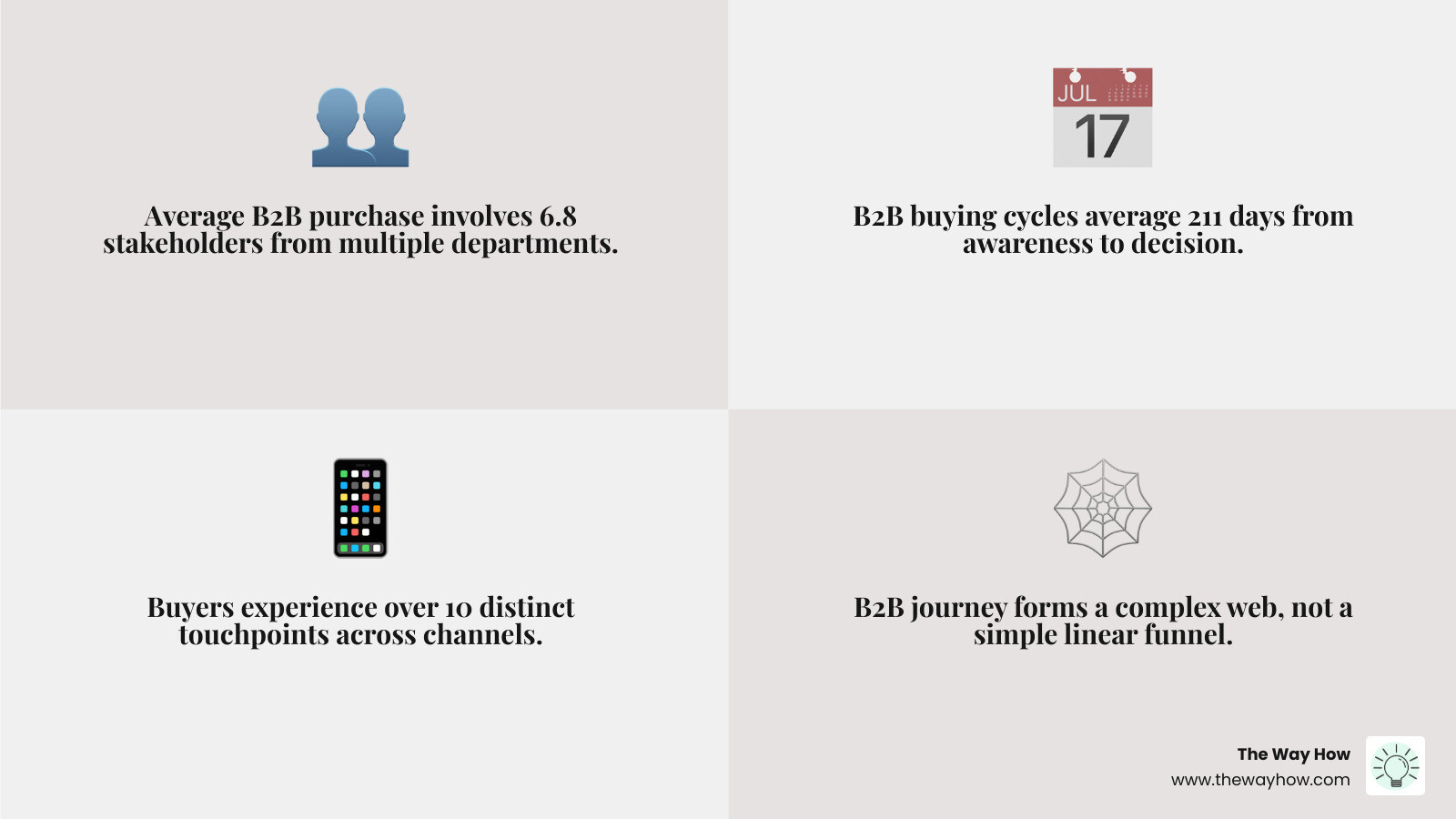
The B2B buying journey is fundamentally different from B2C. It involves an average of 6.8 stakeholders, cycles that can run 211 days, and more than 10 distinct touchpoints before a decision is made. That’s not a funnel — that’s a web.
Most companies feel the friction. They sense something is off between how they market and how buyers actually decide. But without a clear map of that experience, teams keep optimizing the wrong things.
That’s where journey mapping becomes a diagnostic tool — not just a visual exercise.
I’m Jeremy Wayne Howell, founder of The Way How, a psychology-first revenue strategy firm where I’ve spent over 20 years helping B2B companies close the gap between buyer psychology and go-to-market execution — including rebuilding the systems and messaging that b2b customer journey map examples are built on. In this guide, I’ll walk you through real industry examples and a step-by-step process to build a map that actually drives action.
Terms related to b2b customer journey map examples:
In B2B, we aren’t just selling to a person; we are selling to a consensus. Research indicates that the B2B buyer journey diagram published by Gartner is rarely linear. Instead, buyers loop through stages like problem identification and solution exploration multiple times. This complexity stems from the fact that an average of 6.8 stakeholders must agree before a purchase happens.
When we look at B2B Sales Strategy, we must account for the 211-day average sales cycle. During this time, the “certainty gap” — the space between a buyer’s current problem and their trust in your solution — is at its widest. Unlike B2C, where emotional gratification often drives immediate action, B2B drivers are rooted in risk aversion and organizational ROI.
| Feature | B2B Journey | B2C Journey |
|---|---|---|
| Decision Maker | Group consensus (6-10 people) | Individual or household |
| Motivation | Efficiency, ROI, Risk Mitigation | Emotion, Status, Convenience |
| Cycle Length | Months to Years | Minutes to Weeks |
| Relationship | Ongoing, high-touch partnership | Transactional or loyalty-based |
| Purchase Driver | business proposals and technical specs | Brand affinity and immediate need |
Effective b2b customer journey map examples aren’t just charts; they are mirrors of behavioral triggers. When a procurement officer sees a potential risk, their cognitive load increases. If your map doesn’t identify that specific moment of friction, your marketing will fail to provide the necessary reassurance. We use these maps to build organizational empathy, ensuring every department understands the weight of the buyer’s responsibility.
The modern B2B buyer has gone digital-first. According to Google, 98% of American internet users switch between devices in a single day. This behavior has bled into professional life, where B2C Marketing Hubspot tactics like self-service and social research are now standard.
Today’s buyers use 10+ touchpoints. They might find you on LinkedIn, read a whitepaper on their phone, and check reviews on G2 before ever speaking to a sales rep. In fact, 61% of buyers now prefer a “rep-free” experience for the early stages of their journey.
Visualizing the path is easier when you see how others do it. Whether you use a template or start from scratch, industry-specific nuances matter. Our work in B2B Sales Consulting shows that the stages that matter most vary wildly depending on what you sell.
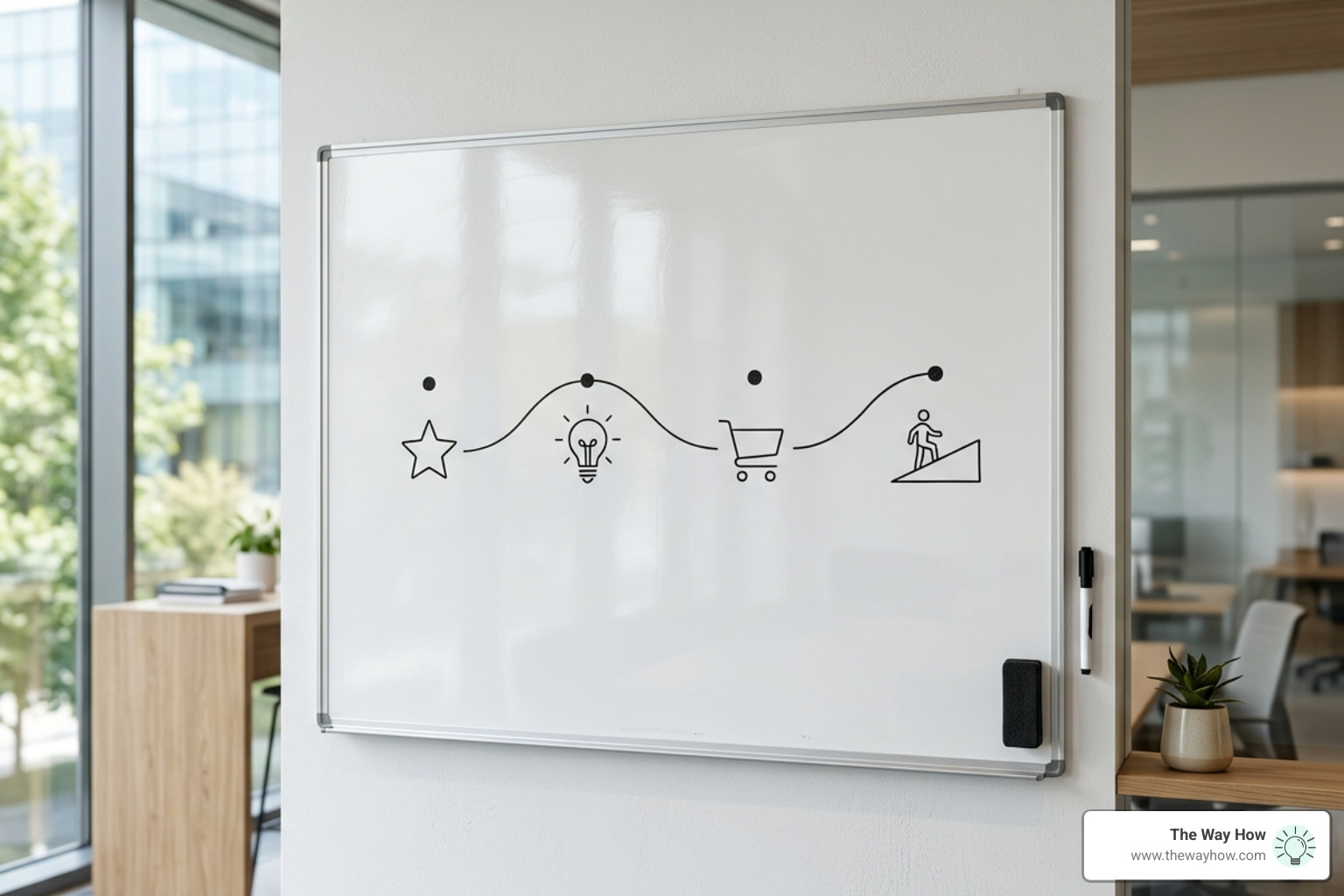
In SaaS, the journey doesn’t end at the “Close” button. Platforms like UXPressia help teams map the critical transition from trial to paid user. The focus here is churn control. If the onboarding experience is confusing, the user’s “time to value” stretches out, leading to early abandonment. Tech buyers often evaluate CPaaS providers for tech companies based on how easily they can integrate the service into existing workflows.
For manufacturing, the journey is built on physical and technical validation. It often begins at trade shows and moves into grueling technical specification reviews. Here, the “Procurement Manager” persona is king. They aren’t just looking for a product; they are looking for supply chain trust. Site visits and factory audits are high-stakes touchpoints that determine if a partnership will last decades or die in the RFP pile.
Healthcare mapping is notoriously complex. As seen in the USA.gov case study, you must align patient outcomes with administrative budgets. You often have a “clinical buyer” (the doctor) who cares about efficacy and a “financial buyer” (the hospital CFO) who cares about compliance and cost. A map that ignores one of these personas will inevitably hit a wall during the final approval stage.
When you sell expertise, your journey map is a trust-building exercise. Utilizing Hubspot B2B Marketing Strategies, firms use thought leadership to move prospects from “Who are you?” to “We need you.” Experts like Paul Boag emphasize that transparency in proposals and referral loops are the lifeblood of this industry.
In banking, the journey revolves around risk assessment. Using tools like Miro to create service blueprints, financial institutions map out how a new payroll or lending system integrates with a client’s existing infrastructure. The CFO’s decision-making process is dominated by regulatory touchpoints and security validation.
Creating a map is a diagnostic process. Our Customer Journey Design Complete Guide emphasizes that if a map doesn’t lead to action, it’s just art. You must create a separate buyer persona for every key stakeholder to understand their unique psychological barriers.
We use tools like Hotjar to see where people get stuck on a site, Google Analytics to track traffic patterns, and Heap to understand feature engagement. By applying the “jobs-to-be-done” framework, we identify what the customer is actually trying to achieve, which is the secret to Sales Funnel Optimization.
Don’t guess. A journey mapping survey by NN/g found that 27% of practitioners believe maps only succeed when they lead to specific design changes. Start with your Hubspot CRM Marketing data. Look at where deals stall. Conduct phone interviews with recent wins and losses. Your sales team’s feedback is a goldmine for identifying where the “certainty gap” is widest.
Every interaction is a touchpoint. Arrange them across the 4 stages of customer journey. Are your buyers finding you on G2 or Capterra? Is your content aligned with their current stage? If you are sending a technical whitepaper to someone who just identified they have a problem, you are creating a friction point.
Once the data is collected, use Lucidchart or Figma to build the visual. But here is the critical part: assign a department to every touchpoint. If “Pricing Clarity” is a pain point, the Sales Ops team owns the fix. According to the NN/g survey, 27% of respondents noted that maps fail when they aren’t used to inform actual business decisions.
The B2B landscape is shifting. A recent Gartner survey found that 61% of respondents prefer a rep-free experience. If your journey requires a phone call just to see a price, you are losing more than half your market.
Referencing our Complete Guide 5 Stages Customer Journey Map, we often see friction in:
The changing B2B customer buying journey demands that we provide information on the buyer’s terms, not ours.
While every business is unique, most Customer Journey Stages follow this path:
The main difference is the “buying group.” In B2C, you usually convince one person. In B2B, you have to convince the user, their boss, the IT department, and the legal team. This leads to longer cycles and a focus on ROI rather than emotional gratification.
Market shifts and product updates happen fast. We recommend a 6-month review cycle. Interestingly, 13% of practitioners say that maps only stay successful if they remain focused and don’t become overly complex. When your feedback loops show a change in buyer behavior, it’s time to update the map.
At The Way How, we believe that growth isn’t about chasing the latest tactic; it’s about diagnosing why momentum has stalled. We use psychology-first marketing and revenue strategy to help founders remove uncertainty from their systems.
Whether through Fractional CMO leadership or rebuilding your HubSpot architecture, our goal is to turn your marketing into a dependable growth engine rooted in human behavior and empathy. If your journey map feels like a dead end, we can help you find the path forward.
Discover our growth services and let’s start closing your certainty gaps today.
 Jeremy Wayne Howell : Jul 22, 2026 9:48:31 PM
 Jeremy Wayne Howell : Jul 21, 2026 9:47:10 PM
 Jeremy Wayne Howell : Jul 20, 2026 9:46:47 PM