
Beyond the Funnel: Why Your Customer Journey is Leaking Revenue

Customer journey design is the strategic process of mapping and optimizing every interaction a customer has with your brand. It moves beyond linear funnels to address the psychological and behavioral factors influencing decisions at each stage.
Quick Answer: What is Customer Journey Design?
- Definition: A framework mapping how customers think, feel, and act across all touchpoints.
- Purpose: Identify friction points and certainty gaps to improve experience and revenue.
- Key Components: Buyer personas, journey stages, touchpoints, emotions, and pain points.
- Core Benefits: Higher conversion rates, improved satisfaction, and reduced churn.
- When to Use It: When growth stalls or customer acquisition costs rise without explanation.
Most companies treat the customer journey as a linear funnel where departments operate in silos. However, customers experience your business as a continuous flow. When this flow breaks, revenue leaks because customers lose certainty. They hit friction points that cause hesitation.
Research indicates that one in three consumers will abandon a brand after a single bad experience. The gap is often psychological; customers decide based on how they feel at every touchpoint, not just features or price. Organizations using journey maps are twice as likely to outperform competitors, yet many maps fail because they are based on internal assumptions rather than actual behavior.
Customer journey design is a behavioral framework that reveals where certainty breaks down. Customer experience drives over two-thirds of loyalty, yet many businesses prioritize internal processes over customer needs. This guide shows how to map and optimize the journey to create momentum.
I am Jeremy Wayne Howell, founder of The Way How. I help companies rebuild revenue systems by applying psychology-first principles to customer journey design. This guide will help you move from documentation to momentum.
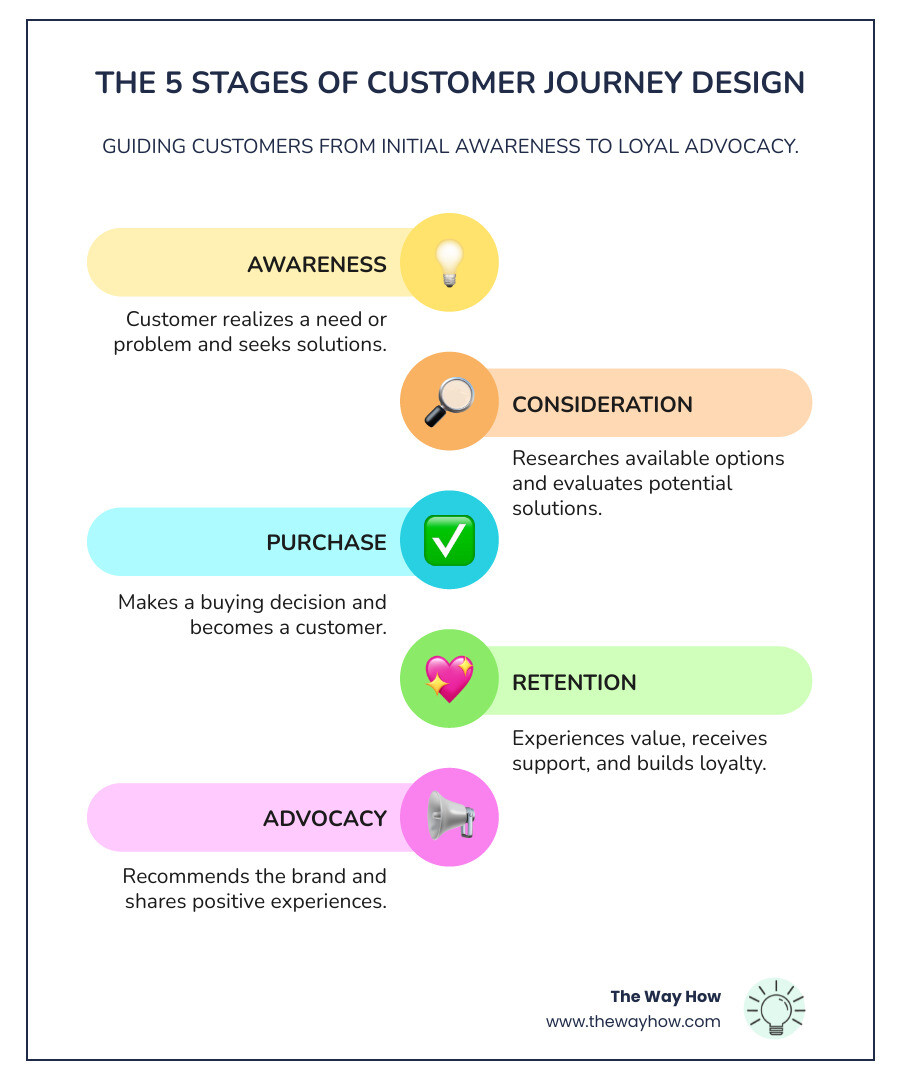
Handy customer journey design terms:
The Strategic Importance of Customer Journey Design
Customer journey design is a strategic imperative. Most marketers anticipate competing primarily on customer experience, which drives loyalty more than brand or price. A customer journey map is a visual representation of every step a customer takes, helping businesses understand the customer perspective and identify opportunities for innovation.
Effective design starts with the customer experience and works back toward technology. Organizations using these maps report significant benefits:
- Product Development: Maps help develop products that match actual customer needs.
- Sales Growth: Most businesses credit maps with driving sales.
- Market Adaptability: Maps help businesses steer changing landscapes and business models.
Despite these benefits, many companies lack a process for mapping journeys. This presents an opportunity to move beyond assumptions to a research-based vision. True design challenges internal assumptions about the journey, revealing critical gaps and aligning fragmented efforts across departments.

Designing for Latent Needs in Customer Journey Design
Customer journey design uncovers latent needs—unarticulated desires and subtle frustrations that transform experiences when addressed. A pain point is anything that hinders a customer from accomplishing a goal. Our work extends this to include unconscious barriers that erode certainty.
By observing behavior and listening to verbs during research, we surface these needs. This insight allows us to proactively design moments of delight. Understanding psychological drivers helps influence people at different stages of their journey, building trust and momentum. Proactively addressing latent needs is high-leverage, as it takes many positive moments to counter one failure.
Identifying Certainty Gaps and Friction Points
Customers steer complex paths across email, social media, and customer service. Each touchpoint is an opportunity to build or erode certainty. High expectations mean consumers expect consistent experiences across all channels, yet many businesses fail to provide seamless transitions.
Consider self-service: most consumers try to solve problems themselves, but few are satisfied with the options provided. This disparity highlights a certainty gap where expectations and experience diverge. These friction points often result from fragmented understanding within organizations. By mapping the journey, we pinpoint moments where customers disengage and design systems to restore trust. Hanover Research on CJM power confirms that mapping is a powerful tool for driving business goals.
Anatomy of a High-Performance Journey Map
A high-performance journey map is a living blueprint designed to foster empathy and drive decisions. It provides a narrative that reveals customer thoughts, feelings, and actions. Core components typically include:
- Actor (Persona): The specific customer segment being mapped.
- Scenario and Expectations: The goal the persona is trying to achieve.
- Journey Phases: Stages like Awareness, Consideration, and Purchase.
- Actions and Touchpoints: Steps taken and channels used (website, email, social).
- Mindsets and Emotions: What the customer thinks and feels at each point.
- Pain Points and Moments of Truth: Obstacles and critical decision points.
- Opportunities and Ownership: Areas for improvement and internal responsibility.
- Metrics: KPIs associated with each stage.
Visuals can be created using tools like Miro or Lucidchart to standardize the format and simplify sharing.
Core Components: Personas, Touchpoints, and Emotions
Buyer Personas: We map research-backed personas representing distinct audience segments. Understanding the human behind the data is paramount. Our HubSpot Personas Guide provides more detail.
Touchpoints: These are moments of interaction, whether digital, physical, or human. A comprehensive map lists all current touchpoints from the customer perspective.
Emotional States: Capturing what customers feel at each touchpoint brings the map to life. Graphing emotional states helps identify where certainty is lost, allowing us to design interventions that build trust.
Leveraging HubSpot for Customer Journey Design
We use HubSpot as an architectural backbone to implement journey insights. It allows for personalized, empathetic experiences at scale. For example, HubSpot Marketing Hub Implementation ensures messages align with the customer stage. HubSpot CRM Implementation gives sales teams context to reduce friction. HubSpot Analytics tracks behavior to validate maps and measure impact.
Comparing Journey Maps, Experience Maps, and Service Blueprints
| Feature | Customer Journey Map | Experience Map | Service Blueprint |
|---|---|---|---|
| Focus | Specific persona/product | Generic human behavior | Internal processes |
| Scope | End-to-end brand interaction | Broader, brand-agnostic | Internal service delivery |
| Perspective | Customer point of view | User point of view | Organization point of view |
| Primary Use | Improve specific experience | Understand human behavior | Optimize service delivery |
A customer journey map is our primary tool for improving interactions within your ecosystem. An experience map informs persona development, while a service blueprint details the internal systems supporting the journey. We use both to ensure internal alignment and operational excellence.
A Behavioral Framework for Creating Your Journey Map
Creating an effective map is a structured process designed to reveal human interaction nuances. It relies on research rather than assumptions.
Step 1: Defining Scope and Behavioral Goals
First, define the map’s purpose. We identify whose journey we are mapping, their specific goal, the time period covered, and the business objectives, such as business growth or reduced churn. Clear scope prevents analysis paralysis.
Step 2: Researching the Human Behind the Data
Maps must be based on what actually happens. We use qualitative and quantitative methods:
- Customer Interviews: Listening for verbs to capture genuine experiences.
- Internal Research: Insights from sales and support teams. Business Data Analysis helps us understand existing data.
- Web Analytics: Analyzing behavior and conversion funnels.
- Social Listening: Identifying common pain points.
Tools like Lucidchart and HubSpot provide templates to organize this research and uncover latent needs.
Step 3: Visualizing the Current vs. Future State
Mapping the Current State: Documenting the existing journey to reveal friction points and where certainty breaks down. This requires honesty about the current experience.
Mapping the Future State: Envisioning the ideal journey. We design solutions for pain points and optimize moments of truth to improve conversion rate optimization. Comparing these maps helps prioritize interventions that impact trust and business outcomes.
Bridging the Certainty Gap with Data and Collaboration
Customer journey design is a collaborative effort. Certainty gaps often stem from internal silos. Journey maps serve as tools to unify departments around the goal of creating predictable revenue.
Unifying Marketing, Sales, and Customer Success
Disjointed experiences erode trust. Journey maps bridge these divides:
- Marketing Teams: See how initial touchpoints influence downstream interactions.
- Sales Teams: Understand the journey before the conversation to adapt their approach.
- Customer Success: Identify opportunities for proactive support. HubSpot Service Hub Implementation integrates service into the overall experience.
Maps foster an aligned mental model, ensuring every department understands its impact on the customer. This collective understanding is essential for creating momentum.
Measuring Success Beyond Surface-Level Metrics
We measure success through indicators reflecting customer sentiment and behavior. Measurement is broken into three parts:
- The Journey as a Whole: Metrics like NPS, CSAT, and CES provide a holistic view.
- Journey Phases: Tracking conversion rates and repeat purchase rates for each stage. Our Revenue Cycle Analytics Complete Guide explains how to connect these to financial outcomes.
- Individual Touchpoints: Measuring the impact of specific interventions.
Data from marketing data analysis and data-driven decisions helps refine maps. Brands using journey mapping often see faster sales cycles and increased revenue from up-selling.
Avoiding the Static Map Trap: Evolution and Optimization
A journey map must be a living document that evolves with your customers. Continuous improvement is fundamental to successful design.
Common Mistakes: Assumptions vs. Reality
Mapping efforts often fail due to:
- Company-First Perspective: Mapping internal processes instead of customer experiences.
- Relying on Assumptions: Building maps without rigorous research.
- Complexity Issues: Making maps too simple or too intricate to be useful.
- Static Treatment: Failing to update maps as behaviors change.
- Lack of Buy-in: Proceeding without executive sponsorship or cross-functional engagement.
We challenge assumptions and commit to optimization. Marketing Budget Optimization strategies are refined based on these evolving insights.
Real-World Success: From Mapping to Momentum
Successful design transforms businesses. T-Mobile shifted to a human-centered experience by revamping policies based on customer insights. The Smithsonian Institute mapped visitor journeys across channels to improve engagement for millions.
These cases show that effective design leads to momentum. Research indicates well-designed journeys achieve higher conversion rates, translating to business growth. Our work in sales funnel optimization and B2B sales strategy relies on these principles. Integrating insights with HubSpot Operations Hub allows us to automate processes that impact the customer experience.
Frequently Asked Questions about Customer Journey Design
What is the difference between a user flow and a customer journey?
A user flow illustrates the technical path a visitor follows to complete a task on a digital platform. A customer journey map is broader, visualizing the entire experience across all channels, including emotional states and motivations. The user flow is a component of the larger journey.
How often should we update our customer journey map?
Maps should be reviewed regularly, typically every few months, or when significant changes occur in your products or market. It is an ongoing program, not a one-off project. Outdated maps fail to provide reliable guidance.
How does psychology influence customer journey design?
Psychology is the bedrock of our approach. It influences:
- Emotional States: Designing experiences that build positive sentiment.
- Cognitive Biases: Addressing biases like anchoring or loss aversion to build certainty.
- Motivation: Understanding underlying drivers to craft value propositions.
- Trust: Identifying certainty gaps to design interactions that build confidence.
Understanding human behavior allows us to design journeys that resonate and drive revenue.
From Fragmented Tactics to Predictable Momentum
The customer journey directly impacts business success. At The Way How, we help leadership teams move beyond fragmented tactics by applying psychology-first principles to customer journey design. We diagnose root causes of stalled growth and identify certainty gaps to design systems that foster trust and predictable revenue.
This approach changes how you view growth. If you are ready to turn marketing and sales into a dependable engine, find more info about our Services and let us design a journey that delivers for your business.