A Complete Guide to CRM Systems and Database Management
 Jeremy Wayne Howell : Jul 22, 2026 9:48:31 PM

The B2B customer journey is the complete path a business buyer takes — from first recognizing a problem to purchasing a solution and beyond — involving multiple stakeholders, dozens of touchpoints, and decisions that can stretch across months or even years.
Here’s what that journey actually looks like, at a glance:
| Stage | What’s Happening | Who’s Involved |
|---|---|---|
| Problem Identification | Buyer recognizes a gap or pain point | End users, managers |
| Solution Exploration | Independent research begins — no vendor contact yet | Multiple team members |
| Requirements Building | Internal criteria get defined | Cross-functional group |
| Supplier Selection | Vendors are evaluated and compared | Decision-makers, procurement |
| Purchase & Onboarding | Deal closes, implementation begins | Buyers, IT, operations |
| Solution Ownership | Ongoing usage, renewal decisions, advocacy | Usage Center members |
Most people assume B2B buying is rational, sequential, and predictable. It isn’t.
The average enterprise buying group includes five to eleven stakeholders. Each one is gathering their own information, carrying their own priorities, and often moving in different directions at the same time. Seventy-seven percent of B2B buyers describe their most recent purchase as complex or difficult. And buyers complete roughly two-thirds of their journey before they ever speak to a sales rep.
That means by the time your team enters the conversation, the customer has already formed opinions, ruled out options, and built internal momentum — with or without your input.
This isn’t a funnel problem. It’s a clarity problem.
I’m Jeremy Wayne Howell, founder of The Way How and a revenue growth strategist with over 20 years of experience helping founders and revenue leaders diagnose what’s actually breaking down in their B2B customer journey — before investing in more tactics. The patterns I’ve seen across dozens of go-to-market engagements are what shaped the framework you’ll find in this guide.
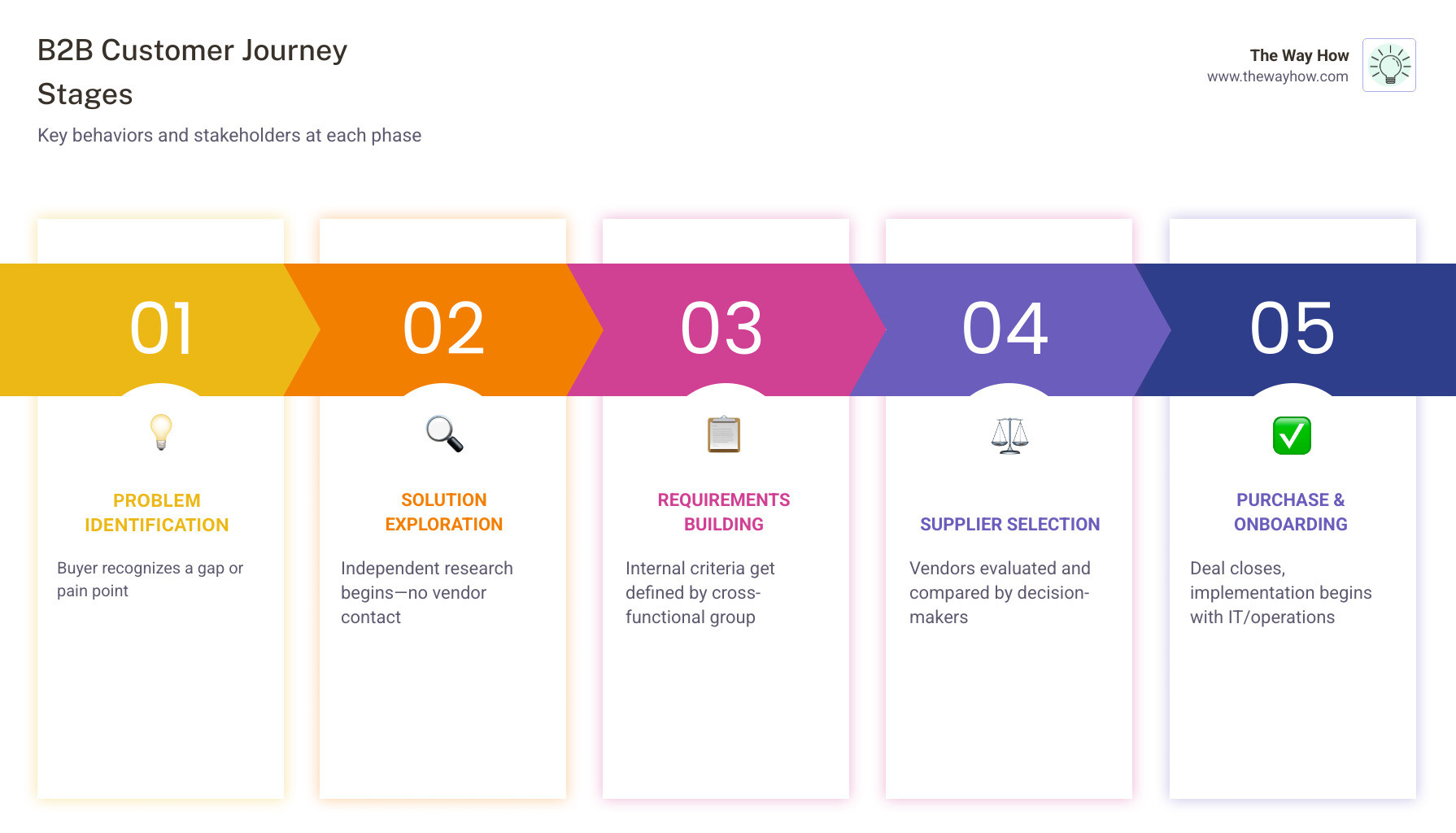
Simple guide to B2B customer journey terms:
When we look at the B2B customer journey through a psychology-first lens, we see that it is less about a “sale” and more about the removal of uncertainty. In an enterprise environment, a wrong decision doesn’t just waste money; it threatens professional reputations. This is why the journey often feels like a series of loops rather than a straight line.
According to Gartner’s B2B customer journey map, buyers engage in a “looping” behavior. They might move from problem identification to solution exploration, only to find new information that forces them back to redefine the original problem. This isn’t inefficiency; it’s the brain’s way of seeking safety in numbers.
With an average of five to 11 stakeholders in a buying group, the cognitive load is immense. Each member gathers four to five pieces of information independently, meaning the group must collectively analyze 24 to 50 pieces of information before reaching a consensus. We must understand these customer journey stages not as hurdles for the salesperson, but as psychological milestones for the buyer.
To truly master this process, we have to distinguish between different types of participants. We often talk about the “Buying Center” (the people who sign the checks and vet the risk), but we frequently ignore the “Usage Center” (the people who actually use the product daily).
A complete guide to B2B marketing must account for both. If the Usage Center had a negative experience with a previous vendor, that memory creates a “certainty gap” that can stall a new purchase. Activation triggers — the specific moments that move a person from one stage to the next — are rarely just “seeing an ad.” They are usually internal realizations, such as a missed KPI or a competitor’s move, that force the buyer to seek a new equilibrium.
The traditional client acquisition funnel suggests a narrowing of options until a choice is made. In reality, the modern B2B customer journey is expansive and non-linear.
Consider these shifts:
We view the journey as a series of decision-making events. If you treat it like a funnel, you’ll try to “push” people through. If you treat it like a journey, you’ll “pull” them forward by providing the clarity they need to move to the next step.
There is a persistent myth that B2B decisions are purely rational — based on spreadsheets, ROI calculators, and technical specifications. While those factors matter, scientific research on B2B emotional connection suggests that B2B customers are actually more emotionally connected to their vendors than B2C customers.
Why? Because the stakes are higher. If you buy a bad pair of shoes (B2C), you lose $100. If you buy the wrong enterprise software (B2B), you might lose your job or derail your company’s annual goals. This makes risk abatement the primary emotional driver.
| Feature | B2C Journey | B2B Journey |
|---|---|---|
| Decision Maker | Individual or household | Buying group (6-10+ people) |
| Motivation | Desire, status, or immediate need | Risk mitigation, efficiency, ROI |
| Cycle Length | Minutes to days | 6 to 24 months |
| Emotional Stakes | Low (personal disappointment) | High (professional reputation) |
| Logic vs. Emotion | High emotional/impulse | High rational/underlying emotional |
The “rational” ROI proof is often just the tool the buyer uses to justify an “emotional” feeling of trust and safety to their board or CFO.
If we don’t map the journey, we are guessing. Currently, only 36% of global B2B companies combine buyer personas and customer journey maps. This is a massive missed opportunity to identify exactly where growth is stalled.
We use buyer personas to target the right audience, but we go deeper than demographics. We look at the “technographics” and the “psychographics” — what are they afraid of? What does a “win” look like for them personally?
Friction occurs whenever a buyer encounters a “certainty gap.” Common friction points include:
In our b2b sales consulting, we often find that half of marketing spend is misaligned. Companies spend millions on “awareness” when the actual friction is happening in the “requirements building” stage. We use data, heatmaps, and customer interviews to diagnose these gaps.
The shift toward a “rep-free” experience (preferred by 61% to 75% of buyers depending on the study) doesn’t mean sales reps are obsolete. It means their role has changed from “information provider” to “consensus facilitator.”
Buyers are using more than 10 different touchpoints on their typical journey. This requires a seamless omnichannel approach where the website, social media, email, and human interactions all tell the same story.
To succeed in this environment, we focus on Total Experience (TX). This integrates:
When these align, you create momentum. For example, providing high-quality testimonials at the exact moment a buyer is comparing suppliers can provide the social proof needed to overcome a final “risk” hurdle. This is the core of a modern b2b sales strategy.
Cycles typically range from 6 to 18 months, though enterprise deals often extend to 24 months depending on stakeholder complexity. The length is usually a function of the “certainty gap” — the more complex the solution, the more time stakeholders need to feel safe making a decision.
The average enterprise buying group consists of five to 11 stakeholders, each requiring specific content to validate their unique goals. In some cases, especially in highly regulated industries, this number can climb even higher as legal, procurement, and IT security teams join the conversation.
A comprehensive map includes buyer personas, touchpoints, timelines, emotional states, friction points, and specific activation triggers. It should also account for the post-purchase “usage” phase to ensure long-term retention and advocacy.
The B2B customer journey is not a series of tactics to be checked off; it is a psychological path that must be navigated with empathy and clarity. When growth stalls, it is rarely because you aren’t “doing enough.” It is usually because there is a fundamental disconnect between how you sell and how your customers actually buy.
At The Way How, we help founders and leadership teams remove this uncertainty. Whether through Fractional CMO leadership, optimizing your HubSpot architecture, or designing demand generation strategies that actually resonate with human behavior, our goal is to turn your marketing into a dependable growth engine.
We don’t just look at the data; we look at the humans behind the data. By diagnosing the certainty gaps in your journey, we help you build a system that creates trust and predictable revenue.
 Jeremy Wayne Howell : Jul 22, 2026 9:48:31 PM
 Jeremy Wayne Howell : Jul 21, 2026 9:47:10 PM
 Jeremy Wayne Howell : Jul 20, 2026 9:46:47 PM