A Complete Guide to CRM Systems and Database Management
 Jeremy Wayne Howell : Jul 22, 2026 9:48:31 PM
B2B revenue strategies are the structured approaches businesses use to generate, accelerate, and sustain income from other businesses — and in 2026, getting them right has never been more urgent or more complicated.
Here’s a quick snapshot of what actually works:
| Strategy | Why It Works |
|---|---|
| Sales and marketing alignment | 87% of industry leaders say teamwork between the two drives growth |
| Consultative selling | 78% of sales leaders are more likely to buy when the experience feels advisory |
| Data-driven decision-making | Teams using data are 58% more likely to hit or exceed revenue targets |
| Engaging the full buying committee | Modern B2B deals involve 6–12 decision-makers — reaching one isn’t enough |
| Account-based marketing (ABM) | Precision targeting outperforms broad outreach by 2–3x on pipeline efficiency |
| Customer retention and expansion | Keeping and growing existing accounts costs far less than acquiring new ones |
| Digital self-service and content | 63% of buyers prefer to research independently before ever speaking to sales |
But here’s what the data won’t tell you directly: most B2B revenue problems aren’t strategy problems. They’re clarity problems.
Buyers don’t stall because your product isn’t good enough. They stall because something in the experience — the messaging, the timing, the trust — didn’t reduce their uncertainty fast enough. And most sales and marketing systems are built around closing, not around understanding the human trying to decide.
That gap between what companies think is happening and what buyers are actually experiencing? That’s where revenue goes to die.
Forrester projects B2B sales will reach $3 trillion by 2027 — nearly double 2021 levels. The opportunity is real. But so is the competition, the complexity, and the cost of guessing wrong.
I’m Jeremy Wayne Howell, founder of The Way How and a revenue growth strategist with over 20 years of experience building and fixing B2B revenue strategies for founders, executives, and go-to-market teams. This guide is built on what I’ve seen work — and more importantly, on what I’ve seen quietly fail even when everything looked right on paper.
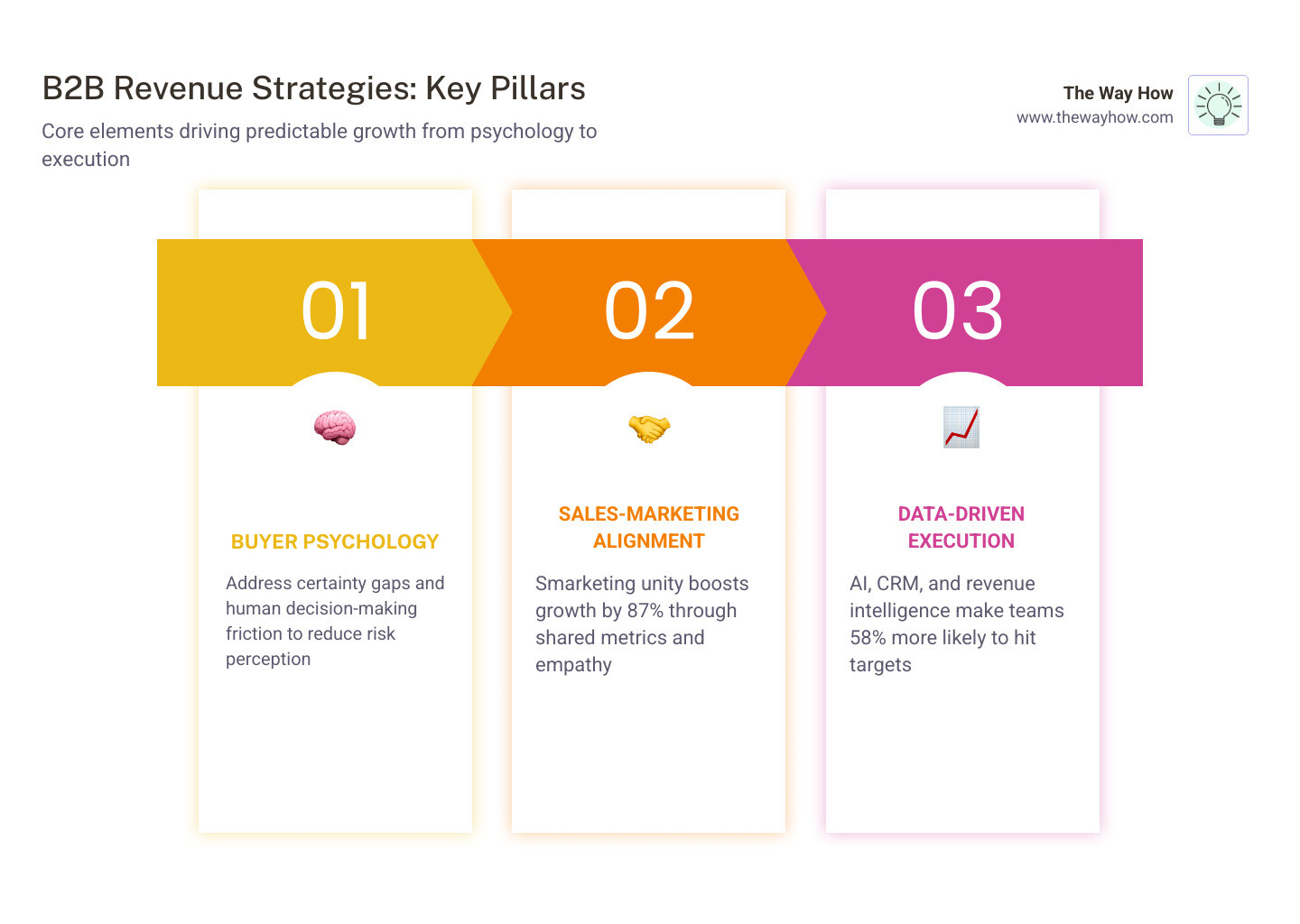
The world of B2B commerce has shifted from a linear path to a complex web of digital research and committee-based decision-making. Today, 77% of U.S. B2B commerce executives agree that digital transformation is critical to their company’s success. Yet, many organizations still operate as if it is 2015, relying on “spray and pray” outreach that buyers have learned to ignore.
The fundamental problem is friction. B2B buying journeys are currently riddled with it—from researching complex product specifications to comparing pricing and accessing service support. When a buyer encounters friction, their brain registers it as risk. In the enterprise world, risk is the ultimate deal-killer.
Modern b2b revenue strategies must account for the fact that the linear funnel is a fiction. Buyers are conducting independent research long before they ever raise their hand. They are consulting peer review sites, checking testimonials, and seeking internal buy-in before a salesperson even enters the frame. If your revenue system doesn’t provide the data and transparency they need during this “ghost” phase, you’ve lost the deal before it started. To fix this, leadership teams are increasingly turning to Revenue Cycle Management Analytics to identify exactly where prospects are falling out of the journey.
One of the most significant shifts we’ve seen is the expansion of the buying committee. Gone are the days of selling to a single “economic buyer.” Today’s enterprise deals involve 6 to 14 stakeholders, each with their own unique anxieties and priorities.
63% of B2B buyers don’t want to interact with a salesperson in the Discovery phase, preferring to engage only after they’ve done the heavy lifting of internal alignment. This means your strategy must prioritize “Buyer Group Marketing”—the practice of engaging the entire committee simultaneously rather than sequentially.
If you wait for your champion to “sell it internally,” you are essentially outsourcing your revenue growth to someone who doesn’t work for you. Instead, you must provide role-specific content that speaks to each stakeholder:
By using What Is Revenue Cycle Analytics to track how different members of an account engage with your content, you can identify “certainty gaps” in real-time. If the IT director is reading your documentation but the Finance lead hasn’t opened the ROI calculator, you know exactly where the bottleneck lies.
We often see companies where sales and marketing operate like two different countries with no extradition treaty. Marketing is focused on lead volume, while sales is focused on closing deals. This misalignment is a major source of revenue leakage.
“Smarketing”—the total alignment of sales and marketing teams—is no longer a “nice-to-have.” Research shows that 87% of sales and marketing industry leaders agree that teamwork between sales and marketing boosts business growth. When these teams share the same metrics, language, and goals, the customer experience becomes seamless.
At The Way How, we look at this through the lens of psychology. A buyer’s journey is essentially a series of micro-decisions. Each decision requires a certain level of confidence. If marketing promises one thing and sales delivers another, that confidence evaporates. By implementing a Revenue Cycle Analytics Complete Guide, teams can ensure they are measuring the same “truth,” focusing on pipeline velocity and win rates rather than vanity metrics like MQLs.

When you are chasing high-value accounts, generic messaging is your enemy. Precision beats volume every time. This is where Account-Based Marketing (ABM) and a clearly defined Ideal Account Profile (IAP) become essential.
An IAP is more than just a list of industries or company sizes. It’s a surgical definition of the accounts where you can provide the most value. It considers their tech stack, their recent funding rounds, their hiring patterns, and their specific pain points.
Once the IAP is set, the strategy shifts to multi-threaded outreach. This involves reaching out to 6–8 contacts within a single account through personalized, value-driven sequences. Instead of asking for a meeting, you offer an insight. Instead of a product demo, you provide a pre-demo ROI calculator. This approach builds trust by proving you understand their business before you ever ask for their time. For firms looking to scale this, Revenue Analytics Consulting can help design the frameworks that move these high-value accounts through the pipeline with predictable speed.
In 2026, the strongest sales organizations aren’t founded on instinct; they are built on data. A data-driven sales approach is 58% more likely to meet or exceed revenue targets.
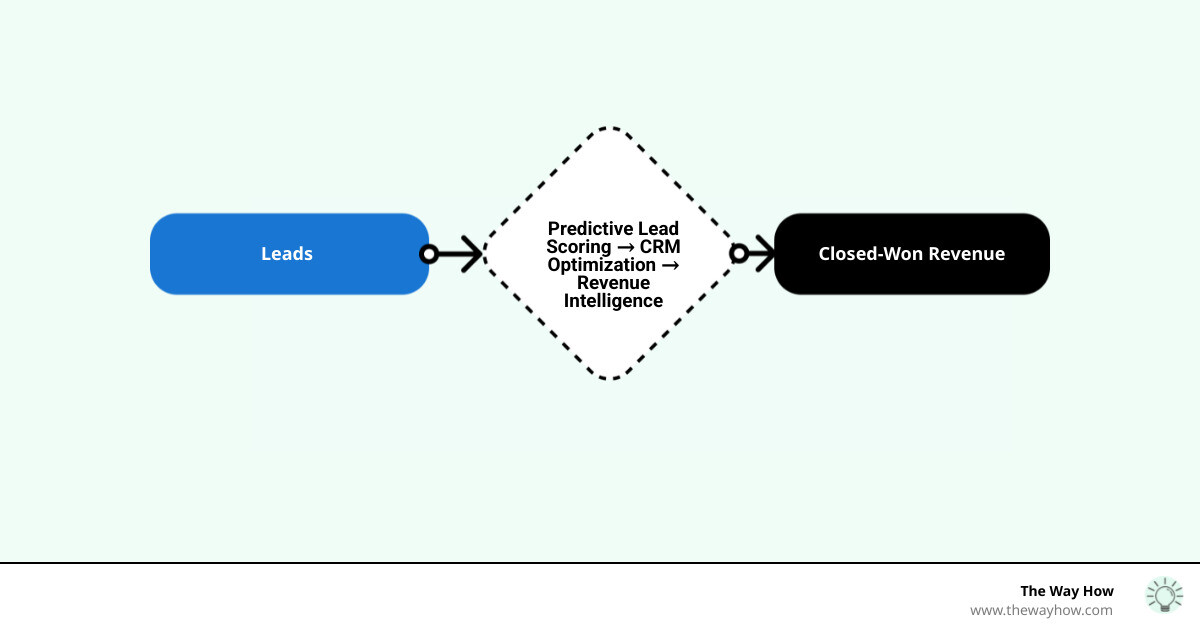
We use revenue intelligence and AI lead scoring to remove the guesswork from the sales process. AI tools can now analyze customer language in emails and calls to prioritize deals that are actually showing “intent” versus those that are just “kicking tires.” This allows your sales team to focus their limited energy on the opportunities with the highest probability of closing.
A robust b2b revenue strategies framework includes:
For a deeper dive into how to structure these systems, consult our Revenue Management Analytics Complete Guide.
The biggest mistake B2B companies make is thinking the job is done when the contract is signed. In a world of recurring revenue and SaaS models, the “close” is actually just the beginning.
Sustainable Revenue Growth comes from the compounding effect of customer retention, upselling, and cross-selling. It is far more cost-effective to grow an existing account than to acquire a new one. This requires a shift from transactional selling to consultative selling.
Consultative selling is about staying involved in the customer’s success long after the initial sale. It means:
When you treat your customers as partners, you create a “moat” around your revenue that competitors find nearly impossible to cross.

Sales cycles are stretching because of increased stakeholder complexity and a heightened sense of risk aversion. With 6–14 people involved in a deal, there are more opportunities for someone to say “no” or “not now.” Additionally, because buyers do so much anonymous research, they often enter the formal sales process later, but with more complex questions that require deeper technical and legal vetting.
Digital transformation isn’t just about software; it’s about removing friction. By providing self-service tools, interactive product tours, and transparent pricing, you allow buyers to move through the “Discovery” and “Explore” phases on their own terms. This speeds up the eventual sales engagement and allows your team to focus on high-value consulting rather than basic information sharing.
Content is the “silent salesperson” that works when your team is asleep. In 2026, content must be “buyer-enablement” focused. This means moving away from generic blog posts and toward high-utility assets like ROI calculators, implementation blueprints, and peer comparison guides. This type of content builds authority and helps your champion sell your solution internally.
At The Way How, we believe that growth doesn’t stall because of a lack of effort. It stalls because of a lack of clarity. When you don’t understand the psychological barriers preventing your buyers from moving forward, no amount of “hustle” will fix your revenue numbers.
We specialize in diagnosing these certainty gaps. Whether you are a healthcare provider needing a Healthcare Revenue Cycle Analytics Guide or a founder wondering Which Revenue Strategy Firms In Location 10 Specialize In Revenue Cycle Analytics And Fixing Broken Marketing Systems, we help you see the problem clearly before we ever talk about solutions.
Our approach blends Fractional CMO leadership with deep HubSpot expertise and behavioral insight to turn your marketing into a dependable growth engine. If you are ready to stop chasing ghosts and start building a system that creates trust and momentum, we are here to guide you.
Remove uncertainty from your sales and marketing systems and let’s build something that lasts.
 Jeremy Wayne Howell : Jul 22, 2026 9:48:31 PM
 Jeremy Wayne Howell : Jul 21, 2026 9:47:10 PM
 Jeremy Wayne Howell : Jul 20, 2026 9:46:47 PM