A Complete Guide to CRM Systems and Database Management
 Jeremy Wayne Howell : Jul 22, 2026 9:48:31 PM
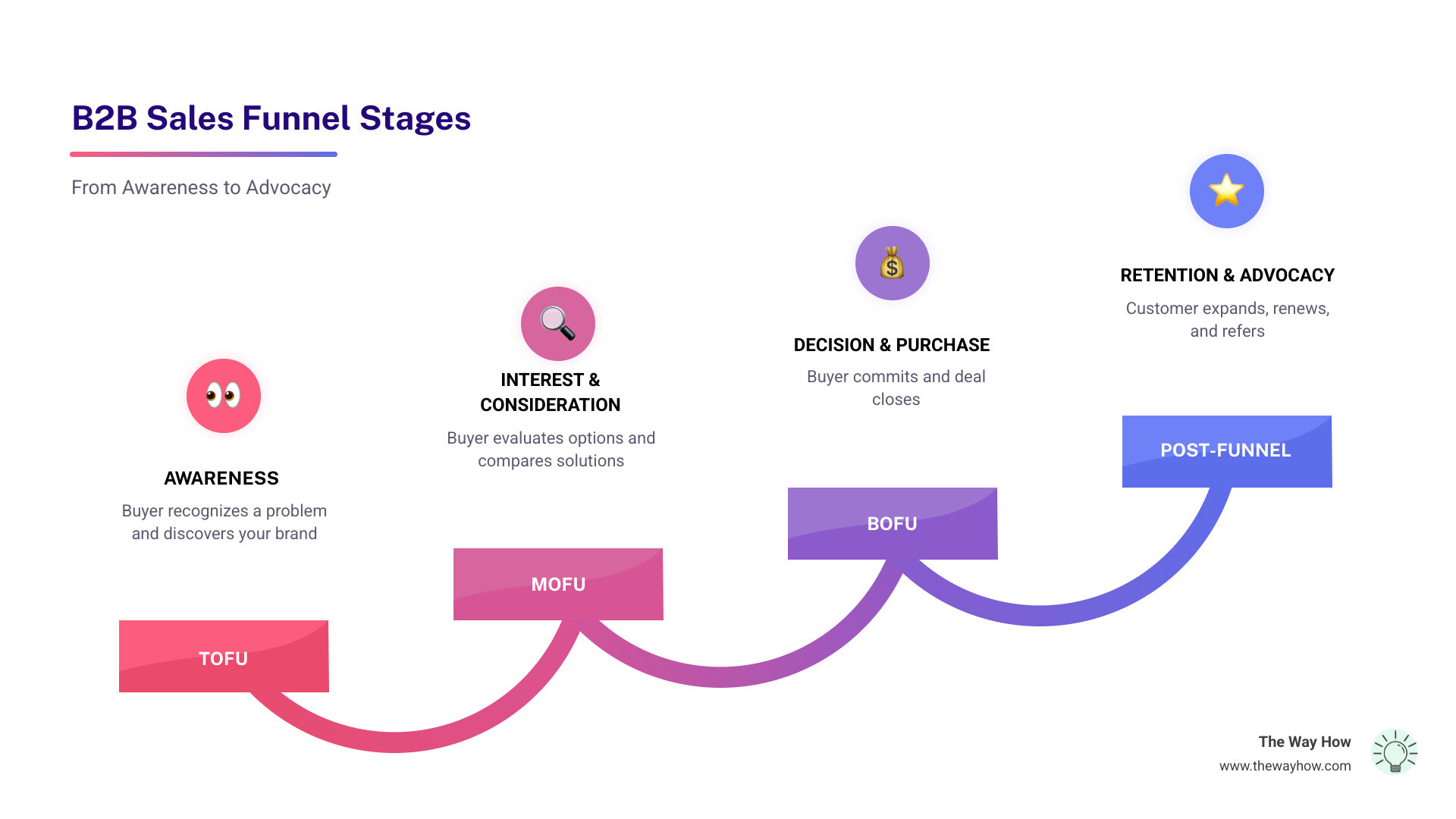
B2B sales funnels are the structured paths that guide a potential buyer from first awareness of a problem all the way through to becoming a paying customer — and ideally, an advocate for your business.
Here is a quick overview of how they work:
| Stage | Where It Lives | What’s Happening |
|---|---|---|
| Awareness | Top of Funnel (TOFU) | Buyer recognizes a problem; finds your brand |
| Interest & Consideration | Middle of Funnel (MOFU) | Buyer evaluates options; compares solutions |
| Decision & Purchase | Bottom of Funnel (BOFU) | Buyer commits; deal closes |
| Retention & Advocacy | Post-Funnel | Customer expands, renews, refers |
Unlike B2C, B2B funnels involve multiple decision-makers, long sales cycles, and complex buying committees. They rarely move in a straight line.
Most revenue leaders know their funnel is leaking. Leads come in, then go quiet. Proposals get sent, then stall. Deals that looked certain disappear into silence. The frustrating part isn’t the leak itself — it’s not knowing where it is or why it keeps happening.
The numbers make this hard to ignore. Only 3% of any given B2B market is actively ready to buy at any moment. Meanwhile, 61% of B2B marketers send every lead directly to sales — yet only 27% of those leads are actually qualified. That’s not a pipeline problem. That’s a structural problem.
What most teams are running isn’t really a funnel. It’s a loose sequence of activities with no shared definition of progress, no clear handoffs, and no way to diagnose where confidence breaks down for the buyer.
And that last part — buyer confidence — is what gets missed most often.
A B2B purchase decision isn’t just a logical process. It’s an emotional one. Buying committees of seven or more people, each with different priorities and different fears, have to reach consensus on a solution that carries real professional risk. When your funnel doesn’t account for that human complexity, it doesn’t convert — no matter how much traffic or outreach you throw at it.
This guide is built around a different premise: before you optimize your funnel, you need to understand the human moving through it.
I’m Jeremy Wayne Howell, founder of The Way How and a revenue growth strategist with over 20 years of experience rebuilding broken B2B sales funnels for founders and revenue leaders who were tired of tactics that looked right on paper but stalled in practice. Everything in this guide comes from that hands-on diagnostic work — not theory.
Simple B2B sales funnels glossary:
When we audit a revenue engine, the most common complaint is that the funnel feels like a sieve. Marketing generates “leads” that sales ignores, and sales complains about “quality” while deals languish in the middle of the process. This isn’t just a lack of effort; it’s a symptom of a non-linear buyer journey that most companies try to force into a straight line.
Modern B2B buying is chaotic. According to Forrester, 86% of B2B purchases stall somewhere in the process. This happens because buying committees — often consisting of 7 to 13 stakeholders — enter and exit the evaluation at different times. One person is focused on ROI, another on technical integration, and another on the risk of changing the status quo.
The “leak” in your funnel is often a certainty gap. It is the space where the buyer’s internal uncertainty outweighs the perceived value of your solution. To fix it, we must stop viewing the funnel as a series of internal tasks (prospecting, demo, proposal) and start viewing it as a journey of building psychological safety for the buyer.
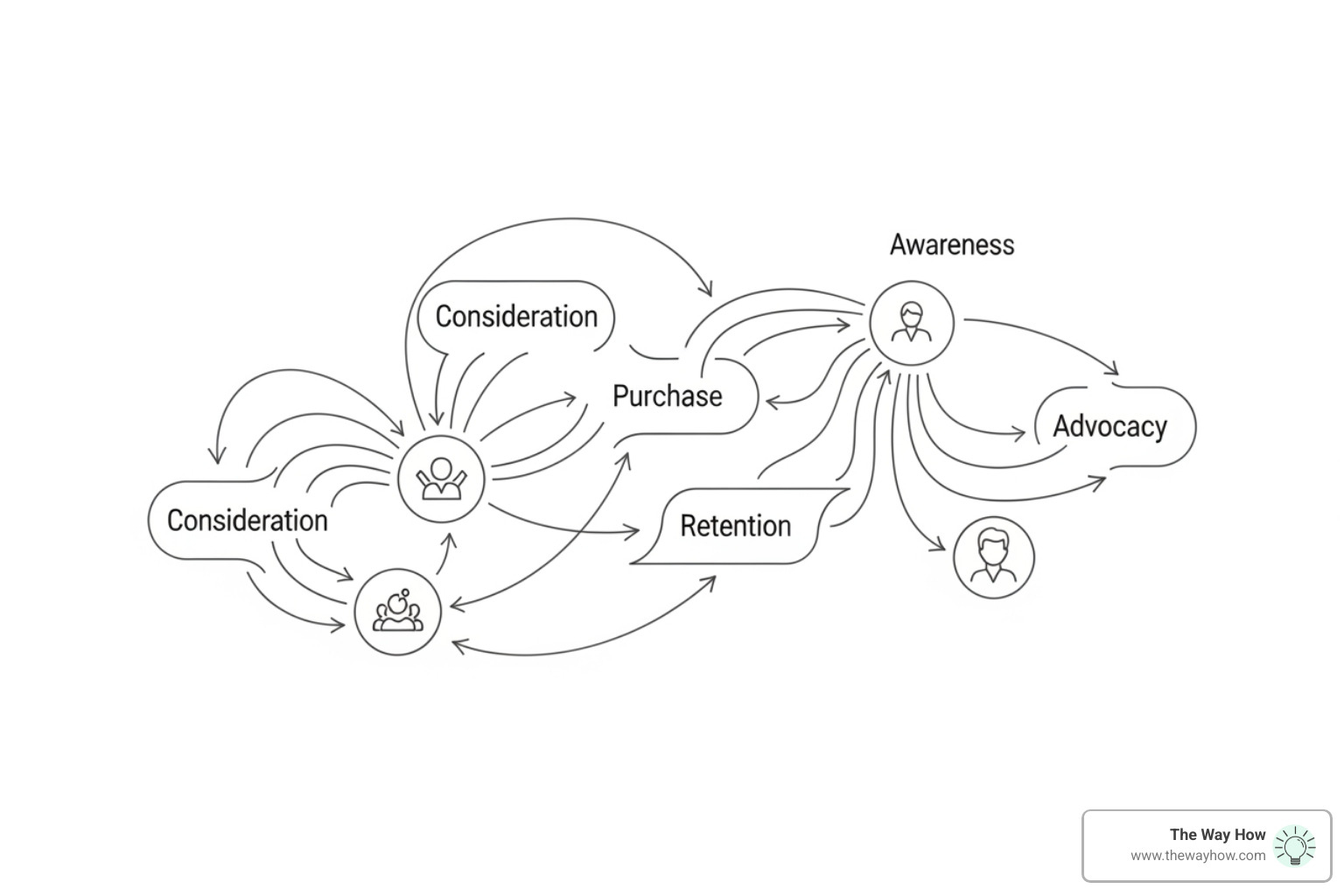
At The Way How, we believe that every stage of the funnel is a psychological milestone. If you don’t understand how a decision-maker moves from “I have a problem” to “I trust this vendor,” your tactics will always fall flat.
The traditional AIDA model (Attention, Interest, Desire, Action) is dangerously outdated. It assumes a single person is moving linearly through a simple emotional arc. In reality, Hubspot research shows only 3% of your market is buying. When you focus only on the “Action” phase, you ignore the 97% who are currently navigating the 4 stages of customer journey — awareness, consideration, decision, and advocacy.
B2B buyers are looking for logic and ROI, but they are driven by the fear of making a mistake. Every piece of content and every sales interaction must serve to reduce that fear. This requires empathy: understanding that your prospect isn’t just a “lead” in a CRM, but a person trying to solve a high-stakes business problem without losing their reputation.
One of the biggest mistakes we see is trying to cram marketing, sales, and customer success into a single funnel. This leads to “team wars” and inaccurate data. For true revenue predictability, you must separate these into three distinct but connected ecosystems.
Separating these funnels allows for better accountability. If your complete guide 5 stages customer journey map shows that leads are stalling at the handoff, you know exactly where the friction lies. A 5% increase in customer retention can boost revenue by 25-95%, making the post-purchase funnel just as valuable as the top.
To gain control over your revenue, you need to define micro-stages. These are the small, measurable actions that indicate a prospect is moving forward. Instead of just “Discovery” and “Proposal,” look for the “in-between” moments.
Effective sales prospecting isn’t just about getting a meeting; it’s about identifying these micro-signals that prove the buyer is gaining certainty.
What does a healthy funnel actually look like? While benchmarks vary by industry, typical B2B sales funnels see these conversion rates:
If your rates are significantly lower, you have a leak. Our funnel optimization complete guide emphasizes that you shouldn’t try to fix everything at once. Identify the single biggest drop-off point — usually the MQL to SQL handoff — and start there.
Content is the fuel for your funnel, but it must be mapped to the buyer’s mindset at each stage.
Because 86% of purchases stall, lead nurturing is critical. You aren’t just sending emails; you are providing the “ammunition” your internal champion needs to convince the rest of the buying committee.
If you want to predict your revenue for the next quarter, you need to understand Sales Funnel Velocity. This isn’t just about how many deals you have; it’s about how fast they are moving.
The formula for Sales Funnel Velocity is: (Number of SQLs x Deal Close Rate x Average Deal Value) / Sales Cycle Length
| Metric | SMB Benchmark | Enterprise Benchmark |
|---|---|---|
| Sales Cycle | 30-60 days | 6-18 months |
| Avg. Deal Value | $5k - $20k | $100k+ |
| Close Rate | 25-30% | 15-20% |
| LTV:CAC Ratio | 3:1 | 3:1 (or higher) |
Tracking these metrics, as noted in the sales pipelinevelocity report, allows you to see the impact of small changes. For example, shortening a 75-day sales cycle by just 5 days can add hundreds of thousands in annual revenue without increasing lead volume.
A high-performing funnel requires more than just a good b2b sales strategy; it requires technical and operational alignment. This is where many companies fail — they have the strategy, but their HubSpot architecture is a mess, or their teams aren’t speaking the same language.
According to the HBR on the new sales imperative, the goal of the modern sales team is to make the purchase easier, not just to sell harder. This requires:
When these systems are aligned, uncertainty vanishes. You gain a 106% net revenue retention because your customers were sold the right solution from the start and were supported throughout their entire journey.
A sales funnel visualizes the buyer’s journey from their perspective (Awareness to Purchase). A sales pipeline tracks the seller’s internal actions (Prospecting, Discovery, Proposal). They should align, but they represent two different viewpoints of the same process.
AIDA assumes a linear, individual decision. Modern B2B involves complex buying committees, non-linear research paths, and a need for post-purchase advocacy. It fails to account for the “stall” points and the psychological complexity of group consensus.
Multiply your number of Sales Qualified Leads by your Win Rate and your Average Deal Value. Then, divide that total by the average length of your sales cycle. This gives you a “velocity” number that represents how much revenue your funnel is producing per day/month.
Building a funnel that actually works isn’t about finding a “magic” tactic. It’s about removing the uncertainty that keeps buyers from saying yes and keeps your team from performing at their best. It requires a blend of behavioral insight, strategic clarity, and operational execution.
At The Way How, we help founders and leadership teams move past the surface-level fixes. We diagnose the root causes of stalled growth and design systems rooted in human psychology to create predictable revenue. Whether you need Fractional CMO leadership or a complete HubSpot architecture rebuild, our goal is the same: to turn your marketing into a dependable growth engine.
If you are ready to stop guessing and start growing, learn more about our revenue strategy services and let’s build a system that works for your buyers and your bottom line.
 Jeremy Wayne Howell : Jul 22, 2026 9:48:31 PM
 Jeremy Wayne Howell : Jul 21, 2026 9:47:10 PM
 Jeremy Wayne Howell : Jul 20, 2026 9:46:47 PM