

Drowning in Data, Starving for Clarity?

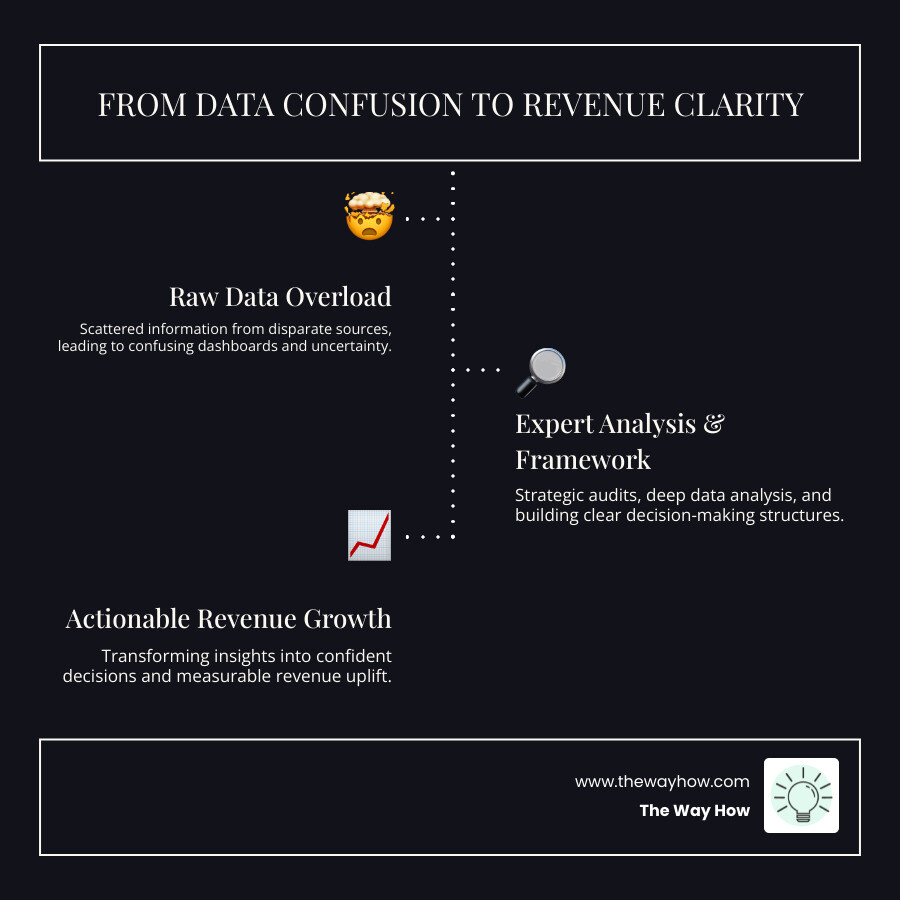
Revenue analytics consulting helps businesses transform raw data into clear, actionable strategies that drive predictable revenue growth. It combines expert analysis and strategic guidance to find what’s working, what’s broken, and where your biggest opportunities lie.
What Revenue Analytics Consulting Delivers:
- Diagnosis of revenue leaks - Find where money is being left on the table
- Strategic roadmaps - Build a clear path from insight to action
- System optimization - Fix broken processes that slow growth
- Measurable ROI - Typically 3-10% revenue uplift with 10x average return
You have more data, dashboards, and tools than ever. Yet, when it’s time to make a critical decision about pricing, marketing spend, or sales strategy, you still feel like you’re guessing.
That’s not a data problem. That’s a clarity problem.
Most businesses collect mountains of data but lack the framework to make confident decisions. They chase vanity metrics, build confusing reports, and invest in tools that create more confusion than conviction.
Revenue analytics consulting solves this. It’s not about more reports or another platform. It’s about building a system that removes uncertainty from revenue decisions, helping you understand why growth has stalled and how to fix it.
The best engagements don’t just deliver insights; they teach you to think differently about your business, customers, and the real drivers of predictable growth.
What is Revenue Analytics? A Framework for Predictable Growth
At its core, revenue analytics is the process of analyzing data to make revenue-related decisions. It’s not just crunching numbers; it’s about understanding the human behavior, market dynamics, and operational efficiencies influencing your bottom line. It covers everything from leads and customers to products and services.
For us, the crucial question is: “What decision will this data inform?” This question acts as a compass, ensuring we focus on insights that empower confident choices. By leveraging Business Data Analysis, businesses can move from reactive measures to proactive, predictable growth.
Why is this crucial? Because uncertainty is the enemy of growth. Businesses overwhelmed by data often suffer from “decision-fatigue,” leading to poor decisions or none at all. Effective revenue analytics provides the clarity to see where sales originate, who your best customers are, what they’ll pay, and how to reach more of them. It’s about turning insights into a dependable growth engine.
The B2B vs. B2C Psychological Divide
While the goal is always driving revenue, the approaches for B2B and B2C companies diverge due to different sales cycles and customer behaviors. Understanding this psychological divide is paramount.
For B2B businesses, the sales process is longer, involving multiple stakeholders and relationship-building. Following a classic sales funnel, revenue analytics consulting focuses on conversion rates between stages, optimizing the sales force to communicate value, and aligning incentives. It’s about understanding the psychology of a buying committee, not just an individual.
B2C, on the other hand, features a shorter, transactional journey driven by individual preferences, emotions, and immediate needs. Analytics must cover product performance, operational efficiency, and marketing impact. Understanding consumer purchasing behavior is critical. The psychology is about individual desire and impulse, not complex organizational needs.
Both models benefit from a deep understanding of buyer psychology. Whether it’s the rational decision-making process of a B2B procurement manager or the emotional triggers of a B2C shopper, analytics provides the lens to decipher these behaviors and optimize for revenue.
Key Metrics That Actually Matter
Not all metrics are created equal. We guide clients to focus on KPIs that inform strategic decisions and reveal the health of their revenue engine. The right metrics depend on whether you’re a B2B or B2C business.
For B2B, our focus often centers on the journey of a lead through the sales funnel:
| B2B Metrics | Description |
|---|---|
| Marketing Qualified Leads (MQLs) | Leads identified as likely to become customers based on engagement. |
| Sales Qualified Leads (SQLs) | Leads vetted by sales and deemed ready for direct engagement. |
| Funnel Velocity | The speed at which leads move through different stages of the sales funnel. |
| Customer Lifetime Value (CLV) | The total revenue a business can expect from a single customer account over their relationship. |
| Conversion Rates (Stage-to-Stage) | The percentage of leads that move from one funnel stage to the next. |
These metrics help us pinpoint bottlenecks, optimize sales processes, and ensure the sales team is effectively communicating value.
For B2C, where the journey is often more volume-driven and transactional, we look at different indicators:
| B2C Metrics | Description |
|---|---|
| Return on Ad Spend (ROAS) | Revenue generated for every dollar spent on advertising. |
| Average Order Value (AOV) | The average dollar amount spent each time a customer places an order. |
| Sell-through Rate | The percentage of inventory sold over a given period, indicating product popularity and inventory efficiency. |
| Customer Cohorts | Analyzing groups of customers acquired at the same time to track their behavior, retention, and spending patterns over time. |
| Sales by Channel / SKU | Tracking sales performance across different marketing channels and for individual products. |
These B2C metrics are crucial for understanding customer behavior, product performance, and marketing efficiency. We often use Marketing Data Analysis to analyze channel effectiveness and customer acquisition costs.
Regardless of the model, the goal is to move beyond raw numbers to actionable insights. We identify data points that correlate with revenue, enabling informed decisions on where to invest resources and how to optimize for growth.
The Hidden Obstacles to a Data-Driven Culture
Many businesses aspire to be data-driven, yet they struggle to bridge the gap between collecting data and actually using it to inform decisions. We often find that the primary challenges aren’t technical, but rather human and organizational.
One of the biggest problems is the sheer volume of data, which paradoxically can lead to “decision-fatigue.” As the folks at Dropbox found, when faced with too much data, businesses tend to become less, not more, data-oriented in their decisions. This often stems from data silos, where information is fragmented across disparate systems (CRM, marketing automation, finance, etc.), making a holistic view nearly impossible.
Organizational friction also plays a significant role. Different departments may track different metrics, use varying definitions for key terms, or prioritize vanity metrics that look good on a report but don’t actually move the needle on revenue. This lack of alignment can create a chaotic environment where no one truly trusts the data, leading to gut-based decisions rather than strategic ones. Without a common language and a shared understanding of what the data means, even the most sophisticated tools can fail to deliver clarity.
The Importance of an ‘Analytics Dictionary’
Imagine trying to build a complex machine if every engineer used different terms for the same parts. Chaos, right? The same applies to revenue analytics. One of the most common, yet overlooked, challenges we encounter is the absence of a shared understanding of data and metrics across an organization. This is why we champion the creation of an ‘Analytics Dictionary’ or, as we sometimes call it, a ‘Rosetta Stone’ for your business data.
An Analytics Dictionary isn’t just a glossary; it’s a foundational document that captures all the key components of your data structure. It defines every KPI, every data point, and every calculation in plain, unambiguous language. For example, what constitutes an “active user”? What’s the exact formula for “customer acquisition cost”? When does a “lead” become “qualified”?
This standardization is crucial for several reasons:
- A Single Source of Truth: It eliminates ambiguity and ensures everyone—from sales to marketing to finance—is working from the same definitions.
- Cross-Functional Alignment: It fosters collaboration by giving teams a common language to discuss performance and strategy.
- Explainable Reporting: When reports are built on clear, agreed-upon definitions, they become easier to understand, scalable, and more efficient in driving insights.
- Improved Decision-Making: With clarity, decision-fatigue diminishes, allowing teams to make confident, data-driven choices.
Developing an Analytics Dictionary is a critical step in building an explainable, efficient, and scalable analytics practice, ensuring that your Business Analysis and Analytics efforts are truly aligned and impactful.
Leveraging AI and Automation with Purpose
In the field of revenue analytics consulting, AI and automation are not just buzzwords; they are powerful tools that, when used thoughtfully, can dramatically improve clarity and efficiency. However, our approach is always “psychology-first,” meaning we leverage these technologies to augment human decision-making, not replace it, and ensure they contribute to understanding, not confusion.

AI for Augmentation: We use AI to uncover patterns and make predictions that would be impossible for humans to identify manually. For instance, AI-improved pricing models can analyze vast datasets to determine optimal pricing strategies, even allowing for dynamic pricing that adjusts rapidly based on real-time market conditions, demand, and individual customer segments. This hyper-personalization, as highlighted by BCG, can lead to significant revenue uplift. AI can also predict customer churn, identify cross-sell opportunities, and forecast demand with greater accuracy, allowing businesses to be proactive rather than reactive.
Automation for Efficiency: Automation streamlines the tedious, repetitive tasks of data collection, cleaning, and reporting. Tools like Airboxr can combine data from disparate sources (Shopify, Google Ads, email software) into a functional dataset, freeing up valuable human time. This means analysts can focus on strategic interpretation rather than manual data wrangling. Automation ensures that reports are consistently generated, always up-to-date, and readily available, providing a stable foundation for decision-making.
Avoiding Black Box Solutions: While AI can be incredibly powerful, we emphasize transparency. Our goal is to ensure that the logic behind AI-driven recommendations is understandable. We build systems where the ‘why’ behind a suggestion is clear, fostering trust and adoption within the organization. This human-centric approach to AI ensures that the technology serves to remove uncertainty, not create a new, impenetrable layer of complexity. It’s about making smarter, faster decisions, not just letting machines decide.
The Role of Expert Revenue Analytics Consulting
When businesses find themselves with stalled growth or a sense of unease about their revenue trajectory, expert revenue analytics consulting becomes an invaluable strategic partner. We don’t just offer tools; we bring a blend of deep domain expertise, a psychology-first approach, and proven methodologies to diagnose the root causes of underperformance.
Our role extends beyond technical implementation. We help identify those subtle “certainty gaps” in the customer journey and design robust systems that create trust, momentum, and predictable revenue. This involves everything from auditing existing tech stacks to understanding market dynamics and customer behavior. The goal is to turn your marketing and sales efforts into a dependable growth engine, not just a series of disconnected tactics.
The impact of such a partnership can be profound. Our research shows that successful revenue analytics initiatives can lead to a 3-10% revenue uplift and an impressive 10x average ROI. For instance, Revology Analytics helped a client achieve “several million dollars of incremental EBITDA annually,” while Revenue Vision Partners enabled a company to realize a “sustainable ~5% decrease in sales expense & $10M in cross-portfolio quick wins.” These aren’t just numbers; they represent the power of clarity and strategic precision.
Core Services: From Audit to Optimization
Expert revenue analytics consulting encompasses a comprehensive suite of services designed to address every facet of your revenue generation process. Our approach is holistic, moving from a deep diagnostic phase to strategic implementation and continuous optimization.
Here are some of the core services we offer:
- System Audits & Tech Stack Review: We dive into your existing technology infrastructure to identify all data sources, pinpoint gaps, and assess the efficiency and integration of your current systems. This includes reviewing CRMs, marketing automation platforms, and other revenue-generating tools.
- Reporting Reviews & KPI Alignment: We examine your current reporting processes to understand what KPIs are being tracked, how they’re being measured, and where reports might be missing critical insights. Our goal is to align your KPIs with your overarching business goals, ensuring every metric serves a strategic purpose.
- Advanced Analysis & Insight Generation: Leveraging sophisticated analytical techniques, we transform raw data into actionable insights. This includes customer segmentation, product performance analysis, market trend identification, and deep dives into sales and marketing effectiveness.
- Attribution Modeling: We help design and implement custom attribution models that accurately credit marketing and sales touchpoints, providing a clearer picture of ROI for your investments. This can range from standard models to complex, multi-touch frameworks.
- Analytics Dictionary Development: As discussed, we facilitate the creation of a ‘Rosetta Stone’ for your data, ensuring a shared understanding and standardization of terms and definitions across your organization.
- Analytics Implementation & Relaunch: We provide guidance and support for implementing new analytics platforms or relaunching existing ones, focusing on proper integration, reporting strategy, UTM strategy, touchpoint strategy, and historical data mapping.
- Ongoing Analytics Retainers: For continuous support, we offer monthly retainers that include KPI reporting, business goal alignment, dashboard creation, and ongoing refinement of your analytics practice.
Our engagement is much like the day-to-day work of a Business Analyst Day-to-Day, but with an added layer of strategic oversight and a psychology-first lens, ensuring that every analytical effort contributes to predictable revenue growth.
Choosing the Right Revenue Analytics Consulting Partner
Selecting the right revenue analytics consulting partner is a critical decision, far more nuanced than simply picking a vendor with the flashiest software. It’s about finding a partner who understands your unique challenges, speaks your language, and can translate complex data into clear, actionable strategies that resonate with your team’s psychology.
Beyond technical skills, here’s what we believe truly matters:
- Strategic Clarity Over Technical Jargon: Look for a partner who can cut through the noise and provide clear, strategic direction. They should be able to diagnose why growth is stalled and articulate the “certainty gaps” in your customer journey, rather than just presenting a list of tools.
- Industry-Specific Expertise: While analytics principles are universal, their application varies. A partner with experience in your industry (e.g., MedTech, CPG, retail, rail) can offer more relevant insights and faster time-to-value, as demonstrated by firms like Revology Analytics who tailor solutions for diverse sectors.
- Proven Methodologies: The best consultants don’t just offer ad-hoc advice; they employ structured, repeatable methodologies. This ensures consistency, efficiency, and predictable outcomes, helping you build systems that create trust and momentum.
- Cultural Fit and Collaboration: An effective consulting engagement is a partnership. Your chosen firm should foster collaboration, understand your organizational dynamics, and be able to communicate effectively with all stakeholders. They should empower your team, not just deliver reports.
- Measurable ROI and Case Studies: A reputable partner will have a track record of tangible results. Look for specific examples of revenue uplift, margin improvement, or cost reduction. Revology Analytics, for example, shares client success stories like achieving “+30bps in Gross Margin %” and saving “thousands of hours of manual pricing work.” This demonstrates their ability to deliver real business impact.
You’re not just investing in analytics; you’re investing in a clearer path to predictable revenue growth. Choose a partner who prioritizes understanding your business and your customers’ behavior above all else.
How Consulting Optimizes Marketing and Sales
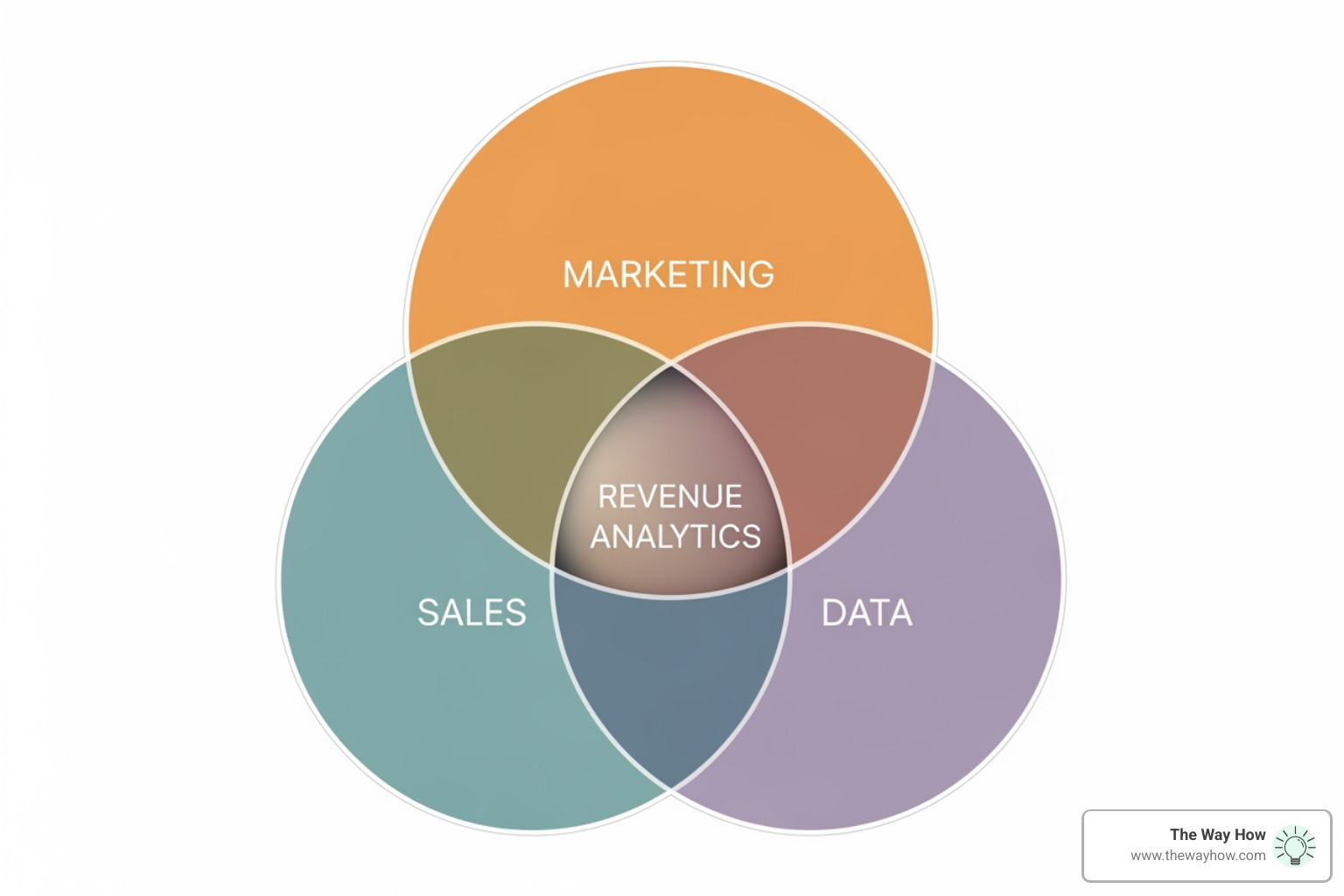
Revenue analytics consulting serves as the vital bridge between marketing and sales, changing these often-siloed departments into a cohesive, data-driven revenue engine. By providing unparalleled visibility into the entire customer journey, we help optimize efforts, eliminate waste, and drive predictable growth.
Sales Force Enablement: Our consulting helps prepare your sales force to communicate and monetize value effectively, especially in complex B2B environments. By analyzing sales performance data, we can identify training needs, optimize sales processes, and ensure that the sales team is equipped with the insights needed to close deals faster and handle price exceptions efficiently. For instance, one packaging giant, with consulting support, was able to slash deal cycle time by 69% and achieve a 4% margin uplift, alongside a 69% reduction in price exceptions. This level of insight ensures that your sales team is not just selling, but selling smarter.
Marketing Spend Optimization: We dig deep into marketing data to determine which channels and campaigns are truly driving revenue, not just vanity metrics. By tracking impressions, clicks, conversions, and ROAS across different platforms, we help you allocate your marketing budget more effectively. This ensures that every dollar spent is contributing to pipeline generation and customer acquisition, optimizing your overall marketing ROI. We help you understand the behavioral triggers that make your marketing effective.
Lead Quality and Funnel Leakage: Through meticulous analysis of your sales funnel, we identify where leads are dropping off and why. This helps improve lead quality by refining your targeting and messaging, ensuring that sales teams are spending their time on truly qualified prospects. By understanding the psychology of your prospects at each stage, we can design interventions that reduce leakage and accelerate conversion rates.
Revenue analytics consulting integrates the efforts of marketing and sales, providing a unified view of performance. This synergy allows for a more efficient allocation of resources, better forecasting, and a stronger, more predictable revenue stream.
Building Your Revenue Growth Engine
A successful revenue growth engine isn’t built on scattered spreadsheets or isolated dashboards. It requires a robust, integrated platform that provides a single source of truth and empowers Data-Driven Decisions. We help businesses construct this engine by focusing on essential components and ensuring they are aligned with their unique operational and psychological context.
Essential Platform Components:
- Seamless Data Integration: The foundation of any strong analytics platform is its ability to pull data from all your disparate sources—CRM, ERP, marketing automation, website analytics, ad platforms, and even third-party data. Tools like Airboxr can help combine this data, but the key is a robust integration strategy that cleans, transforms, and harmonizes information efficiently.
- Powerful Business Intelligence (BI) Platforms: Leveraging BI platforms such as Domo, Tableau, Power BI, or Looker Studio is crucial for visualizing data and creating executive dashboards. These platforms enable cross-functional, platform-agnostic reporting frameworks that make data explainable, scalable, and actionable.
- User Behavior Tracking: Understanding how users interact with your website and products is invaluable. Tools like segment.com help track user behavior, allowing you to send targeted nudges or feed this information into your analytics for deeper insights into the customer journey.
- Scalability and Flexibility: Your revenue analytics platform must be able to grow with your business. This means it should handle increasing data volumes, integrate new data sources as your tech stack evolves, and adapt to changing business needs without requiring a complete overhaul.
- Analytics Dictionary: As we discussed, embedding an Analytics Dictionary directly into your platform ensures that all metrics and definitions are consistently applied and understood, reinforcing trust in the data.
By focusing on these components, we help you build an analytics infrastructure that not only collects data but also transforms it into the clarity needed to drive your revenue growth engine forward.
The Benefits of Data-Driven Pricing
Pricing isn’t just a number; it’s a powerful psychological lever and a critical component of your revenue growth engine. A data-driven approach to pricing and revenue management is about understanding the perceived value of your offerings and monetizing it effectively, leading to significant benefits beyond mere volume increases.
- Improved Value Monetization: For B2B companies, data-driven pricing helps communicate and monetize the true value of complex offerings. For B2C, it allows for dynamic pricing that adapts to demand, competitor actions, and customer segments, ensuring you capture maximum value.
- Optimal Margin Improvement: By analyzing historical data, market elasticity, and customer behavior, we can identify optimal price points that maximize profit margins. This can lead to substantial gains, with some companies seeing a 4% margin uplift and even +30bps in Gross Margin % from optimized pricing strategies.
- Strategic Competitive Advantage: When pricing has “no textbook solution,” a data-driven approach allows you to react quickly to market shifts, price new products strategically, and even introduce innovative models like subscription services. This agility becomes a key differentiator.
- Net Revenue Management: This involves a cross-functional, analytics-heavy approach to optimize pricing, promotions, and product mix. It’s about looking at the entire revenue picture, not just individual sales, to identify opportunities for growth and profitability.
- Reduced Price Exceptions: With clear, data-backed pricing guidance, sales teams can operate with more confidence, leading to fewer ad-hoc price exceptions and greater consistency across the board. One client saw a 69% reduction in price exceptions, streamlining their sales process and protecting profitability.
By moving beyond gut feelings and into the field of precise, data-backed pricing, businesses can open up significant revenue potential and turn their pricing strategy into a formidable competitive edge.
How Revenue Analytics is Evolving
The landscape of revenue analytics is continuously evolving, driven by rapid advancements in technology and data science. We’re moving beyond mere historical reporting to a future where analytics is predictive, proactive, and deeply integrated with decision-making.
- Advanced Data Science and AI: The integration of sophisticated machine learning algorithms is changing how we forecast demand, optimize pricing, and personalize customer experiences. AI-powered solutions, as offered by leading firms, are generating hundreds of millions of price recommendations daily and updating billions of forecasts nightly. The evolution is towards more intelligent systems that not only tell you what happened but also predict what will happen and recommend the optimal course of action.
- Human-Centric AI: While AI brings immense power, the future of revenue analytics emphasizes human-centric AI. This means ensuring that AI models are not “black boxes” but rather explainable and interpretable, allowing human decision-makers to understand the underlying logic. This aligns perfectly with our psychology-first approach, where AI augments human insight and reduces uncertainty, rather than creating it.
- Proactive and Prescriptive Insights: The shift is from descriptive analytics (what happened) and diagnostic analytics (why it happened) to predictive analytics (what will happen) and prescriptive analytics (what you should do). This allows businesses to anticipate market changes, customer needs, and potential revenue leaks before they occur, enabling proactive strategic adjustments.
- Real-Time Capabilities: The demand for real-time data processing and instantaneous insights is growing. Platforms are evolving to provide immediate feedback on performance, allowing for agile responses to market dynamics and customer behavior.
- Integration of Behavioral Economics: As a psychology-first firm, we see the increasing importance of integrating behavioral economics into revenue analytics. Understanding cognitive biases, decision-making heuristics, and emotional drivers allows for more effective pricing, marketing, and sales strategies that resonate deeply with customers.
The future of revenue analytics isn’t just about more data; it’s about smarter, more empathetic, and more actionable insights that truly empower businesses to grow predictably and sustainably.
From Insight to Action: Your Path to Smarter Growth
This guide has shown that effective revenue analytics is not about accumulating more data, but about achieving greater clarity. It’s about diagnosing the real reasons growth has stalled and building a system based on a deep understanding of customer behavior. By shifting from chasing tactics to building a framework for predictable revenue, you can turn your data from a source of confusion into your most powerful asset for smart, sustainable growth. The Way How helps businesses build these systems.
Ready to build a dependable growth engine? Explore our services.