A Complete Guide to CRM Systems and Database Management
 Jeremy Wayne Howell : Jul 22, 2026 9:48:31 PM
8 min read


Sustainable revenue growth is the maximum rate at which your business can expand without depleting resources, increasing unsustainable debt, or outpacing your balance sheet’s capacity to support operations. It differs from general revenue growth by emphasizing long-term financial health over short-term gains.
Key components of sustainable revenue growth:
Most founders and revenue leaders chase growth as if it’s inherently good. But growth without guardrails destroys businesses from the inside out.
The tension is real: you’re expected to scale, hit aggressive targets, and prove momentum to investors or stakeholders. Meanwhile, your marketing and sales systems feel inconsistent. Your cash reserves shrink. Vendor payments stretch longer. You’re moving fast, but it doesn’t feel sustainable—because it isn’t.
This happens when businesses prioritize revenue increases without understanding the financial and operational limits that determine how fast they can actually grow. The result isn’t just stalled growth—it’s resource depletion, rising liabilities, and a balance sheet that can’t support the very expansion you’re chasing.
Sustainable revenue growth isn’t about growing slower. It’s about growing smarter, with clarity on what your business can handle and how to build the systems that support predictable, repeatable revenue over time.
I’m Jeremy Wayne Howell, and over the past 20 years I’ve helped businesses diagnose why their growth stalled and rebuild strategies around sustainable revenue growth through psychology-first marketing, buyer behavior, and systems that create certainty. My work focuses on understanding the human and financial constraints that determine whether growth scales or collapses.
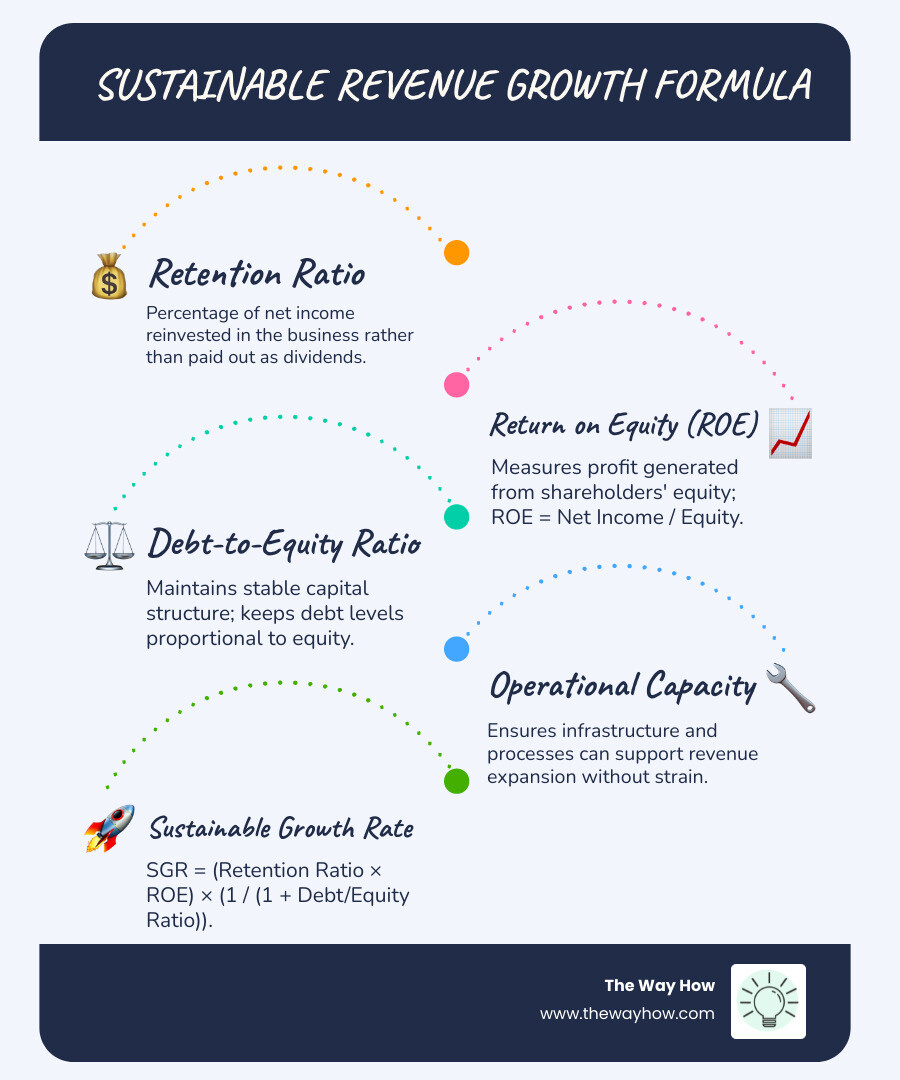
Simple guide to Sustainable revenue growth:
When we look at a tomato plant in a garden, we don’t expect it to double in size overnight. If it did, the stem would likely snap under its own weight. We understand that biological systems need time to build the structural integrity required to support new fruit. Yet, in the boardroom, we often demand that our companies perform “unnatural” feats of speed.
The psychology of growth is often driven by a fear of stagnation. Founders believe that if they aren’t sprinting, they are dying. This creates what we call “certainty gaps” in the customer journey. When a business grows too fast, the systems meant to create trust and momentum begin to fray. The sales team makes promises the operations team can’t keep. The marketing team brings in leads that the product can’t actually serve.
This isn’t just a marketing problem; it’s a resource depletion problem. When we attempt to grow faster than our Sustainable revenue growth rate, we aren’t just working harder; we are borrowing from the future. We deplete our cash reserves, stress our employees to the point of burnout, and alienate the very customers who were supposed to fuel our expansion.

The tension between rapid expansion and planetary or organizational boundaries is real. Research shows that while 128 countries have national climate targets, many businesses struggle to meet their own sustainability goals because their traditional models are built on breaching these boundaries. We must recognize that our economy depends on thriving ecosystems; 50% of global GDP is nature-dependent, with $58 trillion in risk exposure. If your business model ignores these limits, it isn’t just “un-green”—it’s financially fragile.
Think of Sustainable revenue growth as the transmission in a car. You can redline the engine in first gear and move very fast for a few seconds, but eventually, the engine will blow. Sustainable growth ensures you are shifting gears in alignment with your balance sheet’s capacity.
General revenue growth is a simple “top-line” metric. It tells you how much more money came in this year compared to last. It doesn’t tell you how much it cost to get that money, how much debt you took on to acquire it, or if you’ll be able to repeat the performance next year. Sustainable revenue growth (SRG), on the other hand, is a measure of internal capacity. It is the maximum rate of growth a business can sustain without having to increase its financial leverage) or debt financing.
For many, Small Business Growth Strategies often focus on the “hustle.” But true health is found in stability. When we talk about SRG, we are looking at the business as a self-sustaining ecosystem.
Why does stability matter more than sheer speed? Because the market is inherently uncertain. Between 2017 and 2021, fewer than one in four companies achieved more than 10% revenue growth annually. Those who did so sustainably—the “triple outperformers”—delivered 2 percentage points of annual Total Shareholder Return (TSR) above those who only focused on financial metrics.
When you grow within your sustainable limits, you build “resource reservoirs.” These are the buffers of cash, talent, and customer loyalty that allow you to weather a downturn. Without these reservoirs, a single bad quarter can turn a growth story into a bankruptcy filing. Investor confidence isn’t built on a single “hockey stick” chart; it’s built on the predictable, repeatable ability to generate value without constant injections of outside capital.
To find your “speed limit,” you need to look at four key financial levers:
The basic formula for the Sustainable Growth Rate (SGR) is: SGR = Retention Rate × Return on Equity
For a deeper dive into how your internal processes impact these numbers, see our Revenue Cycle Analytics Complete Guide. Understanding these metrics allows you to move from guessing to Data-Driven Decisions.
There is a phenomenon known as “growing broke.” It sounds like a paradox, but it’s the primary cause of death for successful-looking startups.
Imagine a business that retains 5% of its revenue to equity. This allows it to grow at a sustainable 5% per year. Now, imagine that business suddenly lands a massive contract and grows by 15% in a single year. If the gross profit margins don’t change, that extra 10% of growth creates a financing gap.
Where does that 10% come from?
| Growth Metric | Sustainable (5% Growth) | Aggressive (15% Growth) |
|---|---|---|
| Retention to Equity | 5% | 5% |
| Required Investment | 5% | 15% |
| Financing Gap | 0% | 10% (Must be borrowed) |
| Risk Level | Low | High (Potential for “Growing Broke”) |
When you outpace your balance sheet, you lose control. You stop making decisions based on strategy and start making them based on cash flow desperation. This is why we advocate for Data-Driven Decisions over gut-feel expansion.
It is important to know the difference between SGR and the Internal Growth Rate (IGR).
Knowing your IGR tells you how “independent” you are. Knowing your SGR tells you how fast you can grow while staying “stable.” Strategic planning requires balancing both.
Let’s look at a real-world example. Imagine a farm with 200 acres. The owner wants to expand by purchasing a neighbor’s 100-acre farm. This is a 50% increase in land and expected revenue. On paper, it looks like a win.
However, that additional 100 acres requires a 50% increase in the cost of goods—new equipment, more people, and more supplies. If the farmer doesn’t have the cash reserves or the profit margin to support that 50% jump, they will be forced into high-interest debt. If a bad harvest hits the following year, the entire 300-acre operation could be lost.
To avoid this, businesses must pull different strategic levers. Instead of just buying more “land” (or more leads), we can focus on:
McKinsey’s research on Harnessing revenue growth management for sustainable success highlights that a nuanced approach to pricing and assortment can yield 1.2 to 1.5 times net-price realization above inflation. This is far more sustainable than blunt price hikes. Furthermore, Sales Funnel Optimization ensures that the growth you do achieve is efficient.
Digital marketing shouldn’t be a “faucet” you turn on and off for quick leads. It should be a system for building long-term relationships. By using Conversion Rate Optimization, we ensure that we aren’t just pouring more traffic into a leaky bucket.
Sustainable marketing focuses on behavioral adaptation. We look at how consumers are changing—like the 74% of US consumers who are currently trading down due to inflation—and we adjust our messaging to meet them with empathy. SEO integration isn’t just about keywords; it’s about being the most helpful resource for your customers when they have a problem.
The most successful companies today are “triple outperformers.” These are businesses that excel in growth, profitability, and Environmental, Social, and Governance (ESG) initiatives.
The data is clear:
This aligns with the Corporate Knights Sustainable Economy Taxonomy, which tracks how investments in sustainability drive actual financial returns. Even Warren Buffett follows a version of this, looking to grow shareholder wealth by at least 15% annually by ensuring his holdings retain roughly 15% of revenues to equity each year.
How do you bring this into your Monday morning meetings? It starts with aligning your sales forecasts with your balance sheet capacity.
If your sales team forecasts 20% growth, but your SGR calculation says you can only handle 10%, you have a problem. You either need to:
This is where Marketing Budget Optimization becomes vital. Instead of spending more, we spend where the impact on sustainable equity is highest. We move from “spending to grow” to “investing to sustain.”
Internal Growth Rate (IGR) relies solely on retained earnings without any external financing. It answers the question: “How fast can we grow if no one gives us a dime?” Sustainable Growth Rate (SGR) allows for external debt as long as the debt-to-equity ratio remains constant. It answers: “How fast can we grow while keeping our financial risk level the same?”
Companies that integrate ESG with financial performance—known as triple outperformers—deliver higher annual TSR and grow revenues at a median rate of 11% per year. This is because sustainability initiatives often lead to operational efficiencies (lower waste), better talent retention, and higher customer loyalty from a more conscious consumer base.
The business will eventually deplete its cash reserves and be forced to seek outside investment, increase debt, or delay payments to vendors. This often leads to a “growing broke” scenario where the business has high sales but no cash, making it vulnerable to even minor market fluctuations.
Sustainable growth is not an accident; it is the result of intentional system design. At The Way How, we don’t believe in chasing the latest marketing “hack.” We believe in diagnosing the root causes of stalled growth and identifying the certainty gaps that prevent customers from saying “yes” predictably.
Whether through Fractional CMO leadership, optimizing your HubSpot architecture, or designing demand generation strategies rooted in empathy and decision-making psychology, our goal is to turn your marketing into a dependable growth engine. We help you see the problem clearly before we ever talk about solutions.
If you are ready to grow without redlining your engine, we can help you find your sustainable pace.
 Jeremy Wayne Howell : Jul 22, 2026 9:48:31 PM
 Jeremy Wayne Howell : Jul 21, 2026 9:47:10 PM
 Jeremy Wayne Howell : Jul 20, 2026 9:46:47 PM