A Complete Guide to CRM Systems and Database Management
 Jeremy Wayne Howell : Jul 22, 2026 9:48:31 PM

B2B lead generation is the process of identifying other businesses as potential buyers of your product or service, attracting their interest, and converting them into qualified sales opportunities.
Quick answer — what you need to know:
| What | Why it matters |
|---|---|
| Definition | Finding and attracting businesses that fit your Ideal Customer Profile (ICP) |
| Goal | Build a predictable pipeline of high-quality leads, not just volume |
| Key lead types | MQLs (marketing interest), SQLs (sales-ready intent), SALs (handoff confirmed) |
| Who owns it | Both marketing and sales — ideally aligned as a unified revenue team |
| Top challenge | 61% of marketers say generating traffic and leads is their #1 problem |
Most revenue leaders already know what B2B lead generation is. What they can’t explain is why it keeps failing them.
You’ve invested in the tools. You’ve run the campaigns. You’ve hired the agency. And yet the pipeline feels unreliable — full one quarter, empty the next. Leads come in but don’t convert. Sales blames marketing. Marketing points to the numbers. And somewhere in the middle, real revenue opportunities quietly disappear.
Here’s what’s usually actually broken: it’s not the tactic — it’s the thinking behind it.
Most B2B lead generation programs are built around what’s easy to measure, not what actually drives a buyer to trust you enough to say yes. Form fills. Open rates. Impressions. These metrics feel productive. But they rarely connect to why a decision-maker chooses one vendor over another.
The uncomfortable truth is that B2B buyers aren’t waiting to be captured by your funnel. They’re already researching. They’re reading case studies, checking reviews, and quietly evaluating you long before they raise their hand. By the time they fill out your form, the decision is often already half-made — or half-lost.
Researching leads already consumes 21% of a sales rep’s time. The question isn’t how to generate more leads. It’s how to generate leads that are actually worth that time.
This guide was written to address that gap — not with a list of tactics to copy, but with a clear framework for understanding why buyers behave the way they do, and how to build a lead generation system that earns trust before it asks for a meeting.
I’m Jeremy Wayne Howell, a revenue growth strategist with over 20 years of experience in marketing, sales, and go-to-market strategy, and B2B lead generation is at the core of everything I help founders and revenue teams fix. If you’ve ever felt like the tactics are working on paper but revenue still isn’t moving, this guide was written for you.
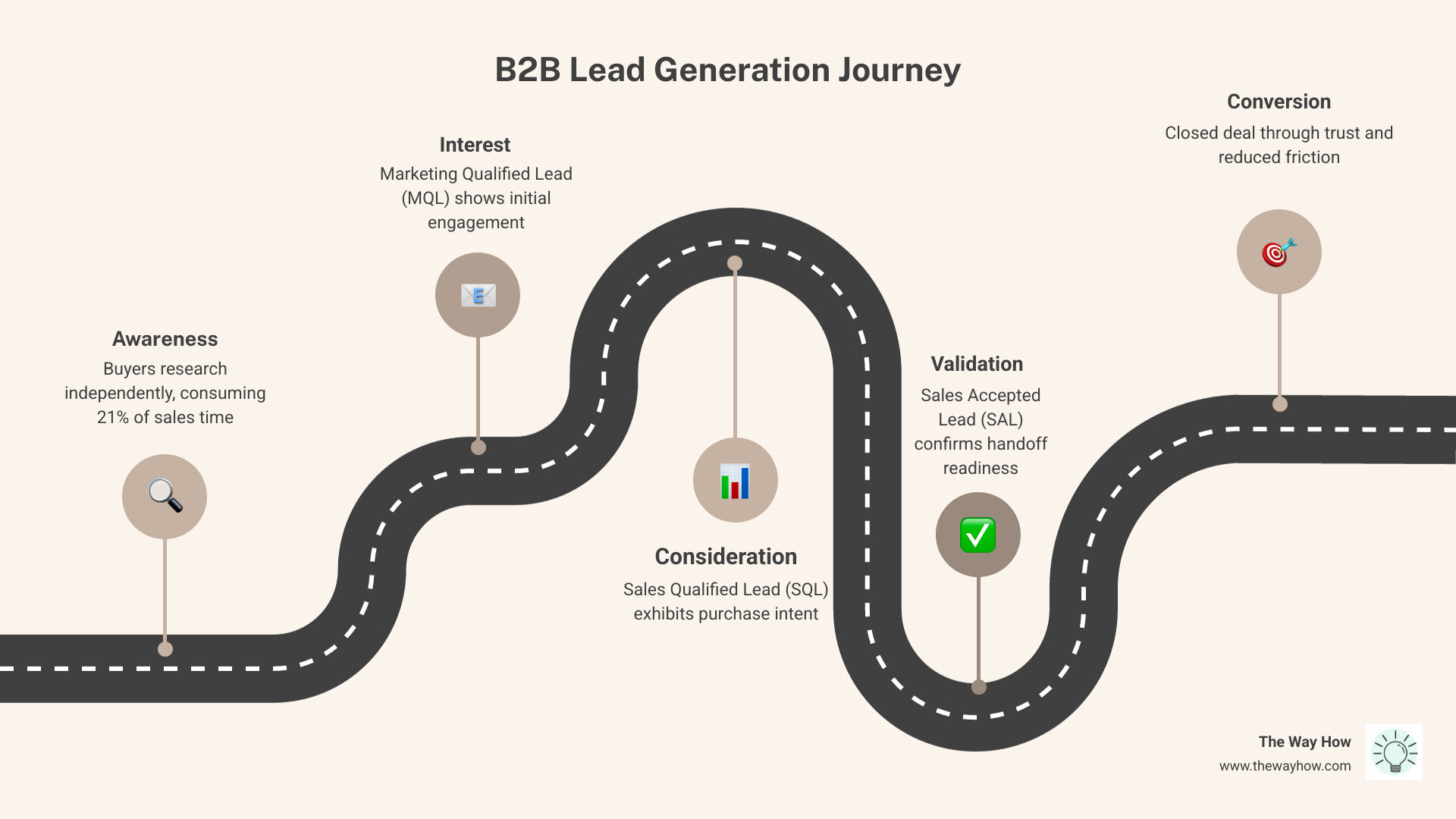
B2b lead generation terms at a glance:
When we look at a stalled pipeline, we often find “certainty gaps.” These are moments in the buyer journey where a prospect feels a flicker of interest but lacks the confidence to move forward. In B2B, the risk of a bad purchase isn’t just a lost few dollars; it is a threat to a manager’s reputation or a company’s operational stability.
Modern B2b lead generation must account for the psychological friction inherent in high-stakes decisions. Buyers are skeptical by default. They encounter an average of 13 content pieces before making a purchase. If those pieces don’t address their specific anxieties or provide clear mental models for solving their problems, they simply stall.
We believe in a psychology-first approach. This means diagnosing where uncertainty exists—perhaps your pricing is opaque, or your case studies lack the “hard proof” a CFO needs—and designing systems that create momentum through empathy-driven strategy.
To build a system that works, we must first define what a “lead” actually is. Too many organizations treat every email address as equal. This is a mistake. High-performing teams focus on the Ideal Customer Profile (ICP)—the specific type of company that derives the most value from your solution and provides the highest lifetime value to yours.
Without a tight ICP, your team wastes time on “noise.” For example, a free incentive like a pizza voucher might drive sign-ups, but it won’t attract a C-suite executive looking for a complex enterprise solution. We use Hubspot Lead Generation tools to track these interactions and ensure we are speaking to the right people.
The distinction between an MQL and an SQL is where most marketing-sales friction begins. Approximately 70 percent of B2B marketers use personalization to bridge this gap, but definitions still vary.
| Lead Type | Definition | Typical Action |
|---|---|---|
| MQL | Engaged with marketing content | Downloaded an eBook, attended a webinar |
| SQL | Ready for a direct sales conversation | Requested a demo, asked for pricing |
| SAL | Accepted by sales for active pursuit | Meeting booked and confirmed as qualified |
We often see a “black hole” where MQLs are passed to sales but never touched. This is why the Sales Accepted Lead (SAL) is the most important handoff point. An SAL is a formal agreement that the lead meets the criteria and the sales rep is accountable for following up.
Establishing a unified revenue team—where marketing and sales share the same metrics—is the only way to fix this. When both teams are responsible for generating traffic and leads that actually turn into revenue, the finger-pointing stops and the growth begins.
The landscape of B2b lead generation is shifting away from mass outreach toward precision. Account-Based Marketing (ABM) has become a cornerstone for high-value sales, with 9 out of 10 B2B companies finding it effective. Instead of casting a wide net, you identify 100 high-value accounts and surround them with personalized content.
AI is no longer a futuristic concept; it is a daily utility. Modern tools can handle the heavy lifting of lead scoring and initial engagement, allowing your human experts to focus on building relationships.
Relying on a single channel is a recipe for fragility. A robust B2B Sales Strategy integrates multiple touchpoints to create a “surround sound” effect for the buyer.
For a deeper dive into proactive tactics, check out our Outbound Lead Generation Complete Guide.
If you are only measuring “leads,” you are missing the forest for the trees. To truly understand your Client Acquisition Funnel, you must look at metrics that correlate with bankable revenue.
We recommend a blend of behavioral intent data and a qualification framework like BANT (Budget, Authority, Need, Timeline). However, in modern B2B, “Need” and “Authority” are often more important than an immediate “Budget.” Use lead scoring to prioritize those who are showing “high-intent” behaviors, such as visiting your pricing page multiple times.
B2B sales cycles are notoriously long, often ranging from 3 to 18 months depending on the contract value. ROI is rarely instant. It requires a consistent nurturing process. You are building a relationship, not just making a transaction. Attribution models can help you see which early-stage touches (like a blog post) eventually led to a late-stage win.
Failure usually stems from “tactical fatigue”—running ads or sending emails without a clear psychological hook. Other common culprits include poor data quality and a lack of alignment between sales and marketing. If the sales team doesn’t believe in the leads marketing is providing, the system collapses.
At The Way How, we don’t believe in chasing the latest marketing fad. We believe in removing the uncertainty that stalls growth. Whether it is through B2B Fractional CMO leadership or optimizing your HubSpot architecture, our goal is to help you see the problem clearly before we ever talk about solutions.
If your pipeline feels stuck, it’s likely because there is a gap between how you are selling and how your customers actually want to buy. We specialize in identifying those gaps and building systems rooted in human behavior and strategic clarity.
Ready to turn your marketing into a dependable growth engine? More info about our services can be found here, or you can explore our B2B Sales Consulting to help align your teams for success.
 Jeremy Wayne Howell : Jul 22, 2026 9:48:31 PM
 Jeremy Wayne Howell : Jul 21, 2026 9:47:10 PM
 Jeremy Wayne Howell : Jul 20, 2026 9:46:47 PM