
Beyond the Spreadsheet: Why Your CRM is Missing the Human Element

CRM empathy mapping is a structured method for capturing the emotions, motivations, silent doubts, and real behaviors of your clients — and embedding that understanding directly into your CRM workflows and team processes.
Here’s what it covers at a glance:
| Component | What It Does |
|---|---|
| Says | Captures direct client quotes and stated needs |
| Thinks | Surfaces internal doubts clients rarely voice |
| Does | Records actual behaviors, not just intentions |
| Feels | Tracks emotional responses at each stage |
| Pains | Identifies friction, fear, and frustration |
| Gains | Clarifies what success looks and feels like to the client |
Most CRMs are excellent at storing what happened. Deal stages. Email opens. Last contact date. But they’re almost useless at explaining why a client went cold, why a proposal didn’t land, or why a longtime customer quietly walked out the door.
The data tells you the outcome. It rarely tells you the human story behind it.
Research consistently shows that 75% of customers are more loyal to brands that understand them on a deeper level — and 73% cite customer experience as a key factor in their loyalty decisions. Yet most revenue teams are still making decisions based on surface-level metrics that strip the person out of the picture entirely.
That gap — between what your CRM records and what your client actually thinks and feels — is where growth stalls.
Empathy mapping closes that gap. Not by adding more data, but by adding the right kind of human context to the data you already have.
I’m Jeremy Wayne Howell, founder of The Way How and a revenue growth strategist with over 20 years of experience helping founders and revenue teams implement psychology-first systems — including CRM empathy mapping integrated directly into HubSpot and go-to-market workflows. If your pipeline feels stuck despite the tactics being “right on paper,” this guide was written for you.
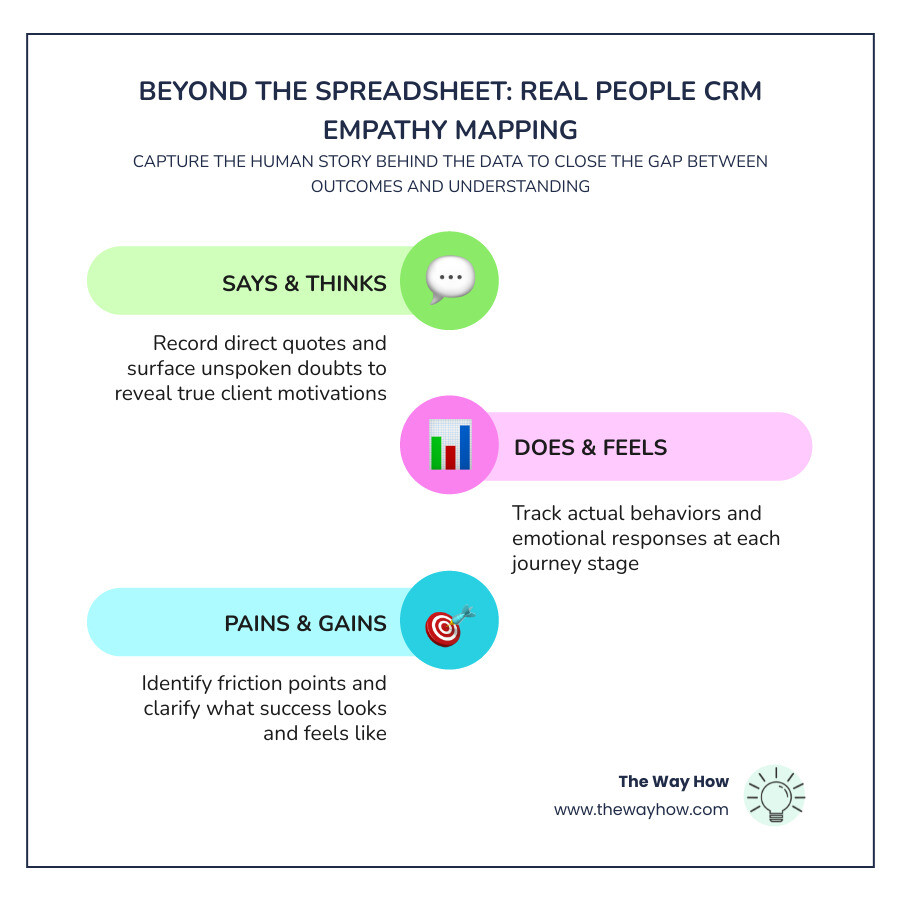
Basic CRM empathy mapping vocab:
Demystifying CRM Empathy Mapping
To understand why traditional customer relationship systems fail to drive deeper client connection, we must first look at their structural design. Standard Customer Relationship Management databases treat humans as transactions. They categorize your valuable clients into rigid fields: annual revenue, job titles, and lead scores.
For professional services firms, where relationships are the primary driver of retention and lifetime value, this clinical approach is a strategic liability. A client experience strategy built purely on transactional tracking misses the emotional currents that dictate B2B decision-making.
CRM empathy mapping is a framework that translates qualitative, human insights into actionable CRM intelligence. Originally developed in the design thinking and agile product development spaces, empathy mapping serves as a bridge between abstract buyer personas and concrete context. By utilizing the framework to map customer behavior, as explored in Using Empathy Mapping to Develop Customer Centricity - Prince the B.A., professional services firms can move from guessing what their clients want to systematically understanding what they actually experience.
The Core Quadrants of CRM Empathy Mapping
A highly functional empathy map is structured around four primary quadrants that analyze the customer’s reality from different angles. When we implement these within a CRM system, they act as dynamic behavioral filters rather than static notes.
- The Says Quadrant: This quadrant contains direct, verbatim statements from your clients. It includes what they tell your sales reps during discovery calls, what they write in support tickets, and what they share in feedback surveys. By documenting exact phrases rather than paraphrasing, we preserve the specific language, vocabulary, and objections they use.
- The Does Quadrant: Here, we record observable actions and behaviors. What does the client actually do? Do they download a specific resource but ignore follow-up emails? Do they log into your portal once a month or every single day? This quadrant focuses on objective touchpoints, allowing us to compare their actions directly with their stated words.
- The Thinks Quadrant: This quadrant captures the internal monologue of your client. It documents the silent calculations, worries, and judgments they might be too polite, self-conscious, or politically cautious to voice out loud. For example, a client might verbally agree that your software is excellent, while internally thinking, “Will implementing this make my team look incompetent if it takes too long to onboard?”
- The Feels Quadrant: This section tracks the emotional state of the client during specific stages of their journey. Are they feeling overwhelmed, anxious, excited, or skeptical? In professional services, emotional alignment is often the deciding factor in contract renewals.
By mapping these quadrants, teams can unlock specific human-centered CRM empathy features that allow account managers and sales teams to tailor their communication based on real-time emotional and behavioral signals.
Uncovering Unspoken Needs and Cognitive Dissonance
One of the greatest benefits of this methodology is its power to reveal cognitive dissonance. Human beings rarely behave in a completely logical, linear fashion. We frequently say one thing while doing another, or feel a deep anxiety while projecting absolute confidence.
For instance, a corporate decision-maker might state in a discovery call that their main priority is “cutting administrative costs.” However, their internal motivation might actually be “avoiding a high-profile implementation failure that could damage their career progression.” If your sales team only addresses the stated need (cost), they will lose the deal to a competitor who addresses the unspoken need (safety, risk mitigation, and step-by-step guidance).
By cross-referencing the “Says” quadrant with the “Does” and “Feels” quadrants, we can construct a highly accurate Pain Point Map. This map exposes the friction points, hidden fears, and silent objections that never show up in traditional customer satisfaction surveys. Understanding these discrepancies is the core of user experience design, as noted in the guide on What is an empathy map and how do you create one?. It allows your team to address the underlying psychological drivers of your clients before those drivers turn into churn.
Integrating Empathy into Your CRM Workflows
An empathy map is only as valuable as its accessibility. If your team creates a beautiful visual map during an annual workshop and then buries it in a PDF on a shared drive, it will have zero impact on your day-to-day operations. To drive real business results, empathy mapping must be operationalized directly inside your CRM systems.
This integration requires a shift in how we structure customer databases. By combining qualitative insights with quantitative metrics, we create a system grounded in behavioral science for CRM. This approach ensures that every sales follow-up, marketing email, and customer success intervention is informed by the client’s current cognitive and emotional state, elevating your Customer Relationship Development from transactional outreach to genuine partnership.
Sourcing the Right Behavioral Data
To populate your empathy maps with authentic insights rather than internal assumptions, you must establish reliable qualitative data streams. Relying solely on what your internal team thinks the customer feels is a dangerous trap that leads to projecting your own biases onto the client.
Instead, pull data from a variety of direct and indirect channels:
- In-Depth Client Interviews: Conduct non-sales conversations with existing clients to discuss their challenges, day-to-day workflows, and industry pressures. Use open-ended questions to encourage them to share their experiences in their own words.
- Verbatim Support Logs and Chat Transcripts: Review customer support tickets to identify recurring phrases, points of frustration, and moments of relief.
- Sales Call Recordings: Analyze recorded discovery and demo calls. Pay close attention to the questions clients ask, the moments they hesitate, and the objections they raise.
- Feedback Loops and Reviews: Gather qualitative feedback from third-party review sites, NPS comments, and lost-deal post-mortems.
For a comprehensive look at how to gather and organize these inputs, the Empathy Map: Complete Guide to Building User Empathy (2026) provides excellent frameworks for translating raw, unstructured user research into structured, visual empathy profiles.
Operationalizing CRM Empathy Mapping in HubSpot and Beyond
Once you have gathered this behavioral data, the next step is to configure your CRM to capture and display these insights dynamically. If you are using a modern platform like HubSpot, you can easily build custom properties and views that bring empathy maps to life.
First, create custom CRM property groups specifically for “Client Mindset” or “Empathy Mapping.” Within these groups, establish fields such as:
- Primary Emotional Driver (Dropdown: e.g., Risk Avoidance, Career Growth, Operational Efficiency, Overwhelmed by Complexity)
- Unspoken Anxieties (Multi-select or Open Text)
- Verbatim Client Quote (Text Area for the “Says” quadrant)
- Observed Friction Points (Multi-select)
Next, customize your CRM contact and company record views so that these fields are prominently displayed on the left-hand sidebar for your sales and customer success teams. When an account manager opens a client record before a call, they shouldn’t just see the deal size; they should immediately see the client’s current emotional state and primary anxieties.
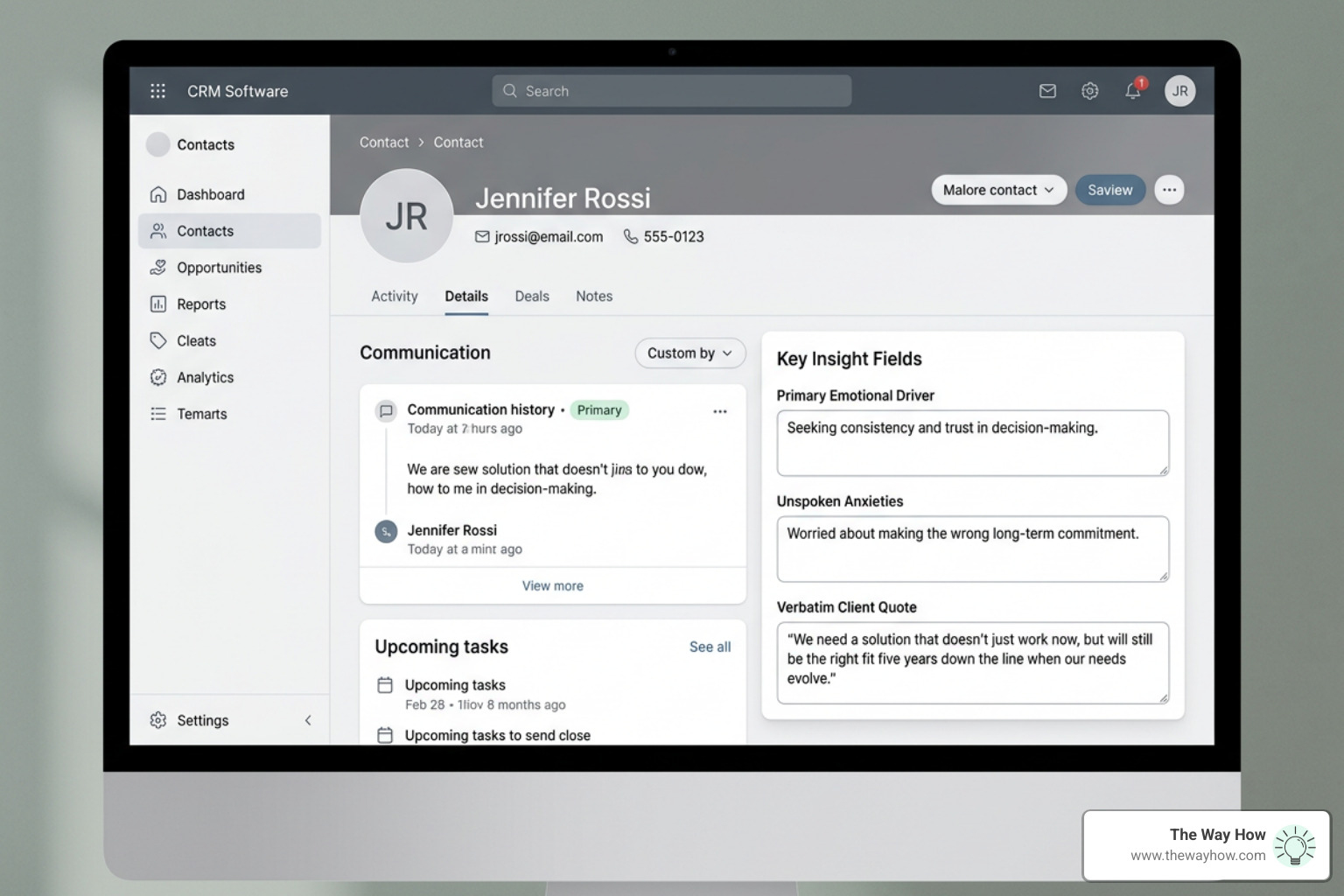
You can also use these custom properties to build automated workflows. For example, if a client’s “Primary Emotional Driver” is marked as “Overwhelmed by Complexity,” you can trigger an internal task for the account manager to send a simplified, step-by-step onboarding checklist rather than a dense technical documentation link. This level of system configuration allows teams to Understand Customers Better with the Empathy Map by turning qualitative psychological insights into real-time operational execution.
Driving Retention and Alignment Through Human-Centered Systems
When organizations operate without a unified, empathetic understanding of their clients, silos naturally form. Marketing designs campaigns based on abstract demographic profiles; sales pitches features and technical specifications; customer success inherits clients who feel misunderstood and overwhelmed.
By building your revenue operations around human-centered systems, you align your entire organization around a single, accurate view of the client’s reality. This structural alignment is the foundation of Human Centered Marketing and is deeply rooted in the Psychology Of Marketing. When your systems respect how human beings actually make decisions, your client retention rates rise, and your sales cycles shorten.
Aligning Sales, Marketing, and Customer Success
A shared empathy map acts as a single source of truth for every department that interacts with the client. It ensures that the language used in your marketing content matches the conversations happening on sales calls, which in turn aligns with the onboarding experience delivered by customer success.
Consider how different departments utilize the same empathy map:
- Marketing: Uses the “Says” and “Thinks” quadrants to write copy that addresses the client’s exact internal dialogue. For instance, if up to 43 million Americans are dyslexic, designing clean, highly accessible, and empathetic content formats improves both your SEO reach and your cognitive accessibility. Marketing can address silent anxieties directly in their educational content, building trust before a prospect ever speaks to sales.
- Sales: Reframes their demos and proposals around the client’s “Feels” and “Pains” quadrants. Instead of presenting a generic pitch, they address the client’s specific fears of implementation failure and position their service as a secure, guided transition.
- Customer Success: Anticipates onboarding friction by looking at the “Does” and “Pains” quadrants, proactively reaching out with targeted support before the client has a chance to disengage or experience frustration.
This cross-functional collaboration is detailed in our Customer Journey Mapping Complete Guide, which demonstrates how shared customer insights break down operational silos and build long-term trust.
Designing Better Customer Journeys
An empathy map provides the emotional context needed to optimize every touchpoint along your customer journey. Traditional journey maps outline chronological steps, but they often fail to capture the emotional transitions that occur between those steps.
By pairing empathy mapping with your journey mapping efforts, you can map emotional highs and lows across the 4 Stages Of Customer Journey. This allows you to pinpoint exactly where clients are most likely to experience anxiety, doubt, or buyers’ remorse.
Whether you are mapping a simple lifecycle or executing a comprehensive Complete Guide 5 Stages Customer Journey Map, injecting qualitative empathy data helps you design strategic interventions. For example, during the transition from “Evaluation” to “Onboarding,” a client often experiences a spike in anxiety. Recognizing this emotional state allows you to design a warm, reassuring welcome sequence that mitigates doubt and secures early momentum.
Step-by-Step Guide to Implementing Empathy Mapping
Implementing empathy mapping within your organization doesn’t have to be an overwhelming, multi-month initiative. It is a highly collaborative, iterative process that can be launched with a single cross-functional workshop.

To get started, gather key stakeholders from sales, marketing, customer success, and product development for a dedicated collaborative session. To explore the foundational workshop dynamics of this exercise, you can refer to Empathy Mapping: How to read your customer’s mind, which details how small and growing businesses can leverage these sessions to drive immediate growth.
Step 1: Define the Persona and Situation
Begin by selecting a specific client persona and a highly defined situation. Trying to map a general customer in a vacuum leads to vague, unhelpful abstractions.
- Define the Persona: Choose a specific ideal client profile (e.g., “Mid-Market HR Director facing rapid organizational growth”).
- Set the Context: Place this persona in a specific scenario (e.g., “Evaluating professional services firms to outsource their payroll and compliance systems”).
- Identify the Goal: What is their primary objective in this specific situation? What decision triggers are forcing them to act right now?
Step 2: Gather Qualitative and Quantitative Inputs
Before the workshop, compile your existing customer research so the team has real data to work with, preventing the session from devolving into pure speculation.
- Print out or share digital access to recent sales call transcripts, support tickets, and client survey responses.
- Review behavioral analytics, noting where users drop off in your portal or which educational resources they engage with most.
- Have team members write down direct quotes they have heard from clients over the past quarter.
Step 3: Map the Quadrants and Identify Gaps
Draw the empathy map framework on a physical whiteboard or a digital collaboration tool like Miro or Figma. Have team members spend 10 to 15 minutes individually writing insights on sticky notes for each quadrant before sharing them with the group.
- Populate the Quadrants: Place sticky notes in the Says, Does, Thinks, and Feels sections. Ensure that the “Says” quadrant contains only verbatim quotes, while the “Thinks” and “Feels” quadrants contain logical inferences based on observed behaviors.
- Analyze Discrepancies: Look for contradictions. Does the client say they “want a comprehensive, highly detailed report” (Says) but only spend 30 seconds looking at the summary dashboard (Does)? This gap indicates that they actually need quick, visual reassurance rather than dense data.
- Actionable Next Steps: Translate your findings into immediate CRM and process optimizations. Create new custom properties in HubSpot to track these insights, rewrite your automated email sequences to address the discovered anxieties, and update your sales discovery playbooks.
Frequently Asked Questions About Empathy Mapping
How does empathy mapping differ from traditional buyer personas?
Traditional buyer personas are often static, demographic-focused profiles that outline a customer’s job title, age, location, and high-level business goals. While useful for initial targeting, they often fail to capture dynamic context.
Empathy mapping focuses on the psychological, emotional, and behavioral reality of a client in a specific moment. It reveals what they are thinking, feeling, seeing, and doing during a particular transaction or challenge. While a persona tells you who is buying, an empathy map explains why they buy, how they feel during the process, and what silent anxieties might prevent them from moving forward.
How often should our team update our empathy maps?
Empathy maps should be treated as living, breathing documents rather than one-time project deliverables. We recommend reviewing and updating your core empathy maps at least once a year, or whenever you experience significant market shifts, launch new services, or target new customer segments.
Additionally, establishing continuous feedback loops—where sales and customer success teams regularly log verbatim client quotes and observed friction points directly into your CRM—ensures that your customer understanding evolves dynamically alongside real-world behavioral changes.
Can empathy mapping be used for B2B professional services?
Absolutely. In fact, empathy mapping is arguably more critical in B2B professional services than in B2C transactions. B2B purchasing decisions are rarely purely logical; they are deeply influenced by organizational politics, career risks, and the personal anxieties of individual stakeholders.
By mapping the experiences of different decision-makers within a client organization (e.g., the economic buyer, the end-user, and the technical gatekeeper), professional services firms can navigate complex sales cycles, build deeper trust, and design tailored onboarding experiences that protect and grow contract value.
Restoring Momentum: Let’s Build Systems That Understand Real People
If your marketing feels disconnected, your sales cycles are stalling, or your client retention isn’t where it should be, the problem isn’t a lack of effort. It’s an empathy gap in your systems.
At The Way How, we help founders and leadership teams build psychology-first marketing and revenue systems that remove uncertainty from your growth engine. We specialize in Fractional CMO leadership, HubSpot architecture, and demand generation strategies designed around human behavior, decision-making psychology, and operational clarity.
We don’t just hand you templates or chase the latest marketing trends. We diagnose exactly why your growth has stalled, identify the certainty gaps in your customer journey, and design human-centered workflows that build trust and predictable revenue.
Let’s stop treating your clients like rows in a spreadsheet. Learn more about our services and let’s build a revenue engine that honors how real people actually think, feel, and make decisions.