A Complete Guide to CRM Systems and Database Management
 Jeremy Wayne Howell : Jul 22, 2026 9:48:31 PM

Customer relationship management (CRM) is the strategy, process, and technology a business uses to manage every interaction with current, past, and potential customers — from first contact to long-term loyalty.
Quick answer:
| What it is | What it does | Why it matters |
|---|---|---|
| A system for managing customer interactions | Centralizes contact data, tracks deals, automates follow-ups | Drives retention, revenue, and team alignment |
| A business strategy and philosophy | Connects sales, marketing, and service teams | Prevents leads from falling through the cracks |
| Software (cloud, SaaS, or on-premise) | Logs every touchpoint in one place | Turns scattered data into predictable growth |
Most revenue leaders assume their CRM problem is a technology problem. They buy software, migrate contacts, and wait for results that never quite arrive.
But the real issue is rarely the tool.
It’s that data is fragmented across spreadsheets, inboxes, and memory. Teams are misaligned. And leads slip away not because no one cared — but because no one had a clear, shared picture of where each relationship stood.
The global CRM market is projected to grow from $101 billion in 2024 to over $262 billion by 2032. That’s not just software spending — that’s a signal of how fundamentally broken most businesses’ approach to customer relationships already is.
The average organization runs nearly 900 different applications, yet only 29% of those are integrated with each other. That’s not a tech stack. That’s a liability.
I’m Jeremy Wayne Howell, founder of The Way How and a revenue growth strategist with over 20 years of experience implementing and optimizing customer relationship management systems around buyer psychology — not just data hygiene. What follows is the framework I use to diagnose why CRM fails and how to build one that actually moves revenue.
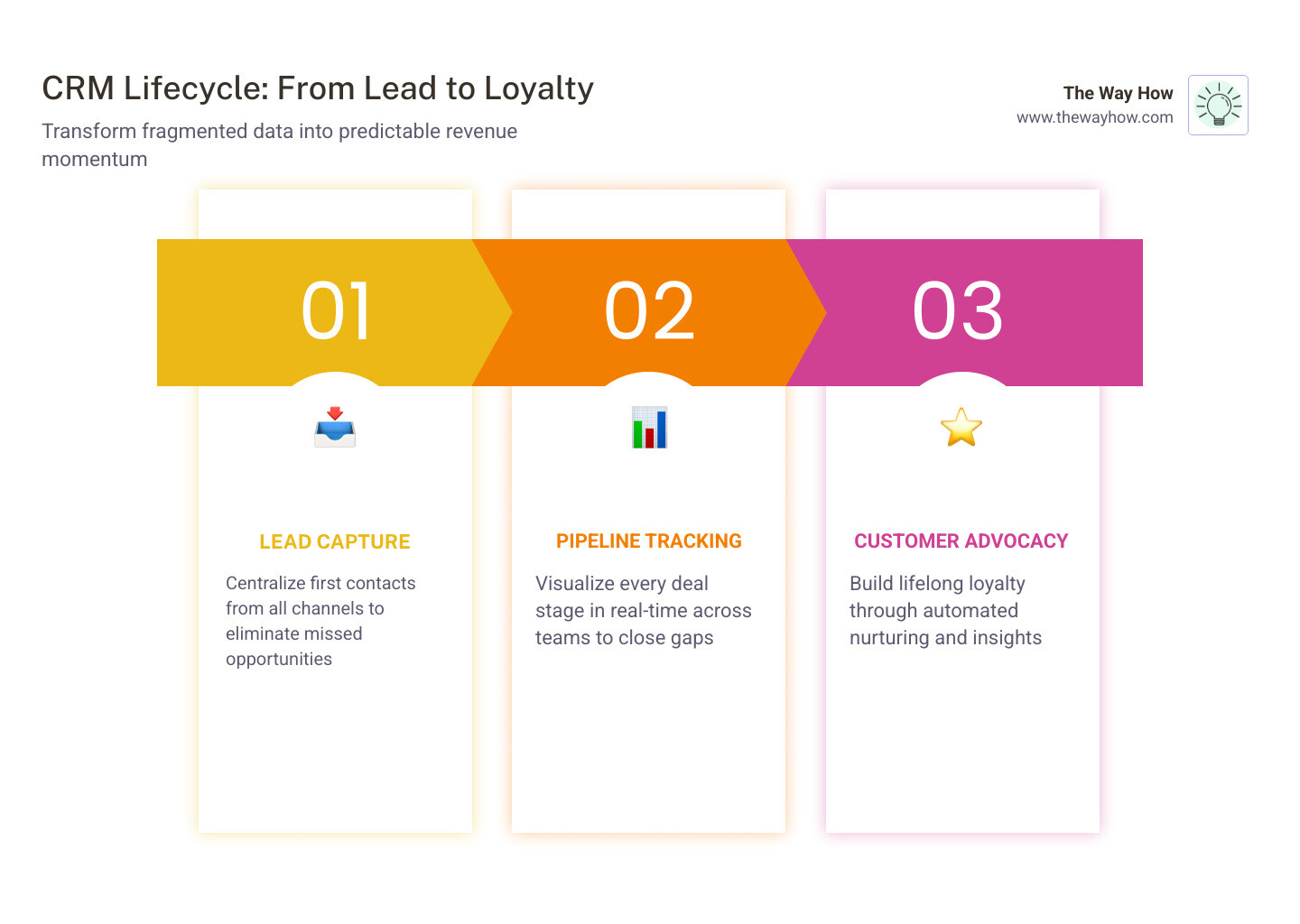
When we sit down with founders in April 2026, the symptom they describe is usually “leaky sales.” They are spending money on demand generation, yet the revenue is not scaling proportionally. From a psychological perspective, this is rarely an issue of lead volume. It is an issue of uncertainty.
Uncertainty is the silent killer of momentum. When your data is fragmented—living in a salesperson’s head, a marketing assistant’s spreadsheet, and a customer support rep’s inbox—your potential buyer feels it. They experience friction. They receive redundant emails or, worse, no follow-up at all. This creates a “certainty gap” where the buyer loses trust in your ability to deliver a seamless experience.
A CRM is not just a digital rolodex; it is a system designed to remove that friction. Without a unified view, decision-making becomes reactive rather than strategic. You aren’t managing relationships; you are managing fires. By centralizing these interactions, we move from a state of chaos to a state of predictable revenue.
In 2026, customer relationship management has evolved far beyond simple contact storage. It is now the central data hub of the modern enterprise—a single source of truth that powers every department. Whether you are looking at Salesforce: The #1 AI CRM or a custom CRM Development project, the goal is “relational intelligence.”
Relational intelligence is the ability to understand the context of a relationship beyond just demographics. It means knowing that a lead didn’t just “click a link,” but that they are currently experiencing a specific pain point that your product solves. A modern CRM captures these signals across every touchpoint, ensuring that your team acts with confidence and relevance.
The journey to modern CRM began long before the cloud. In the early 20th century, political figures used tools like the “Farley File”—a manual system of index cards used to track personal details about constituents to simulate a perfect memory. By the 1970s, this evolved into mainframe systems and annual surveys.
The 1980s and 90s saw the rise of database marketing and contact management software like ACT! and Siebel. However, the true paradigm shift occurred with the advent of cloud migration and SaaS models. This moved CRM from a static record-keeping tool to a real-time, social-integrated platform. Today, developers use a CRM for Web Developers Guide to build ecosystems where data flows seamlessly between the website and the sales floor, reflecting a history of moving from isolated files to interconnected intelligence.
To maximize the impact of your system, you must understand the four distinct types of CRM functionality:

A high-performance CRM is the nervous system of your business. It doesn’t just store names; it tracks the pulse of your market. At its core, the system must excel at several critical functions:
For these features to work, CRM Data Integration is non-negotiable. If your CRM doesn’t talk to your other tools, you are back to square one with fragmented data.
The most significant shift we see in 2026 is the rise of Agentic AI. Unlike traditional AI that simply suggests text, Agentic AI—like HubSpot’s Breeze Agents or Salesforce’s Agentforce—can act autonomously to achieve goals.
These “digital workers” can resolve over 65% of customer inquiries without human intervention, source new prospects, and launch outreach campaigns. They don’t just provide data; they provide context and execution. This allows your human team to focus on high-empathy, high-complexity tasks while the AI manages the repetitive heavy lifting. You can explore these advancements further by looking at how to Try The World’s #1 AI CRM.
A CRM is only as powerful as the ecosystem it inhabits. We find that the average organization uses close to 900 different applications, but only 29% are integrated. To bridge this gap, your CRM must sync with:
When you Discover HubSpot’s Powerful Business Software, you see an ecosystem of over 2,000 integrations designed to ensure that data flows where it is needed most, removing the manual “copy-paste” work that kills productivity.
At The Way How, we believe that technology is only half the battle. The other half is psychology. Most CRM implementations fail because they ignore how humans—both your team and your customers—actually make decisions.
A CRM should be an empathy-building tool. It should tell you not just what a customer did, but why they might be feeling hesitant. When a lead stalls, there is usually a certainty gap. They don’t have enough information, or they don’t trust the process. A proper Business Development and Customer Relationship Management strategy uses data to identify these gaps and provides the “psychological air” needed to build trust and momentum.
The financial impact of this psychological approach is staggering. Research shows that a 5% increase in customer retention can boost lifetime profits by 50% to 90%. CRM automation alone has been shown to increase retention by as much as 15%.
By using HubSpot CRM Marketing tools to track behavioral signals—like a customer visiting a specific help article—you can proactively reach out before they even realize they have a problem. This level of service transforms a transactional relationship into a partnership. Historical examples, such as MBNA Europe, show that focusing on retaining profitable customers through data-driven screening can lead to 75% annual profit growth.
The best CRM in the world is useless if your team refuses to use it. User resistance is the most common cause of CRM failure. To overcome this, we must apply training psychology.
Choosing a platform is a high-stakes decision. You aren’t just buying software; you are choosing the foundation of your revenue engine. Most modern businesses opt for SaaS (Software as a Service) due to lower upfront costs and easier scalability, though some highly regulated industries still prefer on-premise solutions for total data control.
| Factor | SaaS / Cloud CRM | On-Premise CRM |
|---|---|---|
| Upfront Cost | Low (Subscription-based) | High (Licensing & Hardware) |
| Maintenance | Handled by vendor | Handled by your IT team |
| Accessibility | Anywhere with internet | Often limited to office/VPN |
| Scalability | Instant | Requires hardware upgrades |
When evaluating vendors, consider the total cost of ownership, including setup fees, training, and data migration. Many firms find that CRM Consulting Services are essential to ensure the architecture is built correctly from day one.
How do you know when it’s time to move past spreadsheets? We look for these specific “tipping point” indicators:
If you’ve reached these markers, your HubSpot CRM Architecture needs to be designed for scale, not just storage.
Pricing in 2026 is highly variable. Most platforms charge a per-user fee ranging from $12 to $300+ per month. However, you must also factor in implementation costs (which can range from thousands to tens of thousands), potential charges for data storage or record limits, and the cost of third-party integrations. The real question is ROI: if a $600/month CRM saves a sales rep five hours a week and improves conversion by 10%, the return can often exceed 10,000%.
A basic setup can be operational in a week, but full team adoption typically takes 2-3 months. Most organizations begin to see a measurable ROI within 3 to 6 months as lead conversion improves and administrative overhead drops.
Yes, and it should. Spreadsheets lack version control, don’t integrate with your communication tools, and are prone to human error. A CRM provides real-time collaboration and automated workflows that spreadsheets simply cannot match. The migration path involves cleaning your data, mapping fields to your new system, and training your team on the new “source of truth.”
At The Way How, we don’t just “install software.” We help founders and leadership teams remove the uncertainty that stalls growth. Through Fractional CMO leadership and behavioral strategy, we diagnose the certainty gaps in your customer journey and build systems that create trust and momentum.
If your sales and marketing systems feel like a collection of disconnected tactics rather than a dependable growth engine, it’s time for a different perspective. We blend strategic clarity with operational execution to turn your data into a competitive advantage.
 Jeremy Wayne Howell : Jul 22, 2026 9:48:31 PM
 Jeremy Wayne Howell : Jul 21, 2026 9:47:10 PM
 Jeremy Wayne Howell : Jul 20, 2026 9:46:47 PM