
Beyond the Click: Why Your Data is Lying to You

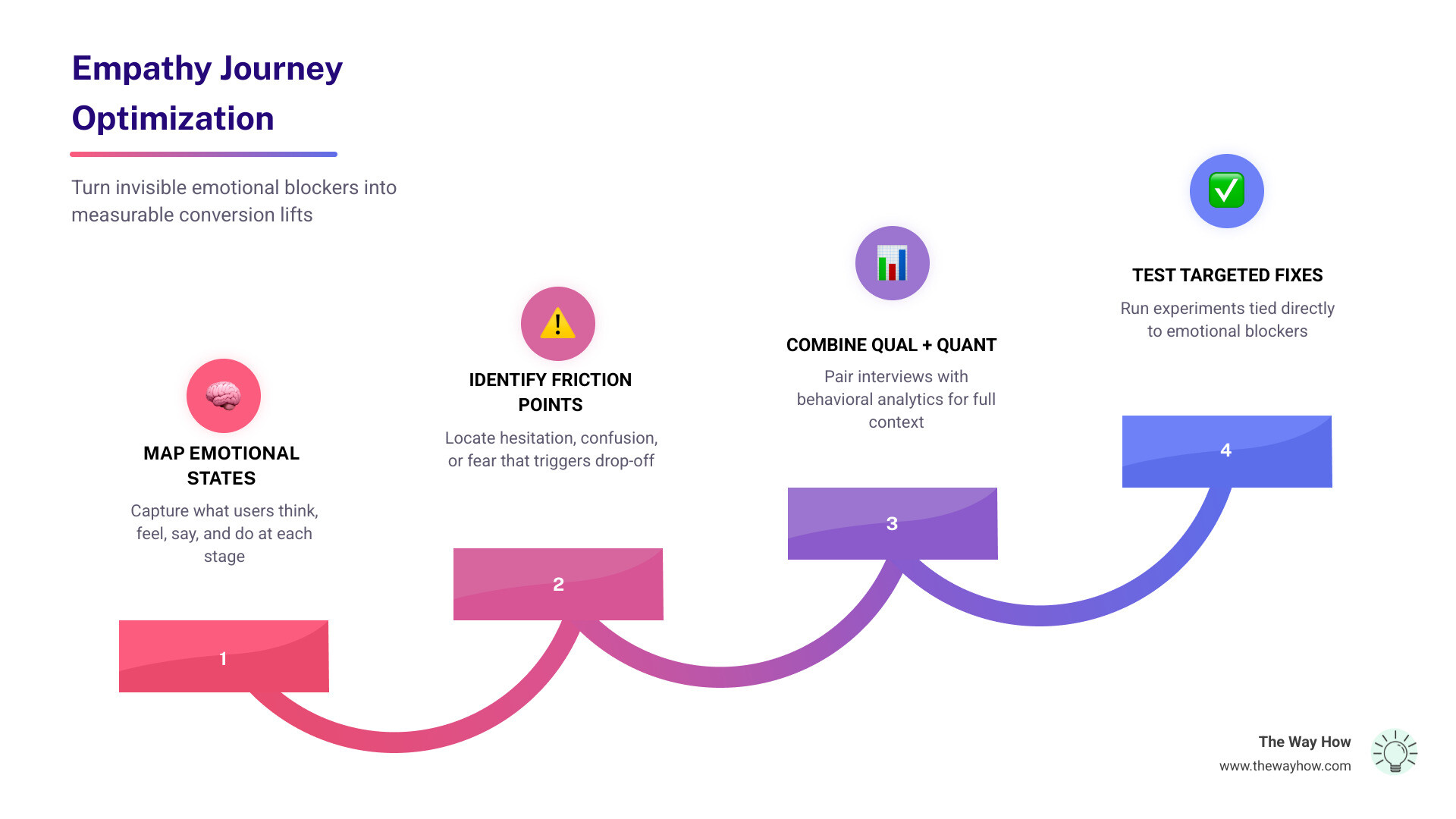
Empathy journey optimization is the practice of mapping not just what users do at each stage of their journey, but what they think, feel, and fear — then using those insights to remove friction, reduce cognitive load, and build experiences that convert.
Quick answer: Here’s what empathy journey optimization involves:
Most revenue leaders assume their data tells the full story. It doesn’t.
Your analytics can show what happened — a page exit, a form abandonment, a drop in session depth. But they can’t tell you why. Was the user confused? Anxious? Unconvinced? Did they feel like the product wasn’t built for them?
That gap — between behavior and internal state — is where growth stalls.
Data tells you what happened. Empathy tells you why it happened. You need both to fix it.
Traditional customer journey mapping tracks actions and touchpoints. It treats the buyer as a task-completer moving through a funnel. But buyers aren’t task-completers. They’re people carrying uncertainty, risk aversion, and emotional context into every decision they make.
Empathy journey optimization closes that gap by treating the internal emotional experience of the user as the primary design variable — not an afterthought.
I’m Jeremy Wayne Howell, founder of The Way How, a psychology-first revenue strategy firm with over 20 years of experience helping founders and revenue teams diagnose the human problems underneath their performance problems. My work in empathy journey optimization has helped companies increase close rates by 20–40%, reduce churn, and rebuild go-to-market strategies that were tactically sound but emotionally disconnected from the buyer. The sections ahead will give you a practical, diagnostic framework to do the same.
Decoding the Human Element in Empathy Journey Optimization
When we talk about journey mapping, we often get caught up in the “plumbing”—the emails, the landing pages, and the CRM triggers. But we have to remember that the plumbing exists to serve a person. Traditional journey mapping is often a linear exercise in documenting touchpoints. Empathy journey optimization, however, is a ruthless investigative tool designed to challenge our assumptions about why people are actually interacting with us.
The core difference lies in the integration of empathy maps. While a journey map looks at the horizontal flow of time, an empathy map provides a vertical deep dive into a specific moment. It asks: What is the user seeing? What are they hearing? What are they really thinking but not saying?
By identifying emotional highs and lows, we can spot where a user feels empowered versus where they feel “processed.” For instance, a user might complete a form but feel anxious because they aren’t sure what happens to their data next. That anxiety is a certainty gap that traditional data might miss, but a Pain Point Map will highlight.
We also believe empathy isn’t a static trait; it’s a system. As explored in The Release Cycle of Care - by Eric Near, we should treat empathy like a software release—something that requires constant debugging, updates, and iterative improvements.

Why Empathy Journey Optimization Outperforms Task-Based Mapping
Task-based mapping focuses on efficiency: “How fast can the user get from Point A to Point B?” This approach ignores cognitive load—the mental effort required to process information. If a page is functionally perfect but emotionally overwhelming, the user will stall.
In Human Centered Marketing, we prioritize intent recognition. We look for the “why” behind the click. If someone is searching for a solution to a complex B2B problem, they aren’t just looking for a feature list; they are looking for the confidence that they won’t get fired for making a bad recommendation. Empathy journey optimization addresses this psychological need for safety, which task-based mapping simply cannot do.
Integrating Personas into Empathy Journey Optimization
Personas are the foundation of this work, but they must be more than just “Marketing Mary” with a stock photo. Effective optimization requires research-backed archetypes that account for behavioral science and demographic shifts.
In a B2B Customer Journey, for example, the “persona” is often a group of stakeholders, each with different fears and motivations. A CFO cares about ROI and risk, while an end-user cares about ease of use and time-saving. Mapping the journey through these multiple lenses allows us to align messaging that speaks to the specific emotional blockers of each stakeholder.
The Architecture of Understanding: Building Your Data-Driven Map
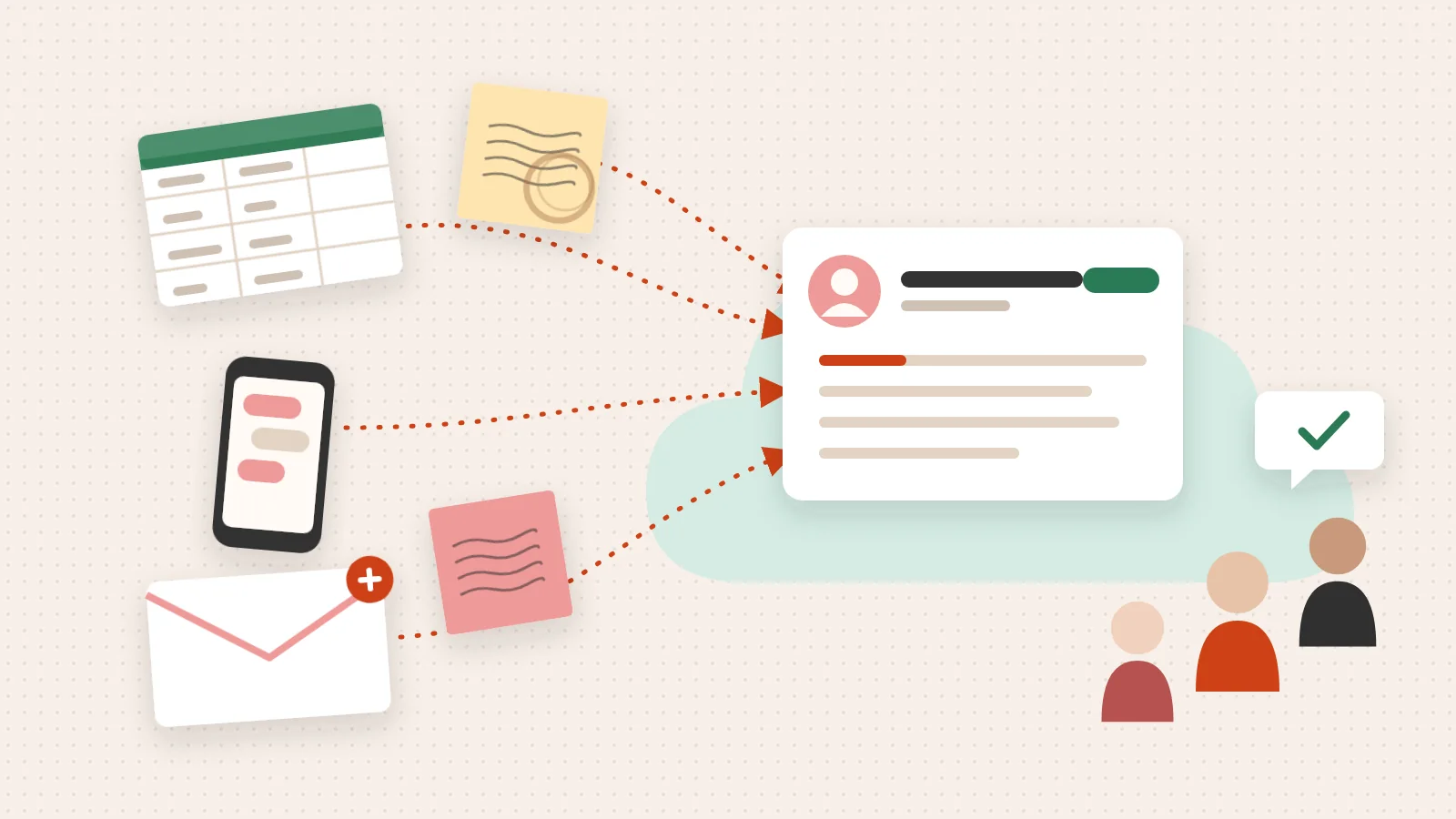
To build a map that actually drives revenue, we must fuse qualitative insights with quantitative signals. Qualitative data (interviews, support tickets, and focus groups) tells us what the user is feeling. Quantitative data (funnel metrics, heatmaps, and exit rates) tells us where those feelings are manifesting as friction.
We recommend following a structured process, such as the one found in our Complete Guide 5 Stages Customer Journey Map. The stages typically include:
- Awareness: What problem are they trying to solve?
- Consideration: How are they evaluating options?
- Purchase: What is the final hurdle to saying “yes”?
- Onboarding: Do they feel supported after the sale?
- Retention: Are we continuing to deliver value?
By anchoring empathy maps to these stages, we can create a “living document” that evolves with new data. As noted in the User Journey Empathy Map: A Practical Guide for Data-Driven UX and Conversion Recovery - Webeyez Insights, linking these insights to specific metrics like exit rates allows teams to prioritize fixes based on actual impact rather than guesswork.

Identifying Friction and Emotional Blockers
The most valuable signal in any digital journey isn’t a click—it’s hesitation. When a user slows down, hovers over a button without clicking, or revisits a pricing page three times, they are showing us exactly where the experience is failing them.
| Behavioral Signal | Likely Emotional Blocker | Strategic Response |
|---|---|---|
| High Form Abandonment | Fear of commitment or data privacy | Reduce fields; add trust signals |
| Repeated FAQ Visits | Confusion or lack of clarity | Simplify copy; use progressive disclosure |
| Rapid Exit from Landing Page | Mismatched intent or high cognitive load | Align headline with search query |
| Prolonged Hovering | Indecision or “Analysis Paralysis” | Offer a “concierge” nudge or comparison tool |
By applying Behavioral Science for CRM, we can diagnose these blockers at specific Customer Journey Stages. Instead of just seeing a “high bounce rate,” we see a “certainty gap” where the user didn’t feel the page answered their specific internal question.
Operationalizing Empathy: Tools, AI, and Iteration
Building these maps shouldn’t be a one-time workshop that ends up as a PDF in a drawer. We use collaborative tools like Miro and Figma to ensure the map remains a central part of the design and marketing process.
In May 2026, we are also seeing the rise of specialized AI agents that can process months of research in minutes. As discussed in I Built a Custom AI Agent for Journey Mapping. | by Alison Grippo | Mar, 2026 | Medium, these tools can synthesize transcripts and tickets into structured JSON data models, allowing for faster pattern recognition and more accurate emotional curves.
This technological shift supports a “Build-Measure-Learn” loop for empathy. We deploy a change, measure the emotional and behavioral response, and refine. Tools with Human-Centered CRM Empathy Features allow us to track these interactions at an individual level, making empathy a scalable operational capability rather than a “soft skill.”
Measuring the ROI of a Human-First Strategy
How do you prove that “feelings” lead to “finance”? By looking at the metrics that matter to the bottom line. Companies that prioritize customer experience have been shown to see an 80% increase in revenue.
When we implement empathy journey optimization, we look for:
- Conversion Recovery: Identifying where users dropped off due to friction and winning them back through intent-matched content.
- Reduced Churn: Addressing emotional lows in the onboarding phase to ensure users feel successful early on.
- Increased Customer Lifetime Value (CLV): Building trust that leads to long-term loyalty and advocacy.
Our Customer Journey Mapping Complete Guide emphasizes that a well-designed journey can increase ROI by 13–22%. As Prince the B.A. suggests in Using Empathy Mapping to Develop Customer Centricity - Prince the B.A., the goal is to move from being a vendor to a trusted partner by consistently solving the user’s hidden problems.
Frequently Asked Questions about Empathy Journey Optimization
How does empathy journey optimization differ from traditional customer journey mapping?
Traditional mapping focuses on the actions a user takes to complete a task, whereas empathy journey optimization focuses on the internal emotional state, thoughts, and feelings that drive those actions or cause hesitation. It seeks to understand the “why” behind the “what.”
What tools are most effective for building empathy and journey maps?
Collaborative platforms like Miro and Figma are industry standards for visualization, while modern AI agents can now be used to synthesize large volumes of qualitative research into structured journey data models. We also utilize CRM tools with behavioral tracking to validate these maps with real-time data.
How can companies measure the ROI of empathy-based improvements?
ROI is measured through conversion recovery, reduced churn, and increased customer lifetime value, often validated by comparing human-centered experience cohorts against traditional task-based control groups. We look for leading indicators like reduced hesitation time alongside lagging indicators like revenue growth.
From Friction to Flow: Restoring Growth Momentum
At The Way How, we don’t believe in chasing the latest marketing fad. We believe in the power of human psychology and the clarity that comes from seeing your customer’s journey as it truly is—not as you wish it were.
Our team provides Fractional CMO leadership and HubSpot architecture that doesn’t just manage data; it manages the human experience. We help founders and leadership teams remove the uncertainty that stalls growth by designing systems rooted in empathy and decision-making science. If your marketing feels like a series of disconnected tactics, it’s likely because there is a gap between your data and your customer’s reality.
We are here to help you bridge that gap. Whether you need a full diagnostic audit or a custom demand generation strategy, we focus on turning your marketing into a dependable growth engine through clarity and behavioral insight. More info about our services.