A Complete Guide to CRM Systems and Database Management
 Jeremy Wayne Howell : Jul 22, 2026 9:48:31 PM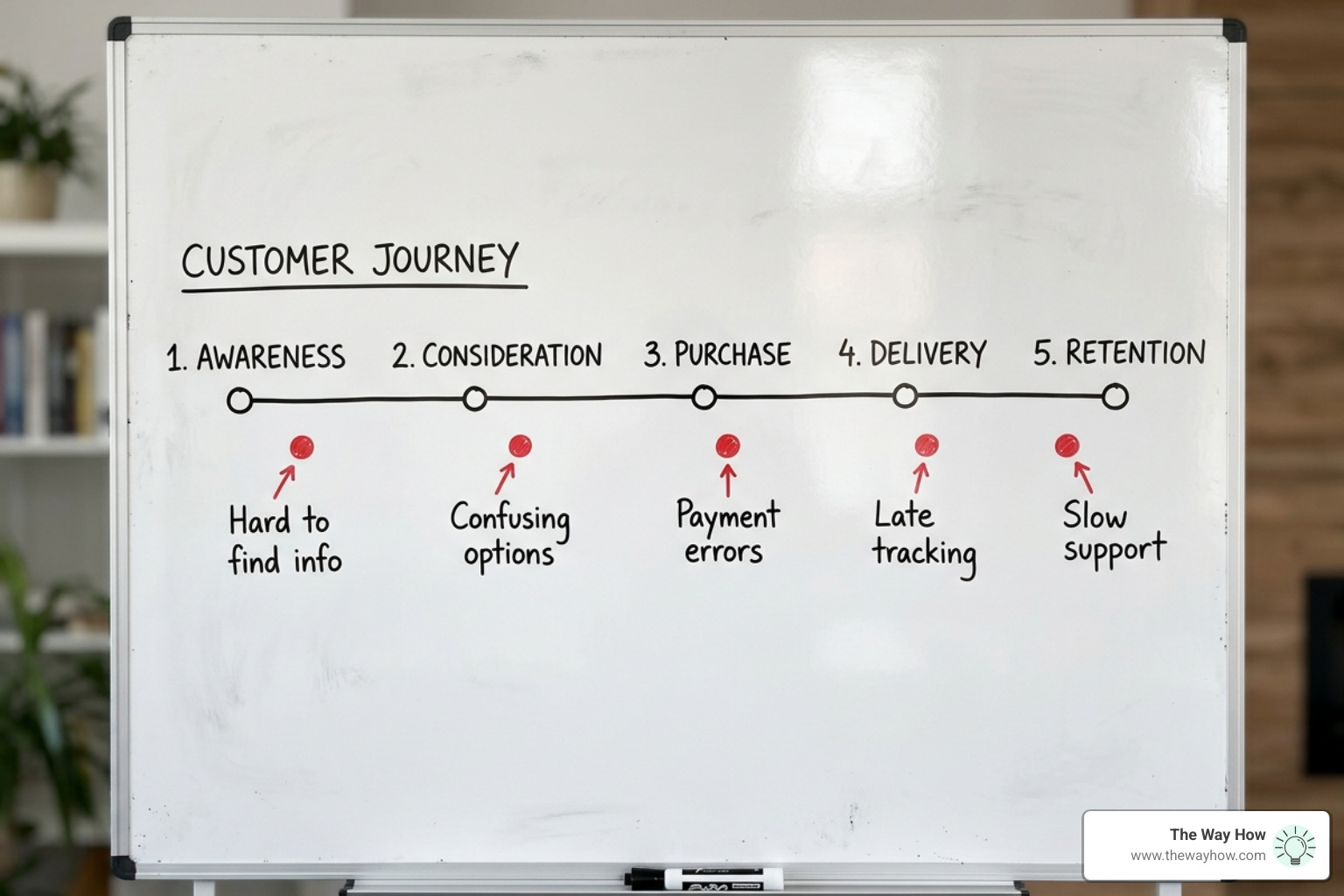
A pain point map is a visual diagnostic tool that identifies the specific moments in your customer journey where frustration, confusion, or friction causes people to disengage, stall, or leave.
Here’s what it does at a glance:
| Element | What It Captures |
|---|---|
| Where | The exact stage in the journey where friction occurs |
| What | The type of pain — process, support, financial, or effort |
| How bad | The severity and frequency of each friction point |
| So what | The business impact: lost revenue, churn, or stalled conversions |
Pain point maps are used to diagnose friction before investing in fixes — so teams spend resources on problems that actually matter.
Most businesses know their customers are frustrated. What they don’t know is where the frustration starts, why it keeps happening, and which friction points are silently costing them the most revenue.
That’s the gap a pain point map is designed to close.
A customer journey map shows you the steps someone takes. A pain point map shows you where those steps hurt — and how badly. It goes beyond tracking touchpoints to diagnosing the emotional and operational friction that quietly erodes trust, delays decisions, and drives customers toward competitors.
The research is clear: in crowded markets where products are increasingly similar, customer experience is often the only real differentiator. Yet most teams are still guessing at what’s broken — defaulting to whoever argues loudest in the room, or patching symptoms without ever diagnosing the root cause.
This guide will change that.
I’m Jeremy Wayne Howell, founder of The Way How, and over 20 years of working with founders and revenue teams I’ve seen how a well-built pain point map consistently reveals the hidden friction that explains why growth stalls — even when tactics appear to be working. Let’s get into the diagnosis.
When growth plateaus, our instinct is often to “do more.” More ads, more content, more features. But in April 2026, we find that growth rarely stalls because of a lack of tactics. It stalls because of the “Friction Gap”—the space between what your customer expects and what they actually experience.
At The Way How, we look at this through the lens of buyer psychology. Every time a customer encounters a hurdle—whether it’s a confusing pricing page or a slow support response—they experience a “certainty gap.” Their brain begins to weigh the effort of continuing against the potential reward. If the friction is too high, the brain chooses safety: they stop.
A pain point map allows us to practice “diagnosis before prescription.” Instead of guessing which marketing campaign to launch, we identify where the psychological resistance is highest. By mapping these certainty gaps, we can design systems rooted in empathy that restore momentum and create predictable revenue.
It is a common mistake to use these terms interchangeably. While a B2B Customer Journey provides the skeleton of the customer experience, the pain point map provides the nervous system—it tells us where it hurts.
A standard journey map is often a “happy path” document. It lists the stages: Awareness, Consideration, Decision. It tracks touchpoints like “Visited Website” or “Downloaded Whitepaper.” But it rarely captures the visceral frustration of a user who can’t find a “Reset Password” button or the anxiety of a B2B buyer who doesn’t understand your implementation process.
According to Insight7, a pain point map is a strategic visualization that pinpoints these specific challenges. It shifts the focus from what the customer does to how the customer feels and where the industry is blocking their progress.
Think of a journey map as a GPS route. It shows the turns and the destination. A pain point map is the traffic and weather overlay. It shows you the construction zones and the accidents that make the journey unbearable.
When we perform touchpoint analysis, we aren’t just looking for completion rates. We are looking for emotional resonance. If a customer reaches the “Purchase” stage but abandons their cart, the journey map tells us they left. The pain point map tells us they left because the multi-step checkout felt like an interrogation. Understanding these 5 Stages Customer Journey Map through the lens of friction allows us to solve for the human, not just the metric.
Many industries suffer from “status quo bias.” We become numb to the friction we impose on our customers because “that’s just how it’s done.”
For example, in the B2B world, long sales cycles and opaque pricing are often accepted as standard. But these are actually significant blocks to buyer utility. When you map out the Customer Journey Stages, you often find that the biggest opportunities for growth lie in solving the “unspoken” pains—the ones your competitors have ignored for a decade.

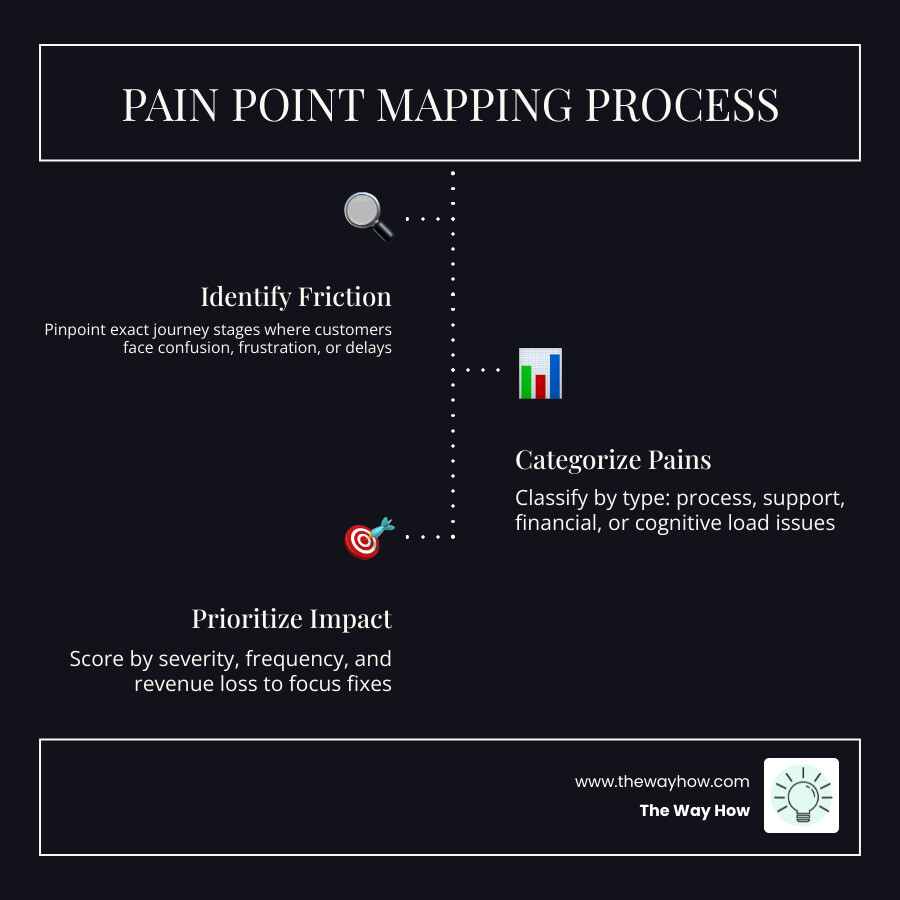
Not all pains are created equal. Some are minor annoyances, while others are “deal-breakers” that trigger immediate churn. To fix them, we must first categorize them.
In psychology-first marketing, we look for things like cognitive load (how hard the customer has to think) and decision fatigue. If your 4 Stages Of Customer Journey require too much mental heavy lifting, the customer will simply opt out.
To determine which issues are worth your capital, we often use a Severity Matrix. This helps distinguish between a customer “whining” and a customer experiencing a problem that has a real economic impact.
We can categorize friction using physical injury analogies:
Reviewing B2B Customer Journey Map Examples shows that major chronic pains are the leading indicators of churn.
Most pain points fall into one of four categories:
As noted by Standing Partnership, analyzing these pillars allows businesses to move beyond anecdotes and toward empirical evidence.
To find truly “Blue Ocean” opportunities, we use the Buyer Utility Map. This framework looks at 36 potential “utility spaces” by crossing the six stages of the buyer experience cycle with six utility levers (like simplicity, risk reduction, and environmental friendliness).
Most industries crowd into one or two spaces—usually “Productivity” in the “Use” stage. By mapping the pain point map against this grid, you can find the 34 other spaces where your competitors are currently blocking utility. This is how you design a Complete Customer Journey that feels like a breath of fresh air to your market.
A classic example of this is Groupe SEB’s ActiFry. In the early 2000s, the French fry maker market was shrinking by 10% every year. The industry was blind to the pain points: making fries was messy, unhealthy (too much oil), and the machines were a nightmare to clean.
By using a buyer utility map, they identified these “blocks to utility.” They developed a product that used only one tablespoon of oil for two pounds of fries—resulting in 40% fewer calories and 80% less fat. By solving the “health” and “cleaning” pain points, they turned a dying category into a €1 billion global success. Even their stock price jumped 5% after Oprah Winfrey tweeted about how much she loved the product.
To replicate this success, you must look at the entire buyer experience cycle:
Creating a pain point map is a collaborative diagnostic process. It requires moving from “I think” to “The data shows.”
You cannot build a map from an ivory tower. You need raw, unfiltered feedback.
Once you have the data, bring a cross-functional team together—Marketing, Sales, Support, and Product.

Every journey map surfaces more problems than you can fix. Prioritization is where most teams fail—they fix the “easiest” things or the things the CEO complained about this morning.
To be objective, use a scoring framework based on three dimensions:
| Pain Point | Severity | Frequency | Business Impact | Total Score |
|---|---|---|---|---|
| Complicated Checkout | 9 | 8 | 10 | 27 |
| Broken Help Link | 4 | 2 | 2 | 8 |
| No Human Support | 10 | 5 | 9 | 24 |
According to Smaply, simple addition is often more effective than complex weighted formulas for keeping the team aligned.
To prevent “anchoring bias”—where everyone agrees with the most senior person in the room—have team members score the pains individually in a spreadsheet before meeting. If scores for a specific pain point diverge by more than 2 points, use that as a prompt for a “calibration session” to look at the evidence.
Your pain point map should become the North Star for your roadmap.
JTBD focuses on the “why”—the underlying functional and emotional goal a customer wants to achieve (e.g., “I want to feel secure in my retirement”). A pain point map focuses on the “what’s in the way”—the specific friction points (e.g., “The retirement calculator is too confusing to use”) that prevent them from doing that job. JTBD is great for innovation; pain point mapping is essential for optimization.
In the fast-moving landscape of 2026, customer expectations shift rapidly. We recommend a full review of your pain point map quarterly. Additionally, any time you launch a new product, enter a new market, or see a sudden spike in churn, you should revisit the map to see if new friction points have emerged.
The biggest mistake is relying on internal opinions rather than external data. Another common error is ignoring “Minor Chronic” pains. While they don’t cause an immediate fire, they are the “death by a thousand cuts” that lead to long-term brand erosion. Finally, failing to involve sales and support teams—who are the closest to the customer’s actual pain—results in a map that is theoretically correct but practically useless.
At The Way How, we believe that marketing shouldn’t be a series of “best guesses.” It should be a system designed to remove uncertainty.
When you see your customer’s journey clearly—not as a series of steps, but as a series of human emotions and psychological hurdles—you gain the clarity needed to lead. By using a pain point map, you stop chasing tactics and start building the systems that create trust and momentum.
If your growth has stalled and you aren’t sure why, it’s time to stop guessing. We help leadership teams diagnose these certainty gaps and design revenue engines that work because they are rooted in how humans actually make decisions.
 Jeremy Wayne Howell : Jul 22, 2026 9:48:31 PM
 Jeremy Wayne Howell : Jul 21, 2026 9:47:10 PM
 Jeremy Wayne Howell : Jul 20, 2026 9:46:47 PM