
The Empathy Deficit: Why Your Tech Stack Feels Like a Barrier

Human-centered CRM empathy features are the tools, workflows, and design principles inside a CRM that help businesses respond to customers as human beings — not just records in a database.
Here’s a quick overview of what these features typically include:
| Empathy Feature | What It Does |
|---|---|
| Missed Call Text Back | Automatically follows up with missed callers so no one feels ignored |
| Consolidated Conversation Stream | Keeps full context across channels so customers never repeat themselves |
| Sentiment Analysis | Detects emotional cues in text or voice to guide the right response |
| AI-to-Human Handoff | Routes emotionally sensitive conversations to a live agent at the right moment |
| Automated Personalized Follow-Up | Sends contextually relevant messages across calls, SMS, and email |
| Relationship History Tracking | Gives agents full context before every interaction |
These features matter because the gap between what customers expect and what most businesses deliver is wide. Research shows 68% of customers expect brands to demonstrate empathy — but only 37% say brands actually do. That’s not a technology problem. It’s a systems and philosophy problem.
Most CRMs were built to track pipelines, not people. They were designed around operational convenience, not around the psychological reality of how trust is built and lost. The result? Agents spend 89% of their time on administrative work and only 11% actually connecting with the humans they’re supposed to serve.
That’s the empathy deficit. And it’s costing businesses more than they realize — in lost leads, eroded loyalty, and customers who simply feel unseen.
I’m Jeremy Wayne Howell, founder of The Way How, a psychology-first revenue strategy firm where I’ve spent over 20 years helping businesses close the gap between their systems and their buyers’ emotional reality — including implementing CRM frameworks specifically designed around human-centered CRM empathy features. Understanding why customers disengage before prescribing a tech fix is exactly the kind of diagnostic work that shapes everything you’ll read below.
Beyond the Database: A Philosophy of Recognition
When we talk about a human-centered CRM, we aren’t just talking about a software license. We are talking about a shift in how a business views its audience. Historically, the earliest CRMs were little more than digitized Rolodexes or contact databases. They were designed to help salespeople remember who they called and what they promised. Over time, they evolved into enterprise-scale platforms focused on pipeline visibility and sales forecasting.
But in that evolution, something was lost. People were “flattened” by the system. A policyholder became a claim number; a donor became a line item; a patient became a billing record. This creates what we call “certainty gaps” — moments where a customer feels like a faceless member of a system rather than an individual with unique needs.
To bridge this gap, we must look at empathy as a system-level design principle. It isn’t just a frontline behavior; it is how the software is built to protect the dignity of the person on the other side of the screen.
Empathy Features Central to a Human-Centered CRM Philosophy
To turn cold data into a warm welcome, the CRM must actively work to remove the friction that makes interactions feel robotic. When we provide CRM consulting services, we prioritize features that acknowledge the customer’s time and emotional state.
Missed Call Text Back
Up to 60% of businesses miss inbound calls. In the mind of a customer, a missed call without a response is a signal that they don’t matter. An empathy-driven CRM uses “Missed Call Text Back” to immediately send a personalized text: “Sorry we missed you! How can we help?” This simple automation acknowledges the person’s intent and provides immediate “certainty” that their needs are being tracked.
Consolidated Conversation Stream
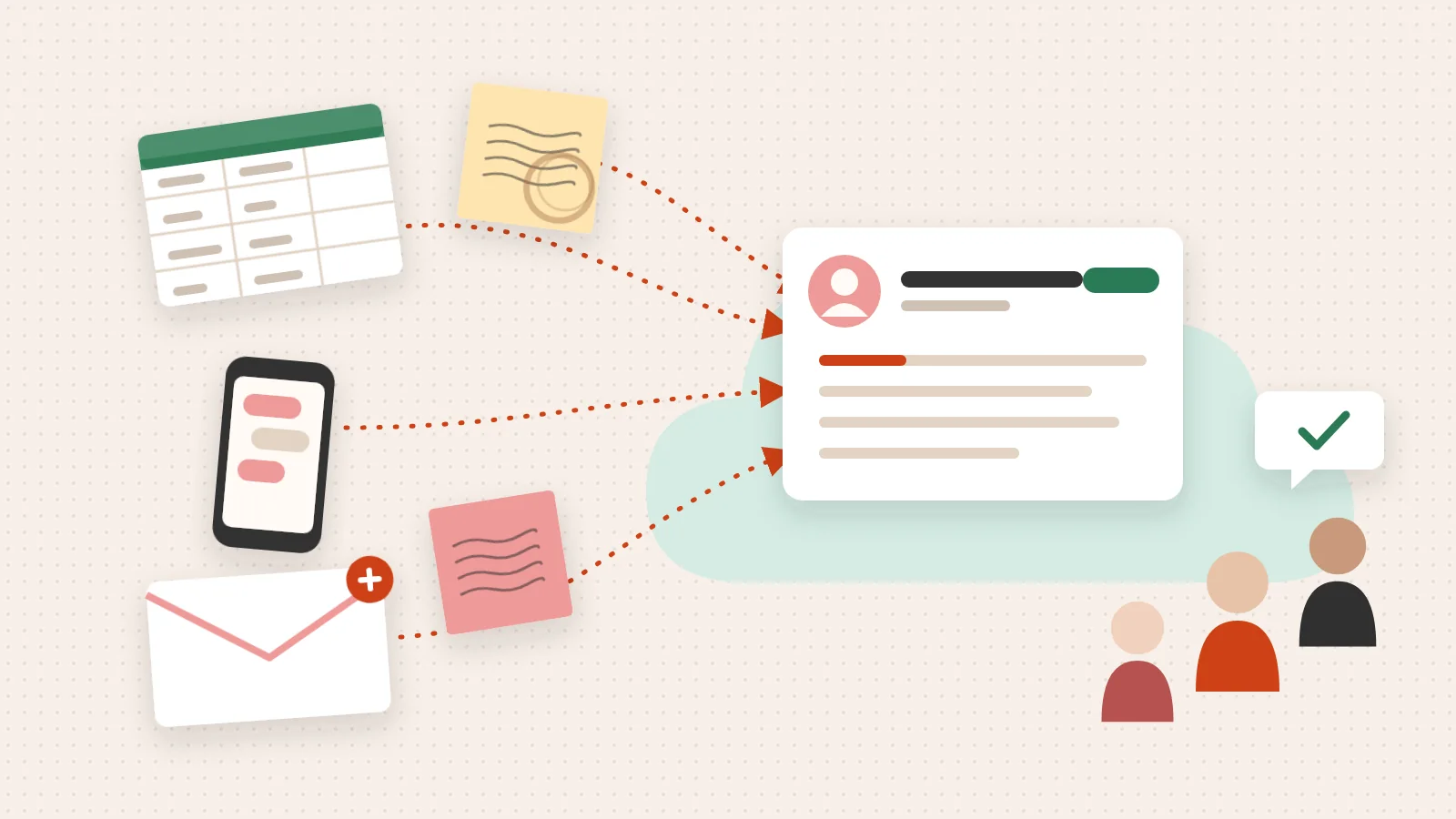
There is nothing less empathetic than asking a customer to repeat their story for the third time. A consolidated stream pulls in SMS, email, WhatsApp, and social DMs into one view. This ensures that whether a customer reaches out on Instagram or via email, the agent has the full context of the relationship. This is a core component of CRM development focused on human connection.
Web Chat Widget
Real-time engagement shouldn’t feel like an interrogation. Modern widgets allow for “Reading the Room,” where the AI or agent can see if a visitor is stuck on a specific page and offer help that feels supportive rather than intrusive. According to research on the connected customer, 68% of customers will spend more with brands that treat them like individuals.
How Empathy Features Reduce Cognitive Load
When an agent is overwhelmed by administrative “leg-work,” they lose the capacity for genuine emotional intelligence. By automating data entry and activity tracking, tools like People.ai allow machines to do the heavy lifting. This transforms the CRM into a “relationship engine” or an “extension of the agent’s brain.” When the system handles the “what” and “when,” the human is free to focus on the “how” — the nuance, the tone, and the care required for complex interactions.

Sentiment Analysis and Real-Time Emotional Intelligence
Traditional personalization often falls short because it relies on historical data while ignoring the real-time emotional context. If a customer says, “Fine, whatever,” a basic AI might see a neutral response. However, emotive AI uses NLP (Natural Language Processing) and voice analysis to detect frustration or resignation.
This allows the system to:
- Sense: Detect urgency or dissatisfaction through phrasing and pitch.
- Interpret: Understand that “I’m fine” might actually mean “I’m about to cancel my subscription.”
- Interact: Prompt the agent with a de-escalation suggestion or automatically route the ticket to a senior specialist.
While AI empathy won’t replace human leaders yet, it acts as a powerful “co-pilot” that helps humans navigate the emotional landscape of a high-volume business.
The Hybrid Model: Balancing AI Precision with Human Sincerity
The goal of human-centered CRM empathy features isn’t to replace humans with “artificial empathy.” It is to create a hybrid model where AI handles the scale and speed while humans handle the depth and sincerity.
As Professor Anat Perry noted to Neuroscience News, “The more we rely on AI, the more our words risk feeling hollow.” If a customer perceives that every message is AI-generated, the perceived sincerity — and the emotional connection — may disappear. This is why HubSpot CRM implementation must be handled with a “psychology-first” lens.
We design systems where:
- AI handles routine empathy: “I understand how frustrating a delivery delay can be. Let me check that for you.” (Speed = Empathy in low-stakes scenarios).
- Humans handle complex empathy: Interactions involving financial hardship, health concerns, or long-standing disputes are flagged for immediate human intervention.
Implementing Empathy Features for Long-Term Loyalty
Does this approach actually work for the bottom line? The data says yes. Users of empathetic CRM systems often see a +40% conversion lift through AI-powered, empathetic follow-ups. Instead of a generic “Following up on your inquiry,” the system might send: “I noticed you were looking at our sustainability report. We’re really proud of our 2024 goals — do you have any questions about our sourcing?”
This mirrors the success of campaigns like Dove’s Real Beauty, which used empathy to say, “We understand your insecurities, and we celebrate you as you are.” By acknowledging real human feelings rather than offering “pity,” the brand built a community of belonging.
Designing Systems for Trust and Transparency
For empathy to be effective, it must be rooted in trust. If a customer feels “managed” or “manipulated” by an AI, the relationship is broken. This is why we advocate for ethical guardrails and transparency in all human-centered CRM empathy features.
- Identity Disclosure: Always let the customer know when they are talking to an AI.
- Data Privacy: Use emotional data only for real-time interaction improvement, not for building “psychological profiles” for future manipulation.
- Bias Audits: Regularly check that your AI isn’t responding differently based on cultural linguistic patterns.
As Peter Block argues in Community: The Structure of Belonging, genuine belonging arises through authentic connection and relational trust. A CRM should be an instrument of recognition, preserving the stories and context of each individual rather than flattening them into a data point.
Measuring What Matters: Metrics Beyond the Transaction
If you only measure “tickets closed” or “emails sent,” you are measuring efficiency, not empathy. To understand if your human-centered CRM empathy features are actually working, you need to track qualitative outcomes.
| Traditional KPI | Empathy-Driven Metric |
|---|---|
| Average Handle Time (AHT) | Sentiment Trend (Negative to Positive) |
| Number of Leads | Trust Indicators (Referral Rate) |
| Conversion Rate | Relationship Depth (Touchpoints per Year) |
| Response Time | Escalation Avoidance Rate |
By shifting the focus to how many commitments were honored and how many voices were remembered, a business can move from a “pipeline” mindset to a “people” mindset.
Frequently Asked Questions about Empathetic CRM
Can AI truly master human empathy?
Not in the way a human does. AI provides “artificial empathy,” which is a simulation based on pattern recognition. It can recognize that a customer is upset and use “understanding language,” which is highly effective for routine support. However, it cannot “care.” For high-stakes emotional interactions, the AI’s role is to read the room and prepare the human agent to step in with genuine sincerity.
How does a human-centered CRM approach differ from traditional platforms?
Traditional platforms are often “black boxes” designed for the convenience of the business. A “Real People” approach is psychology-first. It treats the CRM as a “living archive” or a “stewardship tool.” While traditional CRMs focus on the “record,” an empathetic CRM focuses on the “relationship,” ensuring that the human dignity of the customer is preserved at scale.
What is the ROI of implementing empathy features?
Beyond the immediate 40% conversion lift mentioned earlier, the long-term ROI is found in Customer Lifetime Value (CLV). When customers feel understood, they stay longer and spend more. For example, Supermetrics’ “Get Your Sheet Together” campaign effectively tapped into the “chaos” marketers feel when juggling spreadsheets. By empathizing with a specific pain point and offering a solution that reduced that stress, they built a deeper connection than a generic “data tool” ever could.
Restoring Momentum: Your Path to Psychology-First Growth
At The Way How, we believe that growth stalls when there is a disconnect between your technology and your customers’ humanity. If your CRM feels like a barrier rather than a bridge, it’s time to look at the systems beneath the software.
We help founders and leadership teams remove uncertainty by designing revenue systems rooted in human behavior and decision-making psychology. Whether through Fractional CMO leadership or a deep-dive into your HubSpot architecture, our goal is to help you turn marketing into a dependable growth engine that treats people like people.
Ready to move beyond cold data? Explore our CRM and Revenue Services and let’s build a system that turns every touchpoint into a warm welcome.